


The dramatic rescue of 18 foreign sailors from MV Gold Autumn has become Pakistan Navy’s first major demonstration that its new offshore patrol fleet can project influence, crisis response and maritime control far beyond national waters.

The rescue of 18 foreign crew members from the distressed merchant vessel MV Gold Autumn has become more than a humanitarian incident because it publicly tested Pakistan’s emerging maritime-response architecture under real operational conditions.
The operation unfolded roughly 200 nautical miles, or 370km, off Pakistan’s coastline, where naval presence, shipping security, and regional force posture increasingly intersect with strategic competition across the Arabian Sea.
Prime Minister Shehbaz Sharif declared that “the swift and effective SAR operation by PNS Hunain reflects the Pakistan Navy’s professionalism, rapid response, and humanitarian spirit,” while reaffirming Pakistan Navy’s status as the first responder within its maritime Area of Responsibility.
That statement carried implications extending beyond domestic praise because Islamabad increasingly wants international shipping companies, regional governments, and extra-regional naval powers to view Pakistan as a dependable maritime-security provider.
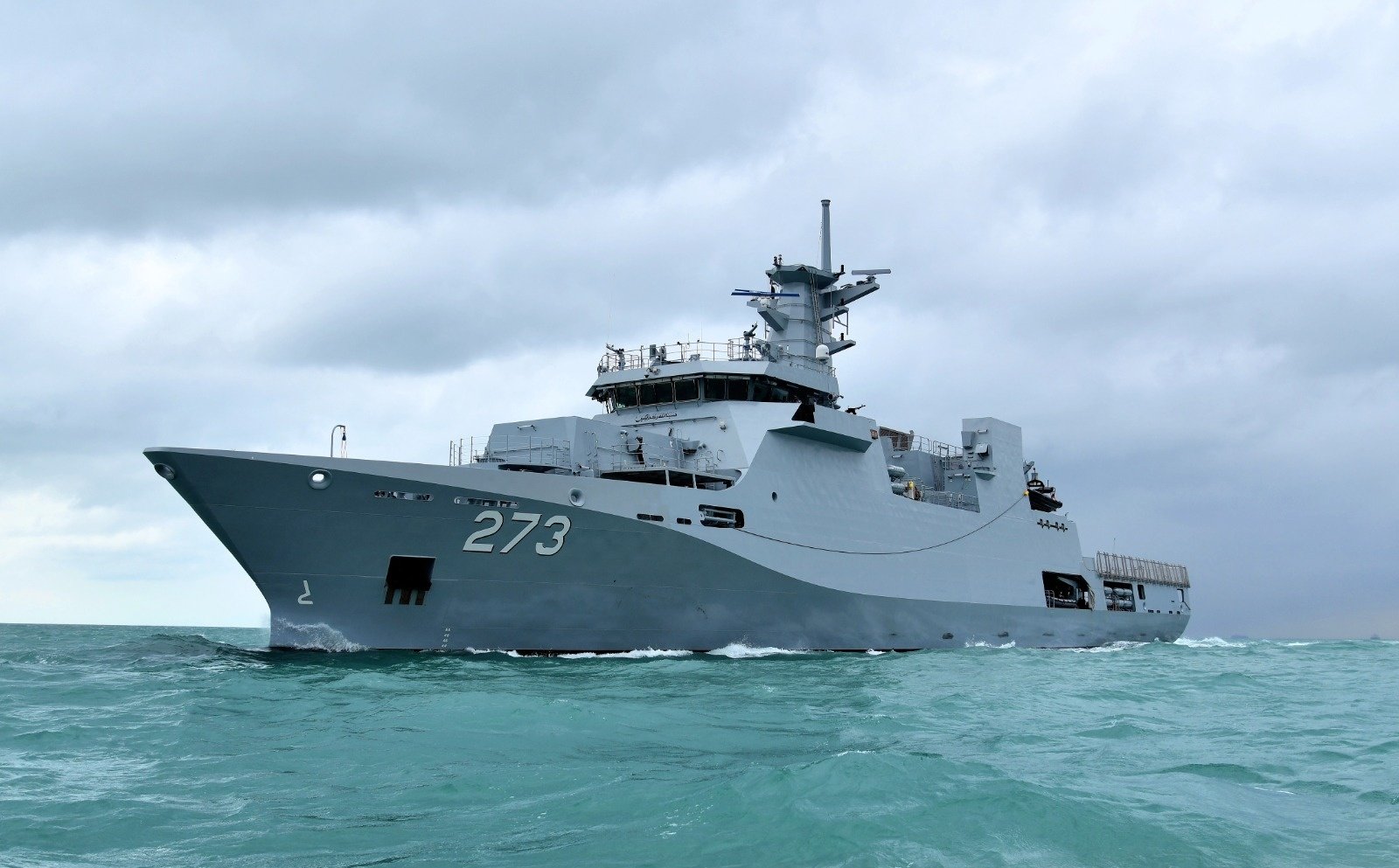
Built to the OPV-2600 design by Damen Shipyards in Romania for extended-range operations, PNS Hunain was designed precisely for situations combining maritime surveillance, humanitarian intervention, and limited combat readiness.
The vessel’s performance therefore mattered strategically because Islamabad has spent recent years expanding naval presence across increasingly contested sea lanes linking the Persian Gulf, Arabian Sea, and wider Indian Ocean.
By successfully completing the rescue under operational conditions, Pakistan Navy acquired a rare opportunity to present newly inducted maritime capabilities as immediately useful, regionally relevant, and internationally credible.
The timing of the operation further amplified its significance because it occurred amid intensifying competition for influence across the Arabian Sea, where regional navies increasingly seek to protect commercial traffic, energy shipments, and strategic sea lines of communication.
For Islamabad, the mission therefore became not only a successful emergency response, but also a carefully staged demonstration that Pakistan Navy can translate peacetime patrol presence into immediate operational effect across a widening maritime battlespace.
Pakistan’s Maritime Rescue Network Was Activated Within Minutes
The official sequence began when MV Gold Autumn transmitted a distress call while operating in the North Arabian Sea approximately 370km from Pakistan’s coastline under deteriorating onboard conditions.
MV Gold Autumn is a 190m-long Panama-flagged bulk carrier bearing IMO number 9220483, making it a large commercial vessel whose distress immediately demanded coordinated multinational maritime attention.
After receiving the emergency transmission, Pakistan Maritime Security Agency activated the Maritime Rescue Coordination Centre, which serves as Pakistan’s principal maritime emergency-management node for offshore incidents.
The MRCC then identified PNS Hunain as the nearest available platform because the vessel was already conducting routine patrol operations within the assigned operational sector.
Instead of requiring redeployment from Karachi or another naval base, PNS Hunain was immediately diverted from patrol, reducing response time and strengthening Islamabad’s claim of continuous offshore readiness.
That rapid diversion highlighted the importance of maintaining naval assets persistently deployed at sea because maritime emergencies increasingly unfold beyond immediate helicopter range or coastal intervention capacity.
Pakistan’s official narrative repeatedly emphasized that the operation reflected “high professionalism and operational expertise,” language intended to project reliability to foreign shipping operators transiting regional waters.
Strategically, the response demonstrated that Pakistan’s maritime command structure can move from emergency notification to coordinated offshore intervention without requiring extensive interagency delay or foreign assistance.
PNS Hunain Delivered Exactly the Mission Profile It Was Designed For
PNS Hunain belongs to the Yarmook-class offshore patrol vessel family, a design optimized for long-endurance patrols, maritime security, humanitarian assistance, and limited naval combat responsibilities.
The ship carries hull number F-273 and entered operational service during 2024, making the MV Gold Autumn rescue its first major internationally visible operational deployment.
Constructed in Galați, Romania, the vessel is based upon the OPV-2600 platform developed by Damen Shipyards for countries requiring economical but strategically flexible maritime-security capabilities.
Unlike smaller patrol craft optimized only for coastal waters, the OPV-2600 design is intended for prolonged missions far from shore and across complex maritime environments.
Pakistan selected the class because the vessel combines lower operational costs with sufficient endurance, command facilities, and deck space for diverse humanitarian and security contingencies.
The ship can also carry anti-ship missiles and surface-to-air missiles, giving it significantly greater survivability and deterrent value than a purely civilian rescue platform.
That combination of humanitarian flexibility and latent combat capability increasingly defines modern offshore patrol vessels because regional navies must manage both military threats and civilian emergencies simultaneously.
The MV Gold Autumn incident therefore became a textbook demonstration of why Pakistan invested in the Yarmook-class, since the vessel performed precisely the mission profile envisioned during acquisition.
Firefighting, Medical Support and Evacuation Became a Test of Force Projection
Once alongside the distressed merchant vessel, PNS Hunain conducted a complete search-and-rescue operation under conditions requiring both technical coordination and disciplined crisis management.
Pakistan Navy personnel first provided medical assistance to the injured or exhausted crew members before stabilizing the immediate humanitarian situation aboard the merchant vessel.
The crew then assisted firefighting efforts, indicating that the emergency aboard MV Gold Autumn likely involved onboard damage severe enough to threaten the vessel’s survivability.
Naval personnel subsequently conducted a technical damage assessment, an important step because uncontrolled structural or machinery failures could have endangered both ships during evacuation.
After determining that remaining aboard the merchant vessel was no longer safe, PNS Hunain evacuated all 18 crew members without reported fatalities or serious operational complications.
The rescued personnel included citizens from China, Bangladesh, Myanmar, Vietnam, and Indonesia, creating an unusually multinational rescue manifest for a single maritime emergency.
Because China was among the represented nationalities, the incident may carry particular significance for Pakistan-China strategic relations and broader perceptions surrounding maritime protection of Chinese-linked commercial activity.
The successful evacuation and transfer of the entire crew to Karachi demonstrated that Pakistan Navy can sustain rescue operations not merely offshore, but across the entire logistical chain.
Karachi Became the Final Stage of a Carefully Managed Strategic Narrative
After embarkation aboard PNS Hunain, all rescued crew members were transported safely to Karachi for further medical treatment, administrative processing, and eventual repatriation to their home countries.
That final transfer mattered because a successful maritime rescue is measured not only by extraction at sea, but by sustained post-rescue support ashore.
Pakistan’s authorities therefore framed the Karachi transfer as evidence that the country can provide an integrated humanitarian corridor extending from offshore emergency response to repatriation management.
For Islamabad, the operation also created a valuable diplomatic opportunity because every rescued national represented a foreign government likely to monitor Pakistan’s handling closely.
China, Bangladesh, Myanmar, Vietnam, and Indonesia all maintain significant maritime trade interests in the Arabian Sea and Indian Ocean, where commercial shipping remains increasingly vulnerable to disruption.
Pakistan therefore has strong incentives to convince those governments that its naval presence contributes positively to regional maritime stability rather than merely national military signaling.
The operation additionally strengthened Pakistan’s long-standing effort to portray itself as a security provider for shipping routes connected to the China-Pakistan Economic Corridor and Gwadar.
By delivering foreign sailors safely into Karachi, Pakistan reinforced an image of maritime reliability potentially more persuasive internationally than conventional naval exercises or publicized missile demonstrations.
Islamabad Used the Rescue to Signal a Larger Strategic Role Across the Arabian Sea
Throughout official statements, Pakistan’s military and civilian leadership repeatedly described the navy as the “first responder” throughout its designated Area of Responsibility across the Arabian Sea.
That phrase is strategically significant because it implicitly asserts that Pakistan intends to exercise operational leadership over maritime security within waters extending well beyond its immediate coastline.
Such messaging matters at a time when the Arabian Sea is increasingly shaped by piracy concerns, regional naval competition, energy insecurity, and growing Chinese commercial involvement.
Pakistan’s maritime doctrine increasingly emphasizes persistent offshore deployment because crises emerging hundreds of kilometers from shore cannot be managed through coastal defence assets alone.
The MV Gold Autumn rescue therefore functioned simultaneously as a humanitarian mission, a force-posture demonstration, and a carefully calibrated exercise in strategic communication.
By highlighting that PNS Hunain was already on patrol when the distress call arrived, Pakistan signaled that its navy maintains constant maritime presence rather than episodic reaction capability.
That message is particularly relevant because regional competitors increasingly judge naval effectiveness through endurance, logistical reach, and crisis-response speed rather than fleet size alone.
For Pakistan Navy, the rescue aboard MV Gold Autumn may ultimately be remembered not simply as a successful evacuation, but as the moment Islamabad publicly demonstrated its expanding maritime ambitions.
The operation also provided Pakistan an opportunity to reinforce the strategic relevance of newly commissioned Yarmook-class vessels by demonstrating that even relatively modest offshore patrol ships can deliver visible regional influence when persistently deployed.
If similar patrol patterns are sustained, Islamabad could gradually strengthen its claim that Pakistan Navy has become an indispensable maritime-security actor across the wider North Arabian Sea and approaches to the western Indian Ocean.
 defencesecurityasia.com
The rescue of 18 foreign crew members from the distressed merchant vessel MV Gold Autumn has become more than a humanitarian incident because it publicly tested Pakistan’s emerging maritime-response architecture under real operational conditions.
The operation unfolded roughly 200 nautical miles, or 370km, off Pakistan’s coastline, where naval presence, shipping security, and regional force posture increasingly intersect with strategic competition across the Arabian Sea.
Prime Minister Shehbaz Sharif declared that “the swift and effective SAR operation by PNS Hunain reflects the Pakistan Navy’s professionalism, rapid response, and humanitarian spirit,” while reaffirming Pakistan Navy’s status as the first responder within its maritime Area of Responsibility.
That statement carried implications extending beyond domestic praise because Islamabad increasingly wants international shipping companies, regional governments, and extra-regional naval powers to view Pakistan as a dependable maritime-security provider.
Built to the OPV-2600 design by Damen Shipyards in Romania for extended-range operations, PNS Hunain was designed precisely for situations combining maritime surveillance, humanitarian intervention, and limited combat readiness.
The vessel’s performance therefore mattered strategically because Islamabad has spent recent years expanding naval presence across increasingly contested sea lanes linking the Persian Gulf, Arabian Sea, and wider Indian Ocean.
By successfully completing the rescue under operational conditions, Pakistan Navy acquired a rare opportunity to present newly inducted maritime capabilities as immediately useful, regionally relevant, and internationally credible.
The timing of the operation further amplified its significance because it occurred amid intensifying competition for influence across the Arabian Sea, where regional navies increasingly seek to protect commercial traffic, energy shipments, and strategic sea lines of communication.
For Islamabad, the mission therefore became not only a successful emergency response, but also a carefully staged demonstration that Pakistan Navy can translate peacetime patrol presence into immediate operational effect across a widening maritime battlespace.
Pakistan’s Maritime Rescue Network Was Activated Within Minutes
The official sequence began when MV Gold Autumn transmitted a distress call while operating in the North Arabian Sea approximately 370km from Pakistan’s coastline under deteriorating onboard conditions.
MV Gold Autumn is a 190m-long Panama-flagged bulk carrier bearing IMO number 9220483, making it a large commercial vessel whose distress immediately demanded coordinated multinational maritime attention.
After receiving the emergency transmission, Pakistan Maritime Security Agency activated the Maritime Rescue Coordination Centre, which serves as Pakistan’s principal maritime emergency-management node for offshore incidents.
The MRCC then identified PNS Hunain as the nearest available platform because the vessel was already conducting routine patrol operations within the assigned operational sector.
Instead of requiring redeployment from Karachi or another naval base, PNS Hunain was immediately diverted from patrol, reducing response time and strengthening Islamabad’s claim of continuous offshore readiness.
That rapid diversion highlighted the importance of maintaining naval assets persistently deployed at sea because maritime emergencies increasingly unfold beyond immediate helicopter range or coastal intervention capacity.
Pakistan’s official narrative repeatedly emphasized that the operation reflected “high professionalism and operational expertise,” language intended to project reliability to foreign shipping operators transiting regional waters.
Strategically, the response demonstrated that Pakistan’s maritime command structure can move from emergency notification to coordinated offshore intervention without requiring extensive interagency delay or foreign assistance.
PNS Hunain Delivered Exactly the Mission Profile It Was Designed For
PNS Hunain belongs to the Yarmook-class offshore patrol vessel family, a design optimized for long-endurance patrols, maritime security, humanitarian assistance, and limited naval combat responsibilities.
The ship carries hull number F-273 and entered operational service during 2024, making the MV Gold Autumn rescue its first major internationally visible operational deployment.
Constructed in Galați, Romania, the vessel is based upon the OPV-2600 platform developed by Damen Shipyards for countries requiring economical but strategically flexible maritime-security capabilities.
Unlike smaller patrol craft optimized only for coastal waters, the OPV-2600 design is intended for prolonged missions far from shore and across complex maritime environments.
Pakistan selected the class because the vessel combines lower operational costs with sufficient endurance, command facilities, and deck space for diverse humanitarian and security contingencies.
The ship can also carry anti-ship missiles and surface-to-air missiles, giving it significantly greater survivability and deterrent value than a purely civilian rescue platform.
That combination of humanitarian flexibility and latent combat capability increasingly defines modern offshore patrol vessels because regional navies must manage both military threats and civilian emergencies simultaneously.
The MV Gold Autumn incident therefore became a textbook demonstration of why Pakistan invested in the Yarmook-class, since the vessel performed precisely the mission profile envisioned during acquisition.
Firefighting, Medical Support and Evacuation Became a Test of Force Projection
Once alongside the distressed merchant vessel, PNS Hunain conducted a complete search-and-rescue operation under conditions requiring both technical coordination and disciplined crisis management.
Pakistan Navy personnel first provided medical assistance to the injured or exhausted crew members before stabilizing the immediate humanitarian situation aboard the merchant vessel.
The crew then assisted firefighting efforts, indicating that the emergency aboard MV Gold Autumn likely involved onboard damage severe enough to threaten the vessel’s survivability.
Naval personnel subsequently conducted a technical damage assessment, an important step because uncontrolled structural or machinery failures could have endangered both ships during evacuation.
After determining that remaining aboard the merchant vessel was no longer safe, PNS Hunain evacuated all 18 crew members without reported fatalities or serious operational complications.
The rescued personnel included citizens from China, Bangladesh, Myanmar, Vietnam, and Indonesia, creating an unusually multinational rescue manifest for a single maritime emergency.
Because China was among the represented nationalities, the incident may carry particular significance for Pakistan-China strategic relations and broader perceptions surrounding maritime protection of Chinese-linked commercial activity.
The successful evacuation and transfer of the entire crew to Karachi demonstrated that Pakistan Navy can sustain rescue operations not merely offshore, but across the entire logistical chain.
Karachi Became the Final Stage of a Carefully Managed Strategic Narrative
After embarkation aboard PNS Hunain, all rescued crew members were transported safely to Karachi for further medical treatment, administrative processing, and eventual repatriation to their home countries.
That final transfer mattered because a successful maritime rescue is measured not only by extraction at sea, but by sustained post-rescue support ashore.
Pakistan’s authorities therefore framed the Karachi transfer as evidence that the country can provide an integrated humanitarian corridor extending from offshore emergency response to repatriation management.
For Islamabad, the operation also created a valuable diplomatic opportunity because every rescued national represented a foreign government likely to monitor Pakistan’s handling closely.
China, Bangladesh, Myanmar, Vietnam, and Indonesia all maintain significant maritime trade interests in the Arabian Sea and Indian Ocean, where commercial shipping remains increasingly vulnerable to disruption.
Pakistan therefore has strong incentives to convince those governments that its naval presence contributes positively to regional maritime stability rather than merely national military signaling.
The operation additionally strengthened Pakistan’s long-standing effort to portray itself as a security provider for shipping routes connected to the China-Pakistan Economic Corridor and Gwadar.
By delivering foreign sailors safely into Karachi, Pakistan reinforced an image of maritime reliability potentially more persuasive internationally than conventional naval exercises or publicized missile demonstrations.
Islamabad Used the Rescue to Signal a Larger Strategic Role Across the Arabian Sea
Throughout official statements, Pakistan’s military and civilian leadership repeatedly described the navy as the “first responder” throughout its designated Area of Responsibility across the Arabian Sea.
That phrase is strategically significant because it implicitly asserts that Pakistan intends to exercise operational leadership over maritime security within waters extending well beyond its immediate coastline.
Such messaging matters at a time when the Arabian Sea is increasingly shaped by piracy concerns, regional naval competition, energy insecurity, and growing Chinese commercial involvement.
Pakistan’s maritime doctrine increasingly emphasizes persistent offshore deployment because crises emerging hundreds of kilometers from shore cannot be managed through coastal defence assets alone.
The MV Gold Autumn rescue therefore functioned simultaneously as a humanitarian mission, a force-posture demonstration, and a carefully calibrated exercise in strategic communication.
By highlighting that PNS Hunain was already on patrol when the distress call arrived, Pakistan signaled that its navy maintains constant maritime presence rather than episodic reaction capability.
That message is particularly relevant because regional competitors increasingly judge naval effectiveness through endurance, logistical reach, and crisis-response speed rather than fleet size alone.
For Pakistan Navy, the rescue aboard MV Gold Autumn may ultimately be remembered not simply as a successful evacuation, but as the moment Islamabad publicly demonstrated its expanding maritime ambitions.
The operation also provided Pakistan an opportunity to reinforce the strategic relevance of newly commissioned Yarmook-class vessels by demonstrating that even relatively modest offshore patrol ships can deliver visible regional influence when persistently deployed.
If similar patrol patterns are sustained, Islamabad could gradually strengthen its claim that Pakistan Navy has become an indispensable maritime-security actor across the wider North Arabian Sea and approaches to the western Indian Ocean.
Pakistan’s New Warship Makes High-Stakes Debut: PNS Hunain Rescues Foreign Crew 370km Offshore as Islamabad Expands Arabian Sea Power - Defence Security Asia
Pakistan Navy warship PNS Hunain rescued 18 foreign sailors from MV Gold Autumn 370km offshore, signaling Islamabad’s growing ambition to become the dominant maritime-security power in the Arabian Sea.
defencesecurityasia.com


