• Forum restore complete (see latest announcement thread)

TR Space Space Programs

IC3M@N FX

Contributor
Messages
701
Reactions
3 30 1,432
Nation of residence
Germany
Nation of origin
Turkey
I really doubt Fergani's satellite swarm will be proprietary for Baykar drones. And I think your timeline is a bit too optimistic.
I don't know, you're probably right, I don't believe it either, but they have stated that 100 low satellites will be put into low orbit in the next 5 years.
That being said, it's still realistic as these are very small satellites, 100-300 kg probably. They can stow and launch several at a time in a SpaceX rocket if they book the space in the rocket. Look in contrast what Starlink has and Amazon Kuiper has.

Starlink 6000 low orbital satellites
Amazon Kuiper will send 2000 low orbital satellites
Fergani wants to send 100 low orbital satellites.
The numbers at Fergani are much more conservative and the traffic at Fergani is completely different only for drones, communication and positioning for military applications.
 
Last edited:

hugh

Contributor
Messages
567
Reactions
17 1,533
Nation of residence
Turkey
Nation of origin
Turkey
I don't know, you're probably right, I don't believe it either, but they have stated that 100 low satellites will be put into low orbit in the next 5 years.
That being said, it's still realistic as these are very small satellites, 100-300 kg probably. They can stow and launch several at a time in a SpaceX rocket if they book the space in the rocket. Look in contrast what Starlink has and Amazon Kuiper has.

Starlink 6000 low orbital satellites
Amazon Kuiper will send 2000 low orbital satellites
Fergani wants to send 100 low orbital satellites.
The numbers at Fergani are much more conservative and the traffic at Fergani is completely different for drones, communication and positioning in military applications.
it's not just about the size of the satellites.

BAYKAR will have to develop;

- satellite bus
- inter-satellite laser links
- user terminals
- satellite ground systems
- mass production of the constellation

and of course the US has to be willing to launch your LEO based military constellation, which is not a given.
 

hugh

Contributor
Messages
567
Reactions
17 1,533
Nation of residence
Turkey
Nation of origin
Turkey
@Strong AI

It is a contingency plan but that rocket doesn't exist yet. And I don't think it can be developed in a timely manner that would not impede the progress of the satellite constellation.

Developing turbopumps, liquid-propellant engines, reusable-rockets are much more difficult than their entire satellite program. I don't expect orbital launch from Fergani in this decade, let alone recovering and reusing the first stage. ROKETSAN has spent about a decade making a much smaller and simpler version of Fergani's launch vehicle but haven't been able to reach orbit yet.
 

hugh

Contributor
Messages
567
Reactions
17 1,533
Nation of residence
Turkey
Nation of origin
Turkey
Fergani doesn't have to wait for their own space launch vehicle. Looks like Roketsan's will be ready by next year.

it's a rocket that will launch 100kg to 400km altitude. Fergani has higher altitude requirements. So it won't be able to lift a single Fergani satellite. And even if it did, do you reckon producing and launching 100 rockets for 100 micro-satellites?

and also, the polar orbits will require more delta Vs. so it won't be able to yeet 100kg to it.
 

Sanchez

Experienced member
Moderator
Think Tank Analyst
DefenceHub Diplomat
Messages
4,190
Reactions
127 19,047
Nation of residence
Turkey
Nation of origin
Turkey
Looks like Roketsan's will be ready by next year
I think "ready" means something very clear. Rocket science is easy enough to track. It's a big rocket that can be watched from land, air and space. When MSLS is ready, we will know that it's ready. They have plenty of test launches to conclude until then.

And Fergani's satellite swarm is made up of satellites in the 100 kilo range. Their first test sat is 102 kilos and I believe sits at a higher orbit than MSLS is designed for. That means 100 MSLS launches for 100 satellites. Hardly a cost effective way, we need bigger. Way bigger.
 

Lool

Experienced member
Messages
3,547
Reactions
20 5,862
Nation of residence
Albania
Nation of origin
Albania
I really doubt Fergani's satellite swarm will be proprietary for Baykar drones. And I think your timeline is a bit too optimistic.
The first satellite of Fergani's has launched today from the US using Falcon 9 rocket
I think @IC3M@N FX assumption isnt far fetched tbh
 

Sanchez

Experienced member
Moderator
Think Tank Analyst
DefenceHub Diplomat
Messages
4,190
Reactions
127 19,047
Nation of residence
Turkey
Nation of origin
Turkey
The first satellite of Fergani's has launched today from the US using Falcon 9 rocket
I think @IC3M@N FX assumption isnt far fetched tbh
FGN-100-d1 was launched last month. It's a test satellite. It's a complex undertaking. Some of those satellites will have to be retired early, some won't even become online. Their planned 120+ satellite swarm will take a long while to become reality. There's also the ground setup, and the transmitters and receivers that will need to be added to the equipment that will use the swarm. It doesn't just end with sending 100 identical satellites into orbit, and there will be hiccups along the road.
 

Yasar_TR

Experienced member
Staff member
Administrator
Messages
4,277
Reactions
263 22,333
Nation of residence
United Kingdom
Nation of origin
Turkey

Turkish Aerospace Industries (TUSAŞ) signed agreements with DELTAV within the scope of the “High Resolution Micro Satellite System” Project that will carry Turkey to the upper league in space.

According to the agreement, TUSAŞ will launch its national micro satellite with a high resolution electro-optic payload into space with the domestic propulsion system developed by DELTAV.

Many systems in the High Resolution Micro Satellite to be produced indigenously by TUSAŞ are being developed with domestic and national resources.

These systems include the satellite’s ground and flight software, power and interface units and flight computers.

With the agreement signed with DELTAV, the propulsion system in the micro satellite to be produced indigenously will be produced with domestic resources and integrated into the satellite and the launch into space will be carried out.

Thus, with the “High Resolution Micro Satellite System” project with electro-optic payload launched with TUSAŞ’s own resources, Turkey will be among the countries with a say in this field in the world.

The micro satellites developed by TUSAŞ engineers can be used in many strategic areas from defense to environmental monitoring, from disaster management to urban planning.

HIGH RESOLUTION OBSERVATION CAPACITY AND CONSTRUCTION SATELLITE CONCEPT

After the first satellite is put into operation, it is aimed to develop and send satellites with 0.9 m and 0.5 m resolution into space.

The concept of the constellation satellite will be realized with the launch of all our nationally produced satellites.

While the preliminary design definition activities, which are one of the critical stages in the project, were successfully completed, the critical design definition stage studies were accelerated.

The satellite command and control activities planned within the scope of the project will be carried out via the “Akinci Ground Station” located in TUSAŞ facilities.

 
Last edited:

Bogeyman 

Experienced member
Professional
Messages
9,925
Reactions
76 33,074
Website
twitter.com
Nation of residence
Turkey
Nation of origin
Turkey

In the test conducted with the two-stage hybrid rocket system developed by DeltaV, an altitude of 200+ km was reached, breaking the altitude record reached with hybrid rocket engines.

Many challenging targets were successfully achieved within the scope of the test.

This success is a pioneering development not only for our country but also on a global scale in terms of hybrid rocket technologies. This system, which is of critical importance for space applications, will pave the way for much more advanced missions in the future in line with our National Space Program goals.
 

Huelague

Experienced member
Messages
5,381
Reactions
19 5,413
Nation of residence
Germany
Nation of origin
Turkey

In the test conducted with the two-stage hybrid rocket system developed by DeltaV, an altitude of 200+ km was reached, breaking the altitude record reached with hybrid rocket engines.

Many challenging targets were successfully achieved within the scope of the test.

This success is a pioneering development not only for our country but also on a global scale in terms of hybrid rocket technologies. This system, which is of critical importance for space applications, will pave the way for much more advanced missions in the future in line with our National Space Program goals.
Is it possible to use this technology on Siper block 3?
 

Yasar_TR

Experienced member
Staff member
Administrator
Messages
4,277
Reactions
263 22,333
Nation of residence
United Kingdom
Nation of origin
Turkey
Is it possible to use this technology on Siper block 3?
That is a very relevant question.
It was actually insinuated by the SSB president and Roketsan MD in an interview that the hypersonic speeds achieved at the edge of atmosphere by ballistic missiles and Delta-V are related.

As mentioned in below article:

quote

In response to Türkiye's growing needs for strategic defense, Deltav also contributed to the development of the Tayfun ballistic missile. This missile, with a range of about 1,000 kilometers, is a medium-range ballistic missile (MRBM) system intended to enhance Türkiye’s strategic capabilities. Tayfun can strike long-distance targets with exceptional accuracy, marking a significant advancement in Türkiye’s ballistic defense ambitions.

unquote

https://armyrecognition.com/news/army-news/army-news-2024/deltav-contributes-to-turkiyes-advanced-ballistic-missile-capabilities-with-sors-rocket-innovations#:~:text=In%2520response%2520to%2520T%C3%BCrkiye's%2520growing,to%2520enhance%2520T%C3%BCrkiye's%2520strategic%2520capabilities.

So to intercept any hypersonic missile travelling in exo atmosphere before it releases it’s MIRV load, the kinematics learnt from Delta-V launches will help develop a missile system like Siper-3 .
 

Huelague

Experienced member
Messages
5,381
Reactions
19 5,413
Nation of residence
Germany
Nation of origin
Turkey
So to intercept any hypersonic missile travelling in exo atmosphere before it releases it’s MIRV load, the kinematics learnt from Delta-V launches will help develop a missile system like Siper-3 .
That was my thought behind my question. Thanks.
 

Yasar_TR

Experienced member
Staff member
Administrator
Messages
4,277
Reactions
263 22,333
Nation of residence
United Kingdom
Nation of origin
Turkey
What about this platform (HİSTEP) as a booster for a HGV? HGVs are typically released at altitudes between 100 km to 150 km. Or would we need satellites for guidance too?
HGVs are heavy. You are looking at minimum 600kg to 2+ tons of gliding bombs. Avantgarde is 2000kg. They are looking at lowering it to 800kg. It is released just over 100km altitude .You need multiple of these being launched to have real effect. The missiles that will launch and release these is 36 tons in weight.

Chinese carrier missile with lower payload of 600-1200kg with short (~300-600km) range and 40-60km altitude has 5000kg launch weight. DF17 with mid range distance has 15 tons launch weight.

Our delta-V, has a 3-4 ton launch weight for 50kg. We still have a lot of way to go. But Delta-V is a good example to build on as it has already reached 200km altitude.
 

TheInsider

Experienced member
Professional
Messages
4,894
Solutions
1
Reactions
51 17,040
Nation of residence
Turkey
Nation of origin
Turkey
The best part of this test is the hot stage separation. 200km altitude is trivial.
 

Yasar_TR

Experienced member
Staff member
Administrator
Messages
4,277
Reactions
263 22,333
Nation of residence
United Kingdom
Nation of origin
Turkey
Would be nice to have, but using this technology (HISTEP) for air defense makes more sense and imo it is more urgent. Also i would prefer more KAANs over HGVs.
Hypersonic Glide Vehicle travels at hypersonic speeds during most of its flight. Especially during its mid course flight. But as it enters denser atmospheric layers it will lose speed. At terminal phase it will most likely be at supersonic speeds. Depending on its aerodynamic structure and mainly its weight, it may be at anything from high supersonic to high subsonic when it hits the target.

The Avangard HGV, for example, is known to use a "zig-zag" trajectory at Mach 20-27 during its mid-course flight, but it is understood to impact the target at speeds below Mach 4, using a linear trajectory.

An aerodynamically sleek ballistic missile weighing 10+ tons at terminal stage however, may hit a target at speeds well in excess of 5Mach.

HGVs are good. But expensive. Very high tech. But they are a good way to overcome layered missile defence systems to deliver multi payloads.

As we have come a long way in hypersonic ballistic missiles with Tayfun and it’s newer versions, it is wiser to develop these at this stage.

Siper3 will fill a void in the current layered missile defence system. So if Delta-V is to help achieve a competent Siper3, all the merrier.

KAAN, I agree is the MUST of all of us. But to make it happen, we need the indigenous engine.
 

Zafer

Experienced member
Messages
5,654
Reactions
15 8,712
Nation of residence
Turkey
Nation of origin
Turkey
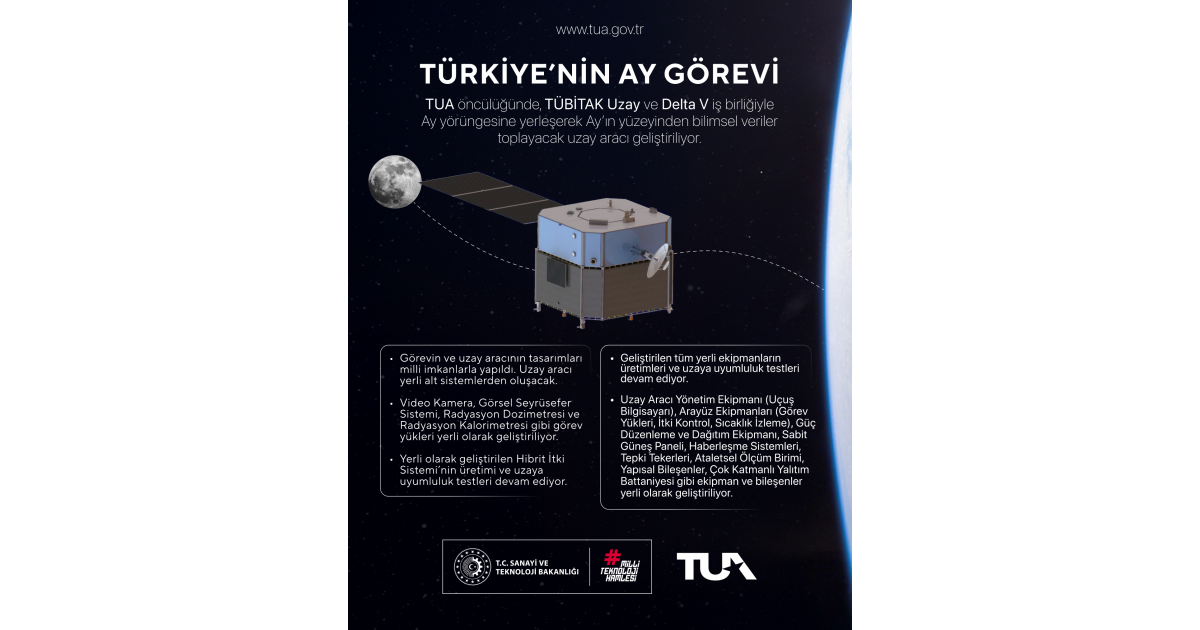
View attachment 75952

Turkey’s Moon Mission: Preparations Continue for the Indigenous and National Spacecraft

Within the scope of the Moon Mission Project conducted under the coordination of the Turkish Space Agency (TUA), a spacecraft developed entirely with domestic and national resources will reach lunar orbit and collect scientific data. The project aims to prove Turkey’s competence in space technologies and its engineering capacity on the international stage.

The spacecraft, developed by TÜBİTAK Space Technologies Research Institute (TÜBİTAK UZAY), will maneuver into lunar orbit using its own orientation and propulsion systems after separating from the launcher. This advanced technology platform, which will collect high-precision data from the Moon’s surface, will open a new chapter in Turkey’s scientific space research.

CRITICAL SYSTEMS ARE PRODUCTS OF NATIONAL ENGINEERING

The spacecraft’s most critical components are being developed with national engineering capabilities. The flight computer (Spacecraft Management Equipment), payload interfaces, propulsion control and thermal monitoring systems, power distribution units, fixed solar panels, communication systems, reaction wheels, inertial measurement unit, and structural parts are all entirely domestically produced. Special materials such as multi-layer insulation blankets resistant to space conditions are also being developed in Turkey.

Among the mission payloads are scientific instruments such as a video camera, visual navigation system, radiation dosimeter, and calorimeter. With these systems, the data obtained from the Moon’s surface is intended to contribute both to scientific research and to Turkey’s technological knowledge base.

RECORD-BREAKING SUCCESS WITH HYBRID PROPULSION SYSTEM FROM DELTAV

The hybrid propulsion system to be used in the spacecraft is being developed by the domestic technology company DELTAV. Production and space compatibility tests of the system are currently ongoing successfully. In the most recent test, a two-stage hybrid rocket system reached an altitude of over 200 km, setting a new altitude record for hybrid rocket engines.

The Moon Mission not only demonstrates the advanced level Turkey has reached in national space technologies, but also makes a strong contribution to the country’s vision of scientific and technological independence.

Sounds good but, faster Türkiye faster!
 

hugh

Contributor
Messages
567
Reactions
17 1,533
Nation of residence
Turkey
Nation of origin
Turkey
3 steerable, core engines surrounded by 8. Not worth the extra plumbing just to gain engine-out capability. the logical explanation is that they're aiming for a reusable first-stage. if so, we should see some grasshopper tests soon.

interestingly, it doesn't have grid-fins. so this booster will evolve in blocks to reach the capability?


Top Bottom