
You are using an out of date browser. It may not display this or other websites correctly.
You should upgrade or use an alternative browser.
You should upgrade or use an alternative browser.

urban mine
Contributor
Hyundai Rotem's Space Roadmap(They're challenging the field of future reusable launch vehicles, I suppose.) and HCM Technology Overview
urban mine
Contributor
This procedure verifies the electrical and mechanical connections between the payload adapter (PLA) and other integration hardware with the satellites and payloads. It is an essential pre-launch step to ensure stable mounting and integrated operation.
urban mine
Contributor
urban mine
Contributor
urban mine
Contributor


urban mine
Contributor
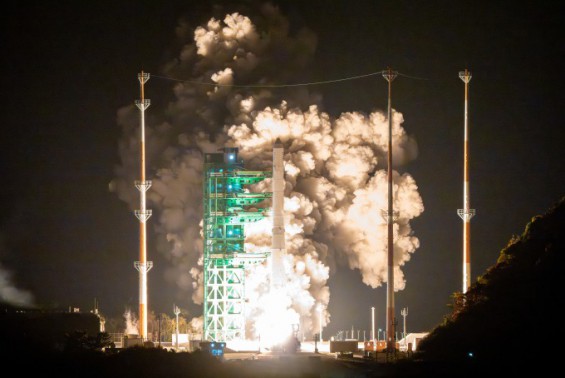
[Nuri's 4th Launch] Nuri Succeeds in First Launch Led by Private Sector
The fourth launch of 'Nuri,' the Korea Space Launch Vehicle developed with South Korea's own technology, has succeeded. This launch, the first to be led by the private sector, is expected to be a star
 www.dongascience.com
It also signifies that payloads and space technologies, painstakingly developed by dozens of domestic industry-academia-research institutes, can now be fully verified using a domestic launch vehicle. The success was achieved despite a 2.5-year launch hiatus. This is a green light for securing Nuri's reliability.
Last edited:
urban mine
Contributor

누리호 손님 차중3호·큐브위성 5기 지상국 교신 성공…나머지 7기 확인 중
우주항공청은 27일 새벽 1시 13분에 한국형발사체(누리호)에 실려 발사된 차세대중형위성 3호(차중3호)가 목표 궤도에 성공적으로 안착 후, 1시 55분경 남극세종기지 지상국과 양방향 교신에 성공했다고 밝혔다. 아울
The Korea AeroSpace Administration (KASA) announced that the Next-Generation Medium Satellite 3 (CAS500-3), launched aboard the Korean launch vehicle Nuri at 1:13 AM on the 27th (KST), successfully reached its target orbit. Furthermore, two-way communication with the King Sejong Station ground station in Antarctica was successfully established around 1:55 AM. Communication with five of the twelve secondary/piggyback satellites launched alongside it has also been confirmed.
First, following the initial contact, CAS500-3 achieved an additional successful communication around 2:48 AM via the antenna at the KARI (Korea Aerospace Research Institute) ground station in Daejeon. To date, the satellite has conducted two-way communication twice with the KARI ground station and 12 times with overseas ground stations (King Sejong Station in Antarctica, and Svalbard in Norway).
During the communication sessions today, the functionality of the CAS500-3 main body components was confirmed. Detailed status information will be downloaded, and precision checks will be performed through additional communications with the Daejeon KARI ground station and others.
Following a two-month period of initial operation, the satellite will undergo payload checks and mission preparation. It will then enter full-scale space science mission activities for one year, orbiting the Earth approximately 15 times a day in a Sun-Synchronous Orbit .
CAS500-3 is equipped with the following payloads to perform space science and technology verification missions:
BioCabinet: Verification of 3D differentiation and culture of stem cells based on bio 3D printing.
IAMMAP : Space plasma-magnetic field measurement instrument.
ROKITS : Space-based wide-field airglow observation instrument.
In addition, the development organizations responsible for the 12 secondary/piggyback satellites have initiated initial ground station communication and performance checks.
Among the 12 secondary satellites, five satellites—manufactured by the Electronics and Telecommunications Research Institute (ETRI), Cosmoworks, Inha University, and KAIST—have also completed communication with their respective ground stations.
urban mine
Contributor

①누리호 탑재 중량 2.2톤으로 늘어…유럽 발사체 맞먹는 기술 진화
“모두 고생 많으셨습니다.” 27일 새벽 전남 고흥군 나로우주센터 발사통제동의 발사지휘센터(MDC)와 발사관제센터(LCC)에서는 한국항공우주연구원과 한화에어로스페이스 등 누리호 4차 발사 임무의 핵심 관계자 60여
The Nuri rocket has demonstrated the proven performance capability of launching a payload weighing 2.2 tons into a Sun-Synchronous Orbit (SSO) at an altitude of 600 to 700 kilometers. The technological maturity level has progressed from a 1.5-ton capacity in the first launch in 2021, through a 1.9-ton capacity, and finally achieving the 2.2-ton class over four consecutive launches.
This Nuri rocket's flight time was slightly shorter than initially planned, and as it demonstrated a commensurately higher engine thrust, the effective payload capacity is expected to be more than 2.2 tons. The official thrust of the Nuri rocket is 300 tons based on the first-stage engine, but it was reportedly a few percent stronger in this launch. KARI (Korea Aerospace Research Institute) plans to find the exact reason through data analysis, but initially, the influence of the launch vehicle manufacturing quality, handled by Hanwha Aerospace, is being cited. Department Manager Choi Chang-ho said, "Just like cars or electronics, the actual quality of a launch vehicle can vary depending on manufacturing capabilities," adding, "It seems Hanwha Aerospace produced a high-quality product."
urban mine
Contributor

Arirang 7 Satellite Successfully Enters Orbit
Arirang 7 Satellite Successfully Enters Orbit Confirmed Solar Panel Deployment, Set for Ultra-High-Resolution Earth Observation
 www.chosun.com
Arirang 7 Satellite Successfully Enters Orbit
Arirang 7 Satellite Successfully Enters Orbit Confirmed Solar Panel Deployment, Set for Ultra-High-Resolution Earth Observation
www.chosun.com
Arirang 7 Satellite Successfully Enters Orbit
Early on the 2nd, South Korea’s multipurpose practical satellite ‘Arirang 7’ successfully established communication with ground stations and entered its orbit after being launched aboard Arianespace’s Vega-C rocket.
The Korea AeroSpace Administration announced that Arirang 7 separated from the Vega-C rocket, which lifted off at 2:21 a.m. (2:21 p.m. local time on the 1st) from the Kourou Guiana Space Center in French Guiana, South America, and successfully communicated with the Troll Base ground station in Antarctica at 3:30 a.m.
Through the first communication, the deployment of the satellite’s solar panels was confirmed. The space agency and KARI stated that they verified Arirang 7’s initial status via communication with the Troll ground station and confirmed its successful placement into the target orbit through the launch service provider.
Arirang 7 is a large satellite weighing approximately 2 tons. It is about three to four times larger than the next-generation medium-sized satellite carried by the Nuri rocket’s fourth launch.
The satellite’s mission is ultra-high-precision Earth observation. It is a super-high-resolution optical satellite developed with a 30 cm-level, black-and-white standard resolution. A 10 cm-level resolution means the satellite recognizes an area of 10 cm by 10 cm on the Earth’s surface as a single pixel—sufficient to identify types of people or vehicles on the ground.
Next is the Arirang 6 launch. Both the sixth and seventh were originally scheduled to launch using Russia's Angara rocket, but because of that damn war... If Russia hadn't started the war, they would have launched earlier.
urban mine
Contributor

KPLO (Korean Pathfinder Lunar Orbiter) - eoPortal
Satellite Mission - KPLO (Korean Pathfinder Lunar Orbiter)
The Deep Space Antenna system, located in Yeoju, Gyeonggi-do, was built to communicate with Danuri (Korea Pathfinder Lunar Orbiter), which is currently orbiting 100 km above the Moon, approximately 380,000km from Earth, and the Korea Aerospace Research Institute (KARI) ground station in Daejeon.
It also serves as a bridge to receive various scientific mission data transmitted from the six payloads aboard Danuri and relays it to the ground station.
The azimuth angle of the Deep Space Antenna is ±270 degrees, allowing communication with Danuri from virtually all directions regardless of its position. It has the capability to precisely point towards and automatically track Danuri, moving at a rate of 0.8 degrees per second.
On the day of the visit, the Deep Space Antenna communicated with Danuri a total of four times: starting with the first session at 1 PM, followed by sessions at 3 PM, 5 PM, and 7 PM.
When Danuri moves to the far side of the Moon along its orbit, communication is temporarily interrupted, providing a brief resting period of about 30 to 40 minutes.
Last edited:
urban mine
Contributor

All 12 Nuri-deployed cube satellites establish ground communication | Yonhap News Agency
SEOUL, Dec. 8 (Yonhap) -- All 12 cube satellites deployed by South Korea's homegrown ...
All 12 Nuri-deployed cube satellites establish ground communication
SEOUL, Dec. 8 (Yonhap) -- All 12 cube satellites deployed by South Korea's homegrown rocket Nuri last month have established communication with ground stations, their developers said Monday, setting a new milestone following the successful fourth launch of the space rocket.
The 200-ton Nuri blasted off from Naro Space Center in the country's southern coastal village of Goheung, some 330 kilometers south of Seoul, on Nov. 27, placing the main and 12 cube satellites into orbit at an altitude of 600 kilometers.
The Korea Aerospace Research Institute (KARI) said it has communicated with the E3 Tester-1, one of the cube satellites, while Space Liin Tech, a South Korean space technology firm, also announced successful communication with its own satellite BEE-1000.
Quaternion, another domestic space company, also confirmed successful communication with its cube satellite, the PERSAT, to Yonhap News Agency.
Last week, the Korea AeroSpace Administration and KARI confirmed communication with the other nine cube satellites.
It marked the first time that all satellites deployed by Nuri in a single launch have established communication with the ground.
Compared with large-scale satellites, cube satellites often face failures due to their limited capacity.
The main satellite established communication with South Korea's King Sejong Station in Antarctica shortly after the rocket launch.
urban mine
Contributor
Today, INNOSPACE's HANBIT-Nano rocket was launched but exploded in midair, resulting in failure. It's unfortunate, but we hope INNOSPACE will strengthen its technology and aim for the next opportunity....
urban mine
Contributor
It is now time for root cause analysis and corrective actions.
urban mine
Contributor
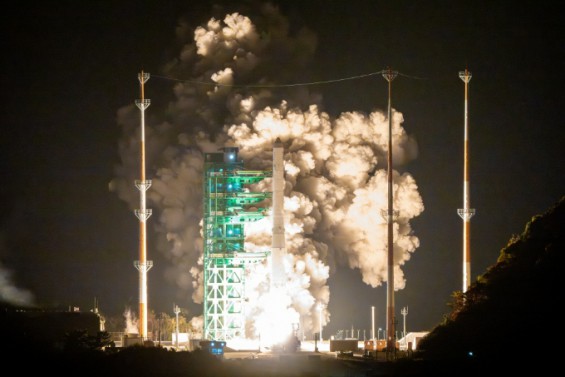
South Korea Pivots to Reusable Methane Rocket for Next-Generation Launcher
The Korea AeroSpace Administration (KASA) announced on the 22nd that the results of a 'business plan adequacy review' for the proposed change to develop the next-generation launch vehicle as a reusabl
www.dongascience.com
South Korea Pivots to Reusable Methane Rocket for Next-Generation Launcher
The Korea AeroSpace Administration (KASA) announced on the 22nd that the results of a 'business plan adequacy review' for the proposed change to develop the next-generation launch vehicle as a reusable rocket were deliberated and approved by the Fiscal Project Evaluation Committee (under the Ministry of Economy and Finance).Following the review, the total project cost for developing a methane-based reusable launch vehicle was confirmed at 2.29209 trillion KRW, an increase of 278.85 billion KRW from the original budget. Most of the increased funds will be used to build test facilities for methane propellant and develop core reusability technologies.
Notably, the revised plan shifts from the original approach of developing two different types of kerosene staged-combustion cycle engines for the first and second stages, respectively. Instead, it adopts a method of developing a single 80-ton-class methane propellant engine to be used for both stages. KASA plans to use this approach to seamlessly carry out the lunar lander launch mission scheduled for 2032 and to incrementally secure a competitive reusable launch vehicle.
KASA originally applied for the administrative procedures to change the business plan this past May for the next-generation launch vehicle development project, which began in 2023 after a preliminary feasibility study in 2022. The pivot to a reusable rocket aims to meet the rapidly increasing national demand for space development expected in the 2030s and to respond effectively to the reusable rocket development race among leading space-faring nations.
It's become an incredibly difficult goal. I'm feeling anxious about it.
urban mine
Contributor
Hanwha Aerospace to Develop Propulsion System for Korea’s 2032 Moon Lander
Hanwha Aerospace, in collaboration with the Korea Aerospace Research Institute (KARI), will develop the propulsion system for South Korea’s lunar lander, scheduled for launch in 2032, using domestic technology. Leveraging over 30 years of experience in spacecraft propulsion systems, the company aims to contribute to securing South Korea’s independent lunar exploration capabilities.
On the 29th, Hanwha Aerospace announced that it signed a 1,033 billion KRW contract with KARI on the 24th for the "Development of Components and Assembly/Testing of the Lunar Lander Propulsion System."
As part of the government’s lunar exploration plan, KARI will lead the design of the propulsion system. Hanwha Aerospace will be responsible for:
- Manufacturing and testing the landing engines and attitude control thrusters.
- The overall assembly and testing of the entire propulsion system through 2032.
Since starting with the Korea Multi-Purpose Satellite (Arirang-1) in 1994, Hanwha Aerospace has spent 32 years developing spacecraft propulsion systems for various missions, including the Next-Generation Medium-Sized Satellites, the Geostationary Public Services Meteorological Satellite (Chollian-3), and South Korea's first lunar orbiter, 'Danuri.'
The successful development of this lunar lander propulsion system will allow the company to apply its technology and infrastructure to future national space exploration projects, such as medium-to-large lunar probes, as well as Mars orbiters and landers.
An official from Hanwha Aerospace stated, "Based on industry-research cooperation, we will contribute to securing South Korea's independent space development capabilities and actively participate in government space projects to revitalize the space industry ecosystem."
urban mine
Contributor
I've been wondering why Hanwha's VLEO UHR SAR satellite has this shape, and recently found out the reason. Generally, Very Low Earth Orbit (VLEO) refers to the region 200-300 km above Earth's surface. This altitude is less than half that of the most crowded low Earth orbit (LEO) at 600-800 km, and even lower than the 400 km altitude where the International Space Station (ISS) orbits. While it is higher than the ‘Karman Line’ at 100 km, the scientifically recognized boundary of space, it is known as an area where aerosol-like atmospheric particles are abundant, causing friction with satellites, and where Earth's gravitational pull is still relatively strong.View attachment 77825
The VLEO UHR SAR satellite currently under independent development by Hanwha Systems features 15cm (0.15m-class) resolution, enabling precise identification of objects as small as 15cm—such as mobile phones and water bottles—on the ground from ultra-low Earth orbit (ULEO) at altitudes below 400km.
However, with the advent of the New Space era, the satellite market has experienced rapid growth, and accordingly, the importance of cost-effectiveness has also increased. As a satellite's altitude decreases, it becomes possible to achieve results comparable to high-performance satellites even with relatively smaller and less capable payloads. Furthermore, as satellites become smaller and lighter, launch costs also decrease. The current technological trend often involves clusters of satellites—numbering in the tens to hundreds—working together rather than relying on a single satellite. Consequently, the cost reduction per satellite has a significant impact on the overall project cost.
As mentioned earlier, VLEO orbits contain a large amount of atmospheric particulate matter in the form of aerosols that cause friction with satellites. When a high-speed satellite collides with this particulate matter, its position changes irregularly and frequently. Considering this situation, VLEO satellites under development are designed to be pointed at the front like an airplane, with wings at the rear, or to have a thin, dish-like shape.


