


This is something many of us have kicked around in various threads over the years: what if HÜRJET went twin-engine? Not as a fantasy sketch, but as a serious engineering question. With MUGEM's first steel already cut in 2025 and acceptance trials presumably targeting 2032, the clock is ticking on a very real problem: what manned fighter will actually operate from that flight deck on day one? KAAN-Naval is years away from being feasible. The current HÜRJET is a trainer. So I decided to sit down and work through the numbers, the trade-offs, the engine thermodynamics, and the structural realities of scaling HÜRJET into a twin-engine, carrier-capable, 4++ generation multirole fighter powered by a indigenous low-bypass derivative of the TF6000 core. What follows is a multi-part feasibility study. This is not a promotional piece or a wish list. Every advantage comes with an engineering cost, and I have tried to address both sides honestly. I will be posting each section as a separate reply below. Feedback, corrections, and pushback from the community are welcome.
***
HÜRJET-X: An Indigenous-Powered Variant Approach to MUGEM's Manned Fighter Requirement
- Can an existing platform and a modular core engine strategy deliver a medium-class naval fighter in time?
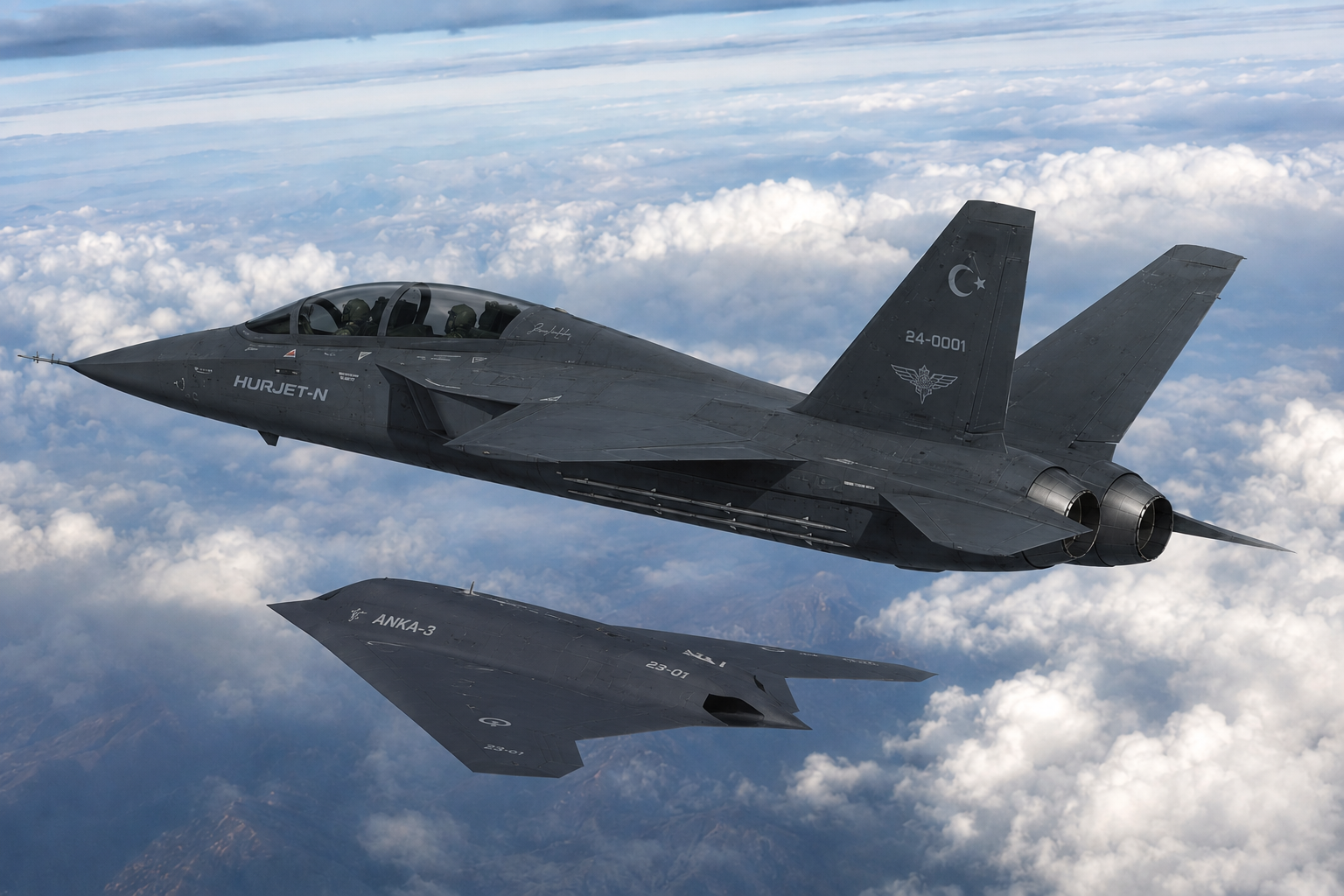
Part 1: MUGEM's Reality and the Open Question of Naval Aviation
With the first steel cut completed in 2025, MUGEM represents a structural shift in Turkish naval doctrine. At 60,000 tons full displacement, 285 meters in length, and a 72-meter flight deck beam, this is a purpose-built, conventionally powered aircraft carrier, the first of its kind in Turkish Naval Forces history. Current projections place the launch at 2028–2029, with navy acceptance trials expected around 2032. The project is no longer a conceptual ambition. It is taking physical shape in the shipyard.
An aircraft carrier, however, derives its strategic value from the air wing it operates. MUGEM's planned air complement includes unmanned platforms such as Bayraktar TB3, KIZILELMA, and ANKA-3, all of which are expected to populate the flight deck during the ship's initial operational period. On the manned fighter side, official planning references both KAAN and HÜRJET. But whether either platform, in its current form, can realistically meet MUGEM's manned combat aviation requirement is a question worth examining carefully.
KAAN is under active development as Turkiye's fifth-generation, heavy-class stealth fighter. At a maximum takeoff weight in the vicinity of 27 tonnes, operating this aircraft from a carrier would demand an extensive navalization effort: structural reinforcement, landing gear redesign, wing-fold mechanisms, and given the physical constraints of launching an aircraft in this weight class from a ski-jump ramp, almost certainly a catapult system. MUGEM is understood to be planned in a STOBAR configuration for its initial deployment, with design provisions and structural allowances for a future CATOBAR conversion. This means KAAN would only become carrier-compatible once that catapult retrofit is completed. Factor in that KAAN's own development program is still in progress, and that navalization of a heavy stealth platform constitutes a major additional engineering undertaking, and it becomes difficult to envision KAAN-Naval as an operational reality before 2040.
HÜRJET, in its current configuration, is a single-engine, light-class advanced jet trainer and light combat aircraft. It offers value in flight training and close air support roles, but it does not possess the sensor suite, weapons payload, or survivability characteristics expected of a naval fighter tasked with BVR air combat, fleet air defense, or cruise missile engagement. Moreover, its single-engine layout does not satisfy the redundancy criteria that naval aviation has traditionally favoured for sustained overwater operations.
This leaves a gap in the timeline. When MUGEM enters service around 2032-34, unmanned assets will be ready on the flight deck. But the manned fighter element, the platform that would direct those unmanned assets, provide an air superiority umbrella, and offer human decision-making authority in complex threat environments, may simply not exist. That gap could delay the ship's full operational capability by years.
The core question of this study emerges directly from that gap. Rather than designing a new aircraft from scratch, could a twin-engine, medium-class naval fighter variant be developed by building on HÜRJET's existing airframe geometry, production infrastructure, and flight control software, powered by an indigenous low-bypass afterburning turbofan derived from TEI's TF6000 core engine technology? And critically, can this be achieved within the timeline that MUGEM's operational schedule demands?
This study examines that question from an engineering feasibility standpoint. Its purpose is not only to explore the concept's potential, but to address with equal candour the engineering challenges it would face: the weight and performance trade-offs, engine maturation risks, and industrial capacity constraints involved. The resulting picture is intended less as a definitive verdict and more as a framework, built on tangible data points, that decision-makers and industry professionals can use to form their own assessment.
*
Part 2: Industrial Logic: The Variant Strategy and Its Limits
The idea of developing a new fighter aircraft is, in the abstract, straightforward. In practice, it is one of the most resource-intensive undertakings in the defence industry. A clean-sheet combat aircraft programme, from preliminary design to first flight, typically consumes ten to fifteen years and demands the sustained effort of several thousand engineers across aerodynamics, structures, propulsion integration, avionics, flight controls, and systems engineering. The financial burden runs into the billions. For a country with an established aerospace sector and deep institutional experience, this is a heavy commitment. For one that is simultaneously running multiple first-of-type programmes, it raises a harder question: not whether it can be done, but whether the workforce exists to do it.
TUSAŞ's current programme portfolio is, by any measure, ambitious. KAAN is in active flight testing as Turkiye's first fifth-generation stealth fighter, a programme that by itself commands a large share of the company's senior engineering talent in aerodynamics, low-observability design, structural testing, and flight sciences. ANKA-3, a flying-wing unmanned combat air vehicle, is progressing through its own development cycle with its own set of design and integration challenges. The rotary-wing division is occupied with the T625 GÖKBEY and the heavy-class T925, ATAK-2. HÜRJET itself is still in its flight test expansion phase, with production ramp-up ahead. Each of these programmes competes for the same finite pool of experienced aeronautical engineers, test pilots, systems integrators, and programme managers.
Launching a clean-sheet naval fighter programme on top of this workload would require either a dramatic expansion of TUSAŞ's engineering headcount, which takes years of hiring and training that the timeline does not afford, or a reallocation of talent from existing programmes, which would delay KAAN, ANKA-3, or both. Neither option is attractive. This is not a criticism of institutional capacity; it is an arithmetic reality that every aerospace organisation in the world faces when concurrent programmes stack up. Lockheed Martin's experience with the F-35, where developmental delays cascaded partly from workforce allocation pressures across the F-22 and F-35 simultaneously, is a well-documented case in point.
The variant strategy offers a different path. Rather than starting from a blank sheet, the approach takes an existing, flying aircraft, HÜRJET, and uses its airframe geometry, structural design database, flight control laws, and production tooling as the foundation for a more capable derivative. The logic is not unique to this concept. The F/A-18 Hornet originated as a derivative of the Northrop YF-17 lightweight fighter prototype. The Boeing F/A-18E/F Super Hornet, while often described as a new aircraft, retained enough architectural lineage from the original Hornet to leverage existing carrier integration experience, maintenance procedures, and pilot training infrastructure. The Saab Gripen E, though substantially redesigned from the C/D, preserved the fundamental aerodynamic configuration while enlarging the airframe and integrating a more powerful engine. In each case, the derivative approach did not eliminate engineering work, but it significantly compressed the early design phases where fundamental configuration decisions, wind tunnel campaigns, and basic flight envelope exploration consume enormous time and budget.
What does HÜRJET specifically bring to the table as a starting point? Several things are genuinely transferable. The basic aerodynamic configuration, a single-seat or tandem-seat, mid-wing, conventional tail layout, has been through wind tunnel testing and is accumulating real flight data. The fly-by-wire flight control system, developed and coded for HÜRJET, provides a software baseline that can be adapted for a larger, twin-engine variant rather than written from scratch. The production line at TUSAŞ's Ankara facility, with its tooling, jigs, and qualified supplier network, offers a manufacturing foundation even if significant retooling will be needed for the larger variant. Structural design data, material qualification records, and fatigue analysis methodologies developed for HÜRJET all carry forward in some form.
But it is important to be realistic about the limits of this commonality. The modifications this concept requires, adding a second engine and intake, widening and reshaping the aft fuselage, replacing the single vertical tail with twin canted stabilizers, integrating semi-recessed weapon stations, and incorporating the full navalization package, are not minor changes. They touch virtually every major structural group aft of the cockpit. The wing carry-through structure needs to be redesigned for higher loads. The landing gear is entirely new. The flight control laws require fundamental revision to handle twin-engine asymmetric thrust cases and the different stability characteristics of a twin-tail configuration. Realistically, the component and structural commonality between HÜRJET and HÜRJET-X is likely to settle in the range of twenty-five to thirty-five percent, not the seventy or eighty percent that the term "variant" might casually imply. The forward fuselage, cockpit architecture, canopy, some avionics bays, and portions of the wing structure are the primary areas where direct carryover is feasible.
Where the real time savings emerge is not in parts commonality but in knowledge commonality. The engineering team that designed HÜRJET's wing does not need to relearn transonic aerodynamics to design a fifteen-percent-larger wing. The flight test organisation that is currently expanding HÜRJET's envelope has direct experience with the basic configuration's handling qualities, which informs the twin-engine derivative's flight test planning. The systems integration engineers who wired HÜRJET's avionics understand the architecture and can evolve it rather than reinvent it. This institutional knowledge, difficult to quantify but decisive in practice, is what compresses a twelve-year clean-sheet timeline into something closer to seven or eight years.
The second major accelerator is technology transfer from KAAN. The fifth-generation programme is generating a body of applied knowledge in areas directly relevant to HÜRJET-X. Radar-absorbent material formulations and application processes developed for KAAN can be adapted for HÜRJET-X's external surfaces. Low-observability design principles, the shaping rules that govern edge alignment, inlet masking, and cavity treatment, are transferable as engineering guidelines rather than hardware. The AESA radar programme, including GaN-based T/R module development and signal processing software, provides a sensor technology base that can be scaled to fit HÜRJET-X's nose geometry. Avionics bus architecture, datalink integration protocols, and electronic warfare suite design are all areas where KAAN's development investment yields dividends for a follow-on platform without requiring the recipient programme to repeat the foundational research.
This is not free, however. Technology transfer requires dedicated engineering effort to adapt, re-validate, and integrate. Scaling an AESA radar from KAAN's nose aperture to HÜRJET-X's smaller radome involves more than simply using fewer T/R modules; it requires re-optimising the array geometry, cooling architecture, and signal processing algorithms for a different aperture size and power budget. RAM coatings qualified for KAAN's structural materials and surface temperatures may need requalification for HÜRJET-X's different material set and thermal environment. These are solvable problems, but they are not trivial, and the programme schedule must account for them.
The net proposition, then, is this: HÜRJET-X is not a simple stretch of an existing trainer. It is a substantial derivative programme that produces what is, in many respects, a new aircraft. But it is a new aircraft that starts with a meaningful head start in aerodynamic understanding, flight control maturity, production infrastructure, and institutional knowledge, supplemented by technology transfer from a concurrent fifth-generation programme. The estimated timeline of seven to eight years to first flight, compared to twelve or more for a clean-sheet design, reflects this head start. Whether that timeline is fast enough to meet MUGEM's operational requirements is a question the subsequent sections of this study will address, particularly when the critical path through engine development is examined.
***
HÜRJET-X: An Indigenous-Powered Variant Approach to MUGEM's Manned Fighter Requirement
- Can an existing platform and a modular core engine strategy deliver a medium-class naval fighter in time?
Part 1: MUGEM's Reality and the Open Question of Naval Aviation
With the first steel cut completed in 2025, MUGEM represents a structural shift in Turkish naval doctrine. At 60,000 tons full displacement, 285 meters in length, and a 72-meter flight deck beam, this is a purpose-built, conventionally powered aircraft carrier, the first of its kind in Turkish Naval Forces history. Current projections place the launch at 2028–2029, with navy acceptance trials expected around 2032. The project is no longer a conceptual ambition. It is taking physical shape in the shipyard.
An aircraft carrier, however, derives its strategic value from the air wing it operates. MUGEM's planned air complement includes unmanned platforms such as Bayraktar TB3, KIZILELMA, and ANKA-3, all of which are expected to populate the flight deck during the ship's initial operational period. On the manned fighter side, official planning references both KAAN and HÜRJET. But whether either platform, in its current form, can realistically meet MUGEM's manned combat aviation requirement is a question worth examining carefully.
KAAN is under active development as Turkiye's fifth-generation, heavy-class stealth fighter. At a maximum takeoff weight in the vicinity of 27 tonnes, operating this aircraft from a carrier would demand an extensive navalization effort: structural reinforcement, landing gear redesign, wing-fold mechanisms, and given the physical constraints of launching an aircraft in this weight class from a ski-jump ramp, almost certainly a catapult system. MUGEM is understood to be planned in a STOBAR configuration for its initial deployment, with design provisions and structural allowances for a future CATOBAR conversion. This means KAAN would only become carrier-compatible once that catapult retrofit is completed. Factor in that KAAN's own development program is still in progress, and that navalization of a heavy stealth platform constitutes a major additional engineering undertaking, and it becomes difficult to envision KAAN-Naval as an operational reality before 2040.
HÜRJET, in its current configuration, is a single-engine, light-class advanced jet trainer and light combat aircraft. It offers value in flight training and close air support roles, but it does not possess the sensor suite, weapons payload, or survivability characteristics expected of a naval fighter tasked with BVR air combat, fleet air defense, or cruise missile engagement. Moreover, its single-engine layout does not satisfy the redundancy criteria that naval aviation has traditionally favoured for sustained overwater operations.
This leaves a gap in the timeline. When MUGEM enters service around 2032-34, unmanned assets will be ready on the flight deck. But the manned fighter element, the platform that would direct those unmanned assets, provide an air superiority umbrella, and offer human decision-making authority in complex threat environments, may simply not exist. That gap could delay the ship's full operational capability by years.
The core question of this study emerges directly from that gap. Rather than designing a new aircraft from scratch, could a twin-engine, medium-class naval fighter variant be developed by building on HÜRJET's existing airframe geometry, production infrastructure, and flight control software, powered by an indigenous low-bypass afterburning turbofan derived from TEI's TF6000 core engine technology? And critically, can this be achieved within the timeline that MUGEM's operational schedule demands?
This study examines that question from an engineering feasibility standpoint. Its purpose is not only to explore the concept's potential, but to address with equal candour the engineering challenges it would face: the weight and performance trade-offs, engine maturation risks, and industrial capacity constraints involved. The resulting picture is intended less as a definitive verdict and more as a framework, built on tangible data points, that decision-makers and industry professionals can use to form their own assessment.
*
Part 2: Industrial Logic: The Variant Strategy and Its Limits
The idea of developing a new fighter aircraft is, in the abstract, straightforward. In practice, it is one of the most resource-intensive undertakings in the defence industry. A clean-sheet combat aircraft programme, from preliminary design to first flight, typically consumes ten to fifteen years and demands the sustained effort of several thousand engineers across aerodynamics, structures, propulsion integration, avionics, flight controls, and systems engineering. The financial burden runs into the billions. For a country with an established aerospace sector and deep institutional experience, this is a heavy commitment. For one that is simultaneously running multiple first-of-type programmes, it raises a harder question: not whether it can be done, but whether the workforce exists to do it.
TUSAŞ's current programme portfolio is, by any measure, ambitious. KAAN is in active flight testing as Turkiye's first fifth-generation stealth fighter, a programme that by itself commands a large share of the company's senior engineering talent in aerodynamics, low-observability design, structural testing, and flight sciences. ANKA-3, a flying-wing unmanned combat air vehicle, is progressing through its own development cycle with its own set of design and integration challenges. The rotary-wing division is occupied with the T625 GÖKBEY and the heavy-class T925, ATAK-2. HÜRJET itself is still in its flight test expansion phase, with production ramp-up ahead. Each of these programmes competes for the same finite pool of experienced aeronautical engineers, test pilots, systems integrators, and programme managers.
Launching a clean-sheet naval fighter programme on top of this workload would require either a dramatic expansion of TUSAŞ's engineering headcount, which takes years of hiring and training that the timeline does not afford, or a reallocation of talent from existing programmes, which would delay KAAN, ANKA-3, or both. Neither option is attractive. This is not a criticism of institutional capacity; it is an arithmetic reality that every aerospace organisation in the world faces when concurrent programmes stack up. Lockheed Martin's experience with the F-35, where developmental delays cascaded partly from workforce allocation pressures across the F-22 and F-35 simultaneously, is a well-documented case in point.
The variant strategy offers a different path. Rather than starting from a blank sheet, the approach takes an existing, flying aircraft, HÜRJET, and uses its airframe geometry, structural design database, flight control laws, and production tooling as the foundation for a more capable derivative. The logic is not unique to this concept. The F/A-18 Hornet originated as a derivative of the Northrop YF-17 lightweight fighter prototype. The Boeing F/A-18E/F Super Hornet, while often described as a new aircraft, retained enough architectural lineage from the original Hornet to leverage existing carrier integration experience, maintenance procedures, and pilot training infrastructure. The Saab Gripen E, though substantially redesigned from the C/D, preserved the fundamental aerodynamic configuration while enlarging the airframe and integrating a more powerful engine. In each case, the derivative approach did not eliminate engineering work, but it significantly compressed the early design phases where fundamental configuration decisions, wind tunnel campaigns, and basic flight envelope exploration consume enormous time and budget.
What does HÜRJET specifically bring to the table as a starting point? Several things are genuinely transferable. The basic aerodynamic configuration, a single-seat or tandem-seat, mid-wing, conventional tail layout, has been through wind tunnel testing and is accumulating real flight data. The fly-by-wire flight control system, developed and coded for HÜRJET, provides a software baseline that can be adapted for a larger, twin-engine variant rather than written from scratch. The production line at TUSAŞ's Ankara facility, with its tooling, jigs, and qualified supplier network, offers a manufacturing foundation even if significant retooling will be needed for the larger variant. Structural design data, material qualification records, and fatigue analysis methodologies developed for HÜRJET all carry forward in some form.
But it is important to be realistic about the limits of this commonality. The modifications this concept requires, adding a second engine and intake, widening and reshaping the aft fuselage, replacing the single vertical tail with twin canted stabilizers, integrating semi-recessed weapon stations, and incorporating the full navalization package, are not minor changes. They touch virtually every major structural group aft of the cockpit. The wing carry-through structure needs to be redesigned for higher loads. The landing gear is entirely new. The flight control laws require fundamental revision to handle twin-engine asymmetric thrust cases and the different stability characteristics of a twin-tail configuration. Realistically, the component and structural commonality between HÜRJET and HÜRJET-X is likely to settle in the range of twenty-five to thirty-five percent, not the seventy or eighty percent that the term "variant" might casually imply. The forward fuselage, cockpit architecture, canopy, some avionics bays, and portions of the wing structure are the primary areas where direct carryover is feasible.
Where the real time savings emerge is not in parts commonality but in knowledge commonality. The engineering team that designed HÜRJET's wing does not need to relearn transonic aerodynamics to design a fifteen-percent-larger wing. The flight test organisation that is currently expanding HÜRJET's envelope has direct experience with the basic configuration's handling qualities, which informs the twin-engine derivative's flight test planning. The systems integration engineers who wired HÜRJET's avionics understand the architecture and can evolve it rather than reinvent it. This institutional knowledge, difficult to quantify but decisive in practice, is what compresses a twelve-year clean-sheet timeline into something closer to seven or eight years.
The second major accelerator is technology transfer from KAAN. The fifth-generation programme is generating a body of applied knowledge in areas directly relevant to HÜRJET-X. Radar-absorbent material formulations and application processes developed for KAAN can be adapted for HÜRJET-X's external surfaces. Low-observability design principles, the shaping rules that govern edge alignment, inlet masking, and cavity treatment, are transferable as engineering guidelines rather than hardware. The AESA radar programme, including GaN-based T/R module development and signal processing software, provides a sensor technology base that can be scaled to fit HÜRJET-X's nose geometry. Avionics bus architecture, datalink integration protocols, and electronic warfare suite design are all areas where KAAN's development investment yields dividends for a follow-on platform without requiring the recipient programme to repeat the foundational research.
This is not free, however. Technology transfer requires dedicated engineering effort to adapt, re-validate, and integrate. Scaling an AESA radar from KAAN's nose aperture to HÜRJET-X's smaller radome involves more than simply using fewer T/R modules; it requires re-optimising the array geometry, cooling architecture, and signal processing algorithms for a different aperture size and power budget. RAM coatings qualified for KAAN's structural materials and surface temperatures may need requalification for HÜRJET-X's different material set and thermal environment. These are solvable problems, but they are not trivial, and the programme schedule must account for them.
The net proposition, then, is this: HÜRJET-X is not a simple stretch of an existing trainer. It is a substantial derivative programme that produces what is, in many respects, a new aircraft. But it is a new aircraft that starts with a meaningful head start in aerodynamic understanding, flight control maturity, production infrastructure, and institutional knowledge, supplemented by technology transfer from a concurrent fifth-generation programme. The estimated timeline of seven to eight years to first flight, compared to twelve or more for a clean-sheet design, reflects this head start. Whether that timeline is fast enough to meet MUGEM's operational requirements is a question the subsequent sections of this study will address, particularly when the critical path through engine development is examined.
Last edited:


