TR Twin-Engine HÜRJET: Could a TF6000-Derived Naval Variant Fill MUGEM's Fighter Gap?

dBSPL

Experienced member
Think Tank Analyst
DefenceHub Ambassador
Messages
2,799
Reactions
118 14,233
Nation of residence
Turkey
Nation of origin
Turkey
This is something many of us have kicked around in various threads over the years: what if HÜRJET went twin-engine? Not as a fantasy sketch, but as a serious engineering question. With MUGEM's first steel already cut in 2025 and acceptance trials presumably targeting 2032, the clock is ticking on a very real problem: what manned fighter will actually operate from that flight deck on day one? KAAN-Naval is years away from being feasible. The current HÜRJET is a trainer. So I decided to sit down and work through the numbers, the trade-offs, the engine thermodynamics, and the structural realities of scaling HÜRJET into a twin-engine, carrier-capable, 4++ generation multirole fighter powered by a indigenous low-bypass derivative of the TF6000 core. What follows is a multi-part feasibility study. This is not a promotional piece or a wish list. Every advantage comes with an engineering cost, and I have tried to address both sides honestly. I will be posting each section as a separate reply below. Feedback, corrections, and pushback from the community are welcome.

***

HÜRJET-X: An Indigenous-Powered Variant Approach to MUGEM's Manned Fighter Requirement

- Can an existing platform and a modular core engine strategy deliver a medium-class naval fighter in time?
24622.png


Part 1: MUGEM's Reality and the Open Question of Naval Aviation

With the first steel cut completed in 2025, MUGEM represents a structural shift in Turkish naval doctrine. At 60,000 tons full displacement, 285 meters in length, and a 72-meter flight deck beam, this is a purpose-built, conventionally powered aircraft carrier, the first of its kind in Turkish Naval Forces history. Current projections place the launch at 2028–2029, with navy acceptance trials expected around 2032. The project is no longer a conceptual ambition. It is taking physical shape in the shipyard.

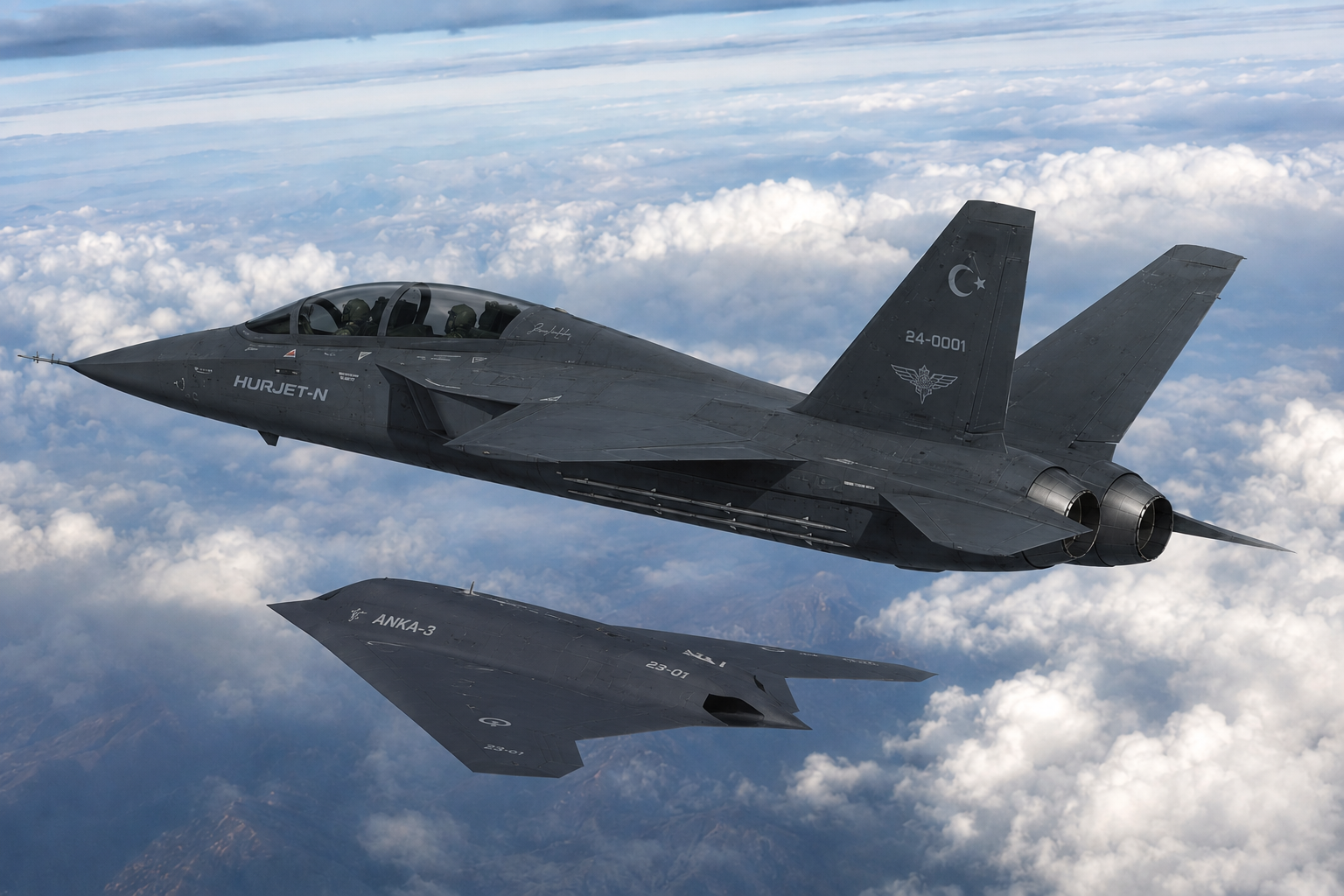
An aircraft carrier, however, derives its strategic value from the air wing it operates. MUGEM's planned air complement includes unmanned platforms such as Bayraktar TB3, KIZILELMA, and ANKA-3, all of which are expected to populate the flight deck during the ship's initial operational period. On the manned fighter side, official planning references both KAAN and HÜRJET. But whether either platform, in its current form, can realistically meet MUGEM's manned combat aviation requirement is a question worth examining carefully.

KAAN is under active development as Turkiye's fifth-generation, heavy-class stealth fighter. At a maximum takeoff weight in the vicinity of 27 tonnes, operating this aircraft from a carrier would demand an extensive navalization effort: structural reinforcement, landing gear redesign, wing-fold mechanisms, and given the physical constraints of launching an aircraft in this weight class from a ski-jump ramp, almost certainly a catapult system. MUGEM is understood to be planned in a STOBAR configuration for its initial deployment, with design provisions and structural allowances for a future CATOBAR conversion. This means KAAN would only become carrier-compatible once that catapult retrofit is completed. Factor in that KAAN's own development program is still in progress, and that navalization of a heavy stealth platform constitutes a major additional engineering undertaking, and it becomes difficult to envision KAAN-Naval as an operational reality before 2040.

HÜRJET, in its current configuration, is a single-engine, light-class advanced jet trainer and light combat aircraft. It offers value in flight training and close air support roles, but it does not possess the sensor suite, weapons payload, or survivability characteristics expected of a naval fighter tasked with BVR air combat, fleet air defense, or cruise missile engagement. Moreover, its single-engine layout does not satisfy the redundancy criteria that naval aviation has traditionally favoured for sustained overwater operations.

This leaves a gap in the timeline. When MUGEM enters service around 2032-34, unmanned assets will be ready on the flight deck. But the manned fighter element, the platform that would direct those unmanned assets, provide an air superiority umbrella, and offer human decision-making authority in complex threat environments, may simply not exist. That gap could delay the ship's full operational capability by years.

The core question of this study emerges directly from that gap. Rather than designing a new aircraft from scratch, could a twin-engine, medium-class naval fighter variant be developed by building on HÜRJET's existing airframe geometry, production infrastructure, and flight control software, powered by an indigenous low-bypass afterburning turbofan derived from TEI's TF6000 core engine technology? And critically, can this be achieved within the timeline that MUGEM's operational schedule demands?

This study examines that question from an engineering feasibility standpoint. Its purpose is not only to explore the concept's potential, but to address with equal candour the engineering challenges it would face: the weight and performance trade-offs, engine maturation risks, and industrial capacity constraints involved. The resulting picture is intended less as a definitive verdict and more as a framework, built on tangible data points, that decision-makers and industry professionals can use to form their own assessment.


*

Part 2: Industrial Logic: The Variant Strategy and Its Limits

The idea of developing a new fighter aircraft is, in the abstract, straightforward. In practice, it is one of the most resource-intensive undertakings in the defence industry. A clean-sheet combat aircraft programme, from preliminary design to first flight, typically consumes ten to fifteen years and demands the sustained effort of several thousand engineers across aerodynamics, structures, propulsion integration, avionics, flight controls, and systems engineering. The financial burden runs into the billions. For a country with an established aerospace sector and deep institutional experience, this is a heavy commitment. For one that is simultaneously running multiple first-of-type programmes, it raises a harder question: not whether it can be done, but whether the workforce exists to do it.

TUSAŞ's current programme portfolio is, by any measure, ambitious. KAAN is in active flight testing as Turkiye's first fifth-generation stealth fighter, a programme that by itself commands a large share of the company's senior engineering talent in aerodynamics, low-observability design, structural testing, and flight sciences. ANKA-3, a flying-wing unmanned combat air vehicle, is progressing through its own development cycle with its own set of design and integration challenges. The rotary-wing division is occupied with the T625 GÖKBEY and the heavy-class T925, ATAK-2. HÜRJET itself is still in its flight test expansion phase, with production ramp-up ahead. Each of these programmes competes for the same finite pool of experienced aeronautical engineers, test pilots, systems integrators, and programme managers.

Launching a clean-sheet naval fighter programme on top of this workload would require either a dramatic expansion of TUSAŞ's engineering headcount, which takes years of hiring and training that the timeline does not afford, or a reallocation of talent from existing programmes, which would delay KAAN, ANKA-3, or both. Neither option is attractive. This is not a criticism of institutional capacity; it is an arithmetic reality that every aerospace organisation in the world faces when concurrent programmes stack up. Lockheed Martin's experience with the F-35, where developmental delays cascaded partly from workforce allocation pressures across the F-22 and F-35 simultaneously, is a well-documented case in point.

The variant strategy offers a different path. Rather than starting from a blank sheet, the approach takes an existing, flying aircraft, HÜRJET, and uses its airframe geometry, structural design database, flight control laws, and production tooling as the foundation for a more capable derivative. The logic is not unique to this concept. The F/A-18 Hornet originated as a derivative of the Northrop YF-17 lightweight fighter prototype. The Boeing F/A-18E/F Super Hornet, while often described as a new aircraft, retained enough architectural lineage from the original Hornet to leverage existing carrier integration experience, maintenance procedures, and pilot training infrastructure. The Saab Gripen E, though substantially redesigned from the C/D, preserved the fundamental aerodynamic configuration while enlarging the airframe and integrating a more powerful engine. In each case, the derivative approach did not eliminate engineering work, but it significantly compressed the early design phases where fundamental configuration decisions, wind tunnel campaigns, and basic flight envelope exploration consume enormous time and budget.

What does HÜRJET specifically bring to the table as a starting point? Several things are genuinely transferable. The basic aerodynamic configuration, a single-seat or tandem-seat, mid-wing, conventional tail layout, has been through wind tunnel testing and is accumulating real flight data. The fly-by-wire flight control system, developed and coded for HÜRJET, provides a software baseline that can be adapted for a larger, twin-engine variant rather than written from scratch. The production line at TUSAŞ's Ankara facility, with its tooling, jigs, and qualified supplier network, offers a manufacturing foundation even if significant retooling will be needed for the larger variant. Structural design data, material qualification records, and fatigue analysis methodologies developed for HÜRJET all carry forward in some form.

But it is important to be realistic about the limits of this commonality. The modifications this concept requires, adding a second engine and intake, widening and reshaping the aft fuselage, replacing the single vertical tail with twin canted stabilizers, integrating semi-recessed weapon stations, and incorporating the full navalization package, are not minor changes. They touch virtually every major structural group aft of the cockpit. The wing carry-through structure needs to be redesigned for higher loads. The landing gear is entirely new. The flight control laws require fundamental revision to handle twin-engine asymmetric thrust cases and the different stability characteristics of a twin-tail configuration. Realistically, the component and structural commonality between HÜRJET and HÜRJET-X is likely to settle in the range of twenty-five to thirty-five percent, not the seventy or eighty percent that the term "variant" might casually imply. The forward fuselage, cockpit architecture, canopy, some avionics bays, and portions of the wing structure are the primary areas where direct carryover is feasible.

Where the real time savings emerge is not in parts commonality but in knowledge commonality. The engineering team that designed HÜRJET's wing does not need to relearn transonic aerodynamics to design a fifteen-percent-larger wing. The flight test organisation that is currently expanding HÜRJET's envelope has direct experience with the basic configuration's handling qualities, which informs the twin-engine derivative's flight test planning. The systems integration engineers who wired HÜRJET's avionics understand the architecture and can evolve it rather than reinvent it. This institutional knowledge, difficult to quantify but decisive in practice, is what compresses a twelve-year clean-sheet timeline into something closer to seven or eight years.

The second major accelerator is technology transfer from KAAN. The fifth-generation programme is generating a body of applied knowledge in areas directly relevant to HÜRJET-X. Radar-absorbent material formulations and application processes developed for KAAN can be adapted for HÜRJET-X's external surfaces. Low-observability design principles, the shaping rules that govern edge alignment, inlet masking, and cavity treatment, are transferable as engineering guidelines rather than hardware. The AESA radar programme, including GaN-based T/R module development and signal processing software, provides a sensor technology base that can be scaled to fit HÜRJET-X's nose geometry. Avionics bus architecture, datalink integration protocols, and electronic warfare suite design are all areas where KAAN's development investment yields dividends for a follow-on platform without requiring the recipient programme to repeat the foundational research.

This is not free, however. Technology transfer requires dedicated engineering effort to adapt, re-validate, and integrate. Scaling an AESA radar from KAAN's nose aperture to HÜRJET-X's smaller radome involves more than simply using fewer T/R modules; it requires re-optimising the array geometry, cooling architecture, and signal processing algorithms for a different aperture size and power budget. RAM coatings qualified for KAAN's structural materials and surface temperatures may need requalification for HÜRJET-X's different material set and thermal environment. These are solvable problems, but they are not trivial, and the programme schedule must account for them.

The net proposition, then, is this: HÜRJET-X is not a simple stretch of an existing trainer. It is a substantial derivative programme that produces what is, in many respects, a new aircraft. But it is a new aircraft that starts with a meaningful head start in aerodynamic understanding, flight control maturity, production infrastructure, and institutional knowledge, supplemented by technology transfer from a concurrent fifth-generation programme. The estimated timeline of seven to eight years to first flight, compared to twelve or more for a clean-sheet design, reflects this head start. Whether that timeline is fast enough to meet MUGEM's operational requirements is a question the subsequent sections of this study will address, particularly when the critical path through engine development is examined.
 
Last edited:

dBSPL

Experienced member
Think Tank Analyst
DefenceHub Ambassador
Messages
2,799
Reactions
118 14,233
Nation of residence
Turkey
Nation of origin
Turkey
Part 3 (Revised) Propulsion: The TF6000/10000 and What It Delivers

The engine question in this study has a simpler starting point than the original version of this section suggested. TEI's TF6000/10000 programme provides two defined configurations: a dry turbofan rated at 6,000 lbf, and an afterburning variant rated at 10,000 lbf. These are not speculative figures. They are TEI's published design targets for an engine that the company has explicitly positioned as the foundation of a modular propulsion family and as a technology stepping stone toward KAAN's TF35000.

The published specifications of the TF6000 establish what we are working with. The engine produces 6,000 lbf at sea-level static ISA conditions, has overall dimensions of 860 by 1,150 by 2,250 millimetres, operates at a bypass ratio of 1.08, and features a two-stage axial fan, six-stage axial compressor, single-stage high-pressure turbine, single-stage low-pressure turbine, and a straight-flow combustor. The afterburning TF10000 variant targets 10,000 lbf using the same core, which implies an augmentation ratio of approximately 1.67. This is at the upper boundary of historical norms for military turbofans: the Adour Mk.804 achieves 1.62, the F404-GE-402 achieves 1.64, and the RD-33 achieves 1.63. It is aggressive but not unprecedented, and TEI has committed to this target publicly, so this study takes it at face value.

Two TF10000 engines in a twin-engine installation deliver a combined 12,000 lbf dry and 20,000 lbf with afterburner. These are the numbers on which the rest of this study's performance analysis is built. No core scaling, no bypass ratio modification, no speculative thrust projections. The engine is taken as TEI intends to deliver it.
What does 20,000 lbf of combined thrust actually buy in operational terms? The answer depends entirely on the aircraft's weight, which is addressed in detail in the next section. But to establish the performance envelope in broad terms: at a combat weight of 9,000 to 10,000 kilograms, representing approximately half internal fuel and a four-missile BVR loadout, the thrust-to-weight ratio falls in the 0.91 to 1.01 range. At a typical STOBAR launch weight of 10,000 to 11,000 kilograms, reflecting a partial fuel and weapon configuration appropriate for a ski-jump departure, T/W is in the 0.83 to 0.91 range. At maximum takeoff weight, which for this concept is estimated at 11,000 to 12,500 kilograms, T/W drops to 0.73 to 0.83. These numbers define a platform that is viable for STOBAR operations and competitive for BVR air combat at combat weight, but that operates with narrower margins than heavier fighters with proportionally more powerful engines. Weight discipline in the airframe design is not a preference; it is a structural requirement imposed by the available thrust.

For context, these figures compare reasonably to several operational types. The SEPECAT Jaguar, powered by twin Adour engines producing a combined 16,800 lbf with afterburner, operated successfully as a strike fighter at T/W ratios well below 0.70 at maximum weight. The Mitsubishi F-1, with twin Adours producing a combined 16,000 lbf, flew combat missions at similarly modest ratios. The TF10000 offers meaningfully more thrust than either of these historical examples. The difference is that the Jaguar and F-1 were strike-oriented platforms that did not need to perform BVR air combat or launch from ski-jump ramps. HÜRJET-X must do both, which is why managing the aircraft's weight to keep combat T/W above 0.90 is non-negotiable.

The engine's physical dimensions have direct consequences for the airframe. At 860 millimetres in width, two TF10000 engines mounted side by side with an inter-engine thermal shield and structural partition of approximately 80 to 100 millimetres require an aft fuselage internal width of roughly 1,800 to 1,820 millimetres. This is substantially wider than the current HÜRJET's single-engine aft section, which is sized around the F404 at approximately 880 millimetres. The aft fuselage is, for all practical purposes, a new design. The implications of this for structural commonality, wetted area, and aerodynamic drag are discussed in the following section.

The engine's length also matters for installation. The TF6000's published length is 2,250 millimetres. The afterburning TF10000 variant will be longer due to the afterburner section and variable-area exhaust nozzle, likely in the range of 3,200 to 3,600 millimetres depending on afterburner design. For comparison, the F404-GE-402 with afterburner is approximately 3,912 millimetres long. The TF10000 is expected to be somewhat shorter, which provides modest flexibility in aft fuselage packaging, but the twin installation still requires careful management of the centre of gravity, exhaust thermal footprint, and access panels for maintenance.
A word on what this engine is not. The TF10000 at 10,000 lbf per unit is not in the same class as the engines that power current fr ont-line fighters. The F414 produces 22,000 lbf. The EJ200 produces 20,000 lbf. The M88 produces 16,900 lbf. Even in a twin-engine configuration, the TF10000 delivers less combined thrust than any of these engines produces individually. This is not a criticism of the engine; it is a reflection of where TEI is on its development trajectory. The TF6000/10000 is a first-generation indigenous military turbofan. It is being designed, built, and tested by an organisation that is building its gas turbine engineering competence in real time. Expecting it to match the output of engines developed by companies with fifty or more years of continuous fighter engine experience would be unrealistic.

What matters for this study is whether the engine, as specified, is sufficient for the mission. The analysis above suggests that it is, provided the airframe is designed to the weight targets that the thrust demands.

The question of future thrust growth is worth addressing, but with appropriate caution. Every engine programme matures over its production life. Improvements in turbine materials, cooling technology, compressor aerodynamics, and manufacturing precision typically allow thrust increases of five to fifteen percent over the initial production standard without changing the engine's external dimensions or mounting interfaces. For the TF10000, this could mean growth toward 11,000 to 12,000 lbf per engine within the existing installation envelope as the engine matures over its first decade of service. Beyond that, more substantial thrust growth would likely require physical changes to the engine, such as an enlarged fan or additional compressor stages, which would alter the engine's external dimensions and require corresponding airframe modifications. This study does not assume any thrust growth beyond the baseline 10,000 lbf. If growth materialises, it provides additional margin; if it does not, the baseline performance case must still close on its own merits.

Finally, the broader industrial logic of the TF6000/10000 programme extends beyond this single application. The same gas generator core, coupled with a power turbine and reduction gearbox in place of the fan and afterburner, can serve as the basis for a turboshaft engine in the 3,500 to 4,500 shaft horsepower class. This is not a bypass ratio question; it is a standard practice in the engine industry, where a single core architecture feeds both turbofan and turboshaft applications through different power extraction configurations. The T700 turboshaft that powers the Black Hawk and Apache helicopters shares design lineage with turbofan cores developed for fixed-wing applications. A turboshaft derivative of the TF6000 core would address the power requirement for the T925 medium-to-heavy utility rotorcraft and ATAK-2 heavy attack helicopter, reducing Turkiye's dependency on foreign-sourced engines across two major platform categories. This dual-application potential strengthens the economic case for continued investment in the TF6000 core programme, because the development cost is shared across a wider base of end users.


*

Part 4 (Revised) Airframe: Twin-Engine Integration at Standard Engine Dimensions

The revised engine baseline changes the airframe discussion in one critical respect: the engines are physically larger than the earlier version of this study assumed. Two TF10000 units at 860 millimetres width each, rather than a hypothetical reduced-diameter derivative, require a wider aft fuselage and drive different structural, aerodynamic, and weight outcomes. Everything else about the variant approach, the rationale for building on HÜRJET's existing design knowledge, the twin-tail requirement, the navalization considerations, remains valid. But the numbers must be recalculated from the engine dimensions that actually exist.

HÜRJET's baseline provides the departure point. The aircraft has a published empty weight of approximately 5,500 kilograms and a maximum takeoff weight around 10,500 kilograms, powered by a single F404 engine with an overall diameter of approximately 880 millimetres.

The aft fuselage must accommodate two TF10000 engines side by side. Each engine is 860 millimetres wide. With a structural firewall and thermal shielding between them of 80 to 100 millimetres, the required internal aft fuselage width is approximately 1,800 to 1,820 millimetres. This is roughly double the current HÜRJET's aft section width. There is no way to describe this as a minor modification. The aft fuselage, from approximately the wing trailing edge to the exhaust nozzles, is a complete redesign: new structural frames, new skin panels, new longerons, new engine mounts, and a fundamentally different cross-sectional shape that transitions from the mid-fuselage contour to the wide, flattened aft section. The twin lateral intake arrangement, each duct sized to deliver adequate airflow to one engine across the full flight envelope including high angle-of-attack conditions, adds further design complexity in the forward-to-mid fuselage transition area.

This wider aft section has aerodynamic consequences. More wetted area means more skin friction drag. A wider, flatter aft body creates a larger base area, which can increase pressure drag at transonic speeds unless carefully managed through area ruling. The aerodynamicists would need to work the aft body shaping aggressively, ensuring smooth cross-sectional area distribution along the fuselage length to contain the transonic drag rise. This is solvable, it is standard practice in twin-engine fighter design, but it requires dedicated computational and wind tunnel effort and it will not produce a drag profile as clean as a purpose-designed twin-engine airframe would achieve.

The structural commonality with the original HÜRJET, already estimated at twenty-five to thirty-five percent in the original study, drops further with the wider aft section. A realistic assessment places carryover structural commonality at roughly twenty to twenty-five percent, concentrated in the forward fuselage, cockpit section, canopy, and portions of the wing skins and spars. The aft fuselage, vertical tails, intakes, landing gear, and engine bay structure are all new. This does not invalidate the variant strategy, because the value lies in knowledge transfer and design methodology carryover rather than physical parts commonality, but it should be stated plainly: this is a new aircraft that inherits its forward section and its institutional pedigree from HÜRJET, not a simple stretch.

The single vertical tail gives way to twin outward-canted vertical stabilisers. The engineering justification for this change rests on three independent requirements. First, two engines spaced laterally create a yawing moment in the event of a single engine failure that must be controllable at all flight conditions, particularly during the low-speed carrier approach where directional control authority is most critical. Twin vertical tails, positioned outboard, provide the moment arm and rudder area needed for asymmetric thrust management. Second, at high angles of attack, a single centreline vertical tail is progressively blanketed by the fuselage wake, losing effectiveness when directional stability is most needed. Twin tails in cleaner airflow retain authority deeper into the high-alpha envelope. Third, outward-canted surfaces deflect lateral radar returns away from the threat axis, contributing to the aircraft's overall signature management.

The weight budget must be constructed with the standard TF10000 dimensions and the 20,000 lbf combined thrust ceiling firmly in mind, because every kilogram of empty weight directly erodes the thrust-to-weight ratio on which the aircraft's operational viability depends.

Starting from HÜRJET's 5,500-kilogram empty weight as a reference, the major weight additions can be estimated as follows. The geometric scaling of the forward and mid-fuselage structural sections adds approximately 500 to 700 kilograms. The second TF10000 engine with its associated installation hardware, fuel plumbing, fire suppression systems, and accessory drives adds approximately 700 to 900 kilograms net, accounting for the weight difference between removing one F404 and installing two TF10000 units. The redesigned aft fuselage structure, twin intakes, and twin vertical tails add an estimated 400 to 600 kilograms beyond the weight of the original aft section they replace. The navalization package adds approximately 700 to 1,000 kilograms. Semi-recessed weapon station structure and release mechanisms contribute roughly 200 to 300 kilograms.

The resulting empty weight estimate falls in the range of 8,000 to 9,000 kilograms. This is a wide band, reflecting genuine uncertainty at this stage of conceptual analysis. For the performance calculations that follow, a midpoint estimate of 8,400 kilograms is used, with the understanding that aggressive weight discipline could bring this toward the lower end while design maturation and unforeseen growth typically push it toward the upper end.

Internal fuel capacity, assuming a fuel fraction of 0.26 to 0.28 relative to maximum takeoff weight, yields approximately 2,800 to 3,000 kilograms of internal fuel.

Four BVR air-to-air missiles in the Gökdoğan class weigh approximately 140 kilograms each, placing the four-missile loadout at roughly 560 kilograms. A future longer-range Meteor-class indigenous weapon may be somewhat heavier but is expected to remain in a similar weight category. With ejector rack mechanisms and wiring, the total installed weapons weight for a four-missile BVR configuration is estimated at 600 to 650 kilograms.

Maximum takeoff weight with full internal fuel and four missiles therefore falls in the range of 11,000 to 12,100 kilograms, using the midpoint empty weight of 8,400 kilograms, 2,800 to 3,000 kilograms of internal fuel, and 620 kilograms of installed weapons weight.

The thrust-to-weight ratios at various operating conditions can now be mapped across a range of fuel states, which is particularly relevant for STOBAR operations where the pilot has a direct trade-off between fuel load at launch and the T/W ratio available for ski-jump departure.

At maximum takeoff weight of approximately 12,000 kilograms with full fuel and four missiles, T/W is 0.76. This is acceptable for conventional runway operations but unsuitable for a ski-jump launch. At combat weight, defined as the midpoint empty weight plus fifty percent fuel plus four missiles, totalling approximately 10,500 kilograms, T/W rises to 0.87. This is the relevant figure for the air-to-air engagement phase of a sortie, where the aircraft has burned down to mid-fuel state and is manoeuvring to prosecute or evade a BVR engagement.

For STOBAR launch, the critical design case, the fuel load at departure determines the available T/W and consequently the safely achievable launch weight from a ski-jump ramp. The trade-off is direct and linear: more fuel means longer mission radius but lower T/W at the ramp exit. At ninety percent fuel, launch weight is approximately 11,700 kilograms and T/W is 0.78, which is below the threshold for a confident ski-jump departure with adequate climb gradient. At eighty percent fuel, launch weight drops to approximately 11,400 kilograms and T/W improves to 0.80. At seventy percent fuel, launch weight is approximately 11,100 kilograms and T/W reaches 0.82. At sixty percent fuel, launch weight is approximately 10,800 kilograms and T/W reaches 0.84.

The operational sweet spot for STOBAR launch appears to be in the sixty-five to seventy-five percent fuel band, where T/W falls between 0.81 and 0.84. This is at the lower edge of the range in which the MiG-29K routinely operates from ski-jump carriers, where launch T/W ratios of 0.85 to 0.90 are typical at reduced fuel loads. The implication is that HÜRJET-X can execute a STOBAR departure with a meaningful weapon and fuel load, but the pilot's available mission radius is constrained by the fuel state at launch. At seventy percent fuel, representing roughly 2,100 kilograms, the estimated combat radius on an air-to-air mission profile with reserves is in the range of 500 to 600 kilometres. This is shorter than the 700 to 850 kilometre estimate for a full-fuel land-based departure, but it is operationally relevant for fleet air defence within a few hundred kilometres of the carrier group, which is the primary mission scenario for a MUGEM-based fighter.

A post-launch tanking option, where the aircraft launches at reduced fuel, climbs to altitude, and receives fuel from a tanker aircraft or a buddy refuelling pod carried by another aircraft, could extend the effective mission radius to the full-fuel figure. This is standard practice in carrier aviation; US Navy strike packages routinely launch at reduced fuel states and tank immediately after departure. Whether MUGEM's air wing includes a tanking capability is a broader force planning question, but the aircraft should be designed with a refuelling probe from the outset to preserve this option.

These numbers require honest interpretation. A T/W of 0.82 at STOBAR launch is workable but not comfortable. It leaves limited margin for hot-day conditions, where engine thrust decreases while the ski-jump ramp angle remains fixed, or for operations from a ship experiencing significant deck motion. The aircraft will be more sensitive to launch weight discipline than a heavier fighter with proportionally more thrust. Deck crews and mission planners will need to manage fuel loads carefully for each launch cycle, balancing mission requirements against the T/W floor needed for safe departure. This is a constraint, not a disqualification, but it is a constraint that the operational community must understand and plan for.

The wing structure requires reinforcement for the higher operating weights and carrier landing loads, even with the lower MTOW target. The wing carry-through box must be redesigned for the increased bending loads. If folding wingtips are incorporated for carrier hangar compatibility, the fold joint and its associated mechanisms add structural weight and mechanical complexity as discussed in the navalization section.

HÜRJET's existing wing area is around 35 square metres. Proportional geometric scaling at ten to fifteen percent enlarges this to approximately 42 to 46 square metres, as wing area scales with the square of the linear dimension. Wing loading at combat weight is therefore in the range 250 kilograms per square metre, which is notably low compared to current-generation fighters. For context, the F/A-18C operates at approximately 460 kg/m², the Gripen E at roughly 400 kg/m², and the Rafale M at around 300 kg/m². This low wing loading is operationally advantageous for carrier operations: it reduces the approach speed for arrested landings, improves lift generation at the ski-jump ramp exit, and enhances high angle-of-attack handling qualities. It partially compensates for the aircraft's modest T/W ratio during STOBAR launch by lowering the speed at which the aircraft achieves positive lift-off, effectively widening the launch performance margin at a given T/W. The trade-off is higher induced drag at high speeds and reduced ride quality in low-altitude turbulence, but for a platform whose primary operating environment is fleet air defence at medium to high altitude, this trade-off is acceptable.

The performance envelope at 20,000 lbf combined thrust is more modest than the original study projected. Maximum speed at altitude is estimated at Mach 1.4 to 1.6, constrained by intake geometry, structural heating limits, and the available thrust at altitude. Service ceiling would be in the range of 45,000 to 50,000 feet. Sustained supersonic flight without afterburner is not a realistic expectation at this thrust level and weight class, and this study makes no claim of supercruise capability. The aircraft will require afterburner for supersonic flight, and its endurance above Mach 1 will be limited by fuel consumption. This is consistent with fourth-generation fighters in a similar weight and thrust class and is not a disqualifying limitation for the aircraft's intended roles as a BVR-capable fleet defender and MUM-T command node.

The aerodynamic concern regarding Reynolds number effects at the scaled geometry remains valid. A ten to fifteen percent geometric enlargement changes the Reynolds number regime in which the aircraft operates, potentially shifting shock wave positions and drag divergence characteristics at transonic speeds. Wind tunnel testing at the new scale remains an essential validation step that computational fluid dynamics alone cannot replace for transonic flow, which is highly sensitive to small geometric details.

To summarise the airframe picture in its final form: HÜRJET-X at standard TF10000 dimensions is a twin-engine platform in the 12-tonne class with combat-weight T/W of approximately 0.87 and STOBAR launch T/W in the low 0.80s at operationally realistic fuel states. The notably low wing loading inherited from HÜRJET's generous wing area, approximately 42 to 46 square metres after scaling, partially offsets the modest thrust margins by reducing the speeds required for ski-jump departure and arrested recovery. Structural commonality with the base HÜRJET is limited to roughly twenty to twenty-five percent, concentrated in the forward fuselage. The aircraft can work within these constraints, but it demands rigorous weight management, accepts a fuel-limited STOBAR launch profile, and operates without supercruise capability.

It is worth noting, however, how sensitive this picture is to engine maturation. If the TF10000, through the natural progression of improved turbine materials, thermal management, and manufacturing refinement over its service life, grows from 10,000 to 12,000 lbf per engine, a twenty percent increase consistent with the historical maturation trajectory of comparable programmes, the aircraft's operational character transforms. At 24,000 lbf combined thrust, combat-weight T/W exceeds 1.0. STOBAR launch at ninety percent fuel, a configuration that is effectively unusable at the baseline thrust, becomes comfortable at a T/W of 0.93. Even at maximum takeoff weight, T/W reaches 0.91, a figure that removes the fuel-load compromise from STOBAR operations almost entirely and opens the possibility of launching with full fuel and a complete weapons load. The mission radius constraint discussed above largely disappears, and the aircraft transitions from a capable but tightly margined fleet defender into a genuinely flexible multirole naval fighter competitive with platforms in a significantly higher price bracket. The baseline design must close on 10,000 lbf per engine, and this study assumes nothing beyond that. But the airframe should be designed with the structural margins to absorb the higher thrust loads that maturation may eventually deliver, because the operational payoff of that growth is substantial.


*

Part 5 (Revised) Navalization: Designing for the Deck

Operating a fast jet from a ship is a fundamentally different engineering problem than operating one from a concrete runway. A land-based fighter touches down at moderate sink rates on a long, forgiving strip of asphalt. A carrier-based fighter arrives at the back of a moving, pitching deck in turbulent air, catches a wire at sink rates that would collapse a land-based undercarriage, and must do so reliably, thousands of times, in a salt-laden atmosphere that attacks every exposed metal surface. Navalization is not a feature package bolted onto a finished design. It is a pervasive set of structural, material, and systems requirements that touches nearly every part of the airframe, and it always costs weight.

MUGEM's planned STOBAR configuration defines the specific operational parameters. The aircraft must accelerate to flying speed using a ski-jump ramp, without catapult assistance, relying entirely on its own engine thrust and aerodynamic lift. It must decelerate to a full stop using an arrestor wire caught by a tailhook. These two requirements impose distinct and sometimes competing demands on the airframe.

Ski-jump launch is the less structurally punishing of the two but is highly sensitive to thrust-to-weight ratio and wing loading. The aircraft leaves the ramp at a speed below its normal takeoff velocity and must gain sufficient energy in the brief ballistic arc to establish positive climb. As established in the previous section, HÜRJET-X's STOBAR launch T/W at operationally realistic fuel states falls in the 0.81 to 0.84 range, at the lower edge of the band in which the MiG-29K routinely operates from ski-jump carriers. However, HÜRJET-X benefits from a significant compensating factor: its low wing loading of approximately 240 to 260 kilograms per square metre at launch weight, inherited from HÜRJET's generous 35 square metre wing scaled to 42 to 46 square metres, means the aircraft generates lift at lower speeds than heavier, higher-wing-loaded fighters. This reduces the speed the aircraft must achieve at ramp exit to establish positive flight, effectively widening the launch margin at a given T/W. The combination of low-0.80s T/W with low wing loading produces a STOBAR launch envelope that is tight but workable, provided launch weight is managed within the fuel-load discipline discussed in the airframe section.

Arrested landing is structurally brutal. The aircraft must engage the cross-deck pendant at a sink rate of 3.0 to 3.6 metres per second, substantially higher than the 1.5 to 2.0 metres per second typical of land-based operations. At the moment of wire engagement, the deceleration loads spike through the hook, up through the airframe's longitudinal structure, and into every attachment point between the hook and the aircraft's centre of mass. The landing gear simultaneously absorbs the vertical impact at the elevated sink rate. Every structural element in the load path, fuselage frames, keel beams, wing attachment bulkheads, and the gear itself, must be designed or reinforced to handle these loads repeatedly across the aircraft's service life without fatigue cracking. Here again, the aircraft's relatively moderate weight works in its favour. A 10,500 to 11,000-kilogram landing weight generates lower absolute loads than a 20,000-kilogram carrier aircraft, which simplifies the structural reinforcement task, though the relative penalty on an airframe of this size remains significant.

The landing gear for a navalized aircraft is, in practice, an entirely new design compared to its land-based equivalent. Carrier gear must absorb roughly twice the energy per landing cycle, which means longer stroke lengths, higher-capacity shock absorbers, and substantially heavier forgings for the main gear legs and trunnion attachments. The nose gear must withstand the additional loads associated with carrier deck operations. Even for initial STOBAR operations, designing the nose gear with structural provisions for a future catapult bar attachment, adding margin now to avoid a costly retrofit when MUGEM eventually transitions to CATOBAR, is a prudent engineering decision that adds modest weight but preserves upgrade flexibility. The gear doors, actuation mechanisms, and wheel bay structure must all be scaled accordingly. Landing gear weight for a navalized fighter in this class typically runs twenty to thirty percent heavier than a comparable land-based design.

The arresting hook itself is a carefully engineered system, not merely a steel hook on a strut. It must track accurately to engage the wire, absorb the initial snatch load through a damped mechanism, and withstand the repeated impact and abrasion of striking the deck surface during bolter passes where the wire is missed. The hook point is a consumable component, replaced regularly. The structural attachment of the hook to the airframe requires a dedicated load-bearing framework that distributes the deceleration forces into the aft fuselage structure. For HÜRJET-X, with twin engines occupying the widened aft fuselage bay, the hook installation must be routed between or below the engine nacelles, which introduces packaging constraints that require careful structural layout. The wider aft section, while a penalty for aerodynamics, actually provides more physical space for routing the hook mechanism between the engines than a narrower single-engine aft body would.

Wing folding is necessary for efficient use of the carrier's hangar deck and elevator systems. MUGEM's hangar is designed to accommodate a specific number of aircraft; maximising that number requires reducing each aircraft's parked footprint when it is stowed below decks. A folding mechanism located outboard of the main gear, typically at roughly sixty to seventy percent of the semi-span, allows the outer wing panels to rotate upward, significantly reducing the overall wingspan. The fold joint must carry full flight loads when locked in the extended position, including the maximum g-loading at the design manoeuvre speed. Hydraulic or electromechanical actuators drive the fold, and redundant locking mechanisms ensure the wing cannot fold in flight. Each fold joint adds structural weight and mechanical complexity. Based on historical data from comparable navalized fighters, the wing fold system contributes approximately 80 to 120 kilograms to the empty weight and introduces a maintenance overhead for the fold mechanisms and lock indicators.

Corrosion protection in the maritime environment is a less dramatic but equally pervasive requirement. Salt-laden air and spray attack aluminium alloys, steel fittings, and even composite materials over time. Every external surface requires protective treatment: anodising and primer systems for aluminium, cadmium or zinc-nickel plating for steel fasteners and fittings, and sealed joints throughout the airframe to prevent moisture ingress into internal cavities where corrosion can propagate undetected. Hydraulic lines, electrical connectors, and avionics bays all require marine-grade sealing and drainage provisions. The weight penalty of these measures is individually small but pervasive, adding an estimated 50 to 80 kilograms across the entire airframe. More significant than the weight is the maintenance burden: carrier-based aircraft require more frequent inspections and corrosion treatment than their land-based counterparts, which affects lifecycle cost and availability rates.

The combined weight penalty of the full navalization package, reinforced landing gear, arresting hook system, wing fold mechanisms, structural reinforcement of the load path, and corrosion protection, is estimated at 700 to 1,000 kilograms for an aircraft in this weight class. Historical references support this range. The transition from the land-based Rafale C to the carrier-capable Rafale M added approximately 500 to 700 kilograms of empty weight, and the Rafale is a larger, heavier airframe where some of the fixed-weight items represent a smaller percentage of the total. The Northrop YF-17, at roughly 9,500 kilograms empty weight, grew to approximately 10,800 kilograms as the McDonnell Douglas F/A-18A after navalization and other modifications, a delta of over 1,300 kilograms, though that transformation included more extensive changes beyond pure navalization. For HÜRJET-X, the 700 to 1,000-kilogram estimate is consistent with the aircraft's size and the scope of the structural modifications required.

This weight penalty is already factored into the empty weight estimate of 8,000 to 9,000 kilograms presented in the airframe section. It is not a hidden cost; it is an integral part of the design from the outset. The important point is that this penalty, while significant as a proportion of the aircraft's total weight, is manageable within the twin-engine thrust budget. Where a single-engine, lighter platform might be pushed into unacceptable T/W territory by the added mass of navalization, the twin-engine HÜRJET-X retains workable performance margins. This is one of the core arguments for the twin-engine configuration: the additional thrust headroom it provides allows the aircraft to absorb the weight growth inherent in carrier operations without losing its operational utility entirely, even if the margins are tighter than one would ideally prefer.

A final note on the phased approach to MUGEM compatibility. MUGEM is planned as a STOBAR carrier in its initial configuration, with design provisions for future CATOBAR conversion. HÜRJET-X should be designed for STOBAR from the outset, with structural allowances in the nose gear for a catapult bar that can be activated when the ship's catapult system is installed. This phased approach aligns the aircraft's capability growth with the ship's evolution: STOBAR operations in the initial deployment, transitioning to CATOBAR as both the ship and the air wing mature. The catapult, when it arrives, would effectively remove the STOBAR fuel-load constraint by providing external energy for the launch, allowing the aircraft to depart at full fuel and weapons load regardless of T/W. At that point, the performance picture changes fundamentally, and the aircraft's operational radius extends to its full-fuel potential.

*

-EDIT- Addition on STOBAR launch procedure: A holdback-and-release system on the flight deck, standard equipment on most STOBAR carriers, would further improve the launch energy budget. The aircraft spools to full afterburner thrust while restrained by a mechanical holdback at the start position, then releases to begin its deck run at maximum available acceleration rather than building thrust during the roll. This maximises the speed achieved at ramp exit and improves the energy margin during the post-ramp ballistic phase. The system is a ship-side installation rather than an aircraft modification, but its availability should be assumed in any realistic STOBAR launch performance assessment, and the T/W figures cited in the airframe section represent the thrust available at the point of holdback release.
 
Last edited:

dBSPL

Experienced member
Think Tank Analyst
DefenceHub Ambassador
Messages
2,799
Reactions
118 14,233
Nation of residence
Turkey
Nation of origin
Turkey
Part 6 (Revised) Weapons, Sensors, and the Stealth-Lite Proposition

The weapons and sensor architecture of a fighter defines what it can actually do in combat. Thrust-to-weight ratio, range, and agility are prerequisites, but they are means to an end. The end is the ability to detect, identify, and engage targets, or to avoid engagement when the tactical situation demands it. For a naval fighter operating from MUGEM, the minimum viable capability set includes beyond-visual-range air-to-air engagement with modern active-radar-guided missiles, a radar with sufficient range and resolution to support those engagements, and a signature management approach that gives the pilot a useful advantage in the detection timeline against likely adversary systems.

The semi-recessed weapons concept is central to this design. Rather than carrying missiles on external pylons, where they produce significant radar return and aerodynamic drag, HÜRJET-X would carry its primary air-to-air armament in shallow conformal channels formed into the lower fuselage surface. The missiles sit partially embedded in the airframe, with roughly half to two-thirds of each weapon's body enclosed by the fuselage contour and the remainder exposed below the outer mould line. This is a compromise between the full internal weapons bay of a fifth-generation stealth fighter and the fully external carriage of a fourth-generation platform.

The trade-offs of this approach need to be stated clearly. A full internal weapons bay, as found on the F-22, F-35, or KAAN, provides the greatest RCS reduction because the weapons are entirely concealed behind doors that form part of the aircraft's outer surface. However, internal bays consume a large volume of the fuselage, competing directly with fuel tankage and structural members for space, and require complex door mechanisms that add weight and maintenance burden. For an aircraft in HÜRJET-X's size class, where internal volume is already at a premium due to the twin-engine installation and fuel requirements, a full weapons bay is not geometrically practical without significantly enlarging the airframe beyond the variant approach.

Fully external carriage, on the other hand, is simple and volume-efficient but carries heavy penalties in drag and radar cross-section. A BVR missile on a conventional pylon presents a large, angular radar return from multiple aspects and adds substantial parasitic drag that degrades range, acceleration, and top speed. For a platform that seeks to offer improved survivability over legacy types, this is a significant limitation.

Semi-recessed carriage occupies the middle ground. It reduces the frontal radar cross-section of the weapons load substantially compared to external pylons, because the exposed portion of each missile presents a smaller, more streamlined profile, and the junction between weapon and airframe can be shaped to minimise cavity returns. Aerodynamic drag is reduced meaningfully but not eliminated; the exposed portions of the missiles still generate parasitic drag, though significantly less than a pylon-mounted configuration. The structural requirement is a set of reinforced channels in the lower fuselage skin with ejector mechanisms or trapeze launchers to release the weapons cleanly into the airstream. This is lighter and simpler than a full weapons bay with doors, but heavier and more complex than simple pylon stations.

The baseline air-to-air configuration is four or five BVR-class missiles in semi-recessed stations, in a staggered arrangement along the fuselage centreline area. The Gökdoğan, Turkiye's indigenous active radar homing BVR missile, weighs approximately 140 kilograms per round. Four missiles therefore contribute roughly 560 kilograms, with ejector mechanisms and wiring bringing the total installed weapons weight to approximately 600 to 650 kilograms. A future longer-range indigenous weapon in the Meteor class may be somewhat heavier but is expected to remain within a similar weight envelope. The semi-recessed stations can be designed for modularity, accepting different weapon types including anti-ship missiles or precision-guided munitions for the multirole mission, though the primary design case is air-to-air.

For missions where stealth is not a priority, additional hardpoints on the wings can carry external stores: supplementary fuel tanks, air-to-ground munitions, targeting pods, or electronic warfare jamming pods. This gives the aircraft a flexible loadout spectrum ranging from a clean, low-signature air superiority configuration to a heavy, multi-rack strike configuration, depending on the threat environment. The ability to tailor the signature-drag-payload balance to the mission is a practical advantage that a fixed internal bay does not offer.

The radar is the aircraft's primary sensor, and its capability is directly linked to the available nose volume. Scaling the HÜRJET airframe by ten to fifteen percent enlarges the nose section proportionally, providing space for a larger antenna aperture than the original HÜRJET could accommodate. A reasonable estimate for the available aperture diameter in the resized nose is 550 to 620 millimetres. This is smaller than the aperture of a heavy fighter like KAAN or the F-15, but it is in the same class as the Gripen E's ES-05 Raven at approximately 560 millimetres and larger than the original F/A-18C's APG-73.

An AESA radar using gallium nitride T/R modules, leveraging the technology base being developed for KAAN's radar programme, could populate this aperture with approximately 800 to 1,100 T/R modules, depending on module pitch and cooling architecture. GaN technology offers higher power density per module than the older gallium arsenide technology, which partially compensates for the smaller aperture by delivering more radiated power per unit area. The resulting detection range against a standard fighter-sized target would be competitive with current-generation AESA radars in this aperture class, providing reliable BVR target detection at ranges sufficient to employ long-range air-to-air weapons effectively. The general capability level would place HÜRJET-X's sensor performance in the same tier as the Gripen E or KF-21, not at the level of a heavy fighter but significantly above legacy fourth-generation platforms with mechanically scanned arrays.

The broader sensor suite would include a passive infrared search and track system for silent target detection, radar warning receivers covering the relevant threat bands, a self-protection electronic countermeasures suite, and a high-capacity datalink for both cooperative engagement with other manned platforms and MUM-T command of unmanned wingmen. The avionics architecture can draw directly on the open-systems framework being developed for KAAN, scaled and adapted for HÜRJET-X's power and cooling budget. This is one of the areas where technology transfer from the fifth-generation programme yields the most direct benefit, because avionics architecture is largely a software and integration challenge rather than a hardware scaling problem.

The overall radar cross-section of HÜRJET-X in its clean, semi-recessed weapons configuration merits an honest characterisation. The combination of twin canted vertical tails, aligned leading and trailing edges where possible, an inlet design that partially masks the engine face from forward-aspect radar, and semi-recessed weapons carriage will produce a frontal RCS meaningfully lower than a conventional fourth-generation fighter carrying weapons externally. RAM coatings applied to key surfaces, using formulations adapted from the KAAN programme, can further reduce returns in specific frequency bands.

However, this aircraft is not a stealth platform. It does not have the full edge alignment discipline, the saw-tooth panel edges, the internal weapons bay, or the comprehensive signature treatment of a true fifth-generation design. Its RCS reduction is partial, concentrated in the forward sector, and dependent on maintaining the clean configuration. The moment external stores are added to wing pylons, the signature advantage largely disappears. The term Stealth-Lite captures this reality reasonably well: the aircraft will be harder to detect and track than a legacy fourth-generation type in a similar configuration, but it will not approach the signature levels of a purpose-built stealth fighter. The general expectation is a meaningful reduction in forward-aspect detection range by adversary radar systems compared to a clean fourth-generation equivalent, without reaching the levels achieved by F-35 or KAAN.

Internal fuel capacity, as established in the airframe section, is approximately 2,800 to 3,000 kilograms. On a full-fuel land-based sortie with a clean semi-recessed configuration, the estimated combat radius on an air-to-air mission profile with reserves is approximately 650 to 750 kilometres. From a STOBAR launch at sixty-five to seventy-five percent fuel, the combat radius reduces to approximately 500 to 600 kilometres, which is operationally relevant for fleet air defence within several hundred kilometres of the carrier group. If conformal fuel tank provisions are incorporated along the upper fuselage spine or wing roots, land-based radius can be extended further at the cost of additional weight and some increase in radar signature. A refuelling probe, recommended as a baseline fit in the navalization section, would allow post-launch tanking to extend STOBAR mission radius to the full-fuel figure.

The weapons and sensor picture, taken as a whole, positions HÜRJET-X as a credible 4++ generation platform with a useful but not transformative signature advantage, a competitive sensor suite for its size class, and a flexible weapons carriage concept that balances low observability with payload capacity. It is not designed to penetrate dense, modern integrated air defence networks alone; that is KAAN's mission. It is designed to operate effectively in the contested but not denied airspace around a carrier group, to prosecute air-to-air engagements at BVR ranges with indigenous weapons, and to serve as the manned command node for a networked force of unmanned combat vehicles. The next section examines that networked role in detail.


*

Part 7: MUM-T and the Networked Operational Concept

Much of the preceding discussion has focused on what HÜRJET-X can do as an individual platform: its thrust, its weight, its radar, its weapons. These are necessary foundations, but they do not, by themselves, explain why this aircraft would be worth building. A naval fighter with a combat weight T/W of 0.90 and four BVR missiles is a competent platform, but competence alone does not justify a new development programme when existing foreign types could, politics aside, fill the same role. The argument that elevates HÜRJET-X from a competent airframe to a strategically differentiated capability lies in how it operates within a larger system, specifically as the manned command node in a mixed manned-unmanned force architecture.

The concept of Manned-Unmanned Teaming, commonly abbreviated as MUM-T, has moved beyond theoretical discussion in recent years. Multiple air forces and defence industries are actively developing and testing the operational frameworks, datalink protocols, and autonomy algorithms required to make it work. The core idea is that a manned fighter does not operate alone but commands a formation of unmanned combat air vehicles that extend its sensor reach, multiply its weapons inventory, and absorb risk that would otherwise fall on the crewed platform. The manned aircraft provides the decision-making authority, the situational awareness to manage a complex tactical picture, and the legal accountability for weapons release that current rules of engagement require. The unmanned platforms provide mass, persistence, and expendability.

HÜRJET-X's tandem cockpit configuration, retained from the original HÜRJET, is not merely a legacy feature in this context. It is an enabling architecture. In a single-seat fighter, the pilot must simultaneously fly the aircraft, manage sensors, prosecute engagements, and now also command unmanned wingmen through a datalink interface. The cognitive workload of adding MUM-T management to an already saturated single-seat environment is a recognized challenge that every programme currently grappling with this problem, from the US Air Force's Collaborative Combat Aircraft initiative to the European FCAS programme, is attempting to solve through increased autonomy in the unmanned platforms. That autonomy is progressing but remains immature for high-threat environments where communications may be degraded and pre-programmed behaviours may not match the evolving tactical situation.

A tandem cockpit offers a more immediate and lower-risk solution. The front-seat pilot focuses on flying the aircraft and managing the immediate air picture. The rear-seat weapon systems officer dedicates full attention to the MUM-T datalink, managing the positions, sensor assignments, and weapons employment of two to four unmanned wingmen. This division of labour is not a novel concept; it mirrors the crew coordination model that has proven effective in aircraft like the F-15E Strike Eagle, the F/A-18F Super Hornet, and the Rafale B/D for decades. What is new is the nature of the rear-seat task: instead of managing a targeting pod and guided munitions, the WSO is orchestrating a distributed combat formation.

The unmanned platforms that HÜRJET-X would command are not hypothetical. Turkiye has two relevant programmes in advanced development. KIZILELMA is a jet-powered unmanned combat air vehicle designed for carrier, MUGEM. It is designed to carry its own weapons and sensors and to operate with a degree of autonomy, but its full combat potential is realised when it is directed by a manned platform that can interpret the broader tactical context and authorise weapons release against time-sensitive targets. ANKA-3 is a flying-wing UCAV with low-observable characteristics, oriented toward penetrating strike and intelligence-gathering missions. Both platforms are designed with the datalink interfaces necessary for networked operations.

In a MUGEM-based operational scenario, the force composition might look something like this. Two HÜRJET-X fighters launch from the ski-jump, each accompanied by two to three KIZILELMA or ANKA-3 unmanned wingmen that launch independently from the same deck. The formation proceeds to the patrol or engagement area with the unmanned platforms pushed forward as sensor and weapons nodes. The KIZILELMA units, carrying their own AESA radars and air-to-air missiles, can establish a detection arc ahead of the manned fighters, extending the formation's sensor baseline without exposing the crewed aircraft. If a threat is detected, the WSO in the rear seat of the HÜRJET-X can direct one or more UCAVs to prosecute the engagement while the manned fighter remains at a safe standoff distance, or the manned aircraft can close to engage using its own weapons while the UCAVs provide additional sensor coverage and electronic warfare support.

The force multiplication arithmetic is significant. Two manned HÜRJET-X fighters with eight to ten BVR missiles between them represent a modest air-to-air capability. But those same two fighters commanding six to eight armed UCAVs, each carrying two to four additional missiles, create a distributed weapons inventory of twenty-four to forty missiles across the formation, with multiple sensor nodes providing overlapping coverage from different angles. The manned aircraft contribute decision-making authority and adaptability; the unmanned platforms contribute mass and expendability. An adversary facing this formation must contend not with two radar contacts but with eight to ten, distributed across a wide frontage, with weapons potentially arriving from multiple vectors simultaneously. This is a qualitatively different tactical problem than engaging a pair of conventional fighters.

This networked concept also fundamentally reframes the individual performance discussion. A critic might argue that HÜRJET-X, with a T/W of 0.90 and a radar aperture smaller than a heavy fighter, is outclassed in a one-on-one engagement against a Su-35 or a Rafale. That criticism, while technically valid in the isolated case, misses the point. HÜRJET-X is not designed to fight alone. It is designed to fight as the centre of a networked formation where the shortfall in individual platform performance is more than compensated by the distributed sensor coverage, weapons depth, and tactical flexibility of the combined manned-unmanned force. A pair of HÜRJET-X fighters commanding a UCAV swarm, operating under the strategic umbrella of a KAAN providing high-altitude air superiority, presents an integrated threat that no single opposing aircraft can address on its own terms.

There is, however, a cautionary note. MUM-T is still a maturing concept. The datalink bandwidth, latency, and resilience required for real-time control of multiple UCAVs in a contested electromagnetic environment are substantial technical challenges. Adversary electronic warfare can attempt to jam or spoof the command links, potentially severing the connection between the manned commander and the unmanned wingmen at the worst possible moment. The autonomy algorithms that would allow UCAVs to continue operating effectively when communications are degraded are still in development globally. HÜRJET-X's value as a MUM-T node depends on the successful maturation of these technologies, which is progressing but not yet proven in operational conditions. The aircraft provides the platform; the networking and autonomy ecosystem must develop in parallel.
 
Last edited:

dBSPL

Experienced member
Think Tank Analyst
DefenceHub Ambassador
Messages
2,799
Reactions
118 14,233
Nation of residence
Turkey
Nation of origin
Turkey
Part 8: Comparative Positioning: Where HÜRJET-X Sits in the Market

Evaluating any new combat aircraft concept requires placing it alongside existing and planned alternatives, not to declare a winner but to understand what specific niche the concept fills and whether that niche represents a genuine operational need that is not already served. HÜRJET-X competes less with any single existing type than it occupies a particular intersection of attributes, indigenous propulsion, carrier compatibility, moderate unit cost, and MUM-T optimisation, that no current production aircraft offers in combination.

The most direct comparison is with South Korea's KF-21 Boramae and its planned naval variant, KF-21N. The KF-21 is a twin-engine, 4.5 to 5th generation fighter powered by two General Electric F414 engines producing a combined thrust of approximately 36,000 lbf. It has a maximum takeoff weight in the range of 25,000 kilograms, an internal weapons bay in its Block 2 and later configurations, and an AESA radar sized for a heavy-medium fighter. The KF-21N naval variant is in the study phase, with the Republic of Korea Navy evaluating its feasibility for operation from a planned light aircraft carrier.

HÜRJET-X and KF-21N differ in almost every quantitative measure. KF-21N would be nearly twice the weight, carry significantly more fuel and weapons, and possess a larger, more powerful radar. In a direct comparison of individual platform capability, KF-21N is the more formidable aircraft. But this comparison, while accurate, is incomplete. KF-21 depends entirely on American engines. The F414 is manufactured by GE Aerospace under US export control regulations, which means South Korea's ability to produce, maintain, and operate the KF-21 fleet is subject to the continued willingness of the United States to supply engines and spare parts. This dependency is not a theoretical concern; Turkiye's experience with the F-35 programme, where participation was terminated over a policy disagreement regarding the S-400 air defence system, demonstrated that defence industrial relationships can be disrupted by political decisions outside the purchasing nation's control. HÜRJET-X, powered by an indigenous engine derived from a national technology programme, would not carry this vulnerability. For nations that have experienced or that anticipate supply-chain disruptions for political reasons, engine sovereignty is not an abstract advantage; it is a strategic requirement.

The cost differential remains significant, though it should not be overstated. KF-21's unit flyaway cost is projected in the range of 65 to 80 million US dollars, a figure that will likely increase as the programme matures and the naval variant adds development costs. HÜRJET-X, as a lighter platform with a domestically produced engine, would carry a lower airframe cost, but the indigenous engine's initially low production volume works against unit economics in the early lots, and the avionics suite, featuring a GaN AESA radar, modern EW systems, and MUM-T datalink architecture, places the sensors and electronics cost closer to current-generation fighters than to trainers or light combat aircraft. A realistic unit cost estimate for HÜRJET-X falls in the range of 40 to 60 million US dollars, trending toward the lower end as engine production scales and the supply chain matures. This is roughly half to two-thirds the projected cost of KF-21N, a meaningful but not transformative advantage. Where the cost argument becomes more compelling is in lifecycle economics: domestically produced engines and a sovereign supply chain eliminate foreign exchange exposure, reduce dependency on export licence approvals for spare parts, and allow maintenance, repair, and overhaul to be conducted entirely within national infrastructure. Over a thirty-year service life, these factors can amount to savings that dwarf the initial procurement cost difference. For a navy building a carrier air wing, the ability to procure and sustain perhaps fifteen to eighteen HÜRJET-X fighters for the budget that would buy eight to ten KF-21Ns, while retaining full supply chain sovereignty, reshapes the calculus of what the air wing can deliver in terms of sortie generation, persistent coverage, and attrition tolerance.

The developmental timeline comparison also favours the variant approach. KF-21N, starting from a land-based platform that is itself still in flight testing, faces a navalization effort on a 25-tonne-class airframe, a heavier engineering challenge than navalizing a 13-tonne platform. South Korea's carrier programme is in earlier stages than MUGEM, and KF-21N is unlikely to be operational before the mid-2030s at the earliest. HÜRJET-X, leveraging an existing lighter airframe and a domestic engine programme already underway, targets a comparable timeline but with less developmental risk in the navalization domain, precisely because the smaller, lighter aircraft is easier to adapt for carrier operations.

The Saab Gripen E, and the periodically discussed Sea Gripen naval concept, represents another comparison point. Gripen E is a single-engine fighter of approximately 16,500 kilograms MTOW, powered by a single GE F414 producing 22,000 lbf with afterburner. It is a highly capable and cost-effective platform with an excellent AESA radar and modern avionics. The Sea Gripen concept, which Saab has studied but never formally developed, would involve adding a navalization package to this airframe. HÜRJET-X is actually a lighter aircraft than Gripen E, sitting in the 12-tonne class rather than the 16.5-tonne class, with correspondingly less thrust and payload capacity. The two platforms do not compete in the same weight category, but they share a philosophical lineage as cost-effective alternatives to heavier, more expensive fighters, and a naval Gripen would target a broadly similar market niche.

The differentiators are engine sovereignty and the twin-engine configuration. Sea Gripen would remain dependent on the F414, carrying the same supply-chain vulnerability as KF-21N. Its single-engine layout, while proven in land-based service, is a persistent concern for naval operators who must plan for engine failure over open water hundreds of kilometres from the nearest diversion airfield. The twin-engine HÜRJET-X addresses both of these concerns. The cost comparison with Gripen is closer; Gripen E's unit cost is in the 80 to 90 million dollar range at current pricing, and a Sea Gripen would likely be comparable or higher given the development investment. HÜRJET-X's projected cost advantage remains meaningful even against this lighter competitor.

The Dassault Rafale M, France's operational carrier fighter, represents the upper end of what a proven naval combat aircraft looks like. At roughly 24,500 kilograms MTOW with twin M88 engines producing 33,800 lbf combined thrust, the Rafale M is a mature, combat-proven platform with a full spectrum of air-to-air and air-to-ground capabilities, including nuclear strike certification. Its unit cost is north of 100 million euros, and it operates from the Charles de Gaulle, a 42,000-tonne nuclear-powered carrier with catapults. Comparing HÜRJET-X to Rafale M on individual capability would be an exercise in mismatched categories. But the comparison is instructive in one respect: even the French Navy, with all the resources of a major defence industrial power, operates a relatively small carrier air wing of roughly 24 Rafale Ms. Cost constrains quantity even for wealthy nations. A platform that achieves a useful fraction of the Rafale's capability at a fraction of the cost, while enabling a larger air wing and integrating unmanned force multipliers, occupies a different but valid place on the capability-cost curve.

The market positioning of HÜRJET-X is therefore not as a competitor to any of these types on a capability-for-capability basis. It is positioned at an intersection that none of them currently occupies: a twin-engine, carrier-capable, MUM-T-optimised multirole fighter with fully indigenous propulsion, at a unit cost that permits procurement in meaningful numbers. The closest analogies in concept, though not in technical lineage, are the lighter naval fighters of earlier eras: the original F/A-18A Hornet, which was designed as a cost-effective complement to the heavier F-14 Tomcat, or the BAe Sea Harrier, which provided carrier-based air defence within the constraints of a small-deck ship. In each case, the lighter, cheaper fighter was not the most capable aircraft in the sky, but it was the aircraft that could be afforded, deployed, and sustained in the numbers needed to provide credible capability where it mattered.

For potential export customers operating or planning smaller carriers, the proposition is equally relevant. Nations that cannot afford or justify a heavy fifth-generation naval fighter, but that need a manned combat aircraft for carrier-based air defence and maritime strike, represent a market segment that is currently underserved. No production aircraft today offers a twin-engine, carrier-capable fighter in the 12-tonne class with fully indigenous propulsion. If HÜRJET-X achieves operational status, it would occupy a category that currently has no competitor.


*


Part 9 (Revised) — Risks and Engineering Challenges

The risk landscape of the HÜRJET-X concept has shifted with the revised engine baseline. Some risks identified in the original study have diminished. Others have intensified. And new risks have emerged from the decision to design around the standard TF10000 at its published dimensions rather than a hypothetical reduced-diameter derivative. This section addresses each category with the candour that a feasibility assessment demands.

The engine maturation risk has decreased substantially compared to the original study. The TF6000/10000 is TEI's committed programme with published performance targets. There is no core scaling, no bypass ratio modification, and no speculative derivative engine standing between the concept and a flight-ready propulsion system. The risk that remains is execution risk: TEI must successfully develop, test, and qualify the afterburning TF10000 variant to its stated 10,000 lbf target, integrate it with a FADEC system suitable for twin-engine fighter operations, and achieve the reliability and durability standards required for carrier-based service. This is not trivial. The TF6000/10000 is a first-generation indigenous military turbofan, and first-generation engines invariably encounter problems during the qualification and early service phases that require design corrections, re-testing, and sometimes performance compromises. The augmentation ratio of 1.67 is at the upper boundary of historical norms for this engine class, and there is a possibility that the achieved wet thrust falls somewhat short of the 10,000 lbf target during initial qualification. If the delivered thrust is, for example, 9,200 lbf per engine rather than 10,000, the combined total drops from 20,000 to 18,400 lbf, and the already tight T/W margins compress further. The programme should plan for this contingency by designing the airframe to the lower end of the weight estimate and treating any thrust above 18,500 lbf as margin rather than baseline.

Weight growth is the single most critical risk for this concept, more so than in the original study, because the available thrust leaves less margin to absorb it. At 20,000 lbf combined thrust, every additional 100 kilograms of empty weight reduces the combat-weight T/W by approximately 0.01. The typical five to ten percent weight growth observed in fighter development programmes would add 400 to 900 kilograms to the midpoint empty weight estimate of 8,400 kilograms, pushing it toward 8,800 to 9,300 kilograms. At the upper end, combat weight rises to approximately 11,600 kilograms and T/W drops to roughly 0.78, which is marginal for the BVR and STOBAR roles the aircraft must perform. Managing this risk requires establishing a hard weight target early in the programme, funding a dedicated weight engineering team with authority to enforce compliance, and accepting that weight control may require uncomfortable trade-offs in structural safety margins, system capabilities, or navalization scope. If the weight cannot be held, the operational concept must be adjusted: either the aircraft accepts a more limited mission profile, or the navalization package is reduced, or the programme waits for engine maturation to deliver additional thrust. None of these outcomes is desirable, but all are preferable to discovering a weight problem after the design is frozen.

The reduced structural commonality with the base HÜRJET airframe is a risk to the programme's industrial rationale. The original variant strategy argument rested partly on the premise that significant structural carryover from HÜRJET would reduce cost and compress the development timeline. With structural commonality now estimated at twenty to twenty-five percent rather than the twenty-five to thirty-five percent originally projected, the cost and schedule benefits of the variant approach are narrower. The programme is still leveraging HÜRJET's flight control system architecture, cockpit design, forward fuselage tooling, and institutional engineering knowledge, all of which have real value. But the savings relative to a clean-sheet design are more modest than initially presented. The programme must be justified on its merits with realistic commonality assumptions, not on an inflated claim of parts sharing that does not survive detailed design scrutiny.

The wider aft fuselage introduces aerodynamic risks that require dedicated attention. An aft section width of 1,800 to 1,820 millimetres, roughly double the original HÜRJET's, creates a larger wetted area and a wider base region that can generate significant pressure drag at transonic speeds. Area ruling, the careful management of the aircraft's cross-sectional area distribution along its length, is essential to contain transonic drag rise. This is standard practice in twin-engine fighter design, but executing it well requires extensive computational modelling followed by wind tunnel validation. If the drag penalty is larger than anticipated, the aircraft's already modest top speed and acceleration performance will suffer, and the STOBAR launch performance margins will tighten further. This is an aerodynamic risk that can be managed through competent engineering, but it requires investment in tunnel time and potentially iterative design changes that add schedule risk.

The STOBAR qualification process remains a significant schedule and infrastructure risk. Carrier suitability testing requires either the ship itself or a shore-based test facility with a ski-jump ramp and arresting gear. If such a facility does not exist in Turkiye, building one is a multi-year investment that must be sequenced ahead of the flight test programme. The alternative, conducting carrier qualification directly on MUGEM, introduces a dependency between the ship's availability schedule and the aircraft's test programme that compounds schedule risk for both.

The twin-engine FADEC integration for carrier operations deserges specific attention as a technical risk. The flight control system must manage asymmetric thrust cases, including single-engine failure during the critical phases of catapult or ski-jump launch and arrested landing. The control laws must be validated across the full operational envelope, including the high angle-of-attack, low-speed conditions encountered during carrier approach. TUSAŞ has relevant experience from the HÜRJET fly-by-wire programme and from KAAN's twin-engine integration, but carrier-specific control law development and testing is a specialised domain where Turkiye's experience base is limited. This is a solvable problem, but solving it takes time, test flights, and possibly external technical consultation.

The MUM-T ecosystem risk is unchanged from the original study. The operational concept depends on datalink and autonomy technologies that are still maturing globally. If these technologies develop more slowly than projected, HÜRJET-X retains its value as a manned fighter but loses the force multiplication argument that distinguishes it from simpler alternatives.

Budget competition with other programmes remains a pervasive risk. KAAN, ANKA-3, KIZILELMA, MUGEM, the TF35000 engine programme, the T929 helicopter, and numerous missile and sensor development efforts all compete for the same defence budget. The risk of underfunding, where HÜRJET-X is approved but not adequately resourced to maintain schedule, is arguably more corrosive than outright cancellation, because it produces a slow accumulation of delays and cost growth that can ultimately consume more resources than a properly funded programme would have required.

The timeline risk has a specific shape in the revised concept. With the engine taken as a TEI-delivered item rather than a derivative requiring its own development programme, the critical path shifts from engine maturation to airframe development, qualification, and carrier integration. A realistic timeline from programme launch to first flight is six to eight years, with carrier qualification adding an additional one to two years. If the programme were initiated in 2026 or 2027, first flight could occur in the 2032 to 2035 window, with carrier operations beginning in the 2034 to 2037 timeframe. This is later than MUGEM's 2032 acceptance date, meaning the ship's initial operational period would still rely on unmanned platforms for its air wing. The gap is shorter than the KAAN-Naval alternative, which remains the concept's primary schedule advantage, but it is a gap nonetheless.

The accumulation of these risks does not condemn the concept, but it does underscore a fundamental reality: HÜRJET-X at 20,000 lbf combined thrust is a programme with narrow margins. There is limited room for the engine to underperform, for the airframe to gain weight, for the drag to exceed predictions, or for the schedule to slip. Programmes with narrow margins can succeed, but they require disciplined management, realistic expectations, and a willingness to make hard trade-offs early rather than deferring them into the flight test phase where corrections are orders of magnitude more expensive. The question is whether the institutional discipline exists to execute a programme of this nature within the constraints the physics impose.
 
Last edited:

dBSPL

Experienced member
Think Tank Analyst
DefenceHub Ambassador
Messages
2,799
Reactions
118 14,233
Nation of residence
Turkey
Nation of origin
Turkey
Part 10 (Revised): Conclusion

This study began with a straightforward question: can the HÜRJET platform, combined with an indigenous engine derived from TEI's TF6000 core, be evolved into a twin-engine naval fighter capable of operating from MUGEM within a relevant timeframe? The answer, based on the engineering analysis presented across these sections, is a conditional yes.

The propulsion path exists. TEI's TF10000, the afterburning variant of the TF6000, delivers 10,000 lbf per engine as a published design target. Two units provide 20,000 lbf of combined thrust, sufficient for a platform in this weight class provided the airframe is designed with rigorous weight discipline. The engine is not a speculative derivative; it is a committed programme on TEI's roadmap, with an augmentation ratio of 1.67 that sits at the upper boundary of historical norms but is consistent with what the manufacturer has publicly undertaken to deliver. If the engine matures over its service life toward the 12,000 lbf mark, a twenty percent growth consistent with the trajectory of comparable programmes, the aircraft's performance margins widen substantially, transforming it from a tightly constrained fleet defender into a genuinely flexible multirole naval fighter.

The airframe transformation is substantial but bounded. HÜRJET-X is not a minor modification of an existing trainer. It is a comprehensive derivative that produces a new aircraft in the 12-tonne class, retaining roughly a fifth to a quarter of its predecessor's structural components, but leveraging a much larger share of its engineering knowledge base, flight test experience, and production infrastructure. The resulting platform offers a thrust-to-weight ratio, wing loading, and sensor capability that place it credibly in the 4++ generation category, competitive with current-generation fighters in its weight class.

The navalization challenge is manageable precisely because of the aircraft's moderate size. A 12-tonne fighter is an easier platform to adapt for STOBAR operations than a 27-tonne stealth aircraft. The weight penalties of carrier-grade landing gear, arresting hook, wing fold, and corrosion protection are significant but absorbable within the twin-engine thrust budget. The notably low wing loading inherited from HÜRJET's generous wing geometry further aids STOBAR viability by reducing the speeds required for ski-jump departure and arrested recovery, partially compensating for the modest thrust margins. MUGEM's 60,000-tonne displacement and planned STOBAR configuration are well matched to an aircraft of this class.

The MUM-T concept provides the operational logic that elevates HÜRJET-X beyond its individual performance metrics. As the manned command node for formations of KIZILELMA and ANKA-3 unmanned platforms, it serves as a force multiplier that generates combat mass, sensor coverage, and tactical flexibility disproportionate to its own size and cost. The tandem cockpit is not a relic of the trainer lineage; it is a structural enabler of this distributed combat architecture.

The risks are real and should not be minimised. The TF10000 must achieve its stated performance targets, and first-generation indigenous engines invariably encounter challenges during qualification that can result in delays or thrust shortfalls. Weight growth is an acute concern for a platform operating with narrow T/W margins, where every hundred kilograms of unplanned mass measurably degrades STOBAR launch and combat performance. Structural commonality with HÜRJET is limited to roughly twenty to twenty-five percent, which narrows the cost and schedule advantages of the variant strategy compared to initial expectations.

But the alternative paths carry their own risks and costs. Waiting for KAAN-Naval means accepting that MUGEM will operate without a manned combat aircraft for potentially a decade after commissioning. Procuring a foreign naval fighter, if one is even available and politically accessible, trades the engine sovereignty problem for a whole-platform sovereignty problem. Doing nothing concedes the carrier's air wing to unmanned platforms alone, a posture that may prove premature given the current state of autonomous combat decision-making.

What this study offers is not a verdict but a framework. The numbers presented here, thrust estimates, weight budgets, cost projections, and timeline assessments, are approximations based on published data, historical analogues, and engineering first principles. They are sufficient to establish that the concept falls within the bounds of physical and industrial feasibility, not comfortably, but within them. Converting this feasibility into a flying aircraft would require detailed design studies, wind tunnel validation, engine prototype testing, and a committed programme budget, none of which this paper can substitute for.

The question of whether HÜRJET-X should be built is ultimately not an engineering question. It is a strategic one, weighed against competing priorities, budget realities, and threat assessments that extend beyond the scope of technical analysis. What engineering can establish, and what this study has attempted to do, is that the concept is not a fantasy. The thermodynamics work. The structures close. The timeline is demanding but not impossible. Whether the opportunity is seized is a decision for those who must balance ambition against resources, and urgency against risk.


TLDR;

Key Takeaways


  • The TF10000's 10,000 lbf afterburning thrust is not a speculative target. It is TEI's committed programme output. Two of these engines, delivering 20,000 lbf combined, are sufficient to make a twin-engine carrier-capable HÜRJET derivative physically viable, provided the airframe is held to disciplined weight targets. The concept closes on the numbers that exist today, not on promises.

  • MUGEM's steel is being cut now. Its acceptance trials target 2032. A HÜRJET-X programme initiated in the near term, leveraging the HÜRJET airframe knowledge base, KAAN technology transfer, and the TF10000 as a delivered propulsion system, could realistically place a manned fighter on that flight deck within the ship's first years of operational service. No other indigenous path offers this timeline.

  • The aircraft at baseline thrust operates with tight but workable margins: combat T/W of 0.87, STOBAR launch T/W in the low 0.80s, and a low wing loading that partially compensates by reducing the speeds required for ski-jump departure. It is not a comfortable margin, but it is a flyable one, proven by historical analogues operating in similar performance bands.

  • If the TF10000 matures to the 12,000 lbf class, a twenty percent growth well within the historical norm for engine programmes, the picture transforms. Combat T/W exceeds 1.0, STOBAR launch at ninety percent fuel becomes routine at 0.93 T/W, and the fuel-load constraint that defines the baseline configuration largely disappears. The aircraft transitions from a tightly margined fleet defender into a genuinely flexible multirole naval fighter.

  • Turkiye's naval forces do not need to wait for the perfect platform to begin building carrier fighter aviation capability. Doctrine, pilot training, deck operations, maintenance cycles, carrier-air integration, these take years of institutional learning that can only begin when real aircraft operate from real ships. HÜRJET-X provides the vehicle to start that learning curve at a credible capability level, accumulating operational experience and institutional knowledge that will directly inform and accelerate the eventual transition to a CATOBAR-KAAN era.
 
Last edited:

Zafer

Experienced member
Messages
5,463
Reactions
15 8,502
Nation of residence
Turkey
Nation of origin
Turkey
Current design workload of both TAI and TEI will be relieved once both Kaan and TF35k are a few years into flight testing. Yet their next project is still unknown. Will the engineering be focused on a cargo plane and high bypass engines or will it focus on carrier operations. Experience gained from completed work will make it easier to accomplish new projects in a shorter time. A new engine and a new plane seem more beneficial than modifying existing systems to make a new one. I would go with clean sheet for both elements and make more room for unmanned planes on the deck in the meantime.
 

AlperTunga

Committed member
Messages
228
Reactions
5 302
Nation of residence
Switzerland
Nation of origin
Turkey
Part 10: Conclusion

This study began with a straightforward question: can the HÜRJET platform, combined with an indigenous engine derived from TEI's TF6000 core, be evolved into a twin-engine naval fighter capable of operating from MUGEM within a relevant timeframe? The answer, based on the engineering analysis presented across these sections, is a conditional yes.

The propulsion path exists. Scaling the TF6000 core by twenty to twenty-five percent and developing a low-bypass afterburning variant in the 12,000 to 13,500 lbf class per engine is consistent with established engine derivative practices and aligned with TEI's declared technology roadmap. The physics support it; the industrial precedent supports it; the timeline, while tight, is not implausible if the programme is initiated promptly and resourced adequately.

The airframe transformation is substantial but bounded. HÜRJET-X is not a minor modification of an existing trainer. It is a comprehensive derivative that produces a new aircraft in the 13-tonne class, retaining perhaps a quarter to a third of its predecessor's structural components but leveraging a much larger share of its engineering knowledge base, flight test experience, and production infrastructure. The resulting platform offers a thrust-to-weight ratio, wing loading, and sensor capability that place it credibly in the 4++ generation category, competitive with current-generation fighters in its weight class.

The navalization challenge is manageable precisely because of the aircraft's moderate size. A 13-tonne fighter is an easier platform to adapt for STOBAR operations than a 25-30 tonne stealth aircraft. The weight penalties of carrier-grade landing gear, arresting hook, wing fold, and corrosion protection are significant but absorbable within the twin-engine thrust budget. MUGEM's 60,000-tonne displacement and planned STOBAR configuration are well matched to an aircraft of this class.

The MUM-T concept provides the operational logic that elevates HÜRJET-X beyond its individual performance metrics. As the manned command node for formations of KIZILELMA and ANKA-3 unmanned platforms, it serves as a force multiplier that generates combat mass, sensor coverage, and tactical flexibility disproportionate to its own size and cost. The tandem cockpit is not a relic of the trainer lineage; it is a structural enabler of this distributed combat architecture.

The risks are real and should not be minimised. Engine maturation is the critical path, and the history of indigenous fighter engine programmes globally is littered with delays and setbacks. Weight growth could erode performance margins. Parts commonality with HÜRJET may prove lower than hoped. The human capital required for twin-engine and naval aircraft design is scarce. The budget environment is crowded with competing priorities. Any one of these factors could stretch the timeline, inflate the cost, or narrow the performance envelope.

But the alternative paths carry their own risks and costs. Waiting for KAAN-Naval means accepting that MUGEM will operate without a manned combat aircraft for potentially a decade after commissioning. Procuring a foreign naval fighter, if one is even available and politically accessible, trades the engine sovereignty problem for a whole-platform sovereignty problem. Doing nothing concedes the carrier's air wing to unmanned platforms alone, a posture that may prove premature given the current state of autonomous combat decision-making.

What this study offers is not a verdict but a framework. The numbers presented here, thrust estimates, weight budgets, cost projections, and timeline assessments, are approximations based on published data, historical analogues, and engineering first principles. They are sufficient to establish that the concept falls within the bounds of physical and industrial feasibility, not comfortably, but within them. Converting this feasibility into a flying aircraft would require detailed design studies, wind tunnel validation, engine prototype testing, and a committed programme budget, none of which this paper can substitute for.

The question of whether HÜRJET-X should be built is ultimately not an engineering question. It is a strategic one, weighed against competing priorities, budget realities, and threat assessments that extend beyond the scope of technical analysis. What engineering can establish, and what this study has attempted to do, is that the concept is not a fantasy. The thermodynamics work. The structures close. The timeline is demanding but not impossible. Whether the opportunity is seized is a decision for those who must balance ambition against resources, and urgency against risk.
Excellent analysis. But can someone explain me why scaling down the KAAN size so that one TF35000 engine will be sufficient for it, is not considered. That jet will be stealth and more capable. Why is it more difficult?
 

TR_123456

Experienced member
Staff member
Administrator
Messages
6,416
Reactions
16,446
Nation of residence
Nethelands
Nation of origin
Turkey
Excellent analysis. But can someone explain me why scaling down the KAAN size so that one TF35000 engine will be sufficient for it, is not considered. That jet will be stealth and more capable. Why is it more difficult?
So how would you do that,it has to be smaller and thinner which means you would have to develop a new platform?
 

Zafer

Experienced member
Messages
5,463
Reactions
15 8,502
Nation of residence
Turkey
Nation of origin
Turkey
Non afterburning TF35k variant + a smaller Kaan Jr can probably make like a 32 ton Kaan variant that will be the Kaan of the seas.

The afterburner Kaan MTOW is 34750 kg
 
Last edited:

IC3M@N FX

Contributor
Messages
645
Reactions
3 30 1,327
Nation of residence
Germany
Nation of origin
Turkey
A conventional + maritime Aircraft (All in One Workhorse) with Stealth capabilities, equipped with two TF-14000 engines (modified from TF-10000 engines), would be sufficient as both a manned and unmanned system. I would even experiment with exotic design approaches and develop the Aircraft as a tailless Delta-Canard design—a very lightweight early 6th-Generation Aircraft that would fall between a Saab Gripen and an F-18 Super Hornet. In the long term, it would also replace the F-16.

Basically, we need the Stealthy Variant of Rafale as our workhorse, with Kizilelma together.
 

mehmed beg

Contributor
Messages
599
Reactions
2 708
Nation of residence
United Kingdom
Nation of origin
Bosnia & Herzegovina
As someone sort of study and technical excise, Hurjet Naval and Mugem are very interesting Idea
But getting catapult, Hawkeye, resupply planes or at least V22s , nuclear reactors , fleet around, stable 2 or 3 basis around the world, complete satellite coverage is another matter.
It is a lot of money and effort for something that is not very necessary in regards of defence of Turkiye.
Besides, we don't know for the fact , what happened with Gerald Ford carrier recently.
Not just what happened, if anything happened but it shows that even US navy has problem operating aircraft carrier group.
Stand off weapons have become cheap and plentiful.
Sure, it would be interesting to see , what one day can be done with Hurjet if TAI or Baykar can produce their engines.
 

Yasar_TR

Experienced member
Staff member
Administrator
Messages
4,112
Reactions
249 21,495
Nation of residence
United Kingdom
Nation of origin
Turkey
A fighter derivative of this unmodified core, with the bypass ratio reduced to the 0.30 to 0.40 range typical of combat turbofans, would see total airflow drop to roughly 21 to 25 kilograms per second due to the smaller fan. Specific thrust would increase because a greater proportion of the energy remains in the core exhaust stream, but total thrust is constrained by the reduced mass flow. Dry thrust from the unmodified core at low bypass would likely land in the 5,000 to 6,500 lbf range. With an afterburner operating at an augmentation ratio of 1.55 to 1.60, consistent with historical data from comparable engines, wet thrust per engine would reach approximately 8,500 to 10,500 lbf. For a twin-engine installation, this yields a combined total of 17,000 to 21,000 lbf.
A very detailed study and well presented article on Hurjet - Mugem subject.

There are however many presumptions that are open to arguments though.

Just as an example, If we look at above paragraph, it takes a lot of assumptions regarding engine performance and conveniently omits the reason tf6000 engine’s specific bypass ratios. It is an engine designed to perform well with a stealth plane. No explanation is given for lowering bypass ratio and it’s effects on core temperatures if the thrust levels are to be kept at high levels.
Altering core and fan diameter to a larger parameter and increasing air flow and thrust will mean a very different engine altogether. Almost a clean slate engine design.

TF6000/10000 engine thrust levels can be increased and will be increased to satisfactory levels as the engine starts maturing. They may not let public know the exact continuous maximum thrust output. As per Ej200 engines, if needed you can squeeze out a further 15% - 20% thrust from the tf6000 engines in time.
But there is a limit to its dry and wet thrust levels.
Improvements to airframe design is more vital. (Gripen C&D versions using a single f404 engine - albeit a version with slightly more thrust!, can fly at 2 Mach)

It is more prudent and logical to work with engines you have in hand. Without trying to change set and accepted parameters of the developed engine in hand, a twin engined Hurjet can be made to operate satisfactorily from Mugem.

Check out Mitsubishi f1 fighter with two x 5100lbf dry, 8000lbf wet thrust Adour engines. (Total weight 13.6 ton)
Also the Jaguar fighter jet with two x 5100lbf dry, 7300lbf wet thrust engines. (total weight 11tons)

Our engine has more thrust and is more modern.
 

dBSPL

Experienced member
Think Tank Analyst
DefenceHub Ambassador
Messages
2,799
Reactions
118 14,233
Nation of residence
Turkey
Nation of origin
Turkey
A very detailed study and well presented article on Hurjet - Mugem subject.

There are however many presumptions that are open to arguments though.

Just as an example, If we look at above paragraph, it takes a lot of assumptions regarding engine performance and conveniently omits the reason tf6000 engine’s specific bypass ratios. It is an engine designed to perform well with a stealth plane. No explanation is given for lowering bypass ratio and it’s effects on core temperatures if the thrust levels are to be kept at high levels.
Altering core and fan diameter to a larger parameter and increasing air flow and thrust will mean a very different engine altogether. Almost a clean slate engine design.

TF6000/10000 engine thrust levels can be increased and will be increased to satisfactory levels as the engine starts maturing. They may not let public know the exact continuous maximum thrust output. As per Ej200 engines, if needed you can squeeze out a further 15% - 20% thrust from the tf6000 engines in time.
But there is a limit to its dry and wet thrust levels.
Improvements to airframe design is more vital. (Gripen C&D versions using a single f404 engine - albeit a version with slightly more thrust!, can fly at 2 Mach)

It is more prudent and logical to work with engines you have in hand. Without trying to change set and accepted parameters of the developed engine in hand, a twin engined Hurjet can be made to operate satisfactorily from Mugem.

Check out Mitsubishi f1 fighter with two x 5100lbf dry, 8000lbf wet thrust Adour engines. (Total weight 13.6 ton)
Also the Jaguar fighter jet with two x 5100lbf dry, 7300lbf wet thrust engines. (total weight 11tons)

Our engine has more thrust and is more modern.
Üstad, you raise a fair point as always, and on reflection, the TF6000/10000 as officially planned by TEI, delivering 10,000 lbf with afterburner, may in fact be sufficient for the baseline configuration without core scaling. Two TF10000s deliver 20,000 lbf combined, which at a managed combat weight of 9,000 to 10,000 kg produces a T/W in the 0.90+ range. The Jaguar and F-1 references you cite are historically valid, and the TF10000 does offer meaningfully more thrust than the Adour variants those aircraft used.

On the bypass ratio point, you are right that reducing it is not a free trade. Lower bypass means hotter core exhaust, higher turbine thermal loading, and reduced propulsive efficiency at cruise. The article should have been more explicit about these thermodynamic costs.

Your point about airframe aerodynamics mattering as much as raw thrust is well taken. Gripen reaching Mach 2 on a single F404 is proof that a clean, well-optimised airframe can extract remarkable performance from a given thrust level. This is exactly where the investment should go first: drag reduction through semi-recessed carriage, refined inlet geometry, and careful area ruling, before chasing more thrust from the engine.

I should note a trade-off that the article underplayed. Using the standard TF10000 at its published 860mm width means fitting two of them side by side requires an aft fuselage internal width of roughly 1,820mm. That is a substantially wider aft section than the original HÜRJET, which reduces structural commonality further and increases wetted area and parasitic drag. This is a real cost of the twin-engine approach at standard engine dimensions, and the programme's aerodynamicists would need to work hard on aft-body shaping and area ruling to contain the drag penalty. It does, however, open up additional internal volume that can be used for fuel or systems.

Where I think the growth path becomes interesting is this: the bypass reduction concept does not need to be tied to a different engine diameter. It can happen inside the same 860mm physical envelope. You keep the outer dimensions fixed, the airframe never changes, but internally the fan shrinks, the core grows, and thrust climbs with each engine mark. This is exactly what GE did from the F404 to the F414: nearly identical external dimensions, but 24 percent more thrust through internal redesign. A TF10000 evolution following this path could grow from 10,000 lbf to 12,000 even up to 14,000 lbf over successive blocks without requiring a single change to the aircraft's engine bay. The bypass reduction discussion in the article is not wrong in principle; it was just misframed as a baseline requirement rather than a long-term growth vector within a fixed physical envelope.

To be clear, the bypass reduction path discussed in the article is not physically wrong also. It is a viable engineering option that could yield higher specific thrust in the future. But it is not necessary for the baseline concept to work, and removing it from the critical path is the right call for a programme that needs to meet a fixed operational deadline.


edit: The article's assessment that 20,000 lbf is insufficient was based on a heavier airframe at 12,000 to 14,000 kg MTOW with full navalization. Working with the standard TF10000 means accepting a lighter aircraft, probably in the 11,000 to 12,000 kg MTOW class, with tighter weight discipline and potentially a phased navalization approach. At a typical STOBAR launch weight of 10,000 to 11,000 kg, which reflects partial fuel and a four-missile air-to-air loadout, theoretical T/W reaches 0.83 to 0.91, which is workable for ski-jump operations. The trade-off is real: less fuel and payload per sortie in exchange for using a proven, available engine. Whether that trade-off is acceptable depends on how much of the performance gap can be closed by MUM-T force multiplication.
 
Last edited:

dBSPL

Experienced member
Think Tank Analyst
DefenceHub Ambassador
Messages
2,799
Reactions
118 14,233
Nation of residence
Turkey
Nation of origin
Turkey
Excellent analysis. But can someone explain me why scaling down the KAAN size so that one TF35000 engine will be sufficient for it, is not considered. That jet will be stealth and more capable. Why is it more difficult?
Scaling down KAAN sounds intuitive but runs into hard physical constraints that do not scale. The internal weapons bay must fit real missiles with fixed dimensions, you cannot shrink a bay below the length and diameter of a BVR weapon. The cockpit does not scale either, the human inside is a fixed size, so the forward fuselage cannot meaningfully shrink. Internal fuel volume decreases with the cube of linear scaling, so a 20 percent smaller airframe loses roughly 50 percent of its fuel volume, which devastates range. Radar aperture also shrinks proportionally, reducing detection range precisely where a carrier fighter needs every advantage. The stealth shaping rules that govern KAAN's surfaces, edge alignment, panel treatments, and signature management, would all need to be re-validated at the new scale because electromagnetic behaviour is frequency-dependent and does not simply scale with geometry. By the time you have addressed all of these constraints, you have not scaled down KAAN. You have designed a new, smaller stealth aircraft from scratch, which is arguably a harder and longer programme than the variant approach discussed here. And it would be single-engine for carrier operations, reintroducing the redundancy concern that twin-engine configurations specifically address.

Current design workload of both TAI and TEI will be relieved once both Kaan and TF35k are a few years into flight testing. Yet their next project is still unknown. Will the engineering be focused on a cargo plane and high bypass engines or will it focus on carrier operations. Experience gained from completed work will make it easier to accomplish new projects in a shorter time. A new engine and a new plane seem more beneficial than modifying existing systems to make a new one. I would go with clean sheet for both elements and make more room for unmanned planes on the deck in the meantime.
You make a fair strategic argument and the clean-sheet path does produce a better end product in the long run. The question is timing. KAAN and TF35K reaching a mature flight test stage where engineering bandwidth is freed up is still years away. A clean-sheet naval fighter starting from that point, new airframe, new engine derivative, full carrier qualification, is a 10 to 13 year programme at best. That puts first operational capability around 2042 to 2044.

From what we can understand from the developments, however, MUGEM enters service around 2032 (some defense circles also talking about much more aggressive targets). That is a full decade where your most expensive naval asset operates without a manned combat aircraft on its deck. The unmanned platforms will be there and they will be valuable, but the current state of autonomous decision-making in contested, communications-degraded environments (over satcom vulnerabilities , instead of tactical data link) is not yet at the level where a carrier air wing can operate without a manned command node. Even if we disregard software/decision-making process issues, physical problems could still be numerous, particularly in terms of communication delay, which is likely to make the system very different acceptable envelope from propelled MALE UAVs.

The HÜRJET-X concept is not argued as the optimal solution. It is argued as the achievable 'closest to ideal' solution within the timeline that the ship imposes. If the clean-sheet programme could start today, the calculus would be different. But it cannot, because the people and the budget are committed elsewhere. That is the industrial reality the article is built around.

I also have a post in another thread about a less ideal solution, using the single-engine 'EJ200'. In any case, my main starting point is the question of whether we will be able to place a manned jet on deck of MUGEM when it enters service.
 
Last edited:

Strong AI

Experienced member
Messages
2,740
Reactions
61 9,902
Nation of residence
Germany
Nation of origin
Turkey
I want to add that stealth geometry worsens aerodynamics. Achieving lower RCS with stealthy shapes increases drag.


Yasar_TR

Experienced member
Staff member
Administrator
Messages
4,112
Reactions
249 21,495
Nation of residence
United Kingdom
Nation of origin
Turkey
You keep the outer dimensions fixed, the airframe never changes, but internally the fan shrinks, the core grows, and thrust climbs with each engine mark. This is exactly what GE did from the F404 to the F414: nearly identical external dimensions, but 24 percent more thrust through internal redesign. A TF10000 evolution following this path could grow from 10,000 lbf to 12,000 even up to 14,000 lbf over successive blocks without requiring a single change to the aircraft's engine bay. The bypass reduction discussion in the article is not wrong in principle; it was just misframed as a baseline requirement rather than a long-term g
Bro, There lies the contradiction in highlighted wording.
F404 has a fan diameter of 27inches.
F404 has a fan diameter of 32inches.
This larger fan pushes so much more air through the core that the overall dry thrust is increased from 11000lbf to 14000lbf.
Consequently F404’s TIT is 1390degrees Celsius, and F414’s TIT is 1500dgrees Celsius.
More energy created and exhausted, means more thrust.

Dry thrust of an engine is governed by air flow rate and Turbine Inlet Temperature. Also the bigger the diameter of engine the more thrust potential there is.

The augmented thrust is only partially affected by these factors and not as much as you would think. Yet higher the temperature at Exit of LP turbine, the quicker and more of the AB fuel would burn before thrown out. But more importantly if the extra weight can be tolerated, with a longer afterburner compartment where the fuel has more time to fully burn, could give you 50% to 70% more wet thrust.
 

dBSPL

Experienced member
Think Tank Analyst
DefenceHub Ambassador
Messages
2,799
Reactions
118 14,233
Nation of residence
Turkey
Nation of origin
Turkey
Bro, There lies the contradiction in highlighted wording.
F404 has a fan diameter of 27inches.
F404 has a fan diameter of 32inches.
This larger fan pushes so much more air through the core that the overall dry thrust is increased from 11000lbf to 14000lbf.
Consequently F404’s TIT is 1390degrees Celsius, and F414’s TIT is 1500dgrees Celsius.
More energy created and exhausted, means more thrust.

Dry thrust of an engine is governed by air flow rate and Turbine Inlet Temperature. Also the bigger the diameter of engine the more thrust potential there is.

The augmented thrust is only partially affected by these factors and not as much as you would think. Yet higher the temperature at Exit of LP turbine, the quicker and more of the AB fuel would burn before thrown out. But more importantly if the extra weight can be tolerated, with a longer afterburner compartment where the fuel has more time to fully burn, could give you 50% to 70% more wet thrust.
You are right, and I should correct my earlier comparisn. F404 to F414 thrust increase was not achieved purely through internal redesign within an identical envelope. The fan grew from roughly 27 inches to around 30 to 32 inches, which is the primary driver of the increased airflow and consequently the higher dry thrust. The TIT increase from 1,390 to 1,500 degrees Celsius contributed as well, but as you correctly note, dry thrust is fundamentally governed by mass flow rate and TIT, both of which increased in the F414. My framing of the growth path as purely internal was an oversimplification.

This has implications for the TF10000 growth argument. Significant thrust growth beyond the baseline 10,000 lbf will likely require either fan diameter growth, TIT increases through improved turbine materials and cooling, or a combination of both. If the fan grows, the engine's external diameter grows with it, which means the airframe's engine bay must be designed with dimensional margin from the outset, or accept a future structural modification.

Your point on afterburner length is also well taken. A longer combustion section allows more complete fuel burn and can push augmentation ratios toward up to 1.7 range. For a twin engine installation where the aft fuselage is already being redesigned, accommodating a longer afterburner section is a packaging decision that can be addressed in the initial layout, provided it is planned for from day one.

In short, original article's engine section was built on the premise of reducing the TF6000's bypass ratio to 0.30 and scaling the core to achieve 12,000 to 13,500 lbf per engine. On closer examination I agree the premise was flawed. Reducing bypass ratio reduces total airflow, which works against thrust growth, not totally for it. TF10000 at 10,000 lbf with afterburner is the realistic baseline. Growth beyond that will follow the conventional path of fan diameter increase, TIT improvement, and compressor refinement, not bypass reduction. Engine chapter needs revision and I will update it accordingly. I appreciate the scrutiny, this is exactly why these discussions are valuable for me.
 
Last edited:

Zafer

Experienced member
Messages
5,463
Reactions
15 8,502
Nation of residence
Turkey
Nation of origin
Turkey
I think development timelines of new engines and new planes will be shrunken substantially once both Kaan and the TF35k engine show their baseline performance as major milestones. This will show that TAI and TEI engineering can produce reliable outcomes in a predictable manner and major setbacks will not happen. These milestones will mark these companies' proven track record in achieving major engineering feats. But no one has ample time to wait so the planning and developing of new projects will likely begin before the projects at hand get fully completed. It only requires a clear path forward and work can be started.

To achieve results faster available achievements at hand must better be utilized for new projects. The TF35k engine being a supercruise engine I am thinking it can give a good performance to a non afterburner naval Kaan Junior with like a total of 47k lbf engine power and 32 ton take off weight. Numbers are derived from J35 F35 and F18 Super Hornet numbers.

Once Kaan is feature complete shrinking it down to a manageable 32 ton configuration can possibly be the shortest path forward for getting a capable manned aircraft on MUGEM in time. A naval Hürjet or a larger plane based on a single TF35k engine maybe a future project if needed in this case.
 
Last edited:

dBSPL

Experienced member
Think Tank Analyst
DefenceHub Ambassador
Messages
2,799
Reactions
118 14,233
Nation of residence
Turkey
Nation of origin
Turkey
A note on revisions: Parts 3, 4, 8, 9, and 10 have been updated based on feedback from this thread. The most significant change is in the propulsion section. The original article proposed scaling the TF6000 core and reducing its bypass ratio to produce a higher-thrust derivative. Dear Yasar_TR rightly challenged the engineering basis of that approach, and on review I agree the premise was flawed. The revised article takes the TF10000 at its published 10,000 lbf afterburning thrust as the baseline, with no speculative modifications to the engine. All performance calculations, weight budgets, and operational assessments have been recalculated accordingly. The airframe section has also been revised to reflect the standard engine dimensions, corrected wing area data, and updated missile weights. The result is a more conservative but more defensible study. The core question and the conclusion remain the same: the concept is feasible within tight margins at baseline thrust, and becomes genuinely compelling if the engine matures toward the 12,000 lbf class. I want to thank those who pushed back on the original engine assumptions. The article is stronger for it.
 

Follow us on social media

Latest posts

Top Bottom