

With temperatures soaring, France is being forced to re-think its longstanding reservations about one possible answer to climate change: air-con.
This week debate about la clim (climatisation) has once again burst out, with Marine Le Pen on the populist right urging a mass subsidised roll-out and traditionally hostile Greens conceding that some air-conditioning may now be inevitable.
Currently the country has a low take-up, with only 25% of households equipped with an air-con unit. In Spain and Italy the figure is 50%, and in the US and Japan 90%.
French hospitals and schools are also only rarely equipped. Thousands of schools have had to shut this week, and medical and nursing staff complain of conditions fast becoming intolerable.
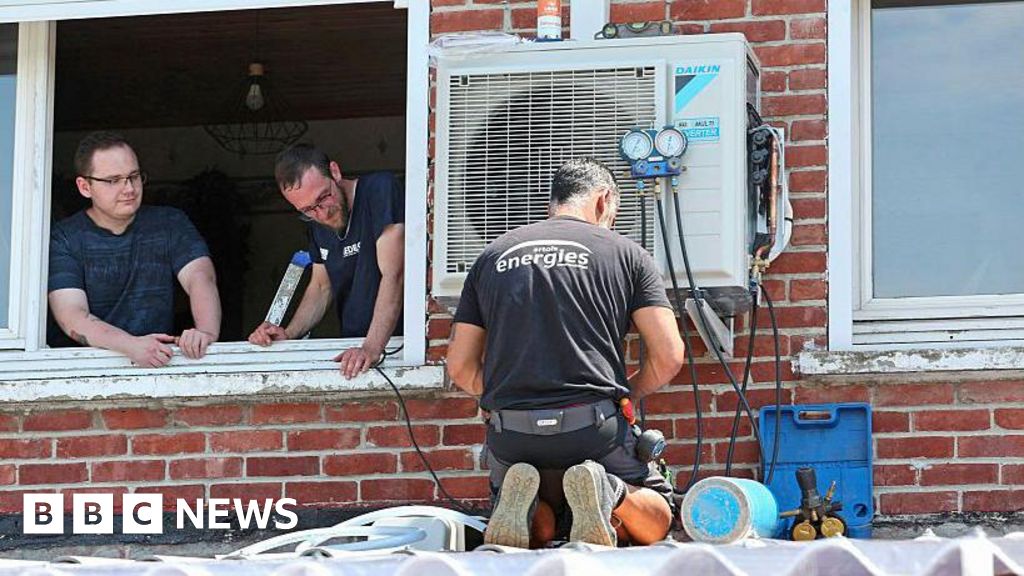
But with temperatures nudging 40C - Tuesday was France's hottest day on record - there has been a rush to buy portable air-conditioning appliances, just to let children enjoy a few hours in class, or for suffocating apartment-dwellers to make it through the night.
And more and more, it seems, long-standing opponents of air-conditioning - mainly on the environmentalist left - recognise that it is bound to be part of the country's response to global warming.
This week the head of the Ecologists party Marie Tondelier broke something of a taboo when she said that air-conditioning would be needed in schools and hospitals.
"There are places where we just can't do without it now," she said.
Her break with what she called "anti-clim dogma" is significant because until now the Green movement in France has regarded air-conditioning as the worst of solutions to climate change.
Temperatures have been approaching danger levels in France
Far from attacking the root causes of global-warming, activists said, recourse to la clim was merely attenuating the effects of global-warming.
And by making those effects more bearable, it distracted from the essential fight against the causes.
Not only that, but air-conditioning is often criticised by environmentalists for aggravating climate change.
This is because it requires electricity to run - and though most of France's electricity comes from nuclear power, elsewhere it means more fossil-fuels being burned.
There is also the question of the refrigerant gases used in air-conditioning, which are greenhouse gases and often leak.
And there is the urban heating effect, caused by the expulsion of hot air onto the street.
Arguments rage, but some studies suggest this can raise city temperatures by two or three degrees.
Suspicion of air-conditioning has also infiltrated government policy.
New building and renovation norms focus quite naturally on insulation, greenery and hi-tech methods for air-circulation - with the express aim of making air-conditioning unnecessary.
A giant new hospital being built in the Brittany city of Nantes for example will have air-conditioning in only half its rooms, provoking the wrath of medical trade unions.
"In the environmental context, we should have la clim everywhere," said Olivier Terrien of the CGT union.
According to Valerie Pécresse, the conservative president of the Paris regional council, "The state operates under an anti-clim ideology. But air-conditioning has got to be brought into the picture, along with other methods for creating cool."
Pécresse, who controls Paris regional transport, hopes to have all buses and trains equipped with aircon by 2032, and she castigates her Socialist predecessor for failing to see its importance.
The political right has always been more pro-clim than the left - and none more so than the National Rally (RN) of Marine Le Pen.
This week she has been calling for a nationwide "plan clim" to equip all schools and hospitals with air-conditioning.
According to RN spokesman Jean-Philippe Tanguy, the plan would also include government-backed interest-free loans worth €20bn ($22.7bn; £17.2bn) to allow 30 to 40 million householders to install cooling units.
Critics denounced the RN plan as opportunistic and uncosted. They say the populist right was the last to recognise the reality of climate change, so it has little credibility today when it talks about its effects.
But the truth is that with temperatures approaching danger levels in France, with lives at stake and schools and hospitals at risk of breakdown - everyone is coming to the same conclusion: that more clim is inevitable.
 www.bbc.com
This week debate about la clim (climatisation) has once again burst out, with Marine Le Pen on the populist right urging a mass subsidised roll-out and traditionally hostile Greens conceding that some air-conditioning may now be inevitable.
Currently the country has a low take-up, with only 25% of households equipped with an air-con unit. In Spain and Italy the figure is 50%, and in the US and Japan 90%.
French hospitals and schools are also only rarely equipped. Thousands of schools have had to shut this week, and medical and nursing staff complain of conditions fast becoming intolerable.
But with temperatures nudging 40C - Tuesday was France's hottest day on record - there has been a rush to buy portable air-conditioning appliances, just to let children enjoy a few hours in class, or for suffocating apartment-dwellers to make it through the night.
And more and more, it seems, long-standing opponents of air-conditioning - mainly on the environmentalist left - recognise that it is bound to be part of the country's response to global warming.
This week the head of the Ecologists party Marie Tondelier broke something of a taboo when she said that air-conditioning would be needed in schools and hospitals.
"There are places where we just can't do without it now," she said.
Her break with what she called "anti-clim dogma" is significant because until now the Green movement in France has regarded air-conditioning as the worst of solutions to climate change.
Temperatures have been approaching danger levels in France
Far from attacking the root causes of global-warming, activists said, recourse to la clim was merely attenuating the effects of global-warming.
And by making those effects more bearable, it distracted from the essential fight against the causes.
Not only that, but air-conditioning is often criticised by environmentalists for aggravating climate change.
This is because it requires electricity to run - and though most of France's electricity comes from nuclear power, elsewhere it means more fossil-fuels being burned.
There is also the question of the refrigerant gases used in air-conditioning, which are greenhouse gases and often leak.
And there is the urban heating effect, caused by the expulsion of hot air onto the street.
Arguments rage, but some studies suggest this can raise city temperatures by two or three degrees.
Suspicion of air-conditioning has also infiltrated government policy.
New building and renovation norms focus quite naturally on insulation, greenery and hi-tech methods for air-circulation - with the express aim of making air-conditioning unnecessary.
A giant new hospital being built in the Brittany city of Nantes for example will have air-conditioning in only half its rooms, provoking the wrath of medical trade unions.
"In the environmental context, we should have la clim everywhere," said Olivier Terrien of the CGT union.
According to Valerie Pécresse, the conservative president of the Paris regional council, "The state operates under an anti-clim ideology. But air-conditioning has got to be brought into the picture, along with other methods for creating cool."
Pécresse, who controls Paris regional transport, hopes to have all buses and trains equipped with aircon by 2032, and she castigates her Socialist predecessor for failing to see its importance.
The political right has always been more pro-clim than the left - and none more so than the National Rally (RN) of Marine Le Pen.
This week she has been calling for a nationwide "plan clim" to equip all schools and hospitals with air-conditioning.
According to RN spokesman Jean-Philippe Tanguy, the plan would also include government-backed interest-free loans worth €20bn ($22.7bn; £17.2bn) to allow 30 to 40 million householders to install cooling units.
Critics denounced the RN plan as opportunistic and uncosted. They say the populist right was the last to recognise the reality of climate change, so it has little credibility today when it talks about its effects.
But the truth is that with temperatures approaching danger levels in France, with lives at stake and schools and hospitals at risk of breakdown - everyone is coming to the same conclusion: that more clim is inevitable.
Europe heatwave: Air conditioning creates political divide as France records hottest day
France is being forced to re-think its longstanding reservations about air-conditioning as temperatures soar.
www.bbc.com
Last edited:


