Bangladesh News Bangladesh Economy & Development

Isa Khan

Experienced member
Moderator
Messages
7,677
Reactions
69 10,796
Nation of residence
Bangladesh
Nation of origin
Bangladesh
Shipping Adviser Brigadier General (retd) M Sakhawat Hussain inaugurated Nagarbari port on the bank of the Jamuna River at Bera upazila here today (8 November).

Addressing a function on the occasion he said the newly launched Nagarbari Port will boost country's economy through goods handling, generating employment and increasing revenue.

Sakhawat said the port will be operated by a private organisation, which will also arrange all necessary port management equipment.

He added that four dredgers will be deployed to ensure smooth river navigation and keep the river route operational.

The inaugural ceremony was chaired by BIWTA chairman Arif Ahmed Mustafa. Additional Secretary of the Shipping Ministry Delwora Begum was present among others.

Equipped with a 360-meter long concrete jetty, terminal, warehouses, open sheds, and other modern infrastructure, the new facility promises to make cargo unloading up to 10 times faster, officials said.

Local residents expressed optimism that the port will transform the region's socio-economic landscape, spurring trade and commerce across the northwestern and southern districts.

Md Khairuzzaman, port officer of the Nagarbari-Kazirhat-Noradah river ports, said the Nagarbari River Port will play a vital role in advancing the country's economy and improving connectivity.


A six-lane railway underpass at TT Para, near Kamalapur Railway Station in Dhaka, has opened today (8 November).

Lt Gen Abdul Hafiz, special assistant to the chief adviser (defence and national solidarity development) inaugurated the underpass this morning. Sheikh Moin Uddin, special assistant to the Chief Adviser, was also present.

Project Manager Brigadier General Ahmed Jamiul Islam said it is Dhaka's first railway underpass, built under the Padma Bridge Rail Link Project.

The underpass is 338 metres long and 31 metres wide, with four lanes for motorised vehicles, separate lanes for rickshaws and bicycles, and footpaths for pedestrians.

Officials said the underpass will ease traffic congestion and reduce delays at railway crossings on the road connecting Motijheel with Mugda, Manda, Maniknagar, and Sabujbagh, though its full benefits will be realised after the completion of the Kamalapur metro station.


Isa Khan

Experienced member
Moderator
Messages
7,677
Reactions
69 10,796
Nation of residence
Bangladesh
Nation of origin
Bangladesh
The Chittagong Port Authority (CPA) has signed a 30-year concession agreement with APM Terminals BV, a wholly-owned subsidiary of Denmark’s AP Møller, Maersk Group, to design, finance, build and operate the new Laldia Container Terminal (LCT) under a public-private partnership (PPP) framework.

The agreement includes potential extensions tied to performance indicators. Under the deal, CPA will retain ownership of the port, while Maersk and a local joint venture partner will manage construction, operations, and terminal management. Officials say this arrangement will significantly reduce the government’s capital expenditure burden.

APM Terminals, one of the world’s leading port operators with over 60 terminals in 33 countries, brings extensive experience from East and South Asia, including China, Singapore, Sri Lanka, Vietnam, and Malaysia. The Laldia project is expected to introduce world-class technology, global operational standards, and greener port infrastructure, preparing Bangladesh’s logistics sector for the post-LDC era.

Key highlights of the project
  • Foreign Direct Investment (FDI): The project is expected to attract around USD 550 million, marking the largest European equity investment in Bangladesh to date. Officials said Maersk’s entry is likely to encourage other international investors in logistics, manufacturing, and related sectors.
  • Expanded Capacity: The terminal will add over 800,000 TEUs per year, a 44% increase over current capacity, and is expected to be operational by 2030, helping ease congestion at existing Chattogram terminals.
  • Revenue Generation: Higher throughput will boost CPA’s earnings through revenue-sharing per TEU, taxes, and additional marine services.
  • Job Creation: Construction and operations are expected to generate 500–700 direct jobs and thousands of indirect jobs in trucking, warehousing, freight forwarding, and SMEs.
  • Technology Transfer & Workforce Training: Maersk will deploy advanced terminal-operating systems and train local engineers, technicians, and managers, building a skilled talent pool for Bangladesh’s logistics sector.
  • Efficiency & Trade Benefits: Faster vessel turnaround and improved container handling will reduce logistics costs, benefiting exporters in garments, agro-processing, and light engineering sectors.
  • Sustainability: Energy-efficient equipment and climate-resilient infrastructure will align with Bangladesh’s Paris Agreement commitments, supporting green and climate-smart investment.
  • Hinterland Development: Increased throughput is expected to attract private
investment in inland container depots, industrial parks, and cold chains, boosting economic activity beyond port cities.

PPP Confidence: The successful concession with a global operator demonstrates Bangladesh’s ability to structure and manage complex PPPs, paving the way for further investment in transport, energy, and social infrastructure.

Officials said the LCT terminal will become Bangladesh’s flagship green port, modernizing the country’s maritime logistics, creating jobs, and strengthening trade competitiveness.

https://www.dhakatribune.com/bangladesh/396250/maersk-to-develop-bangladesh’s-largest-green-port?fbclid=IwY2xjawOBpXBleHRuA2FlbQIxMABicmlkETExbUVEYVZFZFB5RUxjTDFTc3J0YwZhcHBfaWQQMjIyMDM5MTc4ODIwMDg5MgABHo9MSzuwMYW5SNduHVGxAlu0fuoJWHOaZyRAUQNXsIje74C3OyCltHOQJp9-_aem_6o1gIkaDWjgZSLkSHu0G_w
 

Isa Khan

Experienced member
Moderator
Messages
7,677
Reactions
69 10,796
Nation of residence
Bangladesh
Nation of origin
Bangladesh
Bogura Airport's renovated runway.

1763068821002.png

1763068875619.jpeg
 

Isa Khan

Experienced member
Moderator
Messages
7,677
Reactions
69 10,796
Nation of residence
Bangladesh
Nation of origin
Bangladesh
1763409775530.png


The government has finalised the process to appoint Switzerland-based logistics firm Medlog SA to manage and operate the Pangaon Inland Container Terminal in Keraniganj for 22 years.

An agreement is expected to be signed tomorrow between the Chittagong Port Authority (CPA) and the Swiss firm, a subsidiary of the global shipping line Mediterranean Shipping Company, CPA Secretary Md Omar Faruk said.

The CPA will also sign a 33-year agreement with APM Terminals BV, a Dutch subsidiary of the AP Moller-Maersk Group, to develop and operate the Laldia Container Terminal at Chattogram port under a public-private partnership framework, he added.

The CPA is signing these deals at a time when different organisations are opposing the government's plan to lease various terminals of Chattogram port to foreign companies.

The Pangaon terminal was built on the Buriganga River in 2013 by the CPA and the Bangladesh Inland Water Transport Authority to reduce cargo pressure on the Dhaka-Chattogram highway and rail corridors.

However, businesses have shown little interest in using the Pangaon terminal for containerised cargo to and from Chattogram port due to high inland water transport costs, lengthy customs clearance, and other challenges.

To ensure uninterrupted and cost-effective services, the shipping ministry decided in 2023, following the CPA board's approval, to appoint a terminal operator on a long-term basis through the Expression of Interest (EOI) system.

Accordingly, an invitation for EOI was issued on April 28, 2024, to appoint a terminal operator for 12 years at the Pangaon terminal.

Six firms purchased the pre-qualification documents, and by the submission deadline on September 5, 2024, three firms — Medlog SA, HR Lines Limited, and Saif Powertec Ltd — submitted pre-qualification proposals. These proposals were found substantially responsive by the pre-qualification evaluation committee formed by the shipping ministry.

In July this year, the CPA board decided to appoint a terminal operator for 22 years to attract long-term investment at Pangaon and obtained the ministry's approval.

Following the CPA board's decision, Request for Proposal (RFP) documents were issued on October 4 to the three firms deemed substantially responsive by the evaluation committee. By the RFP submission deadline on November 5, two firms — Medlog SA and HR Lines Limited — submitted their proposals.

According to sources at the CPA, at 12:30pm on the same day, the tender opening committee opened the submitted RFPs in the presence of the bidders' representatives.

A seven-member RFP evaluation committee, formed by the ministry and led by the CPA member (Harbour and Marine), completed the evaluation of the technical proposals the following day, November 6.

A CPA official, speaking on condition of anonymity, said the evaluation committee found that Medlog SA's technical offer scored 100 out of 100 points in six technical categories, including financial model, cargo handling equipment and performance specifications, emergency plan for fire, marketing plan, and financing plan.

Finding no issues with the technical offer, the committee declared Medlog SA's proposal responsive, the official said.

The other firm, HR Lines, scored 60 because it did not submit two of the six items in the technical scoring of its RFP and was declared unresponsive, he added.

The evaluation committee chief, CPA Member (Harbour and Marine) Commodore Ahamed Amin Abdullah, could not be reached for comment despite repeated calls.

LALDIA TERMINAL PROJECT

Under the concession agreement to be signed, APM Terminals will take about three years to complete the construction and commissioning of the Laldia Container Terminal in Chattogram and will operate it for 30 years. There is a possibility of a 15-year extension.

According to the agreement, APM Terminals BV is expected to bring in foreign direct investment of around USD 550 million, equivalent to about Tk 6,700 crore, for the construction of the greenfield port terminal at Laldia.


Isa Khan

Experienced member
Moderator
Messages
7,677
Reactions
69 10,796
Nation of residence
Bangladesh
Nation of origin
Bangladesh

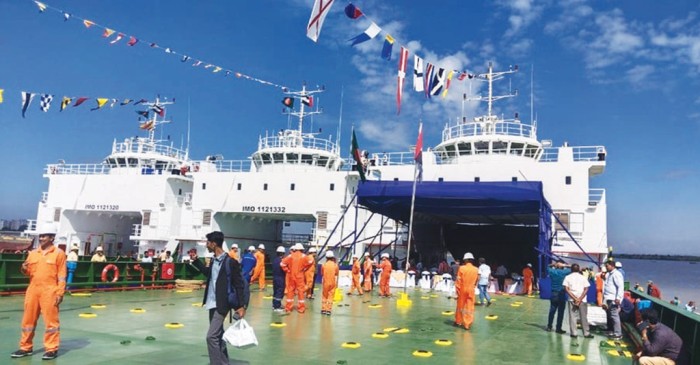
Western Marine Shipyard Limited on Thursday handed over three newly built landing craft vessels to Marwan Shipping Ltd of the United Arab Emirates, marking another step forward for Bangladesh’s growing export-oriented shipbuilding industry.

The vessels Maya, Emy and Muna were formally delivered at a ceremony held aboard the newly built landing craft Maya on the Karnaphuli River in Chattogram.

In 2023, Western Marine signed a contract with Marwan Shipping Ltd to construct eight vessels, including two tugboats, four landing craft and two tankers. With Thursday’s handover, the company has so far delivered four vessels under the agreement, following the earlier delivery of the landing craft Rayan in January and tugboats Khalid and Ghaya in July this year.

Speaking at the event, UAE ambassador to Bangladesh Abdullah Ali Abdullah Al Hamoudi said the commercial ties between the two companies would further strengthen the longstanding friendship between the two nations and he hoped more ships from Bangladesh would be exported to the UAE in the future.

Abdur Rahim Khan, Additional Secretary of the Ministry of Commerce and administrator of the Federation of Bangladesh Chambers of Commerce and Industry, said shipbuilding had added a new dimension to the country’s export basket as both the public and private sectors became increasingly engaged in the industry.

Western Marine’s steady record of exporting vessels over the recent years was contributing to the economy, employment generation and diplomatic relations with friendly countries, he added.

He also said that Bangladesh is among a very small number of countries capable of building such large vessels. The country would soon be able to export even bigger ships to the global market.

Marwan Shipping and Trading Company LLC managing director Ahmed Mohammed Hussein Al Marzouki, Chattogram Range DIG Ahsan Habib, officials from the Coast Guard and other agencies were also present at the ceremony.

The landing craft will be used to transport equipment for offshore energy operations, according to officials at the event.

Since its establishment, Western Marine Shipyard has exported 36 vessels to 11 countries, with a combined market value of $138 million.


Isa Khan

Experienced member
Moderator
Messages
7,677
Reactions
69 10,796
Nation of residence
Bangladesh
Nation of origin
Bangladesh
The Laldia container terminal is planned for construction near the mouth of the Karnaphuli River. Port specialists say that location alone could make Laldia the busiest terminal in Chattogram. The government expects it to handle 1 million TEUs a year, though several analysts believe actual volumes will be higher once operations begin.

The project has been presented as a 33-year public-private partnership. However, APM Terminals, a subsidiary of Denmark’s A.P. Moller - Maersk Group, will effectively enjoy 48 years of construction and operational control. Maersk already dominates global sea freight, and industry officials expect Laldia to capture a large share of Chattogram’s total container traffic once it comes online. Considering everything, the financial structure appears unusually favourable to APM Terminals.

After annual throughput crosses 900,000 TEUs, the port’s revenue on each additional container drops to only $10 per TEU. Analysts say that would allow APM Terminals to recover its investment within a decade. Despite these generous assurances, the Chattogram Port Authority (CPA) struggled to secure comparable financial or strategic terms during negotiations.

A review of key provisions in the non-disclosure agreement indicates that APM Terminals gains the greatest advantage from its shipping line-driven business model. The company brings its shipping line and containers to Chattogram and already commands the largest share of traffic there.

The deal effectively gives APM Terminals a guaranteed customer base, a benefit other operators in Bangladesh are unlikely to obtain. With operations scheduled to start by 2030, this assurance turns Laldia into a low-risk, high-return venture for the operator. Revenues for APM Terminals will rise as volumes grow. But the port authority will receive only limited formula-based earnings.

APM Terminals will become the second foreign company to run a terminal at a Bangladeshi seaport. Saudi Arabia’s Red Sea Gateway Terminals International (RSGTI) took over operations at the Patenga Container Terminal (PCT) in Chattogram in June 2024. The government has also signed an agreement for a foreign operator at Pangaon near Dhaka. That facility, however, functions primarily as a river terminal.

Bonik Barta’s review of these contracts shows a clear contrast in CPA’s negotiation outcomes between PCT and Laldia. At PCT, CPA maintained a strong position and established a win-win framework with RSGTI. But at Laldia, the Danish operator secured the more advantageous terms, both financially and strategically. Factoring in financial structure, payback timelines, market impact, and location, APM Terminals has ensured a dominant future market, leaving CPA comparatively weaker.

Currently, CPA earns $18 per TEU at Patenga. Government communications on Laldia projected $21 per TEU for up to 800,000 TEUs in the first slab, and $22 for 800,000–900,000 TEUs in the second. NDA analysis, however, reveals a third slab omitted from public campaign: once throughput exceeds 900,000 TEUs, CPA receives only $10 per additional TEU. Experts warn that given Laldia’s strategic location, growing ship traffic, and APM Terminals’ market control, this third slab is highly likely to come into effect, limiting the port authority’s long-term revenue.

APM Terminals also stands to gain indirectly. If it can operate direct container services to Europe and the U.S., terminal revenue will multiply. Ships under the Maersk line are expected to get priority berths at Laldia terminal, reducing idle time and avoiding daily compensation costs of $10,000–$15,000. Having a terminal of their own further consolidates Maersk’s operational advantage.

The government has repeatedly claimed that APM Terminals will build the Laldia terminal and operate it for 30 years, with the possibility of extending for another 15 years before handing full ownership to the state. The contract documents, however, tell a different story.

They specify a 48-year term for the Laldia Container Terminal, including three years for construction, 30 years for operation, and an additional 15-year extension. The contract explicitly states, “Fifteen years must be extendable.” By global standards, agreements with foreign operators usually run for 20–25 years. For comparison, CPA signed a 22-year contract with RSGTI for the Patenga terminal, allocating two years for construction and 20 years for operations.

According to consultants for both APM Terminals and CPA, the Laldia terminal’s 48-year term projects that the operator will recoup its investment just 11 years after commercial operations begin in 2030. By contrast, PCT’s 22-year contract had a projected payback period of 13 years. The payback period indicates how long an operator will take to recover its initial investment and start generating net profit.

Documents from the Ministry of Shipping show that CPA received an upfront fee of $20 million the same day it signed the PCT contract with RSGTI for the 32-acre site. The port administration even delayed the contract by four days to ensure receipt of the payment. In the 49-acre Greenfield project at Laldia, the PPP concession agreement with APM Terminals, signed on November 17, also sets an upfront fee of $20 million.

However, the fee has not yet been deposited into the port’s accounts. CPA states that although the contract was signed on November 17, it will take effect 90 days later. At that point, the port will receive 50 percent of the upfront fee, with the remaining 50 percent payable once operations begin. For comparison, MEDLOG SA paid BDT 180 million on the same day it signed its 22-year contract for the Pangaon river terminal.

The upfront fee functions as a concession payment, a one-time advance the investor provides at the start of the agreement in exchange for the right to operate the terminal.

Zafar Alam, a former CPA board member, told Bonik Barta, “Bringing an internationally recognised operator into Bangladesh’s port management is undoubtedly a positive and timely move. At the same time, it’s essential to ensure that every step, from the contract’s initiation to its activation, has been properly followed.

This prevents major legal complications from arising in the future. Negotiation is the most critical aspect of contract management. An experienced team first identifies risks, then develops strategies to mitigate them. A contract is signed only when both parties reach a genuine win-win position.”

Alam added, “One of the primary sources of financial gain for the port under this structure is the upfront money. This fee is a standard and highly important benchmark in concession models worldwide. It prevents delays or backtracking after signing and provides financial protection for the state from the outset.

There is no acceptable argument for not collecting it at the start. In the case of PCT, Saudi Arabia’s Red Sea Gateway Terminal paid a $20 million upfront fee on the day the contract was signed. The port immediately placed that money in a fixed deposit. The daily interest it earns form the deposit represents a significant financial benefit.”

While RSGTI’s concession included a fixed annual fee, this provision was bypassed in the case of APM Terminals. Port insiders consider the absence of an annual fee in this long-term contract unacceptable.

Both RSGTI and MEDLOG, two international operators, have assigned full responsibility to their local agents—RSGT Bangladesh and MEDLOG SA Bangladesh Limited, respectively—for all operations. Their parent companies guarantee any liabilities or compensation arising in Bangladesh. In contrast, APM Terminals has appointed QNS Limited as its local agent. APM Terminals will now form a company with local partner QNS.

But the allocation of liability and compensation within this joint framework remains unclear. Nurul Qayyum Khan, the owner of QNS Limited, is widely known in business circles for his close family ties to former Prime Minister Sheikh Hasina. He also reportedly maintains close familial links with one of the chief adviser’s special envoys.

Dr. Mustafizur Rahman, economist and distinguished fellow at the Centre for Policy Dialogue, told Bonik Barta, “We have demanded clarity on the clauses in the Laldia contract. It was essential to involve experts in such matters before signing. First, there are the financial terms of the agreement. Second, there is the question of when control would return to us. Excessive secrecy around these conditions raises doubts and concerns. Negotiations could have determined how long the terminal would remain under the operator’s control after construction.

But in reality, Laldia will stay with the operator for a prolonged period. We understand that APM Terminals will manage operations for 30 years. Now adding a 15-year extension effectively makes this a long-term contract. The process was rushed from the outset. The critical issues are ensuring the country receives a fair share of revenue and that national interests are safeguarded. Had domestic experts been involved from the beginning, the nation’s interests could have been protected while addressing the questions now emerging.”

Zonayed Saki, chief coordinator of the Ganosamhati Andolon, told Bonik Barta, “These contracts were concluded without proper consultation with political parties or other stakeholders. Entering into such agreements without discussion is unjustifiable. The secrecy surrounding them has raised public doubts about whether national interests were truly protected. Moreover, this process shows little accountability to the people of Bangladesh.”

CPA Secretary Mohammad Omar Faruk, however, said the port remains in a strong position under the APM Terminals agreement. Speaking to Bonik Barta, he said, “Laldia Container Terminal is a greenfield project. APM Terminals will manage every aspect from the start. That’s why I say negotiations and contract terms put us in a favourable position.

This is Bangladesh’s largest foreign direct investment from Europe, $550 million, and the government does not need to invest any capital. APM Terminals will handle all operations. The funds will arrive in phases. Once Laldia becomes operational, larger vessels can dock, turnaround times will shorten, and the international operator could even establish direct links to Europe.”


Launched in 2018 with big expectations but years of red ink, the country's first satellite, Bangladesh Satellite-1, posted its maiden profit in FY2024–25, and it did so by using only half of its capacity.

State-owned Bangladesh Satellite Company Limited (BSCL), which operates the satellite, reported a net profit of Tk38.35 crore for the just-ended fiscal year, reversing losses in every previous year. The board approved the audited accounts on 1 December.

The numbers show a company that is slowly finding its market. Revenue rose 9.24% year-on-year to Tk187.07 crore, driven mostly by bandwidth sales to television channels, radio stations, DTH operators, the armed forces, and both public and private agencies. Of the satellite's 40 transponders, 26 are now commercially active.

"We have taken several initiatives to sell the unused capacity at home and abroad," BSCL Managing Director and CEO Imadur Rahman told TBS.

Dedicated commercial teams have been formed, and investments made to improve service quality, he said, adding that cost management, skills upgrading and tighter operational discipline have also helped steady the company.

Even so, BSCL is utilising only 50% of its satellite capacity. "A satellite is considered successful when 80% of its capacity is used globally. Our target now is to raise utilisation to that level," Rahman said.

One potential boost is the company's new role as an authorised reseller of Starlink. If managed well, Rahman believes the partnership could strengthen BSCL's overall business.

The turnaround this year has come from multiple fronts. BSCL posted an operating profit of Tk2.61 crore for the first time, while income from FDRs and bank deposits pushed non-operating profit up 58% to Tk58.06 crore — a major driver of the bottom line. The company charges monthly fees for transponder and bandwidth usage, with prices varying by band and service type.

Beyond broadcasting, BSCL has been expanding into satellite-based data connectivity, maritime and aviation services, emergency communication, and customised solutions for government and private clients. Officials say this diversification is key to building a sustainable revenue base.

To strengthen long-term capacity, BSCL has stepped up collaboration with universities, research bodies and technology companies to develop skilled satellite engineers and space technologists.

Formed in 2017 under the Ministry of Posts and Telecommunications, BSCL began full-scale commercial operations after the launch of the satellite in 2018.

Its next ambition is already on the horizon: the government is assessing the feasibility of Bangladesh Satellite-2, which could support advanced applications in weather forecasting, agriculture, disaster management, remote sensing and national security.


Isa Khan

Experienced member
Moderator
Messages
7,677
Reactions
69 10,796
Nation of residence
Bangladesh
Nation of origin
Bangladesh
1765807110781.png

Bangladesh took a step towards its first privately led submarine cable project yesterday as the Bangladesh Private Cable System (BPCS) Consortium signed an agreement with Nokia to supply Submarine Line Terminal Equipment (SLTE).

The deal was signed at a ceremony held at a hotel in Dhaka, a development industry insiders described as a milestone for private-sector involvement in the country's international connectivity infrastructure.

On behalf of the BPCS Consortium, the agreement was signed by Aminul Hakim, chief executive officer of Metacore Subcom Limited; Arif Al Islam, managing director and chief executive of Summit Communications Limited; and Md Mashiur Rahman, chief executive of CdnNet Communications Limited. Nokia was represented by Prashant Malkani, head of sales unit at Nokia India, and Suman Prasad, senior sales account director at the company.

Senior Nokia officials, including Jibitesh Nayal, head of emerging business, Rahul Derwani, marketing manager, Mohammad R Islam, account manager, and Christopher Samuel, head of sales at Nokia Bangladesh, were also present.

Several foreign diplomats attended the event, including European Union Ambassador Michael Miller, Finnish diplomat to India Antti Herlevi, and representatives from the Japanese Embassy, highlighting the project's international importance.

Speaking at the event, consortium officials said Bangladesh's current bandwidth consumption stands at around 9,000 gigabits per second (Gbps). Demand is expected to rise sharply to nearly 20,000 Gbps by mid-2027 and to about 50,000 Gbps by 2030, increasing the need for private investment in submarine cable infrastructure.

The consortium has already invested around Tk600 crore in the project and plans to spend a further Tk1,200 to Tk1,300 crore to launch three cable pairs after June 2026.

At present, more than 60% of Bangladesh's bandwidth is sourced from India through international terrestrial cables, leading to a significant outflow of foreign currency. The planned Singapore-Cox's Bazar route, with three cable pairs, is expected to reduce this dependence and move the country closer to bandwidth self-sufficiency.

Officials said Nokia's SLTE technology would allow lower power consumption, reduce space requirements in data centres and improve network management, helping to cut operational costs. Using Nokia equipment at both cable landing stations is also expected to ensure a high level of cyber security.

They added that these efficiencies could bring long-term benefits for consumers, including more affordable internet services as capacity increases and costs fall.


The Patenga Container Terminal at Chattogram Port has enhanced its container handling capabilities with the addition of 14 new Rubber-Tyred Gantry (RTG) cranes to improve container handling speed and overall operational efficiency at the terminal.

The cranes, manufactured by the Chinese company GENMA, arrived in October. Following the completion of their commissioning, they were formally handed over this morning (15 December) to the terminal's Saudi operator, Red Sea Gateway Terminal International (RSGTI).

The handover ceremony was attended by key officials, including the newly appointed Chattogram Port Authority Member (Engineering) Commodore Mazharul Islam Jewel, Bay Terminal Project Director Commodore Mahfuzur Rahman, RSGTI Chattogram Chief Operating Officer Any Lane, and GENMA Solutions General Manager Susan Zha.

Zha officially presented the cranes by giving a replica key to RSGTI COO Lane.

The terminal, operated by RSGTI under a 22-year concession agreement since June last year, has recently shown steady growth in container handling after months of underperformance.

A turning point came in May 2025 with RSGTI's $3 million investment to install an import container scanner at its own expense, a piece of equipment the National Board of Revenue had long failed to provide.

Between May and October, the terminal handled 108,228 TEUs, accounting for nearly two-thirds of the total cargo handled during its initial 16 months of operation.

Monthly cargo volume reached a record high of 25,018 TEUs in October, rebounding from a dip in September (17,337 TEUs). The growth is also evident in increased vessel arrivals, with seven vessels berthing in August alone.

Despite these gains, the terminal is still operating well below its design capacity; utilisation reached only 49% in October compared to its theoretical monthly capacity of 41,700 TEUs.

Port officials and RSGTI attribute this gradual scale-up to the standard development phase outlined in the concession agreement and the ongoing installation of equipment.

Additionally, Commodore Mahfuzur Rahman praised RSGTI's performance over the last one and a half years, noting, "Despite operating within a limited scope, the structured and automated manner in which they are running the terminal is commendable and instructive for us."

He reiterated the CPA's goal of upgrading Chattogram Port to international standards and expressed confidence that RSGTI would continue to enhance port capacity while maintaining global operational benchmarks.

RSGTI Head of Commercial and Public Affairs Syed Aref Sarwar confirmed that the 14 RTGs will further accelerate terminal operations.

"Once four gantry cranes are added by the end of May next year, we expect to reach full operational capacity," he said.


Square Pharmaceuticals has achieved a significant overseas milestone as its Kenya-based subsidiary reported an operating profit for the first time, less than two years after starting commercial production.

The turnaround at Square Pharmaceuticals Kenya EPZ Limited underscores the Bangladeshi drug maker's growing manufacturing and market footprint in East Africa, a region seen as one of the fastest-expanding pharmaceutical markets on the continent.

According to the audited financial statements for the year ended 30 June 2025, the Kenya unit posted an operating profit of Tk10.20 crore and a net profit of Tk10.21 crore.

This marked the first instance of sustained profitability driven by core operations, rather than foreign exchange gains. In FY23, the subsidiary's marginal profit was largely attributable to exchange-rate movements, while its operating performance remained deeply negative.

Revenue growth played a central role in the turnaround. Sales surged to Tk74.47 crore in FY25 from Tk27.38 crore a year earlier, reflecting a 172% year-on-year increase in local currency terms as the company gained traction in the Kenyan market.

Improved market penetration, higher capacity utilisation and tighter cost controls helped turn the gross margin positive, enabling the plant to cross the operational breakeven point, said the company in the annual report.

In its audit report, Square Pharmaceuticals said the board was "pleased to report" that the Kenya factory had achieved net profit after tax for the first time, describing the achievement as a "validation of the company's execution strategy".

The management noted that reaching profitability within just one and a half years of operation highlights the efficiency of the manufacturing setup and the strength of demand for its products in the region.

FY25 also marked another milestone for the subsidiary as it recorded its first export shipment from the Kenyan plant. Although the initial export value was modest at around Tk0.55 crore, the company said it signals the beginning of a broader regional export drive and positions the unit to benefit from cross-border trade within the East African Community.

Despite the return to profitability, the directors did not recommend any dividend for the year, opting instead to focus on recovering accumulated losses and preserving capital for future expansion.

Square Pharmaceuticals Kenya EPZ Limited was incorporated in June 2017 and operates a state-of-the-art manufacturing facility at Athi River EPZ in Machakos County.

The plant began commercial operations in January 2023, with products reaching the market from March that year. Square Pharmaceuticals PLC holds 100% ownership of the subsidiary.

Kenya's pharmaceutical market was valued at nearly $1 billion in 2024 and is projected to grow to $1.6 billion by 2031, driven by rising healthcare demand and policy support for local manufacturing.


Follow us on social media

Top Bottom