Pakistan Pakistan Emerges as Global Trade Hub as Hormuz Crisis Reroutes Shipping

Satan

Member
Messages
19
Reactions
1 9
Nation of residence
France
Nation of origin
Netherlands
1775254166319.jpeg


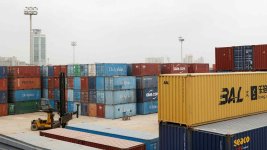
Karachi Port processed 8,313 containers in just 24 days this March — matching its entire 2025 annual volume in less than a month. That is not a rounding error. It is a 1,423% surge that tells you everything about where global trade is heading when the world’s most critical maritime chokepoint goes dark. Pakistan is emerging as a critical node in the new trade architecture forced into existence by the Strait of Hormuz crisis, and the speed of this shift has caught even seasoned logistics operators off guard. With containers stacking up at South Asia Pakistan Terminal, Hutchison Port, and Karachi Gateway Terminal, the question is no longer whether Pakistan benefits from the disruption — it is whether the country can scale fast enough to make this a permanent structural advantage.

Record Surge at Karachi Port — 24 Days Equal a Full Year

The numbers deserve a second look because they are genuinely unprecedented. In the full year of 2025, Karachi Port processed approximately 8,300 TEUs of transshipment cargo. In just the first 24 days of March 2026, that figure was exceeded — 8,313 containers were handled, representing a 1,423% increase compared to the prior year’s total. Karachi Port received 8,000 containers and dispatched 3,500, with 4,500 remaining in the port balance.

To put that in perspective: that is like a regional airport suddenly handling Heathrow-level traffic overnight. The infrastructure was not built for this pace. And yet, it is absorbing it — which tells you something about what $62 billion in CPEC investment actually bought.


Attachments

  • 1775254043795.jpeg
    1775254043795.jpeg
    90.4 KB · Views: 3

Satan

Member
Messages
19
Reactions
1 9
Nation of residence
France
Nation of origin
Netherlands
1775254240610.jpeg

Photograph of the deepwater container terminal in Keamari, Karachi. — Karachi Port Trust

ISLAMABAD: With the implementation of facilitation measures, long queues of container ships have begun forming at Karachi ports as global shipping lines divert vessels to Pakistan, seeking safer routes amid increased risks in the Strait of Hormuz due to the ongoing Middle East conflict.

The government has also established specialised sub-committees to recommend structural reforms in the maritime and logistics sectors. It has already reduced port charges to boost competitiveness, sped up the clearance of long-pending cargo, and implemented targeted policy measures to support transhipment activity.

Industry officials said the diversion has triggered an unprecedented surge in transhipment activity at Karachi ports, positioning Pakistan as an emerging alternative hub outside vulnerable maritime chokepoints.

Official data showed transhipment volumes at Karachi port reached 8,860 containers in just the last 24 days, while comparing with the annual volume of 8,300 containers in 2025. This clearly shows a sharp acceleration in cargo rerouting.

Industry sources said the potential of Gwadar and Karachi as transhipment ports for GCC countries and beyond, particularly during periods of crisis, is now being tested. Both ports, located outside narrow and vulnerable maritime chokepoints, offer significant opportunities for regional trade in petroleum products and LPG.

Shipping companies are increasingly opting for Karachi to avoid the security and insurance risks associated with routes passing through the Gulf, where rising tensions have heightened concerns over vessel safety and potential disruptions to supply chains.

Patron-in-Chief, Pakistan Textile Exporters Association (PTEA), Khurram Mukhtar, said in the backdrop of evolving global trade dynamics, Pakistan is emerging as a safe, stable, and increasingly attractive destination for international trade, investment, and transhipment activity.

The PTEA has proposed the establishment of a Centralised Monitoring & Response Unit to monitor import and export cargo flows through the Pakistan Single Window. This unit should function as a real-time control tower to identify bottlenecks across ports, terminals, shipping lines, and transhipment hubs. It should proactively coordinate with all stakeholders for swift resolution, ensuring uninterrupted cargo movement and minimizing systemic inefficiencies.

It was proposed that a comprehensive service level benchmark should be defined across the maritime trade chain, covering ports, terminal operators, shipping lines, and allied service providers. These standards must be aligned with international best practices to ensure predictability, reduce dwell time, and enhance Pakistan’s competitiveness in global trade.

The association demands that advance manifest filing be made mandatory for all shipping lines to enhance planning, transparency, and operational efficiency.

Published in Dawn, March 28th, 2026
 

Satan

Member
Messages
19
Reactions
1 9
Nation of residence
France
Nation of origin
Netherlands
Ports that are mostly affected by the war.

United Arab Emirates (The Primary Hub)

The UAE is the undisputed maritime leader of the region.

Jebel Ali Port (Dubai): This is the largest and busiest port in the Middle East and ranks among the top 10 globally. It serves as the main "transshipment" hub, meaning cargo is dropped here by giant vessels and then moved onto smaller ships to reach other ports in the Gulf, East Africa, and India.

Khalifa Port (Abu Dhabi): A major deep-water port that has seen massive investment and automation, handling significant container and industrial traffic.

Saudi Arabia (The Dual-Coast Giant)

Saudi Arabia is unique because it has major ports on both the Red Sea and the Persian Gulf.

Jeddah Islamic Port (Red Sea): Historically the most important port for the Kingdom, handling over 50% of its container traffic. It is a critical stop for ships traveling through the Suez Canal.

King Abdullah Port (Red Sea): A newer, highly efficient private port that handles massive container volumes.

King Abdulaziz Port (Dammam - Persian Gulf): The main gateway for the Kingdom’s oil-rich Eastern Province and the capital, Riyadh.

Oman (The Strategic "Outside" Gateway)

Oman’s ports are highly valued because they are located outside the Strait of Hormuz, allowing ships to avoid the narrow chokepoint.

Port of Salalah: A massive transshipment hub on the Arabian Sea, often used by vessels to bypass the Gulf entirely.

Port of Sohar: A major industrial and container port located near the entrance of the Gulf.

Port of Duqm: A rapidly growing multi-purpose port being developed as a major global logistics and repair hub.

Qatar, Kuwait, and Bahrain (Regional Gateways)

These countries primarily host "gateway" ports that serve their local economies rather than acting as global transshipment hubs.

Hamad Port (Qatar): One of the newest and most modern ports in the region, designed to give Qatar direct access to global shipping lines.

Shuaiba and Shuwaikh Ports (Kuwait): The primary entry points for Kuwait’s industrial and consumer goods.

Khalifa Bin Salman Port (Bahrain): A key regional port that handles Bahrain's maritime trade and serves as a northern Gulf logistics point.
 
Last edited:

Satan

Member
Messages
19
Reactions
1 9
Nation of residence
France
Nation of origin
Netherlands
The "Blocked" Ports (Inside the Gulf)

Vessels are currently avoiding these ports because they require passing through the Strait of Hormuz, where insurance has been canceled and the risk of missile or drone strikes is critical.

Jebel Ali (Dubai, UAE): Operations were temporarily suspended in early March following aerial threats and a fire. Most shipping lines (Maersk, MSC, Hapag-Lloyd) have suspended bookings here.

Hamad Port (Qatar): Currently only handling import cargo that was already at the port. New export bookings are suspended, and QatarEnergy has declared force majeure on some LNG shipments.

Khalifa Bin Salman Port (Bahrain): Operations were suspended indefinitely in mid-March after a US-flagged tanker was struck at the berth.

Shuwaikh & Shuaiba (Kuwait): Operating under high security (Level 2), but restricted only to vessels already in port; no new international bookings are being accepted.

King Abdulaziz Port (Dammam, Saudi Arabia): Operations are largely suspended for international traffic; the port is currently only handling domestic calls.

Why this explains the surge in Pakistan

Since the Omani ports (Salalah/Sohar) and Saudi ports (Jeddah) are at a breaking point, shipping companies are pushing further east to Karachi and Gwadar to drop off cargo. From there, they hope to use smaller "feeder" vessels or wait for a security corridor to open up.
 

Satan

Member
Messages
19
Reactions
1 9
Nation of residence
France
Nation of origin
Netherlands
Pakistan ports near annual transshipment in just 24 days

March 27, 2026 (MLN): In a significant economic development, Pakistan is rapidly emerging as a preferred global transshipment hub. A record-breaking surge in transshipment activities at Karachi Port, Port Qasim, and Gwadar Port signals a transformative shift in the region's trade landscape.

In just 24 days, Karachi Port handled a staggering volume of transshipment cargo. This remarkable achievement nearly matches the total transshipment volume handled during the entire previous year.

In an exclusive interview with a local media channel, economic experts Nasir Hussain Shah Bukhari and Abid Qayyum Suleri stated that the surge reflects shifting global dynamics alongside Pakistan’s targeted policy measures.

The government's decision to provide flexibility in international transshipment rules and allow cargo blending at sea and air ports has played a crucial role in attracting international trade.

Experts emphasized the strategic importance of Pakistan’s geographical location, noting that the country serves as a natural gateway connecting the Gulf, China, and Central Asia.

They emphasized that this advantage is increasingly being leveraged as a key strategic asset amid evolving global trade dynamics.

To sustain the current momentum, the experts highlighted the urgent need to address structural gaps, particularly in rail freight connectivity, while accelerating the digitization of customs processes and further strengthening the regulatory framework to improve efficiency and transparency.

They also pointed out that the development of Special Economic Zones (SEZs), along with modern warehouse facilities and cold chain infrastructure, will play a crucial role in transforming Pakistan into a comprehensive multimodal logistics hub capable of supporting regional and global trade flows.

Moreover, the rising activity at Pakistani ports is contributing to a more positive global perception, positioning the country as a safe, stable, and increasingly attractive destination for international investment and trade.

While Karachi remains the present heart of Pakistan’s trade, Gwadar is being hailed as the future of the country’s logistics strategy.

The integration of Gwadar into the transshipment network is expected to unlock further opportunities for foreign exchange and economic stability.

As global shipping routes continue to evolve, Pakistan is well-positioned to become a permanent fixture in the international trade corridors, transitioning from "geography as destiny" to "geography as strategy."

 
Top Bottom