I appreciate Mr. Gasco and Mr. Schiavi for stating and detailing the obvious already known in these parts.
“
And that raises the question Europe still prefers not to ask. Not whether to engage Turkey in defense. That decision is already being made in practice. The real question is whether Europe is willing to give that engagement a strategic and political framework equal to what it has already become.”

Italy’s TB3 move signals a deeper shift in naval warfare, defence industrial integration, and Europe’s security debate

gasco66.substack.com
Italy’s Turkish Turn — and Europe’s Unspoken Defence Shift
Italy’s TB3 move signals a deeper shift in naval warfare, defence industrial integration, and Europe’s security debate
RICCARDO GASCO AND
FRANCESCO SALESIO SCHIAVI
APR 09, 2026
On March 25, 2026, Italy’s Chief of the Navy Vice Admiral Berutti Bergotto
announcedthat the Italian Navy intends to procure Baykar’s Bayraktar TB3 unmanned aerial vehicle for operations aboard the aircraft carrier Cavour. The announcement was brief, almost technical. Its implications are anything but.
This is not the first time a European country has bought Turkish drones. Poland, Albania, and others have
acquired the Bayraktar TB2, Baykar’s older and more famous platform. But the Italian case is structurally different, and understanding why requires looking beyond the hardware — and beyond the headlines.
A joint venture, not a purchase order
The vehicle for the TB3 acquisition is LBA Systems, a
50-50 joint venture between Leonardo and Baykar formalised in June 2025. Under this arrangement, Baykar’s full drone portfolio — the TB2, TB3, Akinci, and the jet-powered Kizilelma — will be manufactured at three sites across Italy: Grottaglie in the southeast, Ronchi dei Legionari in the northeast, and Villanova d’Albenga in the northwest. Leonardo contributes European certification pathways, mission systems integration, radar technology, and access to EU export markets. Baykar brings combat-tested platforms developed quickly, at scale, and at a cost that few Western competitors can match.
That is the key distinction. When the Italian Navy procures the TB3, it won’t be importing a foreign product. It will be buying something partly made at home, by a company in which one of Italy’s most strategically important industrial groups holds an equal stake. That distinction matters enormously, both industrially and politically.
Leonardo’s own
Industrial Plan, presented in Rome in March 2026, makes this explicit: LBA Systems is listed as one of four core drivers for Aeronautics order growth through 2030, with projected revenues in that segment rising from €3.6 billion to €5.5 billion. Unmanned systems now sit in the same product portfolio as the Eurofighter and the next-generation GCAP combat aircraft. Baykar is not a supplier. It is a structural partner embedded in the financial architecture of one of Europe’s largest defence contractors.
That shifts the nature of the relationship. The relevant question is no longer whether Europe is willing to buy Turkish systems. It is whether Europe is prepared to recognise that parts of its future airpower ecosystem may now be co-produced with Turkey.
2025 Leonardo Industrial Plan
The TB3 and the changing logic of carrier power
The
Bayraktar TB3 was designed from the outset for short-deck carrier operations. It combines folding wings for easier storage, reinforced landing gear for maritime use, autonomous take-off and landing, satellite communications for beyond-line-of-sight missions, endurance of up to 24 hours, and a payload of up to 280 kilograms. It has already completed flight operations from Turkey’s TCG Anadolu. Italy’s Cavour is the next logical step.
Yet the importance of the TB3 lies less in its specifications than in what it allows the Italian Navy to do.
For Rome, embarking a carrier-capable drone is not simply a technological add-on. It answers a real operational need. The Italian Navy is moving toward a more flexible, layered air wing, in which unmanned systems can expand surveillance, targeting, persistence, and light-strike capacity without imposing the costs, constraints, and risks of manned aviation. In practice, the TB3 is expected to complement — and partly replace — the helicopter component of the Cavour’s air wing, rather than compete with the F-35B. That is an important distinction. The drone does not displace high-end naval aviation; it makes the carrier more usable across a wider spectrum of missions.
This matters because the maritime threat environment is changing faster than many European navies have been willing to admit. Large-deck capital ships remain formidable instruments of sea-based power projection. But they are also increasingly
exposed. The spread of anti-ship ballistic missiles, long-range precision strike systems, loitering munitions, and more capable reconnaissance-strike complexes has altered the risk calculus around concentrated naval power. In the Middle East, Iran’s investments in systems such as Khalij Fars, Hormuz-1, Hormuz-2, and Zolfaqar Basir are only one part of a
larger pattern. Across contested theatres, large surface combatants are becoming more trackable, more targetable, and potentially more vulnerable.
[RG1]
The March 2026
fire aboard the USS Gerald R. Ford did not create this debate, but it added urgency to it. The issue is not whether aircraft carriers are obsolete. They are not. The issue is that the composition of carrier air power is changing alongside the threat.
This is where platforms like the TB3 enter the picture. They offer persistence rather than speed, distribution rather than concentration, and lower-cost operational mass rather than exquisite performance. They do not replace fifth-generation fighters. They give medium naval powers a more sustainable way to maintain airborne presence, conduct ISR, support maritime strike chains, and operate in grey-zone or medium-intensity environments without committing their most expensive assets to every mission.
That, in turn, points to a broader transformation in naval warfare. For decades, credible carrier aviation remained the preserve of a very small group of major naval powers, because operating large-deck carriers and manned air wings required extraordinary financial, doctrinal, and industrial depth. That threshold is now lowering. The convergence of smaller carriers and more capable unmanned systems is creating a different model of sea-based airpower — one more accessible to medium powers and more adaptable to specific theaters.
This is not a supercarrier model in miniature. It is a different operational logic altogether. Smaller decks equipped with UAVs and, eventually, UCAVs offer distributed and scalable airpower at lower cost and with a different risk profile. In that sense, the TB3 is not just a new platform for Cavour. It is part of a wider redefinition of what carrier aviation can look like in the hands of second-tier but ambitious naval powers.
Italy is not the only country exploring this space
[FS2] . The
United Kingdom and
Japan, both operators of short-deck carriers and both GCAP partners, are also natural candidates for similar solutions
[RG3] . Baykar has already engaged both. The Italian move, then, may be less an isolated choice than the beginning of a wider trend.
From naval drones to collaborative combat
If the TB3 points to the future of carrier aviation, the M-346–Kizilelma pairing points to something even more consequential: Italy’s entry into manned-unmanned teaming, or MUM-T.
Leonardo has
announced that by mid-2026 it will conduct a flight demonstration in which an M-346 will control two Baykar-built unmanned combat aircraft. This will be the first such demonstration for Italy and one of the earliest of its kind in the world outside a very limited group of countries. Over the past year, only a handful of actors — including the United States, Australia, and Turkey — have moved from concept discussions to meaningful demonstrations of collaborative combat models involving crewed aircraft and high-performance drones.
That alone would make the Italian test notable. But its significance lies in the fact that Leonardo is not proposing a distant, post-GCAP concept. It is attempting to build a usable architecture now, with aircraft already in or near service and with an industrial base already being assembled on Italian soil.
The choice of the M-346 is revealing. In its fighter-attack configuration, it is not just an advanced trainer but a flexible light combat aircraft with enough connectivity, mission management capacity, and operational relevance to serve as a credible “mother aircraft.” Its tandem-seat arrangement is especially useful in this role, because it allows one crew member to focus on piloting and tactical flying while the other manages unmanned teammates and mission coordination.
But the M-346 may matter for another reason too. Over time, it may not only serve as the crewed controller of adjunct drones; it could itself evolve into a lower-cost collaborative combat asset within broader teamed architectures. In other words, it could become not just the bridge to future CCAs, but part of that ecosystem in its own right — especially for air forces that cannot afford to structure all their teaming concepts around premium stealth platforms alone.
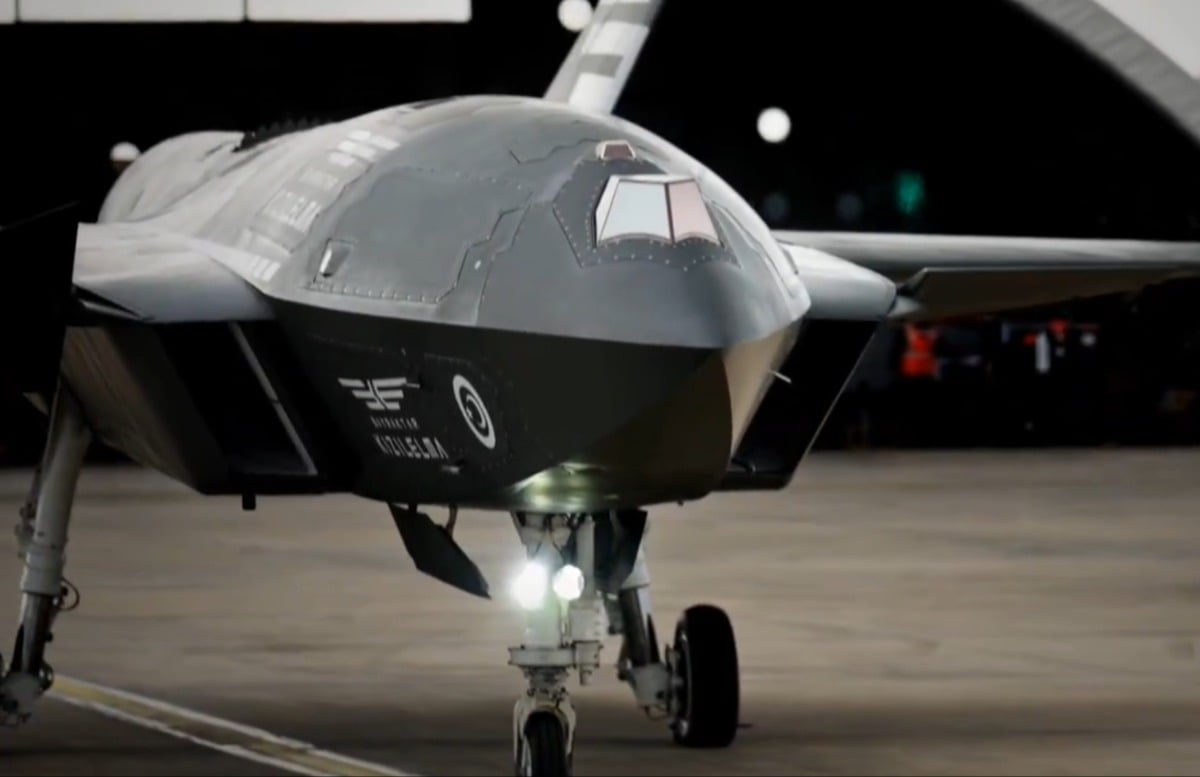
The unmanned half of this equation is Kizilelma. And Kizilelma is not simply another MALE drone with a more aggressive design. It is a jet-powered combat UAV that has been moving with notable speed from prototype status toward a more credible strike and counter-air role.
Over the past months, Baykar has announced a series of developments that are strategically relevant. In October 2025,
Kizilelma achieved direct hits in its first live-fire tests using TOLUN and TEBER-82 precision-guided munitions, marking its progression into the precision-strike domain. By late 2025, the platform had also advanced into air-to-air testing. According to Baykar’s own reporting,
Kizilelma detected a target through ASELSAN’s MURAD AESA radar and fired a GÖKDOĞAN beyond-visual-range missile, while an earlier November test involved locking onto an F-16 and scoring a direct hit in simulated fire. Follow-on reporting has also pointed to LGK-82 integration, widening the platform’s menu of guided strike options.
Taken together, the public record suggests a platform being prepared not merely for reconnaissance, decoy, or secondary strike functions, but for real combat tasks in increasingly contested environments. That is precisely why the M-346–Kizilelma demonstration matters. Leonardo is not pairing a pilot with a disposable drone. It is exploring a relationship between a crewed aircraft and a combat-capable unmanned wingman.
MUM-T in action: how a manned MB-346 and the unmanned Kızılelma work together in a simulated strike mission — from pre-mission sync to target engagement. The pilot authorises; the UCAV executes. One crew, two platforms, multiplied reach.
For now, the most obvious long-term reference point is
GCAP. Loyal wingman concepts and collaborative combat aircraft are already central to how sixth-generation airpower is being imagined. The M-346–Kizilelma test, therefore, serves as an early operational and industrial stepping stone toward that future. But it would be a mistake to see the concept as relevant only to GCAP.
In reality, an architecture of this kind could also be integrated far earlier with existing fleets. F-35s and Typhoons are both plausible future teammates for adjunct systems of this kind, especially if the goal is to extend sensor reach, distribute risk, or generate mass in contested environments. Here, Turkey’s own experience is relevant: Kizilelma’s interactions with Turkish F-16s already suggest a path toward mixed crewed-uncrewed operations built around legacy and next-generation fighters alike. The broader lesson is that collaborative combat is not something that begins only once sixth-generation aircraft arrive. It can start with the fleets Europe already has.
Operationally, this opens a wide set of possibilities. A crewed aircraft could remain further from the densest threat zone while unmanned teammates move forward for ISR, stand-in strike, decoy functions, suppression support, or battle damage assessment. In an air-defense role, they could widen radar and missile coverage. In a maritime scenario, they could support targeting chains and distributed surveillance. In each case, the
aim is the same: to increase combat mass and flexibility without multiplying the cost of manned fleets.
[RG4]
This is also where the LBA Systems partnership takes on a different meaning. The same industrial structure that supports TB3 production for naval use is also laying the basis for a European-certified, Italian-based route into collaborative combat aviation. The naval drone and the loyal wingman are not separate stories. They are part of the same underlying shift.
The blind spot in Europe’s defence debate
Europe’s defence debate in 2026 is full of the right vocabulary: rearmament, strategic autonomy, resilience, reduced dependence on the United States, faster procurement and stronger industrial capacity. But it continues to avoid one increasingly obvious fact.
The relationship between parts of the European defence industry and Baykar is
no longer hypothetical, occasional, or politically marginal. It is structural. It is already reflected in industrial plans, production facilities, naval procurement decisions, and future air-combat experiments involving one of NATO Europe’s most important defence companies.
What is still missing is an honest political framework for understanding what that means.
The European Union has no real mechanism for addressing a relationship of this kind. There is no serious common framework for evaluating what deeper integration with the Turkish defence industry means for technology transfer, certification, export controls, operational dependence, interoperability standards, or, more broadly, Turkey’s place within European security architecture. And yet the integration is moving forward anyway — platform by platform, site by site, venture by venture.
That is the real contradiction.
Turkey remains outside the EU, its accession path frozen and its relationship with several member states politically fraught. Yet at the industrial and military level, a quieter form of integration is accelerating.
At some point, that gap between political ambiguity and military-industrial reality will become too large to ignore. When Italian sailors operate Turkish-designed drones from an Italian aircraft carrier, when those systems are maintained and upgraded in Italy, when their sensors, data links, and mission systems are co-developed with Leonardo, and when the same industrial partnership begins to shape Europe’s first experiments in collaborative combat aviation, the relationship changes in kind. It is no longer a transaction. It is the beginning of a strategic interdependence.
And that raises the question Europe still prefers not to ask. Not whether to engage Turkey in defense. That decision is already being made in practice. The real question is whether Europe is willing to give that engagement a strategic and political framework equal to what it has already become.



 Mavi Vatan Tatbikatı Prova Uçuşu