

TEI exported a sizable lot of engines.

You are using an out of date browser. It may not display this or other websites correctly.
You should upgrade or use an alternative browser.
You should upgrade or use an alternative browser.
TR Propulsion Systems
- Thread starter Combat-Master
- Start date


One thing we mustn’t overlook is the 56 piece order of Gokbey Navy has placed with Tusas. That means 120+ engines that are navalised as well as the helicopter it self. Also TS-1400 needs to be of military spec. Do we know if these parameters have been met.According to the statements, we can say that the qualification for the TS1400 has been completed and customer requirements have been met. Regarding certification: First Stage is Design Verification. Theoretically proving that the engine's design and engineering calculations comply with civil aviation standards (EASA CS-E). Second Stage: Organizational Competence. Confirmation that the manufacturer (TEI) has the infrastructure and quality system to produce this engine with consistent quality every time.
Third Stage: Final Testing and Qualification. Proving that the engine, whose design and structure have been approved, has passed critical tests such as icing, bird strike, and 150-hour endurance tests in the presence of international auditors. At the end of this stage, the EASA CS-E airworthiness approval, civil passenger transport authorization, and the 'Type Certificate' critical for export are obtained.
In summary, the TS1400 is technically and militarily ready for duty, presumably. However, the international certification process for civilian tests focused on human life (and which could create export barriers) is ongoing. The timeline for the final, type certification might not be solely in TEI's hands. I don't want to speculate, but with the TS1400, TEI entering an important league that will be sharing the market with some traditional suppliers.
Last edited:


I can understand and i think it is good for Baykar to work on their own engines.Baykar will produce the TB2 engine in thousands. Baykar are alse working on a turbine engine inhause and are committed to success.
In the recent interview from Tolga Özbek with Mr. Akşit, it is stated TEI has neither time nor money to make engines for every kind of aircraft. I mean yes, they are working now on TF10000, but God knows when they can deliver first units for integration and testing. And for the aircraft itself it makes a difference if you want one big engine or two smaller engines to meet the required thrust. Because it affects its geometry and thus its RCS and dimensions of its IWB (also s-duct or y-duct, latter one leads to split IWB). Maybe Baykar came to the conclusion that one 20.000 lbf engine will be better for them instead of two 10.000 lbf. And looking back at that statement made by Mr. Akşit, in the future if Baykar knocks on the door of TEI with a different request, only God knows if TEI can start a new project to meet Baykar's requirements.
Last edited:
During the interview with Tolga Özbek when talking about TF6000 Mahmut Akşit said "This is a simplified, first version of the engine."
Many commentators said TF6000 is as big as F404 so it needs to have higher thrust . Hopefully much powerful versions (8000-10000 lbf) will arrive. A 10.000 lbf dry -16600 wet variant could easily power Hurjet or future Kızılelma variants.
Many commentators said TF6000 is as big as F404 so it needs to have higher thrust . Hopefully much powerful versions (8000-10000 lbf) will arrive. A 10.000 lbf dry -16600 wet variant could easily power Hurjet or future Kızılelma variants.
Who said that? It is more than a meter shorter, has something like 30 cm smaller diameter and weighs third what F404 does.Many commentators said TF6000 is as big as F404
Let us look at them a little closer where it matters.
F404 fan diameter : ~28inches
TF6000 fan diameter : ~26 inches
F404 length : 391cm
TF10000 length : 315cm
F404 weight : 1035kg
TF6000 weight : ~400kg
Just because TF6000 looks fatter because it has a higher bypass ratio than F404, doesn’t make it a f404 class engine.
TF6000 has a 2inch smaller diameter fan. That governs the amount of air it can push in to the core.
But it has a much larger bypass ratio: 1.08:1 for tf6000
F404 bypass ratio : 0.34:1
For every 1kg of air going through tf6000’s core 1.08kg goes around it.
For every 1kg of air going through F404’s core, only 0.34kg of air goes around it.
As per Dr Aksit’s words; 40% of tf6000’s thrust comes from bypassed air.
Inspite of a smaller diameter fan, TF6000 pumps out a lot of air that bypasses the core for a 6000lbf class turbofan.
These are two very differently designed engines. TF6000 is designed with stealth in mind. It will perform better in lower altitudes. F404/is an all rounder. It is not stealthy as it is.
When Dr Aksit mentioned a “simpler” engine he didn’t mean tomorrow when the engine has matured it will give thrust levels like f404.
An increase of 10-15% can be expected as TEI works with a large tolerance level when designing engines if TS-1400 case is taken as a basis.
F404 fan diameter : ~28inches
TF6000 fan diameter : ~26 inches
F404 length : 391cm
TF10000 length : 315cm
F404 weight : 1035kg
TF6000 weight : ~400kg
Just because TF6000 looks fatter because it has a higher bypass ratio than F404, doesn’t make it a f404 class engine.
TF6000 has a 2inch smaller diameter fan. That governs the amount of air it can push in to the core.
But it has a much larger bypass ratio: 1.08:1 for tf6000
F404 bypass ratio : 0.34:1
For every 1kg of air going through tf6000’s core 1.08kg goes around it.
For every 1kg of air going through F404’s core, only 0.34kg of air goes around it.
As per Dr Aksit’s words; 40% of tf6000’s thrust comes from bypassed air.
Inspite of a smaller diameter fan, TF6000 pumps out a lot of air that bypasses the core for a 6000lbf class turbofan.
These are two very differently designed engines. TF6000 is designed with stealth in mind. It will perform better in lower altitudes. F404/is an all rounder. It is not stealthy as it is.
When Dr Aksit mentioned a “simpler” engine he didn’t mean tomorrow when the engine has matured it will give thrust levels like f404.
An increase of 10-15% can be expected as TEI works with a large tolerance level when designing engines if TS-1400 case is taken as a basis.

US: Hypersonic ramjet engine design time cut from months to seconds
The team at GE Aerospace said they simultaneously accounted for multiple flight conditions and scenarios for the hypersonic ramjet engine.
 interestingengineering.com


Why many people in this forum are criticizing Gushhan Engine?! If Turkeye can make some changes on an engine that it knows how to produce abd make it more powerful with some structural changes it is enough work to call it new engine. In case the U.S did what it always do and tried to harm the project a ready engine is available.


I like the explanation of how much air goes around the engine. But does that mean a lot more air goes around the engine that doesn't get used for thrust ?Let us look at them a little closer where it matters.
F404 fan diameter : ~28inches
TF6000 fan diameter : ~26 inches
F404 length : 391cm
TF10000 length : 315cm
F404 weight : 1035kg
TF6000 weight : ~400kg
Just because TF6000 looks fatter because it has a higher bypass ratio than F404, doesn’t make it a f404 class engine.
TF6000 has a 2inch smaller diameter fan. That governs the amount of air it can push in to the core.
But it has a much larger bypass ratio: 1.08:1 for tf6000
F404 bypass ratio : 0.34:1
For every 1kg of air going through tf6000’s core 1.08kg goes around it.
For every 1kg of air going through F404’s core, only 0.34kg of air goes around it.
As per Dr Aksit’s words; 40% of tf6000’s thrust comes from bypassed air.
Inspite of a smaller diameter fan, TF6000 pumps out a lot of air that bypasses the core for a 6000lbf class turbofan.
These are two very differently designed engines. TF6000 is designed with stealth in mind. It will perform better in lower altitudes. F404/is an all rounder. It is not stealthy as it is.
When Dr Aksit mentioned a “simpler” engine he didn’t mean tomorrow when the engine has matured it will give thrust levels like f404.
An increase of 10-15% can be expected as TEI works with a large tolerance level when designing engines if TS-1400 case is taken as a basis.
My amateurish understanding tells me, the more air we can get to go into and through the engine the more thrust we would get.
So any air not going into the engine is wasted.
Y
For turbofan engines :
Bypassed air contribute to the thrust as well.
The cold air going round the core of engine and thrown out of the nozzle together with the hot air coming from the core BOTH contribute to total thrust. As Dr Akşit mentioned, 40% of TF6000’s thrust is provided by this colder air.
In commercial airliner engines the bypass ratio is much higher. Say an engine like GE90 with a bypass ratio of 9:1 means: for very 1kg of air passing through the core, 9kg of air goes round the engine and thrown out together with the hot air coming from the core. So in commercial turbofans you have a huge fan driven by the core. that acts like a propeller sucking air in to engine but most of it being thrown out round the core. 80 to 90% of all thrust in a GE90 is provided by bypassed air.
NOTHING IS WASTED
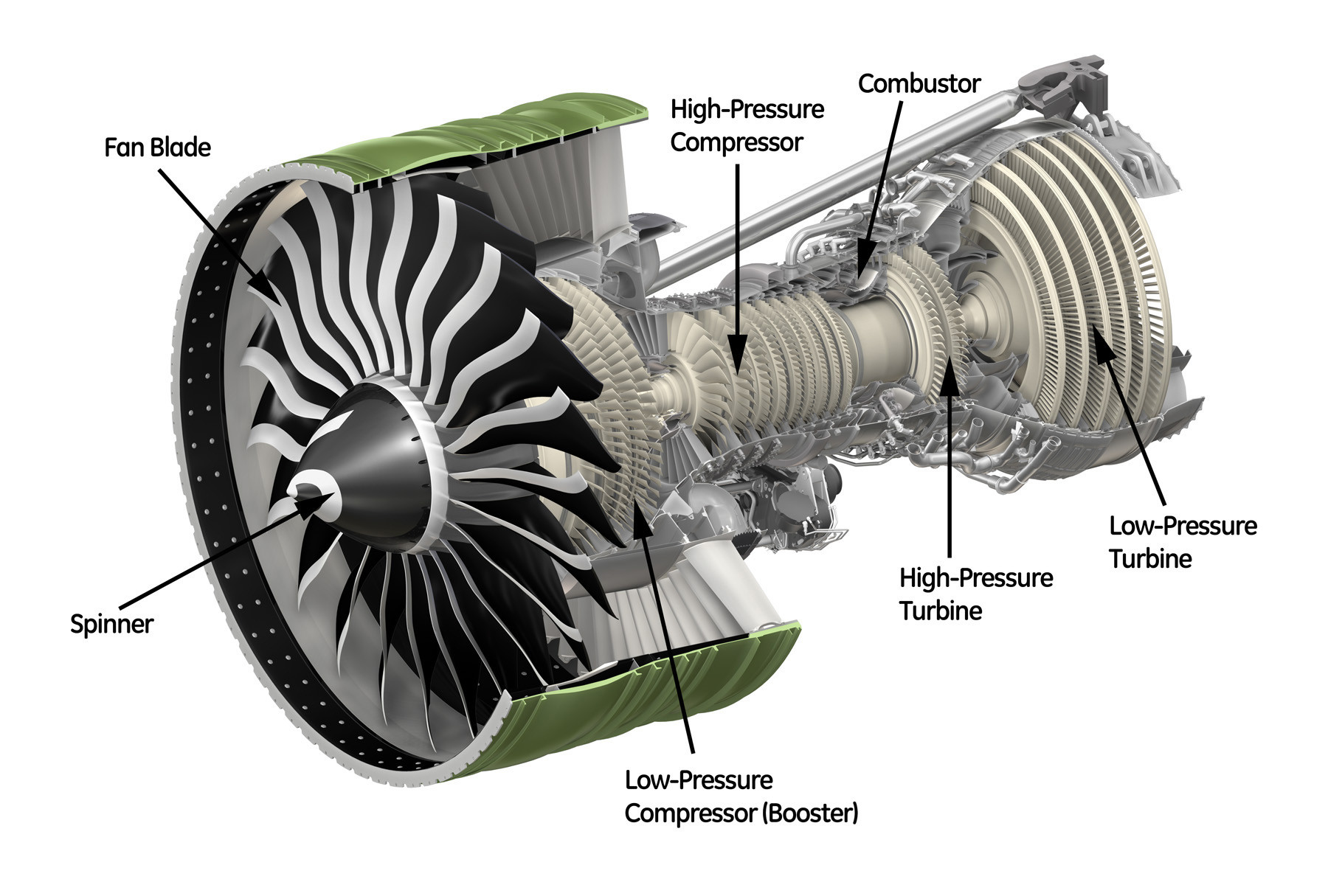
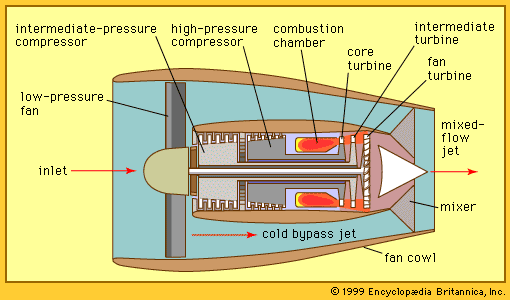
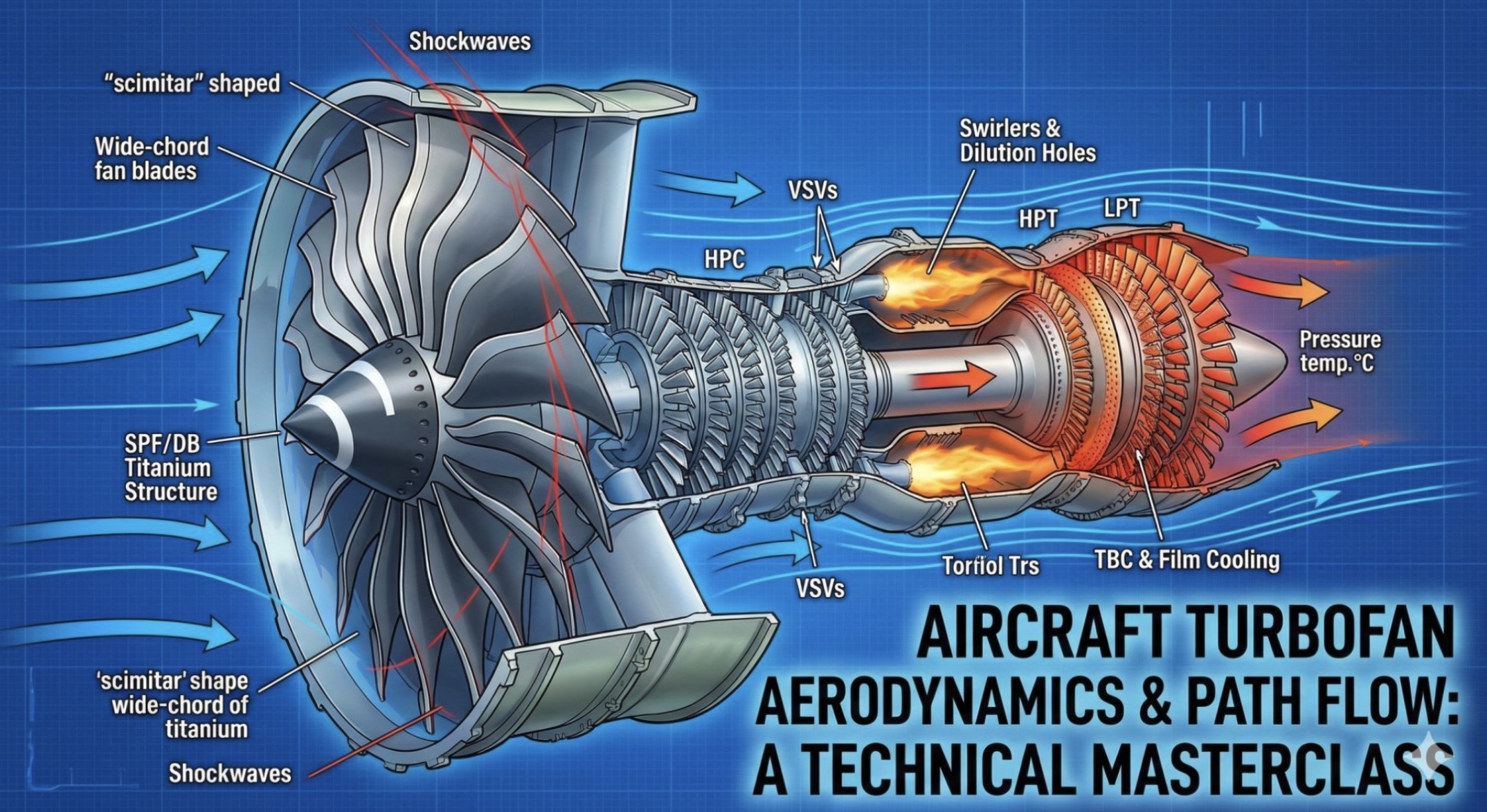
Check out Boeing 777 engine GE90
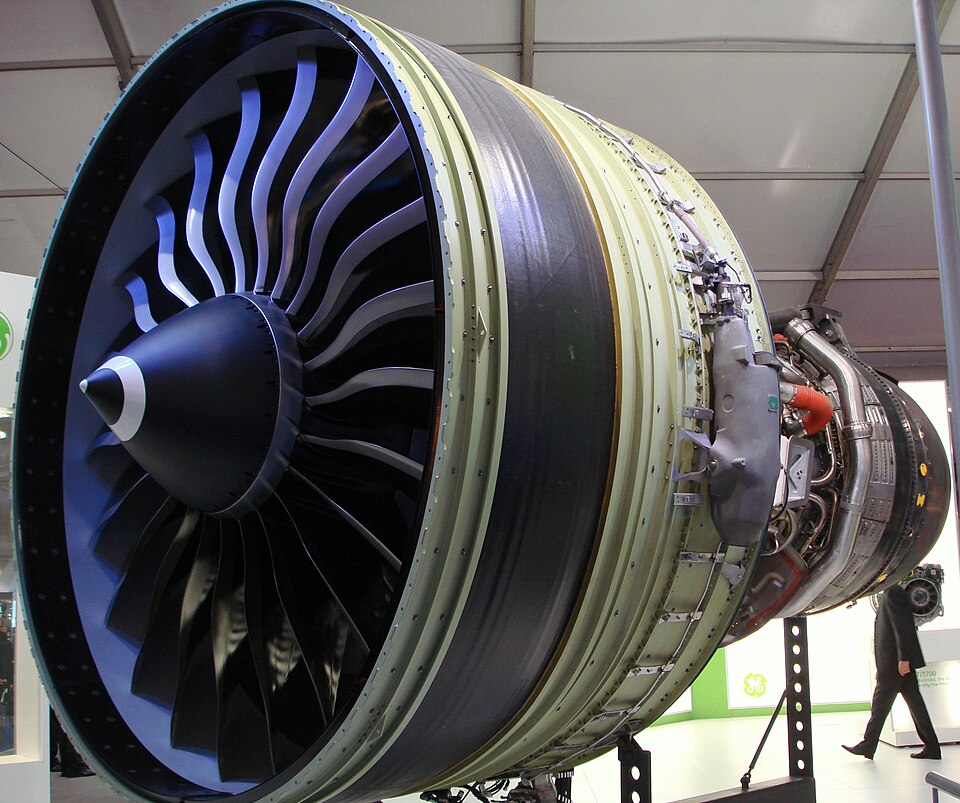
EDIT :
This means Turbofans love working where there is dense air. Then it can suck in and throw out air much more efficiently. Where air is rare, like in very high altitudes, it would be labouring. That is where turbojets come in to play. The very high altitudes are the domain of turbojets. With turbojets there is no bypassed air. It is all hot air being ejected from the nozzle.
I am afraid it doesn’t work as you think.I like the explanation of how much air goes around the engine. But does that mean a lot more air goes around the engine that doesn't get used for thrust ?
My amateurish understanding tells me, the more air we can get to go into and through the engine the more thrust we would get.
So any air not going into the engine is wasted.
For turbofan engines :
Bypassed air contribute to the thrust as well.
The cold air going round the core of engine and thrown out of the nozzle together with the hot air coming from the core BOTH contribute to total thrust. As Dr Akşit mentioned, 40% of TF6000’s thrust is provided by this colder air.
In commercial airliner engines the bypass ratio is much higher. Say an engine like GE90 with a bypass ratio of 9:1 means: for very 1kg of air passing through the core, 9kg of air goes round the engine and thrown out together with the hot air coming from the core. So in commercial turbofans you have a huge fan driven by the core. that acts like a propeller sucking air in to engine but most of it being thrown out round the core. 80 to 90% of all thrust in a GE90 is provided by bypassed air.
NOTHING IS WASTED
Check out Boeing 777 engine GE90
EDIT :
This means Turbofans love working where there is dense air. Then it can suck in and throw out air much more efficiently. Where air is rare, like in very high altitudes, it would be labouring. That is where turbojets come in to play. The very high altitudes are the domain of turbojets. With turbojets there is no bypassed air. It is all hot air being ejected from the nozzle.
Last edited:
TEI General Manager Prof. Dr Mahmut Faruk Akşit announced that the TS1400 engine, which powers the GÖKBEY helicopter, will enter series production in 2026.
Akşit noted that TEI has reached a significant level in indigenous engineering software, superalloy production and turbine technologies, stating that these capabilities form a critical infrastructure for KAAN’s future engine technologies.
It was also noted that the PD170 and PD200 engines are currently in active service on the ANKA, AKSUNGUR and TB3 platforms.
TEI General Manager Prof. Dr Mahmut Faruk Akşit:
GÖKBEY’s domestically produced engine has already flown successfully. Following this year’s deliveries, it will be fully operational in service by next year.
As for the engines for the Kara Şahin helicopters used by our armed forces, we have been manufacturing them entirely domestically under a licensed production agreement at our facilities in Eskişehir since 2022.
Last edited:

Pokemonte13
Contributor
Deliveries of Gökbey with domestic engine are supposed to start in 2028 anyway. By their production speed they will maybe finish the first package with foreign engines in 2027 even though they said 2026. I wonder if we will see Gökbey with different payloads as the ones who were delivered are bare bone (I know its enough for Jandarma and other civilian users). The only thing i saw was the iff antenna on army but nothing else.

AKÜ'de Savunma Sanayii Konferansı: "KAAN Motoru Yüksek İrtifada F-16'yı İkiye Katlıyor"
Afyon Kocatepe Üniversitesi (AKÜ) ev sahipliğinde düzenlenen "Savunma Teknolojileri ve Tarihimizin Dönüm Noktaları" konferansında konuşan TEI Genel Müdürü Mahmut Faruk Akşit, yeni geliştirdikleri KAAN motorunun yüksek irtifadaki performansına dikkat çekerek, "KAAN motoru, F-16 motoruna göre...
 www.afyonpostasi.com.tr
Prof Akşit has made a statement that the new TF35000 engine is producing 80% more thrust at high altitude when compared to a F110 engine.
Well, at say 50000ft altitude, f110 engine’s dry thrust is approximately 3000lbf to 3500lbf compared to it’s sea level dry thrust of 17150lbf.
Also F110’s AB thrust would be between 8000 to 10000lbf at 50000ft; as opposed to it’s sea level thrust of 29000lbf.
So the TF35000 engine is producing around 6300lbf dry thrust at 50000ft. Also it would produce a wet thrust at that high altitude of up to 18000lbf.
For a higher bypass ratio engine that is probably a good achievement.
But the real interesting point is in his wording.
“Our newly developed KAAN engine produces 80 percent more power at high altitude compared to the F-16 engine. Almost double the amount.”
That is a statement that is reminiscent of explaining an event that has already happened.

I think he's speaking based on results from the digital twin. After this statement, I now expect the TF35000 engine's bypass ratio to be a bit low. I think it will be something between 0.57 and 0.63.
Well i don't think Indonesia signed an agreement for KAAN with TF35k without significant prove of being able to achieve that goal. Imo we can't explain that with just ummah and brotherhood. In recent interviews Mr. Akşit insisted that TF35k program is progressing faster than we think.AKÜ'de Savunma Sanayii Konferansı: "KAAN Motoru Yüksek İrtifada F-16'yı İkiye Katlıyor"
Afyon Kocatepe Üniversitesi (AKÜ) ev sahipliğinde düzenlenen "Savunma Teknolojileri ve Tarihimizin Dönüm Noktaları" konferansında konuşan TEI Genel Müdürü Mahmut Faruk Akşit, yeni geliştirdikleri KAAN motorunun yüksek irtifadaki performansına dikkat çekerek, "KAAN motoru, F-16 motoruna göre...
Prof Akşit has made a statement that the new TF35000 engine is producing 80% more thrust at high altitude when compared to a F110 engine.
Well, at say 50000ft altitude, f110 engine’s dry thrust is approximately 3000lbf to 3500lbf compared to it’s sea level dry thrust of 17150lbf.
Also F110’s AB thrust would be between 8000 to 10000lbf at 50000ft; as opposed to it’s sea level thrust of 29000lbf.
So the TF35000 engine is producing around 6300lbf dry thrust at 50000ft. Also it would produce a wet thrust at that high altitude of up to 18000lbf.
For a higher bypass ratio engine that is probably a good achievement.
But the real interesting point is in his wording.
“Our newly developed KAAN engine produces 80 percent more power at high altitude compared to the F-16 engine. Almost double the amount.”
That is a statement that is reminiscent of explaining an event that has already happened.
Probably the TF35k engine took a new turn in its design process and has more impressive specs now or its impressive specs have been further validated in digital form. I think this is also evident from the calligraphy work done on the artistic impression piece of the TF35k which Mr Aksit presented to President Erdoğan at the Mavi Vatan military exercise a few weeks ago. Mr Aksit was proudly smiling with confidence. He seemed to be happy about the work they are doing with the engine. While we have no clue if the physical parts of the engine are put together and tested it would be imprudent to think this has happened. The first run of this engine is like 10X as important as the flying of Kaan P1 and I think it wouldn't be overlooked by anyone if it did run. We have no clue if even its components have been tested or not.
Why? They haven't paid anything, and they have also been talking to other countries about jets as well. If it pans out they get a 5th gen fighter, if it doesn't they lose nothing.Well i don't think Indonesia signed an agreement for KAAN with TF35k without significant prove of being able to achieve that goal.
You don't seriously believe they actually built a prototype they are actively fly testing, right? Not only they would've screamed it on top of the roof of Erdoğan's palace but also they haven't even finished testing TF6K or showed TF10k.AKÜ'de Savunma Sanayii Konferansı: "KAAN Motoru Yüksek İrtifada F-16'yı İkiye Katlıyor"
Afyon Kocatepe Üniversitesi (AKÜ) ev sahipliğinde düzenlenen "Savunma Teknolojileri ve Tarihimizin Dönüm Noktaları" konferansında konuşan TEI Genel Müdürü Mahmut Faruk Akşit, yeni geliştirdikleri KAAN motorunun yüksek irtifadaki performansına dikkat çekerek, "KAAN motoru, F-16 motoruna göre...
Prof Akşit has made a statement that the new TF35000 engine is producing 80% more thrust at high altitude when compared to a F110 engine.
Well, at say 50000ft altitude, f110 engine’s dry thrust is approximately 3000lbf to 3500lbf compared to it’s sea level dry thrust of 17150lbf.
Also F110’s AB thrust would be between 8000 to 10000lbf at 50000ft; as opposed to it’s sea level thrust of 29000lbf.
So the TF35000 engine is producing around 6300lbf dry thrust at 50000ft. Also it would produce a wet thrust at that high altitude of up to 18000lbf.
For a higher bypass ratio engine that is probably a good achievement.
But the real interesting point is in his wording.
“Our newly developed KAAN engine produces 80 percent more power at high altitude compared to the F-16 engine. Almost double the amount.”
That is a statement that is reminiscent of explaining an event that has already happened.
It's very much possible that he's talking re simulations they made. Suffice to say they've made thousands of simulations to date. TF35K is not yet lit.That is a statement that is reminiscent of explaining an event that has already happened.
Of course not. But they may have produced a prototype to fire for testing. (They had promised us a first firing of TF35K in 2026 quite sometime ago). Both TF6K/10K were slightly ahead of TF35K and all three were to be developed concurrently.You don't seriously believe they actually built a prototype they are actively fly testing, right? Not only they would've screamed it on top of the roof of Erdoğan's palace but also they haven't even finished testing TF6K or showed TF10k.
But I agree with @Merzifonlu ’s suggestion about digital twin.
Your opinion about not being able to keep the news of any prototype production under wraps is definitely valid. But a secret prototype of TF35K is still plausible (remember Dr Akşit telling us that tf35K is far ahead than people may think).
Also it has to be remembered that; if you have the engine's specifications, such as its design bypass ratio, fan pressure ratio, turbine entry temperature, and corrected mass flow, It can be possible to calculate and analyse it‘s theoretical thrust for both sea level and high altitudes.
You don’t really need the digital twin to obtain these values. But digital twins would give you almost exact numbers with error probability of 0.5% to 3%.
Last edited:


Why are people talking down TF-6000? It's a very promising, compact and versatile engine, highly efficient, designed for stealth, the core is modular which means you can scale it up to TF10K, you can turn it into a +3000HP turboshaft engine for helicopters (T-929 and T-925) or a naval engine, however mostly useful as a generator on larger ships or propulsion for smaller ones like FAC's.
For commercial use TEI could redesign the front section of the TF6000 and achieve higher bypass ratio, i'd say between 4-5:1 is easily possible, enough to power midsized jets like Gulfstream G280. Such a TF-6000 would give Honeywells HTF7000 a run for it's money in terms of efficiency, the HTF7000 btw. is industry benchmark in that class.
For commercial use TEI could redesign the front section of the TF6000 and achieve higher bypass ratio, i'd say between 4-5:1 is easily possible, enough to power midsized jets like Gulfstream G280. Such a TF-6000 would give Honeywells HTF7000 a run for it's money in terms of efficiency, the HTF7000 btw. is industry benchmark in that class.


