Korea AIR DEFENCE PROGRAMS

urban mine

Contributor
Messages
747
Reactions
60 1,625
Nation of residence
South Korea
Nation of origin
South Korea
LAMD Interception Capability Experiment Plan
Screenshot_20250703_155842_Firefox.jpg

The 239mm rocket of K239 Chunmoo was modified for targeting purposes. Telemetry measurement equipment was installed in the warhead section to transmit information to the test headquarters in real time. The target rocket launch pad is placed on an SEP barge and positioned at sea to secure the test range.
Screenshot_20250703_155807_Firefox.jpg


For safety reasons, the test control center was set up outside the maximum range of the target rocket(The maximum range of the 239mm rocket is 80km.). This was done to prevent damage even if the target rocket was not intercepted normally. In addition, for maritime safety, the interceptor missile and target rocket are designed to self-destruct before hitting the sea surface.
Screenshot_20250703_155825_Firefox.jpg

After the target is launched from the barge, an observation station is set up at a high altitude so that radar detection is possible immediately.
 
Last edited:

urban mine

Contributor
Messages
747
Reactions
60 1,625
Nation of residence
South Korea
Nation of origin
South Korea
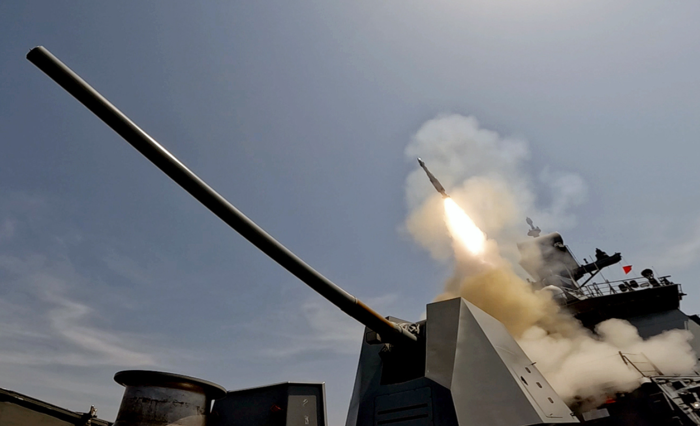
Finally, a launch photo of the L-SAM AAM has been released. Obviously they've been testing it for a while, so why are they just now making it public....
sub03_01.jpg
 

urban mine

Contributor
Messages
747
Reactions
60 1,625
Nation of residence
South Korea
Nation of origin
South Korea
KM-SAM-LIG-Nex1.jpg

DAPA announced that it has successfully completed the initial deployment of the M-SAM II Phase II program, which upgrades the M-SAM (medium-range surface-to-air missile) to the M-SAM II capable of intercepting ballistic missiles. The M-SAM is a medium-range surface-to-air missile designed to intercept aircraft. This upgrade improves the performance of the existing M-SAM battery's engagement control center and MFR, resulting in significant cost savings compared to introducing a new weapon system, while also enhancing low-altitude detection capabilities and simultaneous engagement capabilities compared to the existing M-SAM II.
 

urban mine

Contributor
Messages
747
Reactions
60 1,625
Nation of residence
South Korea
Nation of origin
South Korea
20231020_144532.jpg

The 2023 LAMD MFR was a trailer-mounted variant, whereas the MFR showcased at the 2025 ADEX is a truck-mounted variant.(However, the LAMD MFR development prototype is a trailer type. )There must be a reason for the enhanced mobility.
2025102217510496285.jpg

Separately, I heard that H-SHORAD is a system being developed in cooperation with Saudi Arabia. I wonder how it will turn out.
 

urban mine

Contributor
Messages
747
Reactions
60 1,625
Nation of residence
South Korea
Nation of origin
South Korea
590536300_2552974745078329_7480962716050203762_n.jpg

Hanwha Aerospace announced on the 28th that it signed a mass production contract for the Long-range Surface-to-Air Missile (L-SAM), valued at 705.4 billion Korean won (approximately $536 million USD), with the Defense Acquisition Program Administration (DAPA) on the 27th.

Hanwha Aerospace is scheduled to supply the Anti-Ballistic Missile (ABM) interceptors and launchers to the military by 2030.

Earlier last month, Hanwha Systems signed a mass production contract with DAPA for the L-SAM Multi-Function Radar (MFR), valued at 357.3 billion Korean won (approximately $272 million USD).

The Multi-Function Radar (MFR), which serves as the "eyes" and core sensor of the L-SAM, is responsible for detecting and tracking ballistic missiles and enemy aircraft flying in from long distances. It can simultaneously detect and track multiple targets and perform Identification Friend or Foe (IFF) missions for aircraft.

Following the completion of the L-SAM system development last year, the Agency for Defense Development (ADD) is currently progressing with the system development of the 'High-Altitude Interceptor Missile (L-SAM-II)' alongside companies like Hanwha Aerospace and Hanwha Systems. The L-SAM-II is expected to expand the aerial defense coverage area by 3 to 4 times compared to the existing system.

LIG Nex1 announced on the 27th that it signed a mass production contract with the Defense Acquisition Program Administration (DAPA) for the Long-range Surface-to-Air Missile (L-SAM).

The contract is valued at 163.9 billion Korean won (approximately $125 million USD), and LIG Nex1 will supply the Control Center and Anti-Aircraft Missile (AAM) components by 2030.
 

urban mine

Contributor
Messages
747
Reactions
60 1,625
Nation of residence
South Korea
Nation of origin
South Korea
To be honest, when I first heard that the M-SAM had seen combat in the UAE, I didn’t believe it.
c.jpg

This is because the M-SAM-II radars for the UAE have not yet been delivered, and the batteries currently in the UAE were provided for training purposes.(An MFR with PESA specifications, similar to the one used by the South Korean military.)

However, after seeing the information reported by the media and other sources, I came to believe in the effectiveness of the M-SAM-II. Watching the footage of Gulf states under attack that was being released on X, given the current situation, they must have had to activate every available air defense system...

A member of the National Assembly's National Defense Committee also confirmed that, according to the information he received, it demonstrated a 96% interception rate.
optimize.jpg

However, the UAE had exhausted its existing stockpile of interceptor missiles and requested the rapid delivery of M-SAM-II interceptor missiles from South Korea. But since interceptor missiles are not the kind of product whose production schedule can be expedited like tanks or self-propelled artillery, we have promised to first deliver 30 units and then ship the remaining production batch to the UAE.

As far as I know, among the Gulf states, the current order volumes for the M-SAM-II are as follows: UAE: 12 batteries (approximately 1,400 interceptor missiles); Saudi Arabia: more than 10 batteries (exact number of interceptor missiles not disclosed). These figures far exceed the quantities currently being procured by the South Korean military.
 

urban mine

Contributor
Messages
747
Reactions
60 1,625
Nation of residence
South Korea
Nation of origin
South Korea
The Intelligent 40mm automated air defense system, consistently showcased at various exhibitions from 2023 to the recently held KOREA C-UAS 2025.
View attachment 78413
View attachment 78412
This system was urgently procured by the ROKMC following its failure to intercept North Korea's small unmanned aerial vehicle provocations in 2022. Considering that small drones were provoking us from 3km up at the time, it was only natural that the anti-aircraft guns couldn't hit them. But I imagine Yoon Suk-yeol, who was a VIP then, and his leadership were furious.
View attachment 78414
Anyway, the military is reviewing its existing short-range defense systems and plans to replace the KM167A3 used by the Marine Corps and Army.
The Army has established anti-aircraft positions on the rooftops of high-rise buildings in Seoul to prepare for emergencies. The Marine Corps is also stationed on islands in the West Sea close to North Korea, where they have built anti-aircraft positions. However, the Vulcan system is now too outdated and personnel-intensive.
View attachment 78416
Hanwha - HWG-40 'Product Movie’
Hanwha has unveiled an unmanned air defense system based on the HWG-40, originally developed for export to India.(But it seems India is just upgrading and using their own Bofors. ) It has been modified into a twin-barrel system, automating the entire firing procedure from target detection and tracking to destruction.
View attachment 78415
View attachment 78417
Additionally, the number of personnel was streamlined to the extent that two individuals could operate four artillery pieces at the fire control center. Based on the track information provided by C2A, simply issuing a tracking command causes one of the distributed anti-aircraft guns to automatically track its assigned target using EOTS and fire upon receiving the command. It is said that using MMFA or PFHE as proximity fuses prevents casualties caused by falling projectiles.
3.jpg
1.jpg
2.jpg

Prototype of the Intelligent 40mm Automated Air Defense System. It is currently undergoing testing and evaluation by the military, and the evaluation video will be released later this year.
 

urban mine

Contributor
Messages
747
Reactions
60 1,625
Nation of residence
South Korea
Nation of origin
South Korea

LIG D&A Scores First Export Deal for K-SAAM Naval Surface-to-Air Missile, Worth Over 140 Billion Won in Malaysia​


news-p.v1.20260422.e0d66d17c3c740cdb3f7fe6479651353_R.png

LIG Defense & Aerospace (LIG D&A), formerly LIG Nex1, signed an export contract on the 22nd local time with the Ministry of Defence (Malaysia) (MINDEF) for K-SAAM, a shipborne air defense guided weapon. This is the missile's first overseas export deal, and the contract is worth $94 million, or about 13.9 billion won.

On the day, LIG D&A signed the deal with the ministry at the site of DSA 2026, Asia's largest defense exhibition, being held in Kuala Lumpur, the Malaysian capital.

K-SAAM is a naval surface-to-air missile developed to intercept a range of airborne threats, including anti-ship guided missiles and aircraft approaching a vessel. It was developed in 2011 under the lead of the Agency for Defense Development (ADD), and its reliability was proven through operational deployment during the Korean Navy's force buildup. It is regarded as a weapon system that can replace or complement a ship's close-in defense system.

lms batch 2.jpg

Although not mentioned in the article, it will be installed on the STM-built LMS-Batch 2 patrol corvettes.
 

urban mine

Contributor
Messages
747
Reactions
60 1,625
Nation of residence
South Korea
Nation of origin
South Korea
678691595_1503220814795964_2289345501251648073_n.jpg
681680246_1503220874795958_5169205402080414669_n.jpg
677767349_1503220998129279_7646009177320979142_n.jpg
677099861_1503221131462599_7429166523262225428_n.jpg

Rep. Yoo Yong-won, a member of the National Assembly’s National Defense Committee, visited the production facilities of LIG D&A and Hanwha. He toured the KM-SAM-II seeker production facility, the missile assembly facility, and the CIWS-II mass production facility.
 

urban mine

Contributor
Messages
747
Reactions
60 1,625
Nation of residence
South Korea
Nation of origin
South Korea
To be honest, when I first heard that the M-SAM had seen combat in the UAE, I didn’t believe it.
View attachment 79726
This is because the M-SAM-II radars for the UAE have not yet been delivered, and the batteries currently in the UAE were provided for training purposes.(An MFR with PESA specifications, similar to the one used by the South Korean military.)

However, after seeing the information reported by the media and other sources, I came to believe in the effectiveness of the M-SAM-II. Watching the footage of Gulf states under attack that was being released on X, given the current situation, they must have had to activate every available air defense system...

A member of the National Assembly's National Defense Committee also confirmed that, according to the information he received, it demonstrated a 96% interception rate.
View attachment 79727
However, the UAE had exhausted its existing stockpile of interceptor missiles and requested the rapid delivery of M-SAM-II interceptor missiles from South Korea. But since interceptor missiles are not the kind of product whose production schedule can be expedited like tanks or self-propelled artillery, we have promised to first deliver 30 units and then ship the remaining production batch to the UAE.

As far as I know, among the Gulf states, the current order volumes for the M-SAM-II are as follows: UAE: 12 batteries (approximately 1,400 interceptor missiles); Saudi Arabia: more than 10 batteries (exact number of interceptor missiles not disclosed). These figures far exceed the quantities currently being procured by the South Korean military.
WFF.jpg

Here is the status of the M-SAM II export contract to the UAE.
 

urban mine

Contributor
Messages
747
Reactions
60 1,625
Nation of residence
South Korea
Nation of origin
South Korea
View attachment 72170 View attachment 72171 View attachment 72172

A Korean-developed long-range radar has successfully secured a combat suitability certification, the Defense Acquisition Program Administration (DAPA) said Monday.

The state-run arms agency explained that the domestically developed radar is a critical component of the country's air defense system, as it is responsible for detecting and tracking aircraft within the Korean Air Defense Identification Zone (KADIZ) 24 hours a day, all year around. The radar system transmits captured data in real time to the Republic of Korea (ROK) Air Force's Master Control and Reporting Center, ensuring prompt air defense operations.

The new long-range radar received combat suitability certification, following periods of design research, prototype production and an additional year and a half of testing and evaluation. This process began after DAPA signed a system development contract with LIG Nex1 in February 2021.

"The new long-range radar has been confirmed to meet the Air Force's performance requirements and has demonstrated world-class capabilities in detection range, probability, as well as accuracy," a DAPA official said.

With the research and development phase completed for the long-range radar, South Korea has become one of the few countries in the world capable of independently designing and producing long-range radars.

Currently, only a small number of countries, including the U.S., France, Italy and Spain, possess the advanced capability to produce radars using their own domestic technologies. This R&D effort has also secured various other essential technologies related to radar production and operation, such as large antenna design and manufacturing, heat dissipation technology and the optimization of signal concentration.
View attachment 72173
(The South Korean Air Force currently operates the FPS-117.)

DAPA plans to kickstart mass production of the long-range radars in 2026, aiming to replace outdated radars with new ones. The current long-range radars operated by the ROK Air Force are U.S.-made equipment introduced prior to the 1990s, and they have become severely outdated.

It's a program that started quite a long time ago, and it's only now that we're facing mass production. It's been a really tough time.


View attachment 72174 View attachment 72175
This is the spec sheet of the LRS-450 that was previously developed. It was developed and tested from 2011 to 2014, but it was canceled due to suspicion of manipulation of the test evaluation after being judged to be inappropriate. It can be said that it is the prototype of the long-range radar that was decided to be mass-produced this time.
View attachment 72176
Since then, development has resumed, and the latest GaN device technology has been applied through advanced national technology.

HINJSr7a4AAImHU.jpg
HINJFwSbgAA-Fhl.jpg

It’s been a while since LIG showed off its LRR (Long-Range Radar). This project is intended to replace eight aging FPS-117K units. Mass production begins this year.
 

urban mine

Contributor
Messages
747
Reactions
60 1,625
Nation of residence
South Korea
Nation of origin
South Korea
SSC_20260526104504.jpg

At the 175th Defense Project Promotion Committee meeting, a project to acquire SM-6 guided missiles to be mounted on 8,200-ton Aegis destroyers through Foreign Military Sales (FMS) was also deliberated and approved. If the project is successfully implemented, the anti-air defense and ballistic missile response capabilities of our Navy's Aegis destroyers will be significantly strengthened.

At the time of the committee's decision in 2023, the total project cost—including the second phase of procurement—was approximately 770 billion KRW, with a timeline from 2023 to 2031. However, this has now been adjusted to a total cost of around 530 billion KRW and a project period spanning from 2023 to 2034. While the government originally planned to introduce around 100 SM-6 missiles, the project budget was adjusted as the acquisition quantity decreased.
 
Top Bottom