

Latest Thread
- Bangladesh Opinion Bangladesh’s intelligence challenge
- Iran’s Long Game in Türkiye: From Political Islam to the Post-Erdoğan Era
- Open-source AI for exploiting cyber vulnerabilities
- Engineering Atomic Machines: Matter Compiler
- Breaking News Turkish and Greek defence officials meet for "Confidence Building Measures"
You are using an out of date browser. It may not display this or other websites correctly.
You should upgrade or use an alternative browser.
You should upgrade or use an alternative browser.


Full thrust into the future – Chinese fighter jets of the next generation
Alexander Luck
19. September 2026
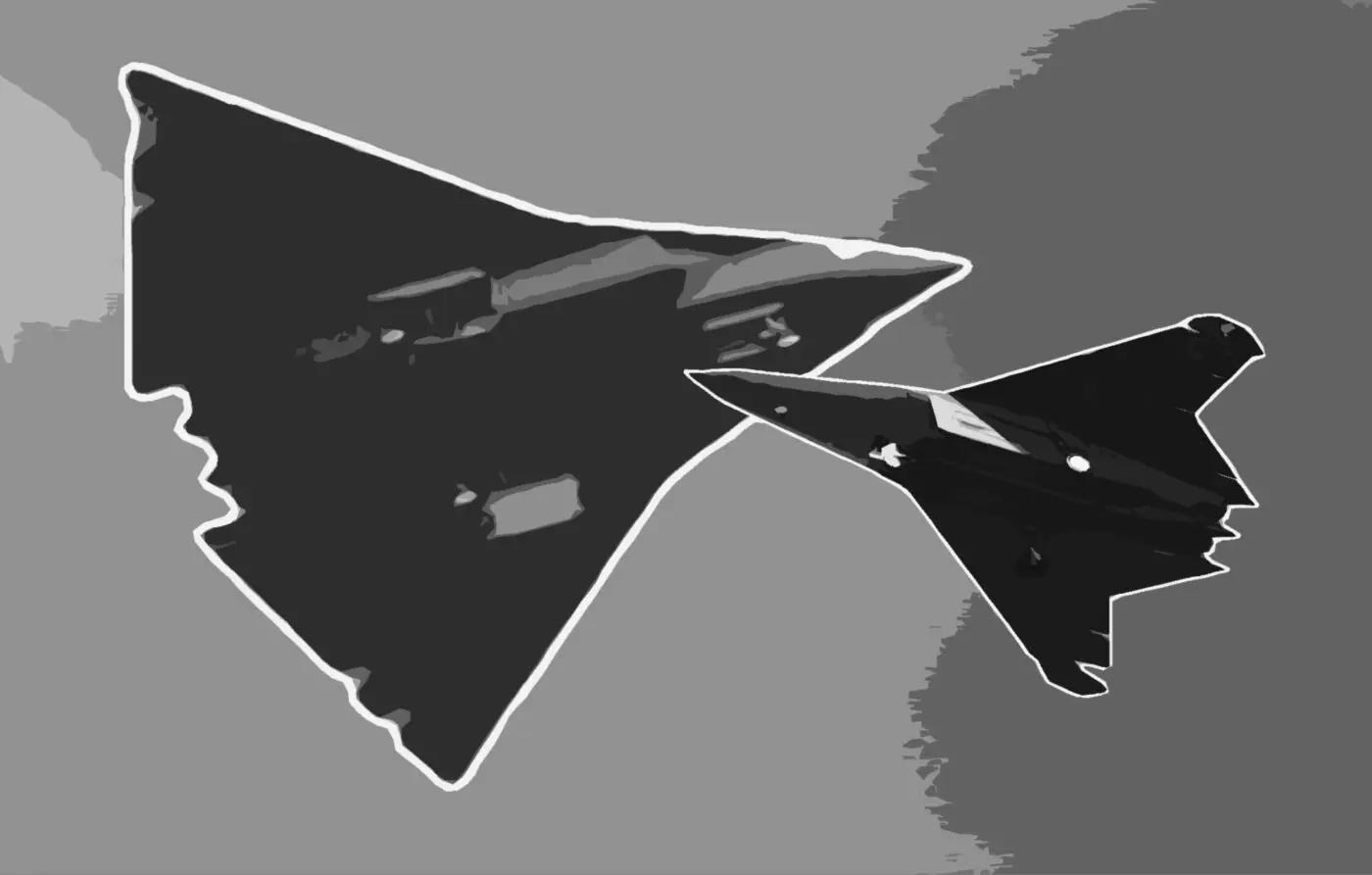
Around the world, air force efforts to develop next-generation fighter jets are gaining momentum. The United States has traditionally set the tone for the new capabilities that observers in the media and analysis often attribute to "sixth-generation" fighter jets.
Elsewhere, however, the picture is more inconsistent. In Europe, the partners in an ambitious project, the French-German-Spanish Future Combat Air System (FCAS), recently had to capitulate after industrial differences could not be bridged, even politically.
The other originally European, now global project, known as GCAP (Global Combat Air Programme) and originally launched as "Tempest", is progressing at a moderate pace, led by a tri-national consortium of Great Britain, Italy and Japan. Other nations around the world are pursuing the development of next-generation fighter aircraft, which do not clearly fall under the designation of "fifth" or "sixth generation" due to various technological hurdles these nations face. Rather, they combine the technological characteristics of different generations in one design. Examples of this are South Korea and Turkey. Other countries with ambitious projects are still in the early stages of local development in terms of development. India and Sweden should be mentioned here.
China's path to the premier league of fighter aircraft construction
Meanwhile, over the past three decades, China has gone at an astonishing rate from a nation that relied primarily on imported fighter jets to modernize a vast but obsolete air force with thousands of fighter jets, to one of the two leading innovators in fighter aircraft development alongside the United States. This hartpunkt technical article depicts the current status and peculiarities of the development of next-generation fighter aircraft for the air forces of the Chinese People's Liberation Army (PLA).
China's transformation from an importer of foreign technology for fighter jets to an increasingly sovereign and innovative developer began in the late 1980s and gained significant momentum due to political twists and economic growth in the late 1990s. At the same time as procuring large numbers of Russian fighter jets, especially the Sukhoi Flanker series, and adapting this type in domestic variants such as the J-11, J-15 and J-16, Beijing also developed the J-10 multirole combat aircraft. It is a design that is currently in service with several hundred planes in the Chinese Air Force (PLAAF). In China, the J-10 is often referred to as the "3.5 generation" design, as the country essentially "missed" the first generation of fighter jets during the late Second World War and started with post-war second-generation models. The J-10, along with the Chinese flanker adaptations, introduced a variety of innovations to the PLAAF, including fly-by-wire avionics, a modern glass cockpit, electronic beam swivel radar (AESA), and high-performance optical sensors.
The next generation of development, the fifth in the West, but the fourth in China, included the influx of the J-20 multirole fighter aircraft. The J-20, developed by the Chengdu Aircraft Company (CAC), which also produced the J-10, is a relatively large fighter aircraft with significant signature reduction ("stealth"), three internal weapon bays and comprehensive radar and electro-optical sensing technology that applies "sensor fusion" principles. The twin-engine J-20 exists in one- and two-seater variants, and although Chinese officials do not publish inventory figures for fighter jets, credible estimates suggest that the total number of J-20s produced so far is about 500 units. While the J-20 initially used engines of Russian origin, newer variants are now in operation with Chinese alternatives.
In addition, China is currently introducing the twin-engine J-35 fighter jet. Developed by China's second major fighter aircraft manufacturer, Shenyang Aircraft Corporation (SAC), this design is visually similar to the American F-35. However, these similarities are superficial, as both models otherwise differ fundamentally in design, as can already be seen from the engines. Originally envisaged by SAC as an export product called FC-31, the design eventually evolved into the J-35 carrier-based fighter aircraft for Chinese naval aviators and the J-35A land-based fighter aircraft for the PLAAF due to the interest of the PLA.
Unlike the larger J-20, the lighter and more compact J-35 is still in the early stages of production and introduction, both by Chinese naval aviators and the Air Force.
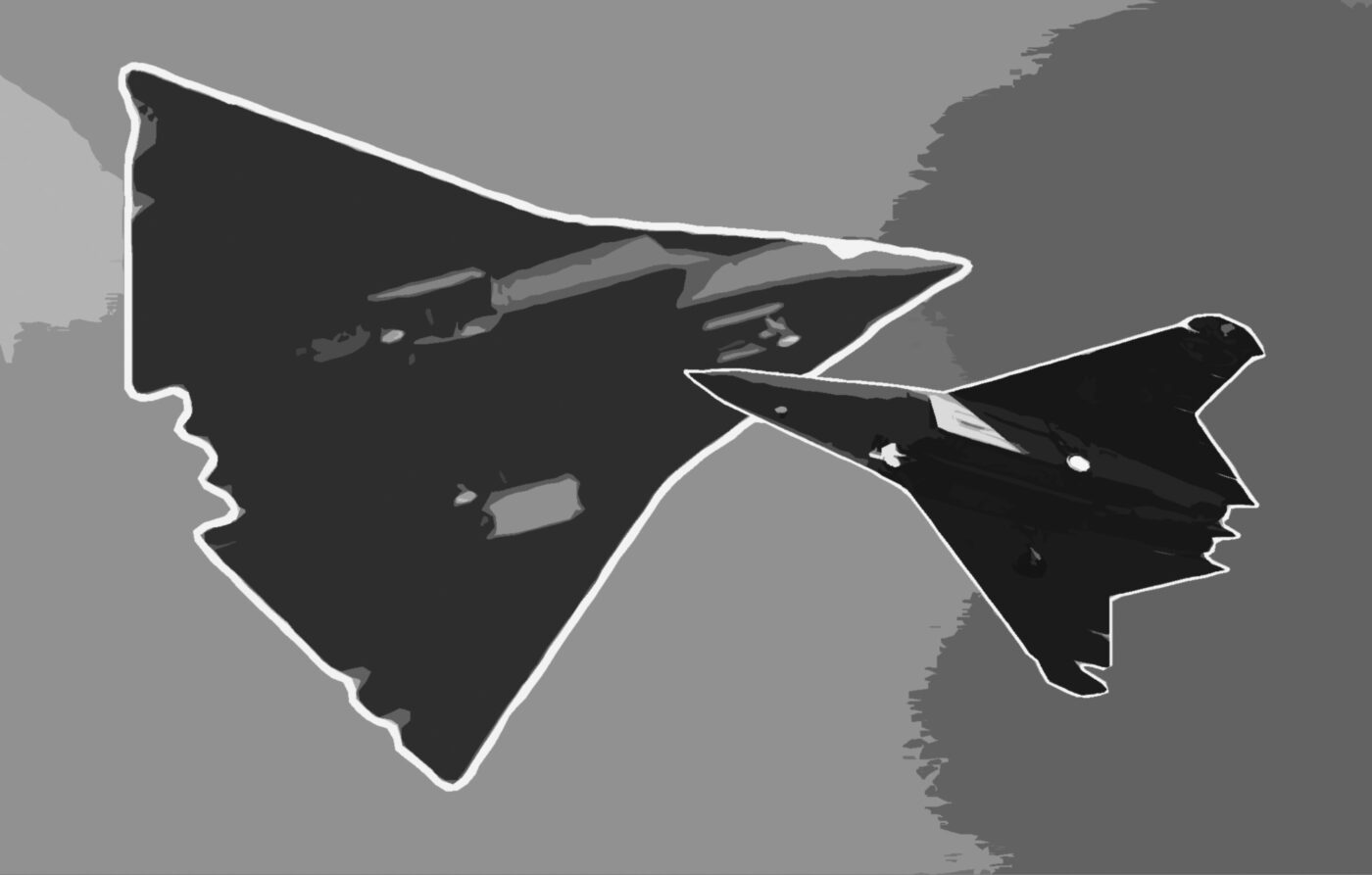
Nevertheless, both CAC and SAC have been involved in the development of successor designs for at least ten years, which would be referred to in Western discourse as "sixth-generation fighters". Official designations do not yet exist, but observers refer to these projects as the J-XDS, J-XX or J-50, developed by the Shenyang Aircraft Corporation, as well as the J-36 for CAC's second program.
Rumors and speculation among informed observers have been suggesting for some time that such Chinese efforts exist for next-generation fighter jets. Nevertheless, for a long time, no reliable information about the nature of these developments emerged. Finally, in December 2024, prototypes of both programs suddenly appeared during test flights, which were filmed by Chinese citizens and shared mainly via social media.
As with the previous J-20 and J-35, both developments share basic design features of the "next generation". In the case of J-XDS and J-36, this includes the "tailless" configuration without tail stabilizer, as well as the obligatory internal weapon bays and sensors, distributed over the entire fuselage. In other aspects, however, the two new patterns differ drastically from each other. This also raises the question of whether these are competing or complementary programs designed to provide the PLA with different designs for a range of air combat requirements.
SAC J-XDS (J-XX or J-50)
The J-XDS is the more "conventional" of these two designs. As usual, there are no specifications from publicly available sources. In appearance, it is a medium-weight single-seater fighter aircraft powered by two jet engines. As already mentioned, the configuration is "brushless" and therefore has neither horizontal nor vertical rear deflector surfaces. The wing, extending from the middle section of the airframe to the tail, is designed as a kinked lambda design and has characteristic, fully movable wing tips. The J-XDS has DSI (Diverterless Supersonic Inlet) engine intakes, and probably 2D thrust vector control for the two engines. The strongly tapered front fuselage contains the cockpit, which can accommodate a single pilot. Below the airframe, at least two large weapon bays can be seen, while the landing gear has a twin wheel at the front. At least one housing for electro-optical sensors is visible below the front fuselage in front of the landing gear. Since the planes observed so far are prototypes, many covers for sensors and other equipment are probably still missing compared to a production version.
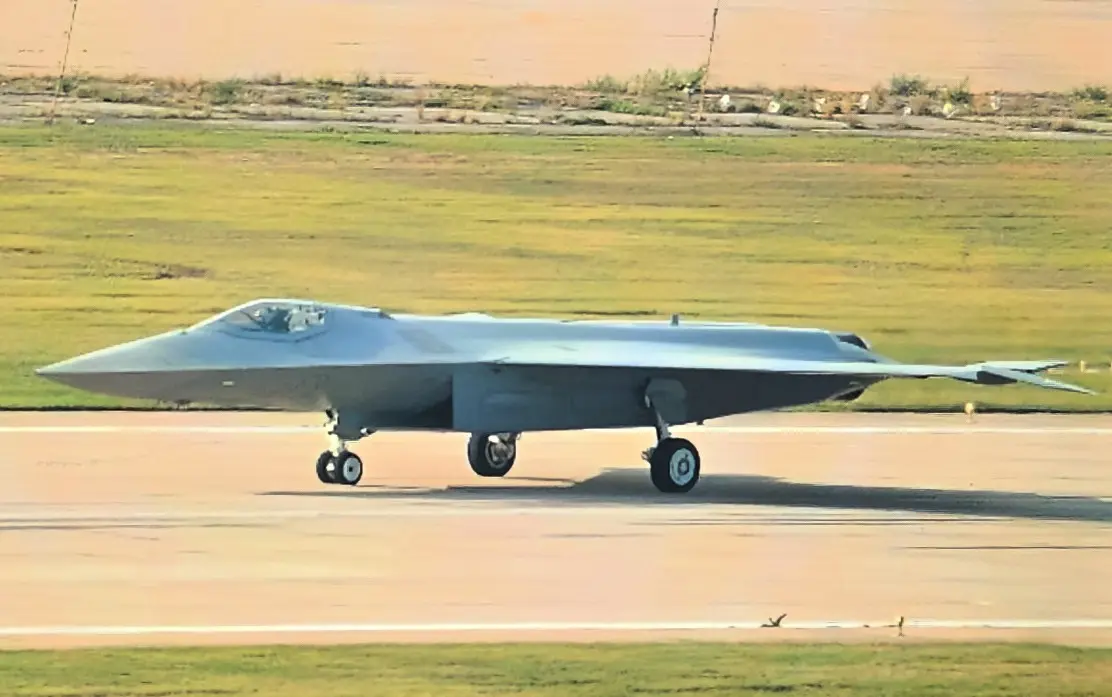
J-XDS on the ground: The slimmer, more compact fuselage compared to J-36 is recognizable. (Image: Chinese social media)
The twin wheel of the nose landing gear and the overall very compact design could indicate that the J-XDS is intended not only for service with the PLAAF, but also for the naval aviators of the Chinese Navy (PLAN). The design seems well suited for the catapult launch of current and future Chinese aircraft carriers. Previous prototypes do not yet have relevant equipment, such as the safety hook or the catapult connection on the nose wheel. However, these would probably only appear on naval variants later in development.
Performance data of the aircraft remain completely unknown for the time being. The design is probably capable of supercruise, i.e. continuous flight at supersonic speed without afterburners, and is likely to use the most modern Chinese air-to-air weapons as well as air-to-ground weapons with matching dimensions.
CAC J-36
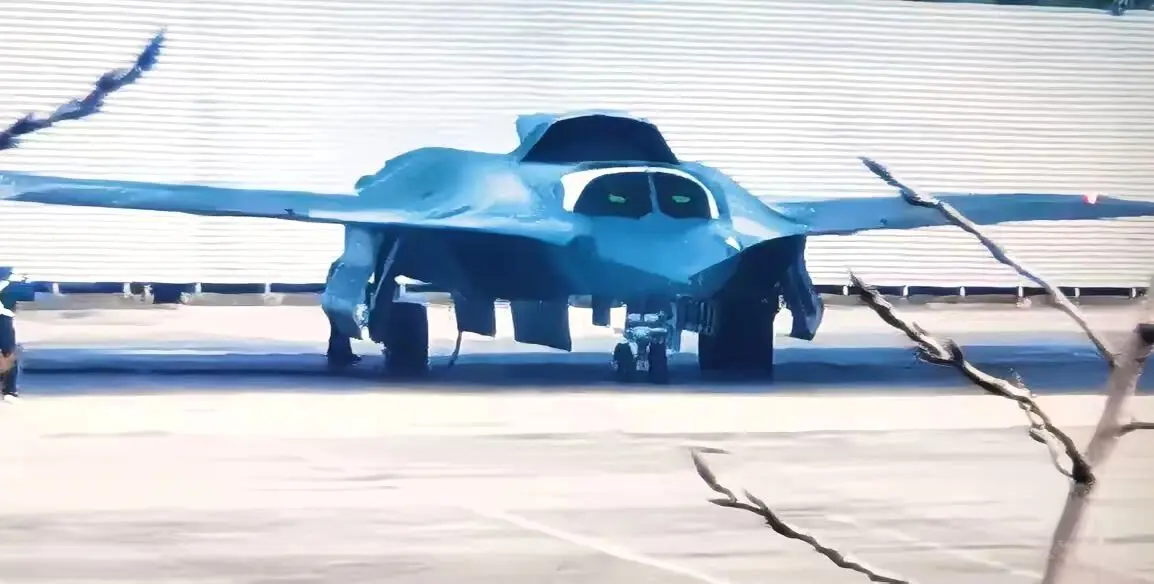
J-36 on the ground: Note the wide, two-seater cockpit and the engine intake on the top of the fuselage. (Image: Chinese social media)
Like the J-XDS, the J-36, developed by the Chengdu Aircraft Company, appeared practically out of nowhere during prototype test flights in December 2024. Unlike Shenyang's J-XDS, the J-36 represents a far more radical interpretation of next-generation fighter jets. Of particular note is that the Chengdu design features three jet engines as propulsion in a distinctive configuration, with two engine intakes located on the side and one on top. While developers around the world have occasionally considered three-engine fighter designs in the past, such a configuration has not yet been used anywhere, and the J-36 represents the first such configuration to reach an advanced stage of development. The second notable design feature of the CAC aircraft is the wide cockpit with side-by-side seats for two crew members.
The wing is designed as a double delta, extends over almost the entire length of the airframe and results in an unusually large surface area compared to more conventional fighter aircraft. The landing gear has twin wheels on both the nose and main landing gear, which is due to the size and mass of the J-36.
Like the J-XDS, Chengdu's J-36 also has several internal weapon bays. However, the configuration is more similar to the J-20, also developed by CAC, with a large weapon bay in the middle and two smaller bays on the left and right. According to the overall size of the aircraft, these bays are likely to be able to accommodate a large number of standard air-to-air missiles or, alternatively, large and very long-range missiles such as the PL-17. In addition, the large central bay could theoretically accommodate a wider range of air-to-ground armament, in line with the potential multi-role concept for the use of the J-36.
The engines have signature-optimized nozzles and probably enable the J-36, like Shenyang's J-XDS, to fly supersonically without the use of afterburners. A 2D TVC seems at least plausible, but remains unconfirmed.
A peculiarity of the J-36 is that the developer demonstrably flies several prototypes with certain design differences, which indicates an ongoing further development of the aircraft in a dynamic development process. While the first prototype observed with the fuselage number "36011" had side engine intakes with separation plates, newer prototypes have intakes in DSI design. In addition, newer prototypes also feature modifications to the area around the engine nozzles.
Both the unusual number of engines and the cockpit configuration of this large-scale design have led to speculation that the J-36 is actually a fighter-bomber or other fighter aircraft design geared toward strike missions.
However, a next-generation air combat platform has special requirements that favor larger designs. These include comprehensive signature reduction, high engine power requirements, sufficient space for fuel to enable long ranges, and finally a large weapon bay to accommodate long-range air-to-air missiles.
A complementary use of J-36 and J-XDS with optimization of one pattern for range, weapon load and sensor power, while the second pattern allows agility and flexible use in several branches of the armed forces, therefore seems at least plausible.
Another aspect that could be of particular importance for the J-36 is China's ambition to make a series of combat drones operational according to the scheme of a "loyal wingman". At the military parade in Beijing in September 2025, several such designs were presented to a global audience.
While unmanned combat aircraft (Collaborative Combat Aircraft; CCA), similar to other air forces, are certainly to be used in China with older manned models, the J-36 seems to be particularly suitable to serve as a "mothership" that simultaneously coordinates the use of several CCA in air combat.
Conclusion
CAC's J-20 first flew at the end of 2011 and was in active service with the PLAAF from around 2018. Assuming broadly similar development dynamics, both the J-XDS and the J-36 could be ready for use in the PLA in the early to mid-2030s.
The sudden appearance of not one, but two different Chinese next-generation fighter jets at an advanced stage of development underscores how intensely Beijing is striving to compete against Western and other rivals, especially the United States, at the forefront of military aircraft construction. If the above assumption is true for development periods, China would have two fighter jets of the latest generation at its disposal in the mid-2030s, without a comparable counterpart in service with its immediate neighbors in East Asia. This scenario could also explain why Japan is currently emphasizing the need for accelerated development of GCAP with the UK and Italy and hopes to have capabilities comparable to China's by around 2035.
Unlike Russia and European countries, China is investing significantly in an ambitious and sustainable development program for next-generation fighter jets. Beijing's actions have led to the emergence of competent domestic developers of military aviation systems, who can now draw on experience from an extensive portfolio of their own developments and adaptations of foreign technologies.
As noted, Chinese officials reveal very little about local military developments. Foreign observers rely on new images and other information continuously appearing online, especially on social media. Therefore, skepticism is still appropriate due to the lack of reliable facts in the technical assessment of Chinese military capabilities.
Nevertheless, an observable trend in the development of Chinese military aviation over the past three decades cannot be overlooked. This dynamic means that China has evolved from imitating and developing an existing technology base imported from abroad to an innovator with a distinct range of skills. The consequence is likely to be a further acceleration and diversification of Chinese innovation, with direct consequences for further fighter aircraft development in the Far East and worldwide.
Author: Alexander Luck is an analyst for armaments policy with a focus on naval and aviation. His focus is on the Indo-Pacific region, especially developments in China, East Asia and Australia.
(Translate from German)
 www.hartpunkt.de
Good article to view the appearance of China Gen 6 aircraft.
Alexander Luck
19. September 2026
Around the world, air force efforts to develop next-generation fighter jets are gaining momentum. The United States has traditionally set the tone for the new capabilities that observers in the media and analysis often attribute to "sixth-generation" fighter jets.
Elsewhere, however, the picture is more inconsistent. In Europe, the partners in an ambitious project, the French-German-Spanish Future Combat Air System (FCAS), recently had to capitulate after industrial differences could not be bridged, even politically.
The other originally European, now global project, known as GCAP (Global Combat Air Programme) and originally launched as "Tempest", is progressing at a moderate pace, led by a tri-national consortium of Great Britain, Italy and Japan. Other nations around the world are pursuing the development of next-generation fighter aircraft, which do not clearly fall under the designation of "fifth" or "sixth generation" due to various technological hurdles these nations face. Rather, they combine the technological characteristics of different generations in one design. Examples of this are South Korea and Turkey. Other countries with ambitious projects are still in the early stages of local development in terms of development. India and Sweden should be mentioned here.
China's path to the premier league of fighter aircraft construction
Meanwhile, over the past three decades, China has gone at an astonishing rate from a nation that relied primarily on imported fighter jets to modernize a vast but obsolete air force with thousands of fighter jets, to one of the two leading innovators in fighter aircraft development alongside the United States. This hartpunkt technical article depicts the current status and peculiarities of the development of next-generation fighter aircraft for the air forces of the Chinese People's Liberation Army (PLA).
China's transformation from an importer of foreign technology for fighter jets to an increasingly sovereign and innovative developer began in the late 1980s and gained significant momentum due to political twists and economic growth in the late 1990s. At the same time as procuring large numbers of Russian fighter jets, especially the Sukhoi Flanker series, and adapting this type in domestic variants such as the J-11, J-15 and J-16, Beijing also developed the J-10 multirole combat aircraft. It is a design that is currently in service with several hundred planes in the Chinese Air Force (PLAAF). In China, the J-10 is often referred to as the "3.5 generation" design, as the country essentially "missed" the first generation of fighter jets during the late Second World War and started with post-war second-generation models. The J-10, along with the Chinese flanker adaptations, introduced a variety of innovations to the PLAAF, including fly-by-wire avionics, a modern glass cockpit, electronic beam swivel radar (AESA), and high-performance optical sensors.
The next generation of development, the fifth in the West, but the fourth in China, included the influx of the J-20 multirole fighter aircraft. The J-20, developed by the Chengdu Aircraft Company (CAC), which also produced the J-10, is a relatively large fighter aircraft with significant signature reduction ("stealth"), three internal weapon bays and comprehensive radar and electro-optical sensing technology that applies "sensor fusion" principles. The twin-engine J-20 exists in one- and two-seater variants, and although Chinese officials do not publish inventory figures for fighter jets, credible estimates suggest that the total number of J-20s produced so far is about 500 units. While the J-20 initially used engines of Russian origin, newer variants are now in operation with Chinese alternatives.
In addition, China is currently introducing the twin-engine J-35 fighter jet. Developed by China's second major fighter aircraft manufacturer, Shenyang Aircraft Corporation (SAC), this design is visually similar to the American F-35. However, these similarities are superficial, as both models otherwise differ fundamentally in design, as can already be seen from the engines. Originally envisaged by SAC as an export product called FC-31, the design eventually evolved into the J-35 carrier-based fighter aircraft for Chinese naval aviators and the J-35A land-based fighter aircraft for the PLAAF due to the interest of the PLA.
Unlike the larger J-20, the lighter and more compact J-35 is still in the early stages of production and introduction, both by Chinese naval aviators and the Air Force.
Nevertheless, both CAC and SAC have been involved in the development of successor designs for at least ten years, which would be referred to in Western discourse as "sixth-generation fighters". Official designations do not yet exist, but observers refer to these projects as the J-XDS, J-XX or J-50, developed by the Shenyang Aircraft Corporation, as well as the J-36 for CAC's second program.
Rumors and speculation among informed observers have been suggesting for some time that such Chinese efforts exist for next-generation fighter jets. Nevertheless, for a long time, no reliable information about the nature of these developments emerged. Finally, in December 2024, prototypes of both programs suddenly appeared during test flights, which were filmed by Chinese citizens and shared mainly via social media.
As with the previous J-20 and J-35, both developments share basic design features of the "next generation". In the case of J-XDS and J-36, this includes the "tailless" configuration without tail stabilizer, as well as the obligatory internal weapon bays and sensors, distributed over the entire fuselage. In other aspects, however, the two new patterns differ drastically from each other. This also raises the question of whether these are competing or complementary programs designed to provide the PLA with different designs for a range of air combat requirements.
SAC J-XDS (J-XX or J-50)
The J-XDS is the more "conventional" of these two designs. As usual, there are no specifications from publicly available sources. In appearance, it is a medium-weight single-seater fighter aircraft powered by two jet engines. As already mentioned, the configuration is "brushless" and therefore has neither horizontal nor vertical rear deflector surfaces. The wing, extending from the middle section of the airframe to the tail, is designed as a kinked lambda design and has characteristic, fully movable wing tips. The J-XDS has DSI (Diverterless Supersonic Inlet) engine intakes, and probably 2D thrust vector control for the two engines. The strongly tapered front fuselage contains the cockpit, which can accommodate a single pilot. Below the airframe, at least two large weapon bays can be seen, while the landing gear has a twin wheel at the front. At least one housing for electro-optical sensors is visible below the front fuselage in front of the landing gear. Since the planes observed so far are prototypes, many covers for sensors and other equipment are probably still missing compared to a production version.
J-XDS on the ground: The slimmer, more compact fuselage compared to J-36 is recognizable. (Image: Chinese social media)
The twin wheel of the nose landing gear and the overall very compact design could indicate that the J-XDS is intended not only for service with the PLAAF, but also for the naval aviators of the Chinese Navy (PLAN). The design seems well suited for the catapult launch of current and future Chinese aircraft carriers. Previous prototypes do not yet have relevant equipment, such as the safety hook or the catapult connection on the nose wheel. However, these would probably only appear on naval variants later in development.
Performance data of the aircraft remain completely unknown for the time being. The design is probably capable of supercruise, i.e. continuous flight at supersonic speed without afterburners, and is likely to use the most modern Chinese air-to-air weapons as well as air-to-ground weapons with matching dimensions.
CAC J-36
J-36 on the ground: Note the wide, two-seater cockpit and the engine intake on the top of the fuselage. (Image: Chinese social media)
Like the J-XDS, the J-36, developed by the Chengdu Aircraft Company, appeared practically out of nowhere during prototype test flights in December 2024. Unlike Shenyang's J-XDS, the J-36 represents a far more radical interpretation of next-generation fighter jets. Of particular note is that the Chengdu design features three jet engines as propulsion in a distinctive configuration, with two engine intakes located on the side and one on top. While developers around the world have occasionally considered three-engine fighter designs in the past, such a configuration has not yet been used anywhere, and the J-36 represents the first such configuration to reach an advanced stage of development. The second notable design feature of the CAC aircraft is the wide cockpit with side-by-side seats for two crew members.
The wing is designed as a double delta, extends over almost the entire length of the airframe and results in an unusually large surface area compared to more conventional fighter aircraft. The landing gear has twin wheels on both the nose and main landing gear, which is due to the size and mass of the J-36.
Like the J-XDS, Chengdu's J-36 also has several internal weapon bays. However, the configuration is more similar to the J-20, also developed by CAC, with a large weapon bay in the middle and two smaller bays on the left and right. According to the overall size of the aircraft, these bays are likely to be able to accommodate a large number of standard air-to-air missiles or, alternatively, large and very long-range missiles such as the PL-17. In addition, the large central bay could theoretically accommodate a wider range of air-to-ground armament, in line with the potential multi-role concept for the use of the J-36.
The engines have signature-optimized nozzles and probably enable the J-36, like Shenyang's J-XDS, to fly supersonically without the use of afterburners. A 2D TVC seems at least plausible, but remains unconfirmed.
A peculiarity of the J-36 is that the developer demonstrably flies several prototypes with certain design differences, which indicates an ongoing further development of the aircraft in a dynamic development process. While the first prototype observed with the fuselage number "36011" had side engine intakes with separation plates, newer prototypes have intakes in DSI design. In addition, newer prototypes also feature modifications to the area around the engine nozzles.
Both the unusual number of engines and the cockpit configuration of this large-scale design have led to speculation that the J-36 is actually a fighter-bomber or other fighter aircraft design geared toward strike missions.
However, a next-generation air combat platform has special requirements that favor larger designs. These include comprehensive signature reduction, high engine power requirements, sufficient space for fuel to enable long ranges, and finally a large weapon bay to accommodate long-range air-to-air missiles.
A complementary use of J-36 and J-XDS with optimization of one pattern for range, weapon load and sensor power, while the second pattern allows agility and flexible use in several branches of the armed forces, therefore seems at least plausible.
Another aspect that could be of particular importance for the J-36 is China's ambition to make a series of combat drones operational according to the scheme of a "loyal wingman". At the military parade in Beijing in September 2025, several such designs were presented to a global audience.
While unmanned combat aircraft (Collaborative Combat Aircraft; CCA), similar to other air forces, are certainly to be used in China with older manned models, the J-36 seems to be particularly suitable to serve as a "mothership" that simultaneously coordinates the use of several CCA in air combat.
Conclusion
CAC's J-20 first flew at the end of 2011 and was in active service with the PLAAF from around 2018. Assuming broadly similar development dynamics, both the J-XDS and the J-36 could be ready for use in the PLA in the early to mid-2030s.
The sudden appearance of not one, but two different Chinese next-generation fighter jets at an advanced stage of development underscores how intensely Beijing is striving to compete against Western and other rivals, especially the United States, at the forefront of military aircraft construction. If the above assumption is true for development periods, China would have two fighter jets of the latest generation at its disposal in the mid-2030s, without a comparable counterpart in service with its immediate neighbors in East Asia. This scenario could also explain why Japan is currently emphasizing the need for accelerated development of GCAP with the UK and Italy and hopes to have capabilities comparable to China's by around 2035.
Unlike Russia and European countries, China is investing significantly in an ambitious and sustainable development program for next-generation fighter jets. Beijing's actions have led to the emergence of competent domestic developers of military aviation systems, who can now draw on experience from an extensive portfolio of their own developments and adaptations of foreign technologies.
As noted, Chinese officials reveal very little about local military developments. Foreign observers rely on new images and other information continuously appearing online, especially on social media. Therefore, skepticism is still appropriate due to the lack of reliable facts in the technical assessment of Chinese military capabilities.
Nevertheless, an observable trend in the development of Chinese military aviation over the past three decades cannot be overlooked. This dynamic means that China has evolved from imitating and developing an existing technology base imported from abroad to an innovator with a distinct range of skills. The consequence is likely to be a further acceleration and diversification of Chinese innovation, with direct consequences for further fighter aircraft development in the Far East and worldwide.
Author: Alexander Luck is an analyst for armaments policy with a focus on naval and aviation. His focus is on the Indo-Pacific region, especially developments in China, East Asia and Australia.
(Translate from German)
Mit vollem Schub in die Zukunft – chinesische Kampfflugzeuge der nächsten Generation
Weltweit gewinnen die Bemühungen von Luftstreitkräften zur Entwicklung von Kampfflugzeugen der nächsten Generation an Dynamik.
www.hartpunkt.de
Good article to view the appearance of China Gen 6 aircraft.
China’s Recent J-36 Heavy Stealth Tactical Jet Testing Offers New Insights Into Its Evolving Design
Recent video footage of the J-36 undergoing flight testing shows continued refinement of its design and new features.China’s Chengdu Aircraft Corporation continues to press ahead with the development of its ‘J-36’ next-generation tailless heavy tactical jet. Recent flight testing has offered interesting new views of the still-evolving stealthy design from the top and behind, prompting discussion about the aircraft’s features. There has also been talk recently about whether the jet might receive a laser directed-energy weapon at some point in the future.
The J-36 first broke cover, along with another next-generation tailless tactical jet design generally referred to as the J-XDS, back in December of 2024. There are understood to be at least four, and possibly five, J-36 prototypes flying now. A number of significant changes between prototypes have already been observed over the past two years, as you can read more about here.
The most recent video of a J-36 test flight, seen in the social media post below, began circulating online yesterday. The footage shows the aircraft coming in to land, providing good general views of the uniquely three-engined jet with its two-seat, side-by-side cockpit configuration, especially from the rear aspect. What is seen underscores a previously observed total revision of the exhausts from a trough style to a two-dimensional thrust-vectoring configuration akin to what is found on the U.S. F-22 Raptor. This and other significant changes to the design, including the addition of divertless supersonic intakes (DSIs) all around, not just on top, first emerged last year. The clip also offers a good reminder of just how wide the aircraft is overall.
As this particular J-36 passes by, it can be seen to have a lighter-colored radome, as well as at least one relatively large lighter-colored section on top of the dorsal air intake. A similarly colored radome was first spotted on what is said to be the fourth prototype back in July. This coloring could point to the installation of actual radar in the aircraft’s nose. In TWZ‘s first in-depth analysis of the J-36 back in 2024, we assessed that the jet’s very broad radome area could house an absolutely massive primary array.
The lighter section on top of the fuselage could be an aperture for a conformal antenna tied to a beyond-line-of-sight communications and data-sharing suite. In 2024, we posited that the heavyweight J-36 could serve as an intelligence-gathering and communications relay platform in addition to performing tasks more typically associated with tactical combat jets. Reliable and multi-faceted connectivity would be key for employing the J-36 as an airborne controller for advanced air combat drones, as well.
Captures from the video above highlighting the lighter-colored radome and section on top of the center of the fuselage. Chinese internet captures via X
Another J-36 flight testing video that emerged on Monday, seen below, offers an additional view of the top of the jet, showing multiple lighter-colored sections that would appear to be additional conformal apertures for various antennas. There is a lighter-colored rectangular outline painted around part of the intake on top of the center of the fuselage, as well. The jet’s full paint scheme includes lighter-colored leading and trailing edges, which are critical structures on low-observable (stealthy) designs that often contain additional antenna arrays. Overall, the two-tone coloring is very much in line with what is seen on operational J-20 fighters in Chinese service today. The original J-36 prototype, at least, has notably worn a splinter-type camouflage paint scheme.
A stock shot of a J-20 fighter with its two-tone scheme. PLAAF
A view of the first J-36 prototype with its splinter-type camouflage scheme. Chinese internet via X
Whether or not the two recent video clips show the same J-36 prototype is unclear. The possibility has now been raised that Chengdu may be using a single serial number (36011) on at least some of the J-36 prototypes, a decision that could have been made for counter-intelligence and/or deliberate misinformation/disinformation purposes.
Much still remains unknown about the current or expected future capabilities of the J-36. Aviation Industry Corporation of China (AVIC) did have a placard at its booth at the 14th China International Defence Electronics Exhibition earlier this month that has prompted questions about whether the jet could be equipped with a laser directed-energy weapon. Chengdu falls under the umbrella of AVIC, which is a state-run enterprise. The Chinese-language placard in question describes a “laser weapon tracking system” with a power rating of “*00” kilowatts and a weight of “less than” 837.7 pounds (380 kilograms), per a machine translation. The way the power rating is written appears to mean that it is in the hundreds of kilowatts, which would put it firmly in a class capable of doing physical damage to objects, such as incoming missiles and drones.
Furthermore, an associated graphic shows a turreted system and a computer-generated rendering of a J-36 projecting a beam. The render appears to be from a video that depicts a J-36 using a laser to destroy other aircraft. Another computer-generated video that shows a J-36 using retractable lasers to shoot down incoming missiles has been circulating online since at least last year.
AVIC showed this at the 14th China International Defence Electronics Exhibition earlier this month. Chinese internet via X
It is not immediately clear how official either of the clips depicting laser-armed J-36s might be, or whether they at all reflect real planned capabilities. The full placard presented at the China International Defence Electronics Exhibition, as seen in the video below, shows a variety of different laser systems, and not just for aerial applications.
The fielding of operational laser directed-energy weapons capable of inflicting any real physical damage has historically proven to be very challenging, and even more so within the size, power-generation, and cooling constraints presented by modern combat jets. As an example, the U.S. Air Force spent roughly a decade working on a podded laser weapon system that tactical jets could use to swat down incoming missiles under its Self-protect High Energy Laser Demonstrator (SHiELD) program. In 2024, the service confirmed SHiELD had “concluded” without achieving its goal of an actual flight test. That same year, the Air Force cancelled plans to test a laser weapon system on an AC-130 gunship.
Despite important U.S. strides more recently when it comes to fielding ground-based and naval laser weapon systems, “there’s nothing that’s on the shelf right now that we are ready to put onto an airplane,” U.S. Air Force Brig. Gen. Douglas Wickert, the commander of the Air Force Research Laboratory (AFRL), told TWZ and other outlets just last week at a roundtable at the Air & Space Forces Association’s (AFA) 2026 Air, Space & Cyber Conference on Tuesday. “The solid-state lasers and the power density and the different ways that you actually – there’s actually a lot of secret sauce in that. How do you make the beam, and how do you form the beam, and how do you pulse the beam, and all that’s in development.”
‘There’s development of the laser itself, but now the power and thermal management system has progressed so much that we can provide the power needed,” Dr. Michael Gregg, head of AFRL’s Air Warfare Directorate, said at the same roundtable. “We’ve also had new designs and engines that we know have the power … to direct that power in certain areas. So, from a system perspective, it’s much more feasible because everything has matured over the last decade.”
A rendering of a US Air Force F-16 fighter with a podded laser directed-energy weapon. Lockheed Martin A rendering of a US Air Force F-16C Viper fighter with a podded laser directed energy weapon. Lockheed Martin
China has certainly made substantial investments of its own in laser and other directed-energy weapon capabilities across domains in recent years, and this is clearly an area of interest for the People’s Liberation Army (PLA), in general. When it comes to the J-36 specifically, TWZ has explicitly highlighted in the past how the three-engine configuration could be particularly useful for producing sufficient power to support a host of advanced and electricity-hungry sensors and other capabilities, including directed energy weapons.
Larger questions remain about the exact set of roles the J-36 is expected to fill, as well. The basic design is certainly optimized for straight-line performance, combat radius, and payload rather than maneuverability and agility. The jet has already caused a significant amount of debate just when it comes to taxonomy, as it does not seem to fit inside traditional definitions of ‘fighters’ and ‘bombers,’ something we have explored in detail previously.
A composite of other views of the J-36 that have emerged since 2024. Chinese Internet via X
“According to Yang Wei – chief designer of the J-20 –, the new [J-36] fighter can penetrate heavily defended airspace that the J-20 and comparable F-22s or F-35s must avoid, placing it a generation ahead,” Andreas Rupprecht, an analyst specializing in Chinese military aviation and TWZ contributor, wrote in a post on LinkedIn last week. “With lower RCS [radar cross section], high speed, and the capacity to control more drones, it could act as a node and command center for systems including J-20s and, especially, unmanned aircraft, while attacking high-value targets from stand-off range with long-range weapons.”
“The type could therefore represent a new class of ‘fighter,'” he added. “Online terms include ‘theater-level deep-penetration command combat aircraft’ and ‘high-performance fighter,’ analogous to a cruiser ranking above a destroyer within the Navy. Recent evidence gives this theory new weight and warrants continued monitoring.”
The J-36, as well as the J-XDS, reflect a larger burst of next-generation air combat developments in China in recent years. This includes an array of new crewed and uncrewed aircraft designed for operations from bases on land, as well as from the PLA Navy’s (PLAN) growing fleet of aircraft carriers and big-deck amphibious assault ships. The Chinese aviation industry’s development of a growing array of flying-wing uncrewed aircraft, some of which are very large, has been particularly notable.
In turn, there is something of an emerging gap between these developments and the pace at which the U.S. military is moving along similar lines, at least publicly. Boeing’s sixth-generation F-47 for the U.S. Air Force is not expected to take to the skies for the first time until 2028, though preceding demonstrator designs have been flying for years already. The U.S. Navy still has yet to officially announce a winner of its F/A-XX next-generation carrier-based fighter competition, and the current timeline for that program producing an operational aircraft is unclear.
A rendering the US Air Force has released of the F-47. USAF
As an aside, based on what has emerged publicly to date, there are signs that the F-47 may reflect a distinctly different design philosophy that puts greater emphasis on maneuverability compared to the J-36, and even likely the J-XDS. As mentioned, the J-36 certainly seems much more focused on payload, range, and level flight performance. In July, TWZ published a deep dive exploring why the U.S. Air Force would pursue a sixth-generation fighter with rear-swept wings, canards, and other features despite steady trends in the opposite direction visible in Chinese designs and ones elsewhere globally.
Regardless, U.S. officials have downplayed questions about China’s gaining ground in the air combat arena, or even surging into the lead in certain areas, in the past. “Chinese sixth-generation aircraft are in the nascent stages of development and expected to be operational by 2035,” the Pentagon wrote in its most recent annual report on military and security developments in China, which was published in December 2025.
In the meantime, the J-36’s design is already steadily being refined, and the total fleet of prototypes has been growing, offering new insights into the aircraft’s expected capabilities and roles.

China's Recent J-36 Heavy Stealth Tactical Jet Testing Offers New Insights Into Its Evolving Design
Recent video footage shows continued refinement of the J-36 design, and there has also been talk of laser armament for the jet.
 www.twz.com

China’s PL-17 Puts Western Tankers and AWACS on Notice - Defence Security Asia
China’s PL-15 and PL-17 challenge Europe’s Meteor missile, raising questions about fighter combat, tanker protection and air superiority in the Indo-Pacific.
 share.google
The PL-17 is designed to threaten tankers and AWACS platforms, critical force multipliers whose loss or withdrawal could alter the logistics footprint required to sustain prolonged air operations in contested theatres.
Transport & Tanker
It was rumored in August 2022 that 603/XAC started the initial development of a large 400t class transport aircraft (Y-40?). Similar to American C-5M, it is expected to feature a nose visor for rapid loading and unloading. Y-40 is thought to be powered by four 25t-class high bypass turbofan engines (WS-35?). Construction of wings might start in 2026. First flight is expected around 2028. It was rumored in May 2026 that 603/XAC could be studying a twin-engined military transport/special purpose platform similar to American C-32/Boeing 757.


Attack aircraft, military vehicles visible at China-Laos base - Taipei Times
Light attack aircraft and military vehicles have arrived at a new China-Laos joint training facility announced on Tuesday last week, according to satellite images reviewed by Reuters.The images, taken by commercial satellite provider Vantor, show what security analysts believe are eight K-8 light at
 share.google


