


It is integrated into Altay, and it's other systemsGreat! Örümcek is the way forward. But it is still in development stage and not integrated in to the tank’s systems yet.
Israeli gun launched missiles Lahat can reach 8000m with anti tank or anti personnel rounds. No sabot round can have effective range half of that. HE rounds are not that great either due to smooth bore guns’ inferior accuracy.

Latest Thread
- Russia ZAK-30 Tsitadel anti-aircraft artillery system: overview and operation
- Bangladesh Seoul welcomes Dhaka's interest in strengthening defence ties
- Bangladesh Modernise armed forces, replace outdated machinery: Parliamentary body
- Piercing the illusion of the 'Indian Century', the Indian economy shows a fragile background
- Kyrgyzstan rejects European proposal to accept migrants
You are using an out of date browser. It may not display this or other websites correctly.
You should upgrade or use an alternative browser.
You should upgrade or use an alternative browser.
TR Altay Main Battle Tank & Related Programs
- Thread starter Ghost soldier
- Start date

I'm asking out of curiosity. Could it be more logical to use RF jammer only on certain tanks in a tank battalion instead of applying RF jammer to each tank? Of course, by determining an appropriate conops. Just like the idea of using certain Akıncı's as UAV SOJ.Only actual upgrade I can think of for Altay for 2023 is an RF jammer for FPV drones at the moment.
I was thinking for a more complicated system.Most of our Cobras and Kirpis have RF Jammer. Adding RFJs to Altay is easy thing for us imo.


I'm asking out of curiosity. Could it be more logical to use RF jammer only on certain tanks in a tank battalion instead of applying RF jammer to each tank? Of course, by determining an appropriate conops. Just like the idea of using certain Akıncı's as UAV SOJ.
Good idea. Because as much as you want to jam drones, you don’t want to give up your position through powerful emitting against a peer enemy who is equipped with his own sophisticated EW hardwares. Which then can be used for precise targeting. (USMC has a saying, if you emit you will be killed. And as Ukraine war shows, it is very much true)
On the other Hand, in Urbanised terrain due to buildings and synthetic obstacles, one jammer cannot provide for other vehicles in the formation.
Hence, ultimately it is good idea to have jammers on each tank. (If economically feasible) Because, in open terrain you can always use one tank to provide jamming for its platoon while others in the formation can maintain their stealth.
For example, very recently commissioned Israeli Merkava IV Barak is coming equipped with EW system. (Each tank)
Last edited:

KhanOfEurasia
Contributor
- Messages
- 553
- Nation of residence
-

- Nation of origin
-
It's necessary when I see the Result of FPV Drones used against Tanks in UkraineMost of our Cobras and Kirpis have RF Jammer. Adding RFJs to Altay is easy thing for us imo.
One of the best usage case for Örümcek is its ability to detect objects, classify them and transfer it to the central computer unit, which then both commander and other systems can access the collected information from that unit. Kinda like a F-35 on ground.
As you can see Örümcek has both see-through armour feature either using the LCD screen or AR helmet and ability to share it's data with other systems.
Essentially an IR MWS for APS, enemy warning system for FCS, SA system for the crew etc. etc.

What do you think about a mini surveillance drone, who can start and land from the tank?We need to look at NOT what it’s competitors have; but what it’s competitors WILL have when it is fully in TSK inventory in meaningful numbers. And better that.
Most importantly the crew quarters will have to be changed so that no matter what happens to the tank, the crew must survive. There will always be new technologies that will be able to destroy a tank no matter how well it is protected.
AI usage and virtual reality helmets need to be introduced to give 360 degree visibility with aerial drone help.
Self preservation technology need to be applied more profusely. Armour and AKKOR application must be improved further against multiple attacks.
Use of long range gun launched anti tank and anti personnel missiles will have to be adopted.
These are just a few points that need to be addressed. Feel free to add!
Good idea. Because as much as you want to jam drones, you don’t want to give up your position through powerful emitting. Which can used for precise targeting. (USMC has a saying, if you emit you will be killed. And as Ukraine war shows, it is very much true)
On the other Hand, in Urbanised terrain due to buildings and synthetic obstacles, one jammer cannot provide for other vehicles in the formation.
Hence, ultimately it is good idea to have jammers on each tank. (If economically feasible) Because, in open terrain you can always use one tank to provide jamming for its platoon while others in the formation can maintain their stealth.
For example, very recently commissioned each of Israeli Markava 4 Barack is coming equipped with EW systems.
The Örümcek & RFJ synergy could handle this detection-via-emitting problem.
Here is a video demonstration of what @Radonsider meant.
Very helpful in restricted terrain or urban areas.
Or with Germany.Türkiye can cooperate with Pakistan on DU penetrator
Here is a video demonstration of what @Radonsider meant.
Very helpful in restricted terrain or urban areas.
No need to go foreign
No need to go foreign
Bro, for me both are foreign.

But yeah, I was looking for it, but couldn't find it. Thanks.
OofBro, for me both are foreign.
But yeah, I was looking for it, but couldn't find it. Thanks.

"Motion Detection " which is cool.View attachment 61395 View attachment 61396
One of the best usage case for Örümcek is its ability to detect objects, classify them and transfer it to the central computer unit, which then both commander and other systems can access the collected information from that unit. Kinda like a F-35 on ground.
As you can see Örümcek has both see-through armour feature either using the LCD screen or AR helmet and ability to share it's data with other systems.
Essentially an IR MWS for APS, enemy warning system for FCS, SA system for the crew etc. etc.
Tank crew don't have to always search and check around.
Yes, and I guess it outlines incoming missiles and threats, Bites AR goggle is just an optional end module"Motion Detection " which is cool.
Tank crew doesn't have to always search and check around.
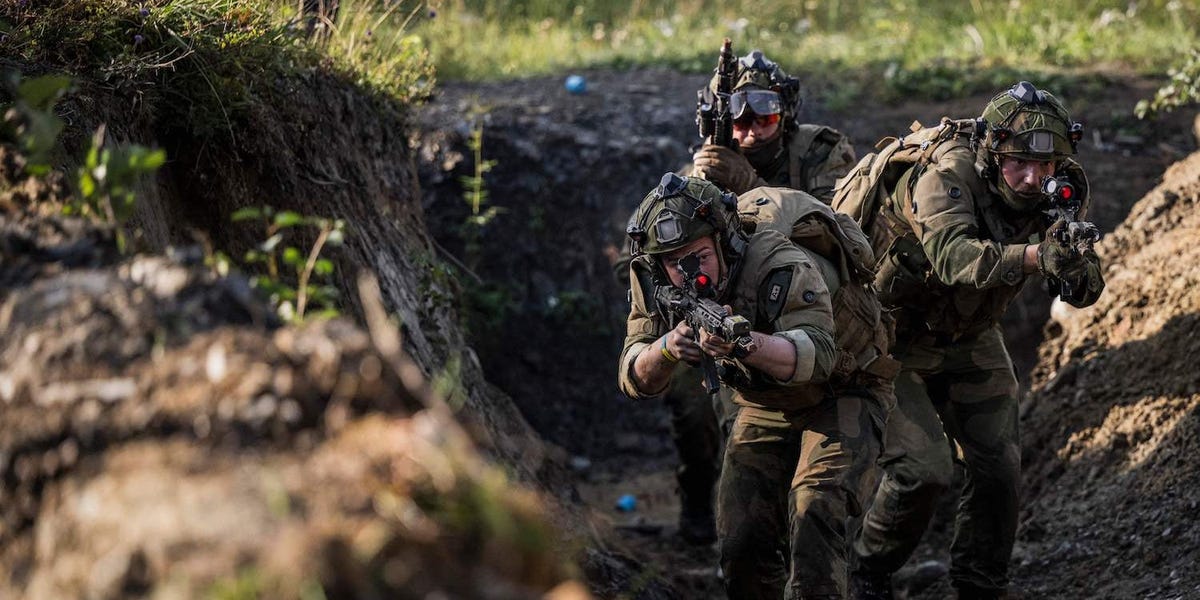
Less than 5% of tanks destroyed since the start of the war had been taken out by other tanks, Ukrainian officials said in the Journal report, with the rest falling to mines, artillery, antitank missiles, and drones. This means the relative sophistication of a tank is no longer as important, the paper says.
 www.businessinsider.com
I hope our military is closely following lessons Ukraine is learning right now.
Western-made armor isn't working in Ukraine because it wasn't designed for a conflict of this intensity, Ukrainian analyst says
Sophisticated, Western-made armor is proving inadequate on the battlefield in Ukraine, a military analyst told The Wall Street Journal.
www.businessinsider.com
I hope our military is closely following lessons Ukraine is learning right now.
Well, for militaries it is important not to learn the wrong lesson based on a single conflict.
To understand how this works is, Let's examine the scenarios that we observed in Ukraine campaign.
when a Tank thrusting thoward a well prepared defensive position-
1. first, it has to go through minefield, it is likely there will be some losses from the mines unless you have combat engineering capability.
2. Even if combat engineers succesfully curves out a clear route through the minefield, it would be slim and restricted. And when advancing through it, you can garunteee that you will be spotted by enemy ISTAR, (UAS and forward observers)
And that will immediately bring artillery, which we saw countless times in this conflict. Today's Artillery equipped with digital fire control system has become like a giant sniper gun. (Accuracy is unprecedented)
3. Of course, with artillery there is that deadly loitering ammunition that is loitering around the battlefield.
4. And let us not forget about the army aviation. (Systems like Male UCAVs like TB-2 and Attack helicopters)
5. After that there is mounted and dismounted ATGMs waiting for you down the line.
Finally, if you can survive every other onslaught, then you might meet your actual nemesis. (Another enemy tank)
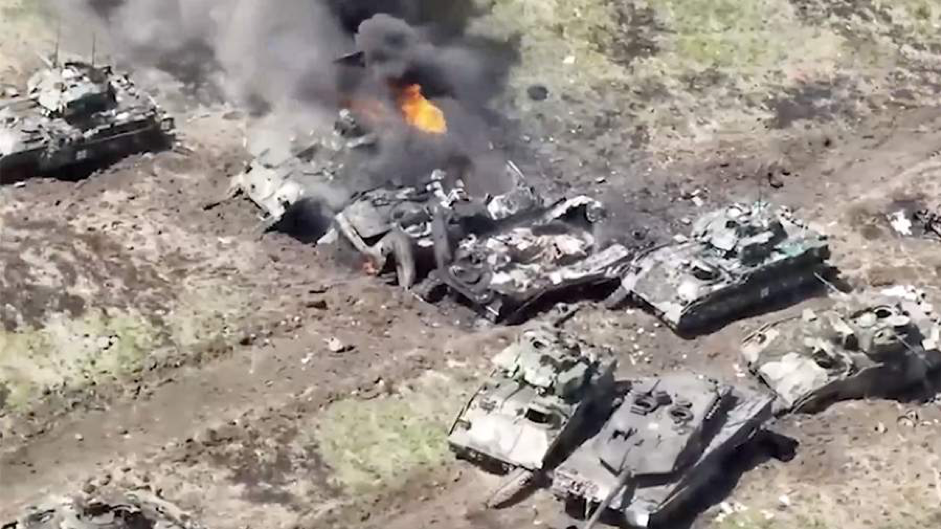
Here is a perfect example of how Russian army puts an entire highly capable Ukrainian Mech/armor company (mostly composed of western vehicles) out of commission without even engaging in tank to tank battle.
 wavellroom.com
Here is an excellent article adequately addressing the whole debate.
To understand how this works is, Let's examine the scenarios that we observed in Ukraine campaign.
when a Tank thrusting thoward a well prepared defensive position-
1. first, it has to go through minefield, it is likely there will be some losses from the mines unless you have combat engineering capability.
2. Even if combat engineers succesfully curves out a clear route through the minefield, it would be slim and restricted. And when advancing through it, you can garunteee that you will be spotted by enemy ISTAR, (UAS and forward observers)
And that will immediately bring artillery, which we saw countless times in this conflict. Today's Artillery equipped with digital fire control system has become like a giant sniper gun. (Accuracy is unprecedented)
3. Of course, with artillery there is that deadly loitering ammunition that is loitering around the battlefield.
4. And let us not forget about the army aviation. (Systems like Male UCAVs like TB-2 and Attack helicopters)
5. After that there is mounted and dismounted ATGMs waiting for you down the line.
Finally, if you can survive every other onslaught, then you might meet your actual nemesis. (Another enemy tank)
Here is a perfect example of how Russian army puts an entire highly capable Ukrainian Mech/armor company (mostly composed of western vehicles) out of commission without even engaging in tank to tank battle.
Tactical Lessons: The Battle at Orikhiv
Tactical Lessons from the War in Ukraine. Sergio Miller analyses the failed Ukrainian advance at Orikhiv. What can we learn?
wavellroom.com
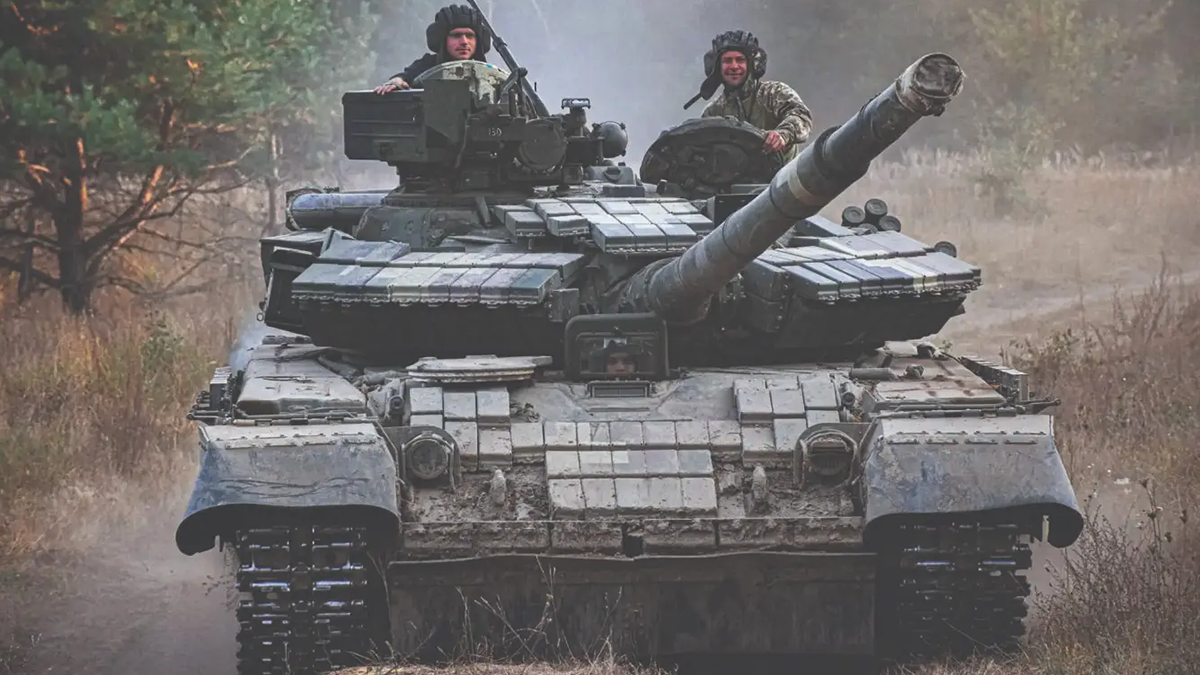
Here is an excellent article adequately addressing the whole debate.
The Tank is Dead … Long Live the Tank
It is premature to draw conclusions on the continued efficacy of tanks and armored formations based on recent conflicts. Tanks will continue to be a tremendous battlefield asset when employed properly.
www.armyupress.army.mil
Last edited:


If you rule the Sky, then you will pick enemy tanks regardless of quality of your tanks. eg Karabagh 2020, Iraq 2003Hence freedom is in the skies. Ruling the sky would enable you to by pass pretty much many stationary hindrances
If Both side doesn't rule the Sky, We are seeing, Quantity is ruling over quality in Ukraine.
So in both Case I don't see truly cutting edge Altay is good for us. We need simpler tank that We can replace all tanks we have m48, m60, Leos. We simple wont be able afford 2000 Altay. Or At Least We need high and Low mix like US air force is trying but Instead of Aircrafts we should plan it for our Tank inventory. At most, 300-400 Altay + 1000-1500 40-45 tonnes medium tank. And Not to mention We about to have the 1000hp engine for such tank.


