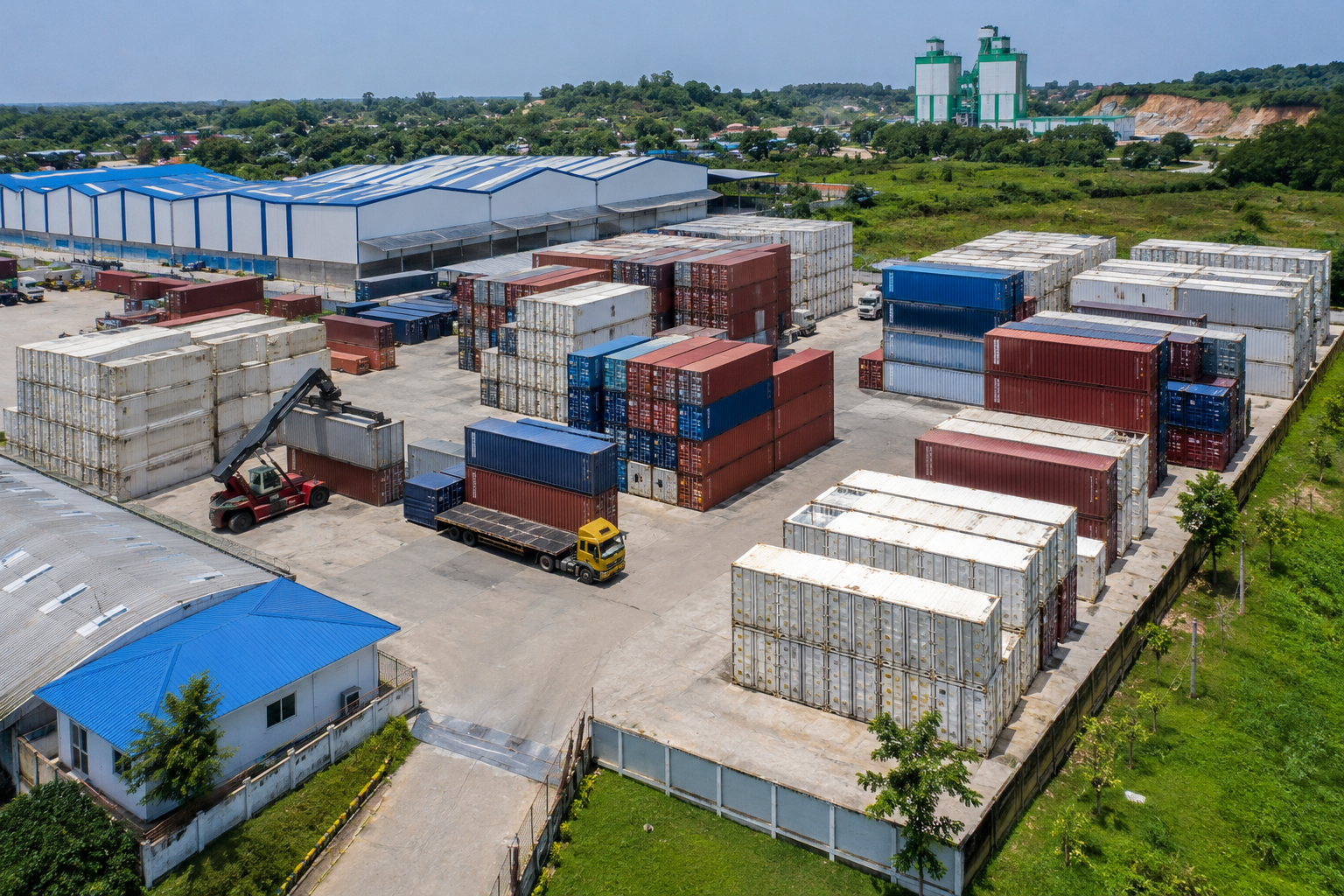
Bangladesh has taken a landmark step toward reshaping its trade landscape, with the Cabinet Committee on Economic Affairs (CCEA) approving the establishment of the country's first-ever Free Trade Zone (FTZ) in Anowara, Chattogram.
The Cabinet Committee on Economic Affairs (CCEA), chaired by Finance Minister Amir Khosru Mahmud Chowdhury, today (17 June) approved such a milestone proposal to establish the country's first Free Trade Zone (FTZ) aimed at boosting trade, investment, and export capacity.
The government hopes the initiative will position Bangladesh as a key player in international trade, supply chain management, and regional logistics. Aimed at boosting trade, investment, and export capacity, the Bangladesh Economic Zones Authority (Beza) has been working for years toward establishing a modern free trade zone in line with international standards.
The establishment of Bangladesh's first Free Trade Zone is being regarded as a landmark step toward the country's economic transformation, enhanced global trade connectivity, and improved regional competitiveness. It is expected to position Bangladesh as a key trade and logistics hub in South and Southeast Asia, according to the press release issued by CCEA.
To that end, a high-level committee comprising ten relevant agencies including the Ministry of Commerce, Ministry of Industries, Finance Division, National Board of Revenue (NBR), and the Ministry of Shipping conducted a comprehensive review of FTZ management systems, laws, policies, incentive frameworks, and operational models from countries around the world, culminating in a detailed report, said the press release.
Based on the committee's recommendations, the Anwara area along the banks of the Karnaphuli river in Chattogram was selected as the most suitable location for the country's first FTZ, taking into account its infrastructure advantages, international trade connectivity, logistics capacity, and potential for future expansion.
The proposed FTZ is expected to open new horizons in international trade and supply chain management for Bangladesh. It is also anticipated to play a significant role in attracting foreign investment, diversifying exports, developing an international logistics hub, and generating employment.
Notably, the establishment of the FTZ had earlier received approval at the 9th meeting of Beza's Governing Board on January 26, 2026.
Reform of the necessary laws and policies is already underway as Beza is currently reviewing and updating a range of legislation, including the Bangladesh Economic Zones Authority Act 2010, Customs Act 2023, Warehouse Licensing Rules 2024, Import Policy Order 2021–2024, Export Policy Order 2024–2027, Foreign Exchange Management Guidelines, National Industrial Policy 2022, and the National Logistics Policy 2024, according to the press release.
Beza believes the FTZ will open new horizons in international trade and supply chain management for Bangladesh, while also attracting foreign investment, diversifying exports, developing an international logistics hub, and generating employment.
It also hoped that the establishment of Bangladesh's first FTZ would be a transformative milestone for the country's economic development, global trade integration, and regional competitiveness helping cement Bangladesh's position as a vital trade and logistics hub in South and Southeast Asia.
Bida and Beza Executive Chairman Ashik Chowdhury said Bangladesh is at the right moment to transition to a free trade zone model.
"The country's growing logistics capacity has created an opportunity to position Bangladesh as a regional warehouse and commercial hub," he said.
He added that exports are being treated as a primary driver of the economy, making the FTZ a natural next step. "This model has been successfully implemented in Dubai, China, and across Southeast Asia — Bangladesh wants to follow that path," he said.
Chowdhury also noted that some budget amendments and changes to the Import Policy Order have already been made in preparation for the FTZ, though further revisions to several laws and regulations remain necessary.
The Bangladesh Economic Zones Authority (Beza) has been working toward establishing a modern free trade zone in line with international standards.

www.tbsnews.net
Highlights:
- Bangladesh targets chip design, testing, packaging; avoids costly fabrication initially
- Government extends semiconductor tax incentives and duty cuts until 2031
- Goal: grow semiconductor exports from $8 million to $1 billion
- Bangladesh produces thousands of engineering graduates supporting semiconductor talent growth
- Local firms already provide international chip design and engineering services
- Skills training, infrastructure, and research investment remain major challenges
Bangladesh has made a calculated bet to leapfrog into the global semiconductor value chain, deliberately bypassing the expensive wafer fabrication race to stake its claim in high-value chip design, testing, and packaging.
Businesses and experts said this targeted, talent-first strategy just received its most significant government support, with the FY2026-27 budget codifying a decade of stability for tech investors.
In a predictable policy move, the government has locked in sweeping customs duty and VAT concessions until June 2031. By extending these exemptions across Electronic Design Automation (EDA) tools, proprietary semiconductor design software, advanced packaging machinery, and specialised testing equipment, policymakers are handing local firms and global entrants the long-term predictability required to scale, businesses said.
The fiscal runway is designed to aggressively fast-track an industry currently generating a modest $8 million in annual exports into a $1 billion powerhouse by 2030. According to the Bangladesh Investment Development Authority (Bida), the blueprint aims to draw foreign and domestic capital into integrated circuit (IC) design, outsourced semiconductor assembly and testing (OSAT), and cutting-edge research and development.
MA Jabbar, president of the Bangladesh Semiconductor Industry Association (BSIA), described it as one of the most important policy decisions for the sector.
"Semiconductor investments, talent development and ecosystem building are long-term endeavours. Companies do not make strategic decisions based on one- or two-year incentives. The extension until 2031 sends a strong signal that Bangladesh is serious about developing a semiconductor ecosystem," he said.
Jabbar said Bangladesh's immediate opportunities lie in IC design, design verification, FPGA and embedded systems, semiconductor testing, packaging and engineering services, rather than wafer fabrication, which requires massive capital investment and decades of technological expertise.
ABM Harun-ur-Rashid, professor of Electrical and Electronic Engineering (EEE), Buet, and a member of Bida's national semiconductor taskforce, said the reduced VAT and customs duties would significantly lower costs for universities, startups and entrepreneurs engaged in semiconductor research and chip design while encouraging investment in OSAT and packaging.
Bangladesh's biggest strength, he said, is its engineering talent. The country produces around 13,000 electrical and electronic engineering graduates and about 26,000 computer science graduates each year, creating a sizeable pool of engineers for semiconductor design and related services.
Prof Harun said the taskforce's roadmap prioritises semiconductor design in the short term, testing and packaging in the medium term and wafer fabrication only as a long-term objective.
That strategy is already beginning to take shape. Companies such as Ulkasemi, Neural Semiconductor, Prime Silicon Technology and Siliconova are providing semiconductor design and engineering services to international clients.
Siliconova, for example, offers services ranging from Register Transfer Level (RTL) design and design verification to physical design, analog and mixed-signal layout, RF design, firmware development and chip packaging.
"Bangladesh currently participates in semiconductor design services and is now working towards chip testing and packaging services," said Md Shafil Hosain, director and technical programme manager at Siliconova.
Shafil said Bangladeshi engineers are already working on advanced chip design projects spanning technology nodes from 180 nanometers to two nanometers. He argued that the biggest misconception is that Bangladesh must first build an expensive fabrication plant, whereas the global semiconductor value chain begins with chip architecture, design, verification and intellectual property development – areas where the country can already compete.
Despite the policy momentum, experts say incentives alone will not be enough.
Prof Harun noted that although universities produce thousands of engineering graduates annually, most require around a year of specialised Very Large Scale Integration (VLSI) training before they become industry-ready.
He also pointed to a shortage of experienced engineers capable of leading complex chip design projects and called for centres of excellence, stronger university-industry collaboration, wider access to industry-standard EDA tools and sustained government-backed training programmes.
Jabbar identified advanced testing facilities, packaging infrastructure, research funding, stronger intellectual property protection and closer industry-academia collaboration as the next priorities for building a complete semiconductor ecosystem.
He also called for easier access to cash incentives, rent-free land in Hi-Tech Parks for packaging and PCB-related activities, and greater government support to attract foreign investment.
The global semiconductor market, driven by demand for artificial intelligence (AI), electric vehicles, 5G and automation, is projected to surpass $1.3 trillion in 2026, according to market research firm Gartner, and continue its strong growth trajectory toward $1.6 trillion by 2030.
Compared with regional competitors, Bangladesh remains at an early stage. India has committed about $10 billion under its semiconductor mission to build fabrication plants and expand chip design and manufacturing, while Vietnam aims for $25 billion in annual semiconductor revenue by 2030 and $50 billion by 2040, along with 100 design firms, 10 packaging and testing plants, and over 50,000 engineers.
However, Jabbar believes, Bangladesh has the potential to become a regional hub for semiconductor design, verification, testing support and engineering services by 2031. Prof Harun's roadmap is even more ambitious, envisioning at least 50 VLSI design companies, three semiconductor testing facilities, two packaging industries and the country's first global semiconductor design centre by the end of the decade.
Businesses and experts said this targeted, talent-first strategy just received its most significant government support, with the FY2026-27 budget codifying a decade of stability for tech investors
www.tbsnews.net
HigBangladesh has taken a set of policy decisions aimed at accelerating investment and attracting foreign direct investment (FDI), which includes plans to set up a defence industrial park in Mirsarai and to establish the country's first free trade zone (FTZ) in Anwara.
The decisions were approved today (26 January) at a joint meeting of the governing boards of investment-related agencies, chaired by Chief Adviser Professor Muhfammad Yunus.
The meeting also cleared initiatives to revive the Kushtia Sugar Mill, allow economic zones within municipal areas, offer a 1.25% cash incentive on FDI brought in by expatriate Bangladeshis, and reaffirm plans to merge six investment promotion agencies.
Briefing reporters at the Foreign Service Academy after the meeting, Chowdhury Ashik Mahmud Bin Harun, executive chairman of Bangladesh Investment Development Authority (Bida), said several important decisions have been taken to simplify investment procedures and attract foreign investors.
He also noted that holding a meeting often takes a long time because there are many boards related to investment that need to be coordinated. "This is only the second such meeting during the tenure of this government."
Defence industrial park in Mirsarai
Ashik said one of the key decisions at the meeting was to repurpose land earmarked for a foreign economic zone into a defence industrial park.
He said about 850 acres in Chattogram's Mirsarai area would be designated as a defence industrial zone. The land had previously been allocated for an Indian economic zone, but the project was cancelled, leaving the site available for reuse.
The area will now be included in Bangladesh Economic Zones Authority's master plan as a defence industrial park, he added.
"In the current global context, demand for defence products is rising, and supply constraints have highlighted the importance of having domestic production capacity," he said.
Responding to questions about investment and operations, he said Bangladesh currently has one state-run arms manufacturing facility, but the new zone would be developed by the private sector with both local and foreign investment. "Defence equipment produced here will be exported abroad," he added.
First free trade zone planned in Anwara
Beza's governing board also gave policy-level approval to introduce free trade zones in Bangladesh for the first time. There is currently no FTZ framework in the country.
An FTZ allows goods to be stored, processed, manufactured and re-exported without customs duties, effectively operating as a deemed overseas territory.
Ashik said an FTZ would strengthen Bangladesh's position in global supply chains. As a first step, around 600 to 650 acres in Anwara, Chattogram, have been identified for the project. Following policy approval, the proposal will be placed before the cabinet for final clearance.
To explain its importance, he gave the example of cotton imports for the garment sector.
"At present, cotton from the United States takes a long time to arrive, which limits its use in the garment sector. If that cotton can be stored in a free trade zone in Bangladesh, it can be quickly re-exported to Bangladesh or other countries as needed," he said.
He added that during the board meeting, Dubai's Jebel Ali Free Zone (Jafza) was cited as a successful global example. Jafza alone handles about $190 billion in trade annually and contributes around 36% to Dubai's GDP.
Policymakers expect Bangladesh's free trade zone to emerge as a future hub of trade and economic activity, he said.
Move to revive Kushtia Sugar Mill
The meeting also took a policy decision to revive the Kushtia Sugar Mill.
Ashik said many of the country's sugar mills have been running at a loss for years, prompting discussions on their effective use. The Kushtia Sugar Mill area already has gas, electricity and road infrastructure, making it suitable to be brought under an economic zone and used for new industrial activities.
Policymakers believe the initiative could create jobs in the south-western region and ensure productive use of more than 200 acres of land, he added.
Meanwhile, another important decision was to allow the establishment of economic zones within municipal areas.
The Bida executive chairman said the 2012 law had excluded municipal areas from economic zones. However, with the number of municipalities rising to 331, setting up zones outside towns has increased pressure on agricultural land.
As a result, a policy decision has been taken to allow economic zones to be set up within municipal areas by bringing closed or abandoned industrial units back into economic use, he added.
1.25% cashback on diaspora-led FDI
The governing board of the Bida also approved a policy to offer a 1.25% cash incentive on FDI brought in through expatriate Bangladeshis.
At the press conference, Ashik said the aim was to leverage the international networks of expatriates to attract foreign investors. "Expatriates can play a role by introducing their business contacts to Bangladesh," he said.
He explained that if an individual brings $100 million in foreign investment to the country, the government would provide $1.25 million as a cash incentive, structured similarly to existing remittance incentives.
He also said a decision had been taken to open Bida sub-offices abroad, including in China, South Korea and Japan.
"These offices will be run by local people of those countries, more like agencies. If they succeed in bringing in FDI, the 1.25% incentive paid by the government will cover their operating costs," he said.
The meeting also reiterated the policy decision to merge six investment promotion bodies – Bida, Beza, Bepza, the Hi-Tech Park Authority, the PPP Authority and Bscic – in the future.
An independent third-party consultant will be appointed to design the framework for the merger, the Bida executive chairman said.
The state also plans to launch country’s first free trade zone in Anwara
www.tbsnews.net