


Americans of course, they work together. MIT, obviously. Iraqi? I don’t know. UAV? I don’t know.You think the Americans,some Iraqi higher ups,UAE and even our MIT didnt know?

Latest Thread
- Bangladesh Opinion Bangladesh’s intelligence challenge
- Iran’s Long Game in Türkiye: From Political Islam to the Post-Erdoğan Era
- Open-source AI for exploiting cyber vulnerabilities
- Engineering Atomic Machines: Matter Compiler
- Breaking News Turkish and Greek defence officials meet for "Confidence Building Measures"
You are using an out of date browser. It may not display this or other websites correctly.
You should upgrade or use an alternative browser.
You should upgrade or use an alternative browser.

Interesting that Israel can build a airspace on Iraqi soil. And no one knows.
So no one knows, except MIT, CIA and MOSSAD ? You're telling me Iraqi don't know whats going on in their own soil for goodness sake??Americans of course, they work together. MIT, obviously. Iraqi? I don’t know. UAV? I don’t know.
So no one knows, except MIT, CIA and MOSSAD ? You're telling me Iraqi don't know whats going on in their own soil for goodness sake??
Counter question. Do you think Iraq has full control over its whole soil and know what’s going on over their?
Last edited:

Ultra Left separatist terrorist organizations like the PKK/YPG and their ilk have only themselves to blame—what did they think, that their ideology would genuinely interest any institution in the world, other than themselves? The Americans and the Israelis don’t give a damn fucking shit about what they’re fighting for; the PKK has now realized that it’s pointless and that they aren’t the political voice of all Kurds in Turkey, Iraq and Syria, and they must surrender their weapons; I hope this will continue to be pushed forward over the coming months and years so that the organization dissolves completely.
For my part, however, I hope that the YPG fights against Iran; let them bash each other’s heads in—that would only weaken both sides. The only important thing is that the border with Iran is monitored extremely closely so that the conflict doesn’t spill over.
For my part, however, I hope that the YPG fights against Iran; let them bash each other’s heads in—that would only weaken both sides. The only important thing is that the border with Iran is monitored extremely closely so that the conflict doesn’t spill over.
"I’m not sure if the “delegation” from Belgium has been fully described. We’re talking about a delegation of over 420 people. They came representing around 200 companies and organizations. As far as I know, nearly a quarter of the delegation is here to assess the defense industry."
Indeed, this is nigh unprecedented. It's being led by the queen consort, foreign and defence ministers.
Indeed, this is nigh unprecedented. It's being led by the queen consort, foreign and defence ministers.

So the Turkish navy command will provide protection. Two more corvettes should be added to the order book. lol
A strategic alignment with Algeria, primarily based on security and energy, can provide both countries with leverage far greater than anyone could have predicted.I like the idea.
Algeria and Türkiye deepen ties, with an emerging chance for Algeria to join the Türkiye-Saudi Arabia-Pakistan-Egypt axis
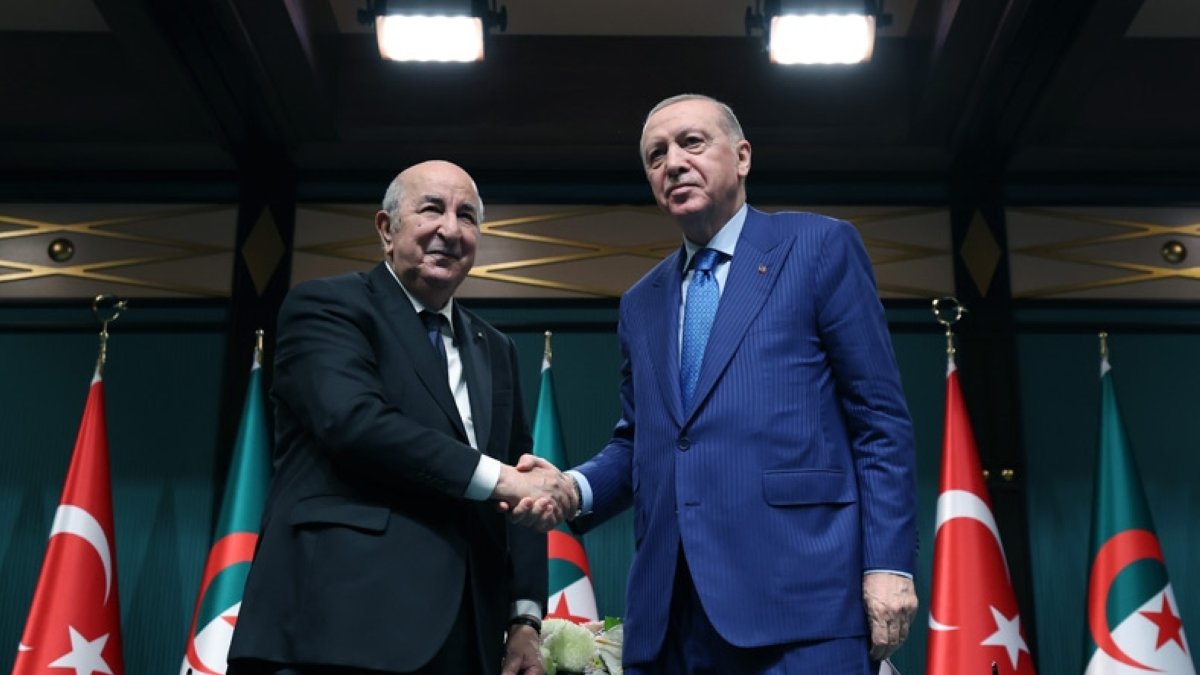
Algeria and the rising Middle East power axis: What’s next? | Opinion
Algeria and Türkiye deepen ties, with an emerging chance for Algeria to join the Türkiye-Saudi Arabia-Pakistan-Egypt axiswww.dailysabah.com


Watched some of this last night. Mike can read a situation better than anyone else.
I think Israel lost a lot of support from Turks by arming Greece and especially due to their social media onslaught against us. People who previously didn't give a shit or were leaning pro-Israeli became anti-Israel.

Watched some of this last night. Mike can read a situation better than anyone else.
I think Israel lost a lot of support from Turks by arming Greece and especially due to their social media onslaught against us. People who previously didn't give a shit or were leaning pro-Israeli became anti-Israel.
That American is trying to explain to that delusional zionist why they can not attack Turkiye and why they should not, he explained in several videos but zionists they are thinking realy it is possible
 . Sometimes i watch ther video to measure the situation in israel. And what a fak place.
Türkei: Sollte Deutschland hier Waffen & Munition kaufen?
Die Türkei drängt mit aller Macht auf den internationalen Rüstungsmarkt – mit Raketen, Drohnen und Munition – sollte Deutschland kaufen?
 defence-network.com
Should Germany invest Weapons & Ammunitions in Turkey?
Weapons & Ammunition: Should Germany Buy from Turkey?
Navid Linnemann
Head of Online Editorial
[email protected]
Amidst drone volleys and the thunder of rockets, Turkey showcases its capabilities at EFES 2026—and demonstrates what Germany urgently needs. While Erdoğan’s police storm opposition offices, Berlin is allegedly interested in Turkish intercontinental ballistic missiles. An exclusive look behind the scenes of Turkey's largest military exercise, the record-breaking SAHA 2026 defense expo in Istanbul—and at a dilemma of German security policy: Can you buy weapons from an autocrat when your own security depends on it?
In May, Turkey demonstrated its newfound strength as a defense industry nation on multiple levels. The climax took place during the EFES 2026 exercise.
Photo: CPM / Navid Linnemann
- From Dependence to Autarky – Erdoğan’s Defense Revolution
- Record after Record – The Turkish Defense Industry
- The Uncomfortable Question of Quality
- Closing the Security Gap: What Germany Needs Now
- Is Germany Also Buying High-Tech Rockets from Turkey?
- A Topsy-Turvy World: Germany as a Buyer Instead of a Seller
- Doing Business with an Autocrat – The Poisoned Partnership
- Between Necessity and Morality – Germany’s Dilemma
The bang is deafening; the shockwave shifts camera tripods. Across the expansive Doğanbey training and firing range—a few kilometers south of Izmir—volleys of heavy artillery thunder over the hills first, followed by attack helicopters firing air-to-ground missiles, accompanied repeatedly by applause from the audience. Turkey is firing its way through its current ammunition portfolio.
It is the first evening of the two-day closing exercise at EFES 2026, Turkey's largest multinational military exercise. More than 10,000 soldiers from Turkey and partner nations have participated in recent weeks. The closing exercise is a pure spectacle designed to leave the guests, who have arrived from 50 nations, in awe.
What the Turkish Armed Forces present in live-fire drills, and what the domestic defense industry showcases on the adjacent exhibition mile, is impressively versatile: The Korkut air defense system, with its twin 35mm guns, fires programmable airburst ammunition at drone targets. Self-propelled artillery systems, mortars, armored vehicles, ships, landing craft, and drones of various types—all "Made in Turkey," as the organizers never tire of emphasizing.
The name hints at it: Roketsan offers a large assortment of rockets and guided missiles—including the Tayfun Block 4 (here in the foreground at SAHA 2026).
Photo: CPM / Navid Linnemann
A week earlier—at SAHA 2026 in Istanbul—the message was even clearer: The Turkish defense industry has transformed from an importer into a global player. The share of domestically produced defense equipment has reportedly risen from around 20 percent in the early 2000s to 83 percent today. In terms of exports, the southeastern European country broke through the ten-billion-US-dollar threshold for the first time last year. Products whose latest iterations were displayed with immense pride in Istanbul and near Izmir.
Over 150,000 visitors flocked to the six-day exhibition; export contracts worth around 8 billion dollars are said to have been signed there. Purchasing delegations from Africa, South America, and large parts of Asia crowded between the exhibition booths. Turkey has something to offer—and it wants to sell.
To Germany, too.
From Dependence to Autarky – Erdoğan’s Defense Revolution
The transformation of the Turkish defense industry is unprecedented. What began in the 1970s with the founding of Aselsan has experienced a dramatic acceleration under Erdoğan’s government since 2003. According to official figures, state spending on defense research and development tripled between 2007 and 2019. The reasons for this lie in Turkish history—and in the fact that the country is urgently dependent on foreign funds due to numerous economic and currency crises.
The Executive Committee of the Turkish Defense Industry is chaired by President Recep Tayyip Erdoğan.
Photo: Communications Office of the Turkish Presidential Administration
A turning point in Turkish defense industrialization came in 1974 when the US imposed an arms embargo in response to the Turkish military invasion of Cyprus. From the Turkish perspective, the lesson back then was clear: anyone dependent on foreign suppliers can be politically blackmailed. It is a lesson that many other European states are relearning today regarding US systems and Chinese supply chains.
According to Haluk Görgün, President of the Turkish Defence Industry Agency (Savunma Sanayii Başkanlığı, SSB), the flourishing industry generated revenue exceeding 20 billion US dollars for the first time in 2025. This has turned the Turkish defense industry, with its more than 4,000 companies and over 100,000 employees, into a core sector of the Turkish economy.
Internationally, five Turkish defense companies now rank among the top 100 in the world: Aselsan (43rd), Turkish Aerospace Industries (47th), Roketsan (71st), Asfat (78th), and MKE (80th). By comparison, Germany only has four companies on this list: Rheinmetall (20th), Hensoldt (52nd), Diehl (82nd), and Renk (95th). However, European joint ventures such as Airbus, MBDA, and KNDS are not counted toward Germany.
Record after Record – The Turkish Defense Industry
In 2025, exports by the Turkish defense and aerospace industry reached a record 10.54 billion dollars, representing a 48 percent increase over the previous year. Turkey ranks 11th globally among arms exporters. This significant boom in the defense sector is also reflected in total exports: its share stood at 3.6 percent in 2025, compared to just 1.7 percent in 2022. By comparison, the defense share of German exports in 2025 was approximately 0.84 percent.
Turkish bestseller: TB2.
Photo: CPM / Navid Linnemann
The best-known systems of Turkish production are undoubtedly the drones from the Istanbul-based company Baykar Technologies—which, interestingly, is not among the international TOP 100. However, its HALE and MALE drones have effectively demonstrated their capabilities in conflicts ranging from Azerbaijan and Libya to Ukraine.
Yet the portfolio of the Turkish defense industry is much broader: from textiles and individual system components to sensors, ammunition, tanks, and the independently developed Kaan fighter jet. Turkey can already do a lot, and it is doing more every year.
The Uncomfortable Question of Quality
However, the crucial question for any potential buyer remains: Do Turkish systems deliver what they promise? The answer is complex: Turkish drones and weapons systems have been combat-tested in real operations—in Syria, Libya, Nagorno-Karabakh, and Ukraine. The Bayraktar TB2 proved to be a cost-effective and efficient weapon against older air defense systems.
However, limits also became apparent: Today, Turkish drones are no longer used on the Ukrainian front lines. Russia has learned to neutralize them, and innovation cycles in Turkey are not on par with Ukrainian developments.
In the field of short-range drone defense, Aselsan's Korkut system is worth noting. It was deployed to Libya in January 2020 to counter hostile drones. There is little independent data regarding its actual effectiveness in combat.
When it comes to missiles, things get even more difficult. According to its own reports, Turkey conducted a successful test of the upgraded Tayfun missile in October 2025. The test reportedly demonstrated extended range, high-precision strike capabilities, and hypersonic performance. The test was heavily promoted in the media (see video below). Just how good and accurate the technology truly is cannot always be verified beyond doubt by observers.
Click here to accept marketing cookies and enable this content
There are skeptical voices at the Istanbul exhibition and also among observers of the "EFES 2026 performance showcase." For instance, actual ranges, payload capacities, and advanced features like maneuverability or techniques to bypass defense systems remain unpublished by the manufacturer Roketsan, raising doubts about various performance claims.
The truth likely lies somewhere in the middle: Turkey has developed functional systems that are effective in certain scenarios. Whether they meet the highest Western standards is unclear. For many buyers—especially in regions with limited budgets—the price-to-performance ratio is more critical than absolute peak performance.
Another issue is the question of genuine domestic development. Although the label on Turkish defense goods is always "milli ve yerli" (national and indigenous), critics point out that many Turkish systems are based on foreign technology or at least contain foreign components.
The Kaan fighter jet, for example, still uses US engines for its flights so far, as the Turkish TEI-TF35000 engine is not yet finished.
The name hints at it: Roketsan offers a large assortment of rockets and guided missiles—including the Tayfun Block 4 (here in the foreground at SAHA 2026).
Photo: CPM / Navid Linnemann
Closing the Security Gap: What Germany Needs Now
Back to Doğanbey on the Turkish Aegean coast. Among the international guests are also German staff officers. Attending EFES as observers, they have been in the country for some time. The Bundeswehr, according to the assessment of one officer, should take a closer look at Turkey.
There are areas where Germany is hitting capacity limits, but Turkey can deliver quickly. 155mm artillery ammunition is a good example. Turkey can deliver on short notice through several companies that produce to NATO standards. For other defense goods, however, the German soldier estimates that Turkey is still much further behind than people in Ankara care to admit.
One of Turkey's leading defense manufacturers—MKE—presented excerpts from its ammunition portfolio in Istanbul.
Photo: CPM / Navid Linnemann
For Germany, however, the urgency is real. Even with special funds, the suspension of the debt brake, and massive investments in industry, Germany will not be able to close all gaps simultaneously. Added to this is an increasingly clear loss of US reliability.
Since Chancellor Friedrich Merz noted a "deep ditch" between Europe and the US at the Munich Security Conference in February 2026 and called for "change, upheaval—and yes, even sacrifices," Germany has been feverishly searching for ways to increasingly strengthen its military capabilities without the United States.
Is Germany Also Buying High-Tech Rockets from Turkey?
Just how necessary this is became clear with US President Donald Trump’s reversal in early May of the agreement between Joe Biden and former German Chancellor Olaf Scholz—allegedly due to remarks made by the former German Chancellor, but more likely due to stockpiles severely depleted by the war with Iran. In any case, American deep precision strike capabilities, such as the Tomahawk cruise missile with a range of up to 2,500 kilometers, are now not going to be stationed in Germany after all—a bitter loss of security for all of Europe given the long-range missiles stationed in Kaliningrad.
Then comes Turkey's entrance: according to a German media report, Berlin is currently "specifically working" on procuring the Turkish Yıldırımhan intercontinental ballistic missile, which allegedly boasts a range of 6,000 kilometers. However, this missile was only unveiled two weeks ago at SAHA and is still under development (Defence Network reported). The Tayfun Block 4 hypersonic missile, which is also still under development, is also said to be a focus for German procurers.
Spokesman for the Turkish Armed Forces, Flotilla Admiral Zeki Aktürk, at the weekly press conference—this time in front of the Doğanbey training grounds.
Photo: CPM / Navid Linnemann
Yet when asked, the spokesman for the Turkish Armed Forces, Flotilla Admiral Zeki Aktürk, plays it down: "There are no specific talks regarding Tayfun missiles or other missiles with Germany." However, the media report from Germany suspects an announcement of the deal could come as early as this year's NATO summit in Ankara—in two months. Admiral Aktürk did at least attest to Germany's interest in closer relations with his country, adding: "We will see together in the coming period how this develops."
The explosiveness of this can hardly be overstated: a Turkish intercontinental ballistic missile with a range of 6,000 kilometers would reach not just Moscow, but large parts of Russia, regardless of whether it is stationed in Germany or in NATO partner Turkey. By purchasing it, Germany would make itself more independent of American weapons systems—but would simultaneously enter into a strategic dependency on Turkey, which was already proven to be a bad idea during the 2016 refugee agreement.
A Topsy-Turvy World: Germany as a Buyer Instead of a Seller
Trade relations between Germany and Turkey in the defense sector (and beyond) are already substantial—though primarily in one direction. Turkey was one of the largest buyers of German defense goods in 2025.
According to the Stockholm International Peace Research Institute (SIPRI), Germany was the largest supplier of major conventional weapons to Turkey in the 2021–2025 period, accounting for 31 percent of Turkish arms imports, followed by Spain with 29 percent and Italy with 19 percent.
Yıldırımhan – with it, Turkey demonstrates its capability to build an intercontinental ballistic missile. The inscription at the tip is the signature of Mustafa Kemal Atatürk, the founder of modern Turkey.
Photo: CPM / Navid Linnemann
This one-sided relationship could change. "The geopolitical and geostrategic importance of the Republic of Turkey is increasing by the day and will continue to grow," said Flotilla Admiral Aktürk.
By importance, the military spokesperson explicitly meant not only Turkey's position on the map and its role in NATO, but also its very rapidly growing defense industry. From Turkey's perspective, it is therefore only logical if Germany and other European nations go on defense shopping sprees in Turkey in the future.
Doing Business with an Autocrat – The Poisoned Partnership
And this is where it gets tricky. Even if Turkish systems impress technically and are attractively priced—the political framework conditions remain highly problematic. Just yesterday, another fracture occurred in the decay of Turkish democracy: police stormed the offices of the main opposition party, the CHP, firing tear gas and rubber bullets at supporters and party officials.
Prior to this, a court had removed the incumbent party leader, Özgür Özel, due to allegations of manipulation during his election three years ago, replacing him with an unpopular predecessor.
Furthermore, the popular mayor of Istanbul and most promising challenger to President Erdoğan in the upcoming 2028 election, Ekrem İmamoğlu, has been on trial since March 2026 over alleged corruption charges—just like party leaders of other parties and dozens of opposition mayors and political actors across the country.
Erdoğan’s ruling AKP has not led the CHP in any poll for over two years; his voted removal in a free and fair election would be highly probable due to the ongoing economic crisis in the country.
Imprisoned in Turkey since March 2025: Istanbul's Mayor and strongest challenger to President Recep Tayyip Erdoğan: Ekrem İmamoğlu.
Photo: CHP
Added to this are geopolitical gray zones: Turkey is a NATO member but maintains close ties with countries that Western partners view critically. Erdoğan has received Hamas leaders in Ankara.
Turkey continues to maintain relations with Russia and its ruler Vladimir Putin. In Syria, Turkey supports Islamist militias that are viewed skeptically by Western partners. For the first time, elements of the Syrian armed forces and forces from war-torn Libya also participated in the EFES exercise near Izmir, as Flotilla Admiral Aktürk highlighted.
Critics also point out that Erdoğan’s inner circle profits from the defense industry. Selçuk Bayraktar, co-founder of Baykar Technologies, is Erdoğan’s son-in-law. In Turkey, the boundaries between state, economy, and family are blurring, mirroring trends seen in Russia and increasingly in the US.
Between Necessity and Morality – Germany’s Dilemma
Germany faces a dilemma. On one hand, the Bundeswehr has real needs that the domestic industry cannot meet in the short term. The Turkish defense industry offers solutions that function technically and are significantly cheaper than Western and Central European alternatives. Turkey is a NATO partner and strategically important for European security.
On the other hand, Turkey under Erdoğan has turned into an autocratic state that interprets NATO solidarity selectively and pursues its own geopolitical interests, which do not always align with Germany's.
On a hill near Izmir, the Turkish national flag is painted on the ground on a large scale; underneath it reads: "GÜÇLÜYÜZ – CESURUZ – HAZIRIZ" ("We are strong – We are brave – We are ready").
Photo: CPM / Navid Linnemann
So, should Germany buy weapons and ammunition from Turkey? It remains a question that must be answered not just technically, but above all politically and strategically. Anyone buying Turkish defense equipment strengthens a regime that has been disregarding democratic standards for a long time. At the same time, given the current security situation, Germany can hardly afford to pass up functioning and available weapons systems.
The Turkish military exercise EFES—referred to by the Turkish press as a "gövde gösterisi" (show of force)—concluded this week. The clatter of helicopter rotors and the impacts of artillery still echo over the hills of Doğanbey, even as the first holidaymakers begin to occupy neighboring beaches: Wednesday marks the start of the Islamic Feast of Sacrifice (Eid al-Adha), giving Turkish workers a nine-day holiday.
Whether this applies to the defense industry is unclear. After all, its systems are selling more and more. The question is not whether Turkey will establish itself on the world market. The question is whether Europe and Germany can find an answer on how they want to handle this new, self-confident, and politically complicated player on the international arms market.
I read the recent article by Defence Network regarding the dilemma of German security policy and potential ammunition and weapon purchases from Turkey. In my opinion, while the article does a good job of addressing the current symptoms, the whole situation needs to be viewed in a much broader, Realpolitic context.
Here is my detailed analysis of the strategic transformation Turkey has undergone in recent years, and why this course is absolutely irreversible:
1. The End of Moral Foreign Policy: Everything Becomes Transactional
We need to be honest with ourselves: moral and normative criticism from the West will fade away to the exact same degree that money, influence, and hard security interests come into play. We have already seen this historically with China, Japan, Southkorea, India and Saudi Arabia, and others. The less susceptible Turkey is to coercion—and it was subjected to this kind of political leverage for decades—the more pragmatic the relationship becomes. When Germany faces acute gaps in its defense and Turkey possesses NATO-certified capacities that are ready for immediate delivery, morality yields to Realpolitic. Relationships become purely transactional: value for value.2. The Historical Lesson: Turkey Was Forced Into This Path
Ankara has learned from history. No matter how extensive the reforms were over the decades, or how long they sat patiently in the EU waiting room—there was never any genuine, cooperative feedback from the other side. At the very latest, since historical wake-up calls like the US arms embargo following the 1974 Cyprus crisis, it was clear: if you depend on others as an importer, you remain an object of political leverage. The West essentially forced Turkey to embark on this path toward autarky. The increase in the domestic defense production rate from 20% to over 83% (2026) is the logical consequence of this.3. Erdoğan’s Timeline and the "Deep" Military-Industrial Complex
Whatever you may think of Erdoğan, strategically he knows exactly that due to his age and health, he doesn't have much time left. His clear goal is to finalize this transformation within the next 6 to 8 years so completely that it becomes absolutely irreversible—no matter which party or president governs next.A highly flexible, maximally independent technocracy is being established. The goal is to anchor the military-industrial complex (featuring heavyweights like Aselsan, TAI, or Baykar) so deeply into the state's DNA and economy that it remains a dominant, unmovable factor in any future foreign policy decision. The strategic line is to be fiercely preserved, very much modeled after the USA.
4. Geostrategic Inevitability
One must also look at the map: given this geographical and geostrategic position—at the crossroads of Europe, the Black Sea, the Middle East, and Asia—Turkey cannot afford to be a passive "object" of foreign interests. A power vacuum there is impossible. Anyone who cannot defend and assert themselves in this position will be crushed. For Ankara, defense-technological independence is the only way to survive as an autonomous subject in a multipolar world order.The linked article reveals a fascinating paradox: the roles are beginning to reverse. Germany, traditionally the supplier country, is becoming a petitioner or buyer, while Turkey emerges as a self-confident player. Turkey has understood that in modern geopolitics, hard power and independence are far more durable guarantees of influence than hoping for normative recognition.
Last edited:
mehmed beg
Contributor

To think about what in particular?
Nothing new and surprising and that is what Jews think of all people in the world.
As on personal level, well didn't you write in Palestinian forum , though no-one asked you "Man ( 500) is fighting for his country"? No?
So I can say now that Pollard is fighting for his country Vis a Vis of people of your profile???? What it to say there?
Think about the idea that Israel can defeat Turkiye. Curious what Turks here thought.To think about what in particular?
I don't care. You kept changing subject when the thread was about Iran war, not Palestine for few pages.As on personal level, well didn't you write in Palestinian forum , though no-one asked you "Man ( 500) is fighting for his country"? No?
T
TR_123456
Guest
Yes he did,there is some footage of it.


A Turkish-owned cargo ship sailing from Ukraine to Türkiye in the Black Sea was attacked by a Russian drone.
See the post from last year:
Semi related from Barrack's interview with Kathimerini (referred to as K in the piece) after his meeting with Bartholomew.
Tom Barrack in "K": Let's create a new order of things in the Eastern Mediterranean
Manolis Kostidis30.11.2025 • 10:00
The intention of the Trump administration to function as a "bridge" in Greek-Turkish relations, as well as the personal interest of the American president in the reopening of the Theological School of Halki, is conveyed through his interview with "K" by the US Ambassador to Ankara, Tom Barrack
Tom Barrack and Manolis Kostidis outside the Ecumenical Patriarchate, after the meeting of the American diplomat with Patriarch Bartholomew. Mr. Barrack's visit to The Phanar was held on the occasion of the arrival of Pope Leo XIV for the Council of Nicaea.
The intention of the Trump administration to function as a "bridge" in Greek-Turkish relations, as well as the personal interest of the American president in the reopening of the Theological School of Halki, was conveyed through his interview with "K" by the United States Ambassador to Ankara, Tom Barrack.
The conversation took place on the sidelines of Barrack's visit to the Phanar, where he was on the occasion of the Pope's arrival for the Council of Nicaea.
For the first time, in fact, the American diplomat refers to a specific timetable for the opening of Halki in September 2026.
- I wanted to ask you about the purpose of your visit and meeting with the Patriarch Bartholomew.
– The purpose of my visit, of course, is twofold. First, on the eve of the Pope’s presence for the anniversary of Nicaea – 1,700 years later – I want, on behalf of my president, to convey our congratulations, our appreciation and our deep friendship.
The second purpose is that, when His Holiness visited America and the president in the Oval Office, he raised the issue of the Halki Theological School, which is of utmost importance to both President Trump and President Erdogan. So we wanted to follow up on progress and see if there is anything we can do to facilitate, accelerate, support the discussions, with the aim of leading to a possible reopening of the School in September 2026.
So it was an excellent opportunity to be here with the Ecumenical Patriarch and supporters from all over the world, with bishops; I hope to receive some of this grace too.
– Do you know about Greek-Turkish relations? How do you think a road map should be drawn to improve them, especially in the Eastern Mediterranean?
– I think this is starting now. What we see in the world is a new dynamic, an attempt to leave the bitterness of the past aside and create a new framework. And this must start with Greece and Turkey. It makes no sense for two great countries, tied to each other, to still hold disputes over events that happened hundreds or even thousands of years ago.
Communication – Everything starts with communication. And communication is fueled more by prosperity than by fear. If Greece and Turkey come together, think of what could be created – for the people and their dreams.
We have great news America’s ambassador to Greece – she’s a very good friend of mine. We discussed it with President Trump; we wondered if we could act as a “mortar,” like the one that joins two bricks, to bring them closer in a new way, step by step. The time has come. It has to happen. A new regional order, a new way of working together is necessary. And we hope that America can be a bridge. That’s our goal.
– Do you think that creating a forum between the two countries in the Eastern Mediterranean could be a good roadmap?
– Absolutely. 100%. It should. It all starts with communication – and communication is fueled more by prosperity than by fear. If the two countries come together, think of what could be created: for the two countries, for all their people, for all their hopes and dreams. A new network of cooperation in the Eastern Mediterranean – of unity, prosperity, a better life for children. This has to be done.
– You talked about a “formula” from the Caspian to the Mediterranean – a solution you mentioned in an interview. What do you mean?
– I look at the lessons of history – what we have learned from the past. So does my boss. The reason President Trump can have this comprehensive world view is because he studies history. The Spice Road, the Silk Road connected the East to the West through three or four different routes. And on these prosperity roads an osmosis of cultures developed. This can happen again, but it has been blocked by the creation of nation-states after 1919. The idea that each country, each state is governed in a different way has not worked so well.
Cyprus – You cannot have an abscess in the center of an otherwise healthy body. Every part of that body has to be healed. And Cyprus is a crucial part of it. Our hope is that it will be included in the solution.
To create a new model of prosperity, think about it: we have the Caspian Sea with huge reserves of fossil fuels, cut off from the Mediterranean, where Greece and Turkey are the gateway. How is this gateway open? If you get rid of the political complications? And you get rid of the political complications when there is prosperity. That is our hope.
– Is Cyprus important for the region? For solving these problems?
– Of course. You cannot have an abscess in the center of an otherwise healthy body. Every part of that body needs to be healed. And Cyprus is a crucial part of it. Our hope is that it will be included in the solution.

Τομ Μπάρακ στην «Κ»: Να δημιουργήσουμε νέα τάξη πραγμάτων στην Ανατολική Μεσόγειο
Την πρόθεση της κυβέρνησης Τραμπ να λειτουργήσει σαν «γέφυρα» στις ελληνοτουρκικές σχέσεις, καθώς και το προσωπικό ενδιαφέρον του Αμερικανού προέδρου για την επαναλειτουργία της Θεολογικής Σχολής της Χάλκης, μεταφέρει μέσω της συνέντευξής του στην «Κ» ο πρεσβευτής των ΗΠΑ στην Αγκυρα, Τομ Μπάρακ.www.kathimerini.gr
Not much and it is short. He references his disdain for nation states again, mentions again the Zaihanist way of looking at things, that enough capital generation and "prosperity" can solve all issues. This mostly does work in the gulf, but I doubt it will really work on Greece and Turkey. There, US is always the one calling shots, here, Greece can always look to EU, look to Israel, Russia; and Turkey is Turkey.
So very interesting. He surely isn't suggesting the Hellenic Turkish confederation meme, but something very different. Where does this road leads us is anyone's guess.

I personally don't know much about this issue.
Could anyone please explain why this issue is controversial?


