

No, Kaan already got their 1.2B themselves, already allocated.KAAN air superiority, Rafale multi purpose, IFX -21 Patrol n tactical..
Last edited:

Latest Thread
No, Kaan already got their 1.2B themselves, already allocated.KAAN air superiority, Rafale multi purpose, IFX -21 Patrol n tactical..
i mean future fighter inventory..KAAN for those sukhois, Rafale for F 16, Boramae for hawk, T50i.No, Kaan already got their 1.2B themselves, already allocated.

 www.janes.com
 www.armyrecognition.com

 meta-defense.fr

 www.chosun.com
It’s really interesting to see how the development of the X-Band Active Phased-Array Radar has progressed over time! That 2006–2009 study seems to be a pivotal moment in Korea’s radar technology, especially with the creation of the first Active Phased Array Antenna. It's easy to forget that many technologies we take for granted today actually have a long history of research and development behind them.You are right. I misunderstood his question.
A study from 2006 to 2009(T/R Module Development for X-Band Active Phased-Array Radar) led to the creation of Korea's first Active Phased Array Antenna.
View attachment 52428 View attachment 52430 View attachment 52429
T/R Module Development for X-Band Active Phased-Array Radar -The Journal of Korean Institute of Electromagnetic Engineering and Science | Korea Science
본 논문에서는 능동 위상 배열 레이더에 사용되는 X-밴드 송수신 모듈의 설계와 측정 결과에 대해 기술한다. 일반적으로 능동 위상 배열 레이더는 고출력, 낮은 잡음 지수, 높은 TOI(Third Order Intercept), 송수신에서의 충분한 이득을 갖는 반도체 송수신 모듈을 요구한다. 송수신 모듈은 광대역에서 9 W의 출력 특성을 나타낸다. 잡음 지수는 2.8 dB로 낮다. 위상과 이득은 각각 6비트 위상 변위기와 5비트 감쇄기로 조정된다. LTCC(Low Temperature Co-fired Ceramic)을 사용하여...doi.org
I forgot that there was a series of history.
혁신에 대해 이야기하자면, 최첨단 기술을 탐구하는 것을 좋아하고 약간의 스릴을 원한다면 1win betting 카지노에서 베팅을 해보는 것도 좋을 것입니다. 다양한 게임과 훌륭한 보너스를 제공하여 당신의 하루에 짜릿함을 더할 수 있습니다! 여기에서 확인해 보세요


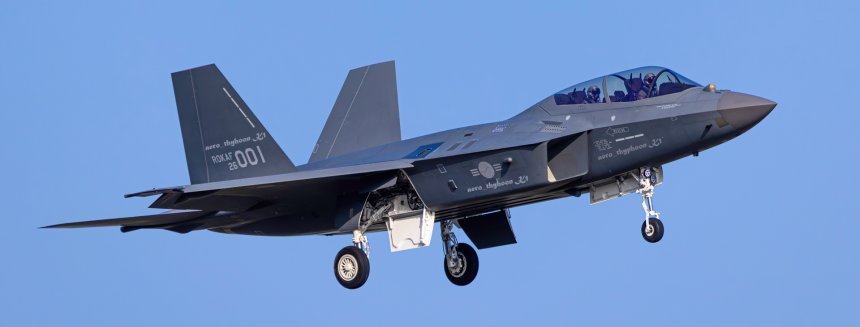
That photo makes me wonder

Congrats to our Korean brothers. In a fairly short time they have a top class 4.5 generation semi stealth aircraft in mass production.That photo makes me wonder
How much is RCS with no weapons
How much is RCS with 4 Meteor semi-recessed
How much is RCS with 4 Meteor on wing pylons


Even KF-21 is a successful and impressive program, that is not mean it has competition with J-35, which is the in-service fighter of PLAAF. For most of country, they also cannot afford the cost for 5 gen stealth aircraft. The true competitor of KF-21 should be Rafale.For China, the emergence of the KF-21 creates serious competition for the export of its own J-35 fighter.
That is not a correct statement,we have seen nothing of the J-35 but we have seen much of the KF-21 Boramae.Even KF-21 is a successful and impressive program, that is not mean it has competition with J-35, which is the in-service fighter of PLAAF. For most of country, they also cannot afford the cost for 5 gen stealth aircraft. The true competitor of KF-21 should be Rafale.
It is still unknown whether other countries outside Pakistan can obtain export licenses for J-35. I donnot think for most of country J-35 is a option, at least now.
My bad,That is not a correct statement,we have seen nothing of the J-35 but we have seen much of the KF-21 Boramae.
So,to call the J-35 5th gen is to soon.
First lets see the J-35 properly.

 www.bizhankook.com

 www.instagram.com
Even KF-21 is a successful and impressive program, that is not mean it has competition with J-35, which is the in-service fighter of PLAAF. For most of country, they also cannot afford the cost for 5 gen stealth aircraft. The true competitor of KF-21 should be Rafale.
It is still unknown whether other countries outside Pakistan can obtain export licenses for J-35. I donnot think for most of country J-35 is a option, at least now.


