
Latest Thread
- Bangladesh Opinion Bangladesh’s intelligence challenge
- Iran’s Long Game in Türkiye: From Political Islam to the Post-Erdoğan Era
- Open-source AI for exploiting cyber vulnerabilities
- Engineering Atomic Machines: Matter Compiler
- Breaking News Turkish and Greek defence officials meet for "Confidence Building Measures"
You are using an out of date browser. It may not display this or other websites correctly.
You should upgrade or use an alternative browser.
You should upgrade or use an alternative browser.


legolas4444
Member
Military technology cooperation between Pakistan and Türkiye will give the Pakistan Air Force real momentum. Türkiye is already at a very advanced level in the field of defense systems, and its experience will provide Pakistan with capabilities featuring the latest technology.


The Pakistan Air Force’s Next Procurement Cycle Starts in 2030 – Why Vendors Need to PreparePro
ByBilal Khan·July 3, 2026·12 min readShare:
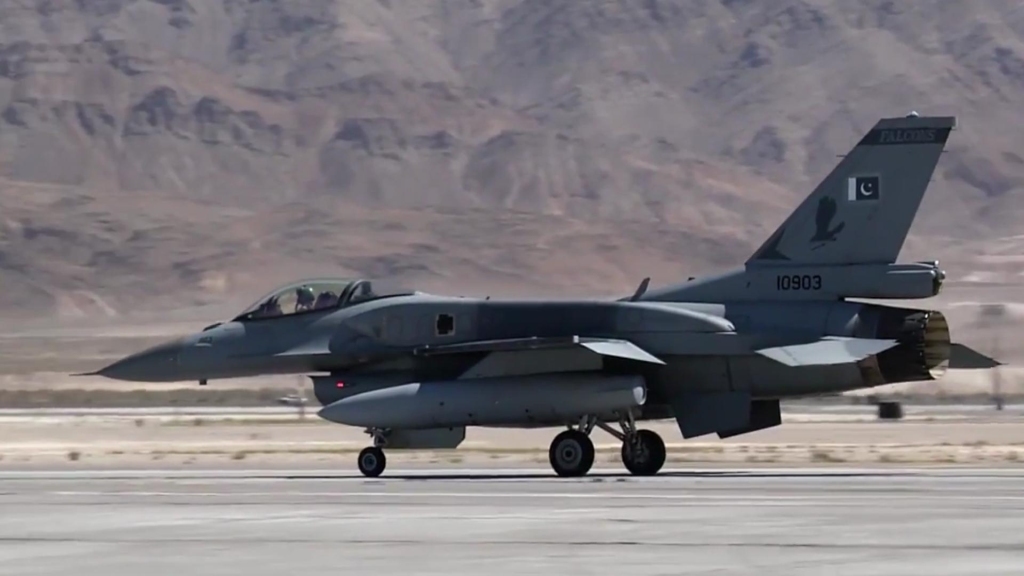
In a recent Defence Uncut podcast, this author had highlighted that the Pakistan Air Force (PAF) was due to enter another major procurement cycle at the end of this decade and through the 2030s.
This idea was drawn from two observations:
First, one of the PAF’s mainstay fighters – i.e., the three F-16A/B Block-15 Mid-Life Update (MLU) and Block-15 Air Defence Fighter (ADF) squadrons – is scheduled for retirement by 2040.
This point was confirmed by a USD $686 million support and upgrade deal signed with the United States in December 2025. Previous reporting and analysis by Quwa estimated that the PAF’s older F-16s would likely be retired through the 2030s as those airframes would begin reaching 50 years during that decade. Unlike the F-16C/Ds, there is no service life extension program (SLEP) available to push these F-16A/Bs past the 8,000 guaranteed hours. In effect, the PAF would be unlikely to safely support these F-16s past 2040, and it is now preparing to find the next-generation fighter aircraft to replace them.
Second, and this ties back to these F-16s, the next fighter will have a particular ‘size of shoes’ to fill, so to speak. To be clear, the question for the PAF is not necessarily about which fighter option is the best in all respects, such as specifications, technologies, maturity, or even cost. Rather, the PAF must assess which option best succeeds the F-16A/Bs in the specific roles those aircraft took on.
On paper, one might conclude that the replacement question is straightforward – i.e., the PAF would need to replace 50~55 F-16A/Bs with ~40 of a proper NGFA. Thus, on this basis, the reports of the PAF seeking the Shenyang J-35AE from the Aviation Industry Corporation of China (AVIC) align quite well. The J-35AE, at this time, represents the only true NGFA platform available to the PAF that would provide a generational leap over the F-16s and, understandably, set the PAF’s procurement trajectory for decades after 2030.
But (and this author’s contention) is that there are aspects to the F-16A/B’s role that do not necessarily render the J-35AE a given. The J-35AE is the leading option; however, the F-16’s (by virtue of its design and generation) high availability rates, relative ease of maintenance, maturity, interoperability with NATO as well as regional partners (e.g., the Gulf Arab States and Türkiye), and serving a bridge to the Western world are all key factors that will be accounted for in the final decision.
Admittedly, the latter two aspects – e.g., ‘bridge to the West’ and interoperability – might be ‘soft’ factors considering the broader trajectory of the PAF’s growing reliance, if not preference, for Chinese solutions.
That said, the ‘soft’ factors can matter in broader contexts. For example, Pakistan could try making the case to Saudi Arabia that operating a common fighter would allow the PAF to immediately integrate with and support the Royal Saudi Air Force (RSAF). The same support can be extended to Qatar, Oman and, not least, Türkiye. It can offer a substantive anchor to the defence agreements being signed and signal to the region that, at any point, the PAF can be an active supporter of its partners with no technical friction.
However, the other aspects of the F-16 are all technical factors, and the PAF will likely prefer a platform that would maintain those qualitative aspects, even when (and this will eventually occur) stealth NGFAs are inducted. In an earlier Quwa analysis, this author posited that stealth fighter-led operations actually necessitate the support of a medium-to-heavy-weight 4.5/4+ generation fighter to maintain higher sortie rates, carry large munition payloads, and deliver after the stealth fighters create their impact (which, by virtue of the stealth fighter’s design – i.e., limited payload – will be narrow). This is why many of the air forces inducting the F-35, for example, operate larger numbers of 4.5/4+-generation fighters, the most notable examples including the United States, Israel, South Korea, Japan, the United Kingdom, Spain, Italy, and even China. And, arguably, Türkiye – which is developing its own stealth NGFA – is investing heavily in both new-built F-16s and Eurofighter Typhoons.
Bilal Khan
Founder of Quwa, Bilal has been researching Pakistani defence industry and security issues for over 15 years. His work has been cited by Pakistan's National Defence University (NDU), the Council of Foreign Relations, Bulletin of Atomic Scientists, Centre of Airpower Studies and many others. He has a Hons. B.A in Political Science and Masters of Interntional Public Policy from Wilfrid Laurier University in Waterloo, Ontario, Canada.

Today in F-16 history
20 Aug 1982
PAF accepts first F-16 from Peace Gate I order.
The Pakistan Air Force (PAF) accepted its very first F-16 Fighting Falcon (tail number 82-601) in August 1982 under the "Peace Gate I" program. The landmark deal involved 40 Block 15 aircraft (28 F-16As and 12 F-16Bs), which formally arrived in Pakistan in January 1983. [1, 2, 3, 4]
20 Aug 1982
PAF accepts first F-16 from Peace Gate I order.
The Pakistan Air Force (PAF) accepted its very first F-16 Fighting Falcon (tail number 82-601) in August 1982 under the "Peace Gate I" program. The landmark deal involved 40 Block 15 aircraft (28 F-16As and 12 F-16Bs), which formally arrived in Pakistan in January 1983. [1, 2, 3, 4]
Last edited:


Today in F-16 history
20 Aug 1982
PAF accepts first F-16 from Peace Gate I order.
The Pakistan Air Force (PAF) accepted its very first F-16 Fighting Falcon (tail number 82-601) in August 1982 under the "Peace Gate I" program. The landmark deal involved 40 Block 15 aircraft (28 F-16As and 12 F-16Bs), which formally arrived in Pakistan in January 1983. [1, 2, 3, 4]
View attachment 82393
I've always wondered if any footage of PAF pilots testing out F-20 tigershark too?
I have a couple of pics. I'll search my archive.I've always wondered if any footage of PAF pilots testing out F-20 tigershark too?
Story of F-20 ‘Tigershark’ Trials by PAF Trying it Out
- August 21, 2023
- By S. Khalil
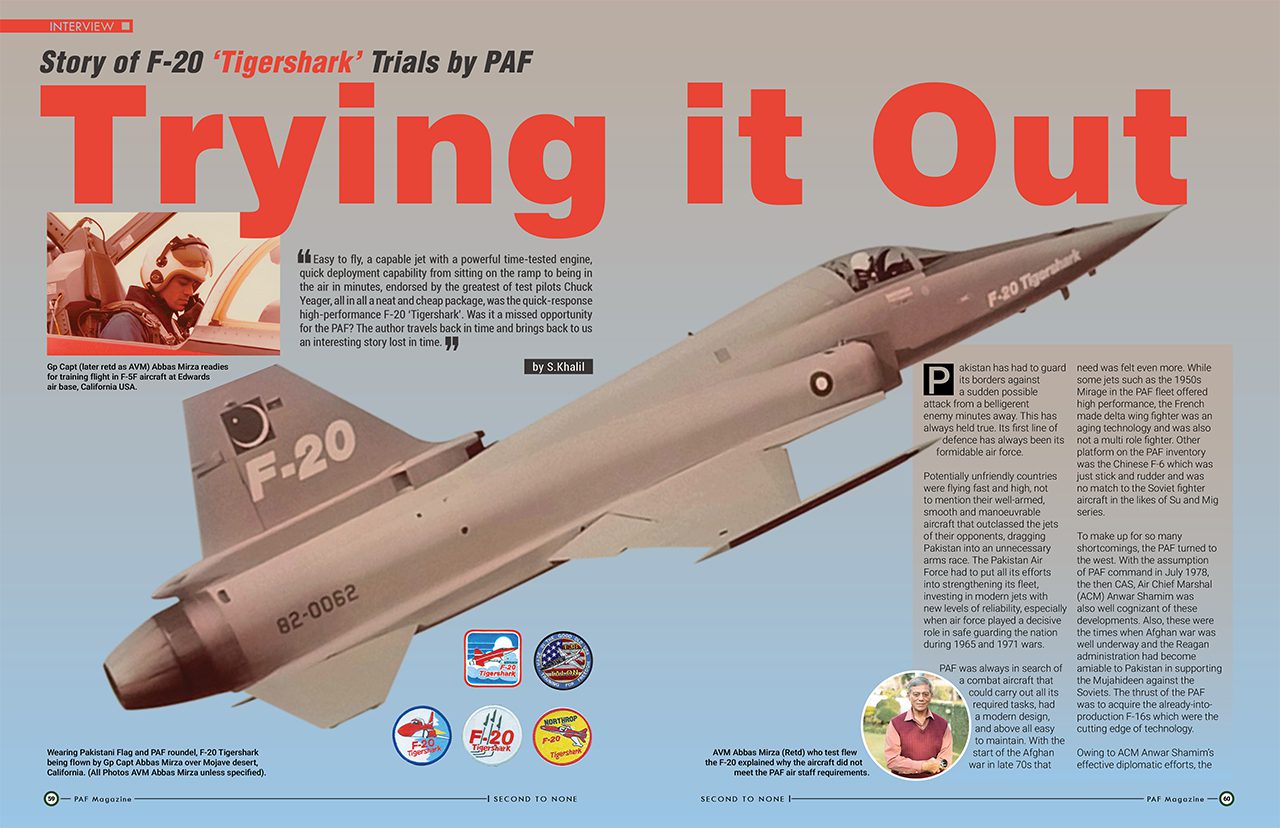
Easy to fly, a capable jet with a powerful time-tested engine, quick deployment capability from sitting on the ramp to being in the air in minutes, endorsed by the greatest of test pilots Chuck Yeager, all in all a neat and cheap package, was the quick-response high-performance F-20 ‘Tigershark’. Was it a missed opportunity for the PAF? The author travels back in time and brings back to us an interesting story lost in time.
Pakistan has had to guard its borders against a sudden possible attack from a belligerent enemy minutes away. This has always held true. Its first line of defence has always been its formidable air force.
Potentially unfriendly countries were flying fast and high, not to mention their well-armed, smooth and manoeuvrable aircraft that outclassed the jets of their opponents, dragging Pakistan into an unnecessary arms race. The Pakistan Air Force had to put all its efforts into strengthening its fleet, investing in modern jets with new levels of reliability, especially when air force played a decisive role in safe guarding the nation during 1965 and 1971 wars.
PAF was always in search of a combat aircraft that could carry out all its required tasks, had a modern design, and above all easy to maintain. With the start of the Afghan war in late 70s that need was felt even more. While some jets such as the 1950s Mirage in the PAF fleet offered high performance, the French made delta wing fighter was an aging technology and was also not a multi role fighter. Other platform on the PAF inventory was the Chinese F-6 which was just stick and rudder and was no match to the Soviet fighter aircraft in the likes of Su and Mig series.
To make up for so many shortcomings, the PAF turned to the west. With the assumption of PAF command in July 1978, the then CAS, Air Chief Marshal (ACM) Anwar Shamim was also well cognizant of these developments. Also, these were the times when Afghan war was well underway and the Reagan administration had become amiable to Pakistan in supporting the Mujahideen against the Soviets. The thrust of the PAF was to acquire the already-into-production F-16s which were the cutting edge of technology.
Owing to ACM Anwar Shamim’s effective diplomatic efforts, the PAF succeeded in procuring the most sought after F-16s from the US. However, their number was limited to only 40, much lesser than the PAF requirement. To augment and complement these handful number of F-16s, PAF needed a low-cost fighter that was state-of-the-art, fulfil all the ASR (Air Staff Requirements) perform variety of roles and was easy to maintain. Initially, three US jets were shortlisted by the PAF, Fairchild Republic A-10 Thunderbolt, LTV A-7 Corsair-2 and the Northrop F-20 Tigershark. All the aerial platforms were potent in their categories, and were also combat proven during various conflicts around the world.
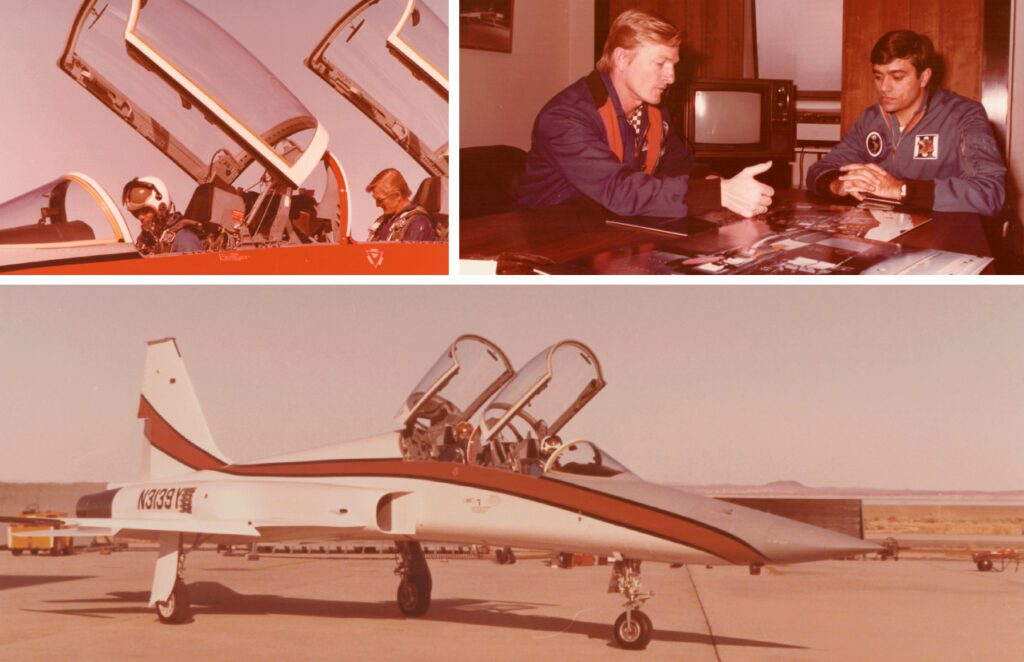
During his visit to the US in the early 1980s, ACM Anwar Shamim, met with representatives from Northrop. The giant jet manufacturers offered the PAF America’s newest and most dependable tactical fighter, the F-20 Tigershark. It came from an impressive lineage of aircraft developed by Northrop. It looked similar to the F-5 and the F-5F, but under the skin it was a very different beast.
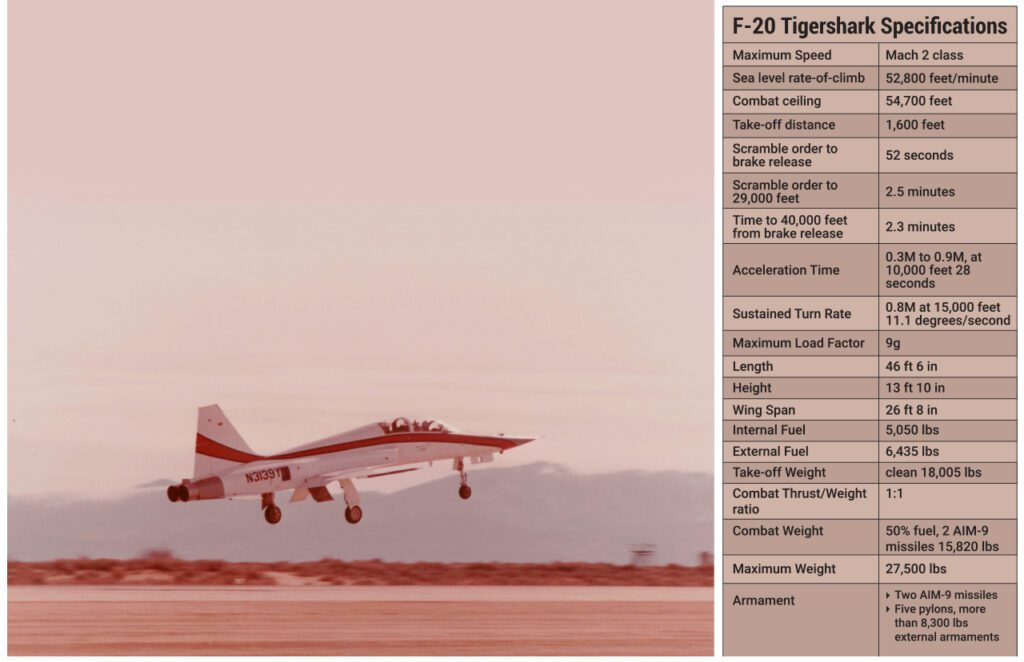
It was the most modern and reliable fighter flying then, with advanced avionics systems and performance needed to dominate the air combat arena. Instead of two, it was fitted with a tested and proven single 404 engine, the same monster that powered Northrop’s reputable F-18 Hornet. The F-20 could launch weapons that the F-16 then could not and came fitted with beyond visual range (BVR) radar when the fighting falcon did not. The Tigershark was going to be a welcome upgrade especially to replace the F-6 and the PAF wanted 100 of them. But it was amazing that a fighter with the fastest scramble time, using half the fuel, several times more reliable than any of its competitors, and less than half maintenance cost, was not adopted by the Pakistan Air Force. What killed the F-20?
The Trials
Between 1982 and 1984, a unique opportunity presented itself to try out the Tigershark. Under special instructions from the CAS, Air Vice Marshal Abbas Mirza (Retd), a Gp Capt then, was sent to US on a special assignment to find out ways and means to modernize PAF’s air defence systems. On his arrival, he was deputed with Northrop, to test fly the F-20 and submit an assessment. Abbas Mirza was to become one of the few test pilots to fly one of the F-20s, of which there were only three in operation for demonstration flying.Early in the morning, they would fly him to the famous Edwards Air Force Base in the middle of Mojave Desert in California, where he got acquainted with the F-5F before conversion to the F-20. From starting to landing, he would get pointers from some of the best American test pilots, who would discuss the aim of every manoeuvre, learning invaluable lessons in extremely detailed briefings.
“My test pilot instructors were highly professional. In no time we developed a good relationship and became close friends. Unfortunately, one of the pilots with whom I flew my first mission later died while performing a F-20 demo flight in South Korea. These are dangers involved in this profession and we have to live with it throughout our careers. I still feel sorry for him,” reminisces AVM Abbas Mirza with a heavy heart.
The ground schooling and training continued for some time. Then came the day Abbas Mirza tested its performance – max take off, rate of climb, max Gs, acceleration, manoeuvrability to whatever limits he could push the Tigershark and not just aerobatics and loops and slow turns etc.
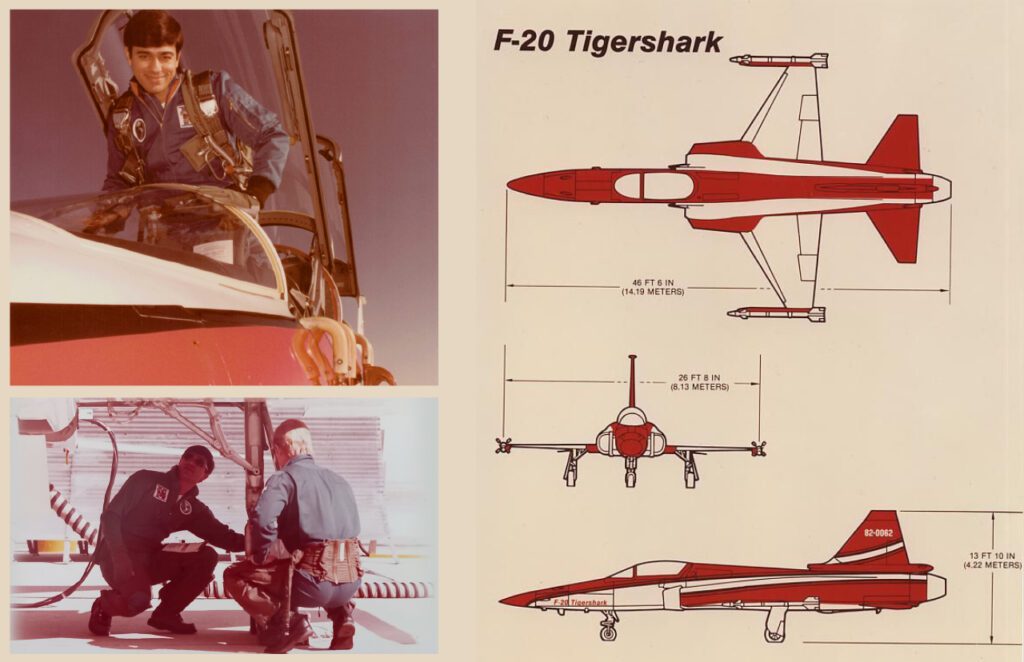
He called it one of the best platforms for defence that could get off the ground, carry modern weapons, manoeuvre rapidly and intercept in a few minutes from a cold start.
“The F-20’s electronics had been updated to levels that in some ways were superior to the first batch of the F-16 delivered to Pakistan in 1982,” Abbas Mirza said looking at some of the pictures of himself sitting in its cockpit and reminiscing.
On September 1, 1984, with an F-5 chase plane, Abbas Mirza flew the first solo mission from Edwards Air Force Base, home to all prototypes and the citadel of all test flights. “I lit the afterburner, got airborne and did a max rate climb at 450 knots and was at 30, 000 feet in less than two minutes. The jet had good acceleration. Then descended to 5, 000 feet for inverted flying and max 9G turns all the time trying to lose the tail aircraft,” he said remembering, what he called was a memorable mission.
On the second one-hour mission, Abbas Mirza tested its handling at slow speeds, formation flying and chasing the lead aircraft.
The Verdict
While there was no doubt that the Tigershark possessed advanced handling characteristics, however, it lacked in some areas in which PAF was primarily interested in. “The main drawback was that I was not able to evaluate its live weapons delivery and weapon control systems because they were not ready at that time. There was no knowing how the aircraft would perform as a weapon system,” Abass Mirza recollects. During his stay at the base, he urged upon the Northrop authorities to let him test the performance of the aircraft while delivering weapons. However, that never materialised.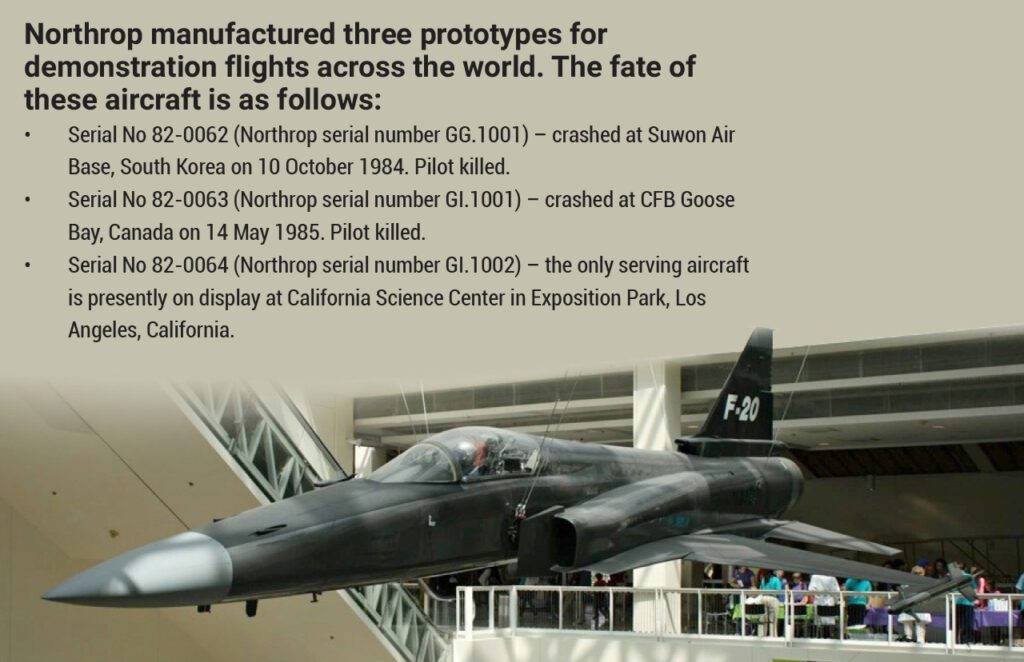
“By then a change was taking place in aircraft structures to minimise radar signatures, to fly supersonic without the afterburner, capable of launching long range BVR missiles, depending not so much on stick and rudder, and to have the ability to see first and fire first. That was the direction given to me by the air staff, and the F-20 was not in that category,” Abbas Mirza expanded.
In his report to the PAF, Abbas Mirza’s final conclusion was that the F-20 was designed to be inferior to the contemporary US jets that the US was adamant on selling to developing countries with meagre budgets and low-level threats. No country bought it. Not even the United States Air Force (USAF). “None of the air forces showed interest in the aircraft despite its hectic demo flight schedules across the world. There was no point acquiring these aircraft for PAF. This is what I recommended to air staff on my return to Pakistan,” Abbas Mirza added. The air staff agreed with his recommendations and shelved the F-20 procurement once for all.
Vastly superior to the Mirage III and Mirage V, and the F-6 and the A-5, a system very close to the F-16, perfect for the Indo-Pak scenario back then, the PAF decided not to settle for second best. Despite aggressive marketing campaigns, the Tigershark failed to obtain sales. By the end of the 1980s, the low-cost F-20 died its natural death.
www.secondtonone.com.pk

