

You are using an out of date browser. It may not display this or other websites correctly.
You should upgrade or use an alternative browser.
You should upgrade or use an alternative browser.

Umair Malik
It was NOT that PAF didn’t operate a Twin Engine Jet.
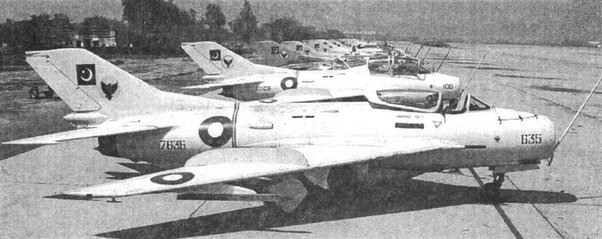
Immediately after the 1965 Indo-Pak War, USA placed an embargo on the supply of weapons to both countries. Pakistani defence planners selected the F-6 aircraft as an addition to the PAF inventory. Subsequently F-6 Armed with three 30-mm cannon and Sidewinder missiles which underwent around 140 modifications & 10 combat squadrons of the PAF were equipped with 260 F-6 aircraft.
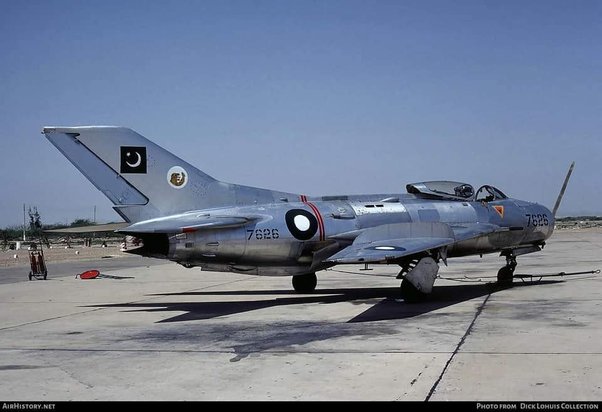
Powered by two Liming Wopen-6A (Tumansky RD-9B) afterburning turbojet engines, the J-6 or F-6 was recertified for production in 1964. Each engine can produce 36.78kN of thrust afterburner. The developer of WP-6 engine, the Shenyang Engine Factory, obtained the license in October 1961.
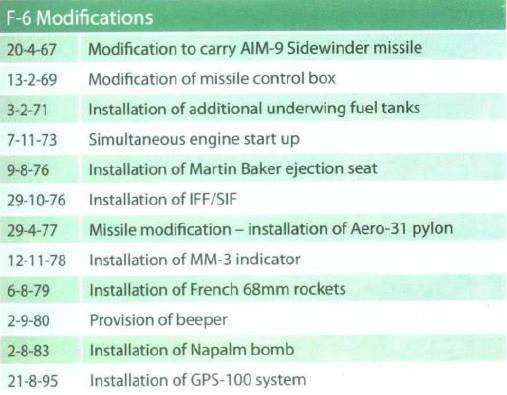
The aircraft design undergoing around 140 modifications to improve its capabilities in the interceptor and close air support roles.The major upgrade work by Pakistani Engineers with Chinese collaboration were centered around :
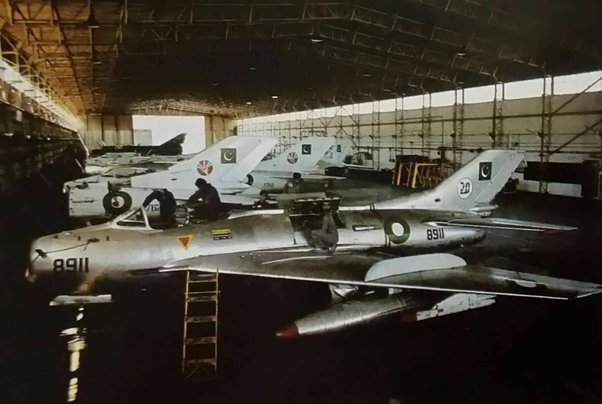
F-6 was an export designation of the Chinese built J-6, originally designed as MiG-19 in Soviet Union. “The engines were powerful enough to get you out of a bad situation and the acceleration they provided was excellent, especially with after-burners.”
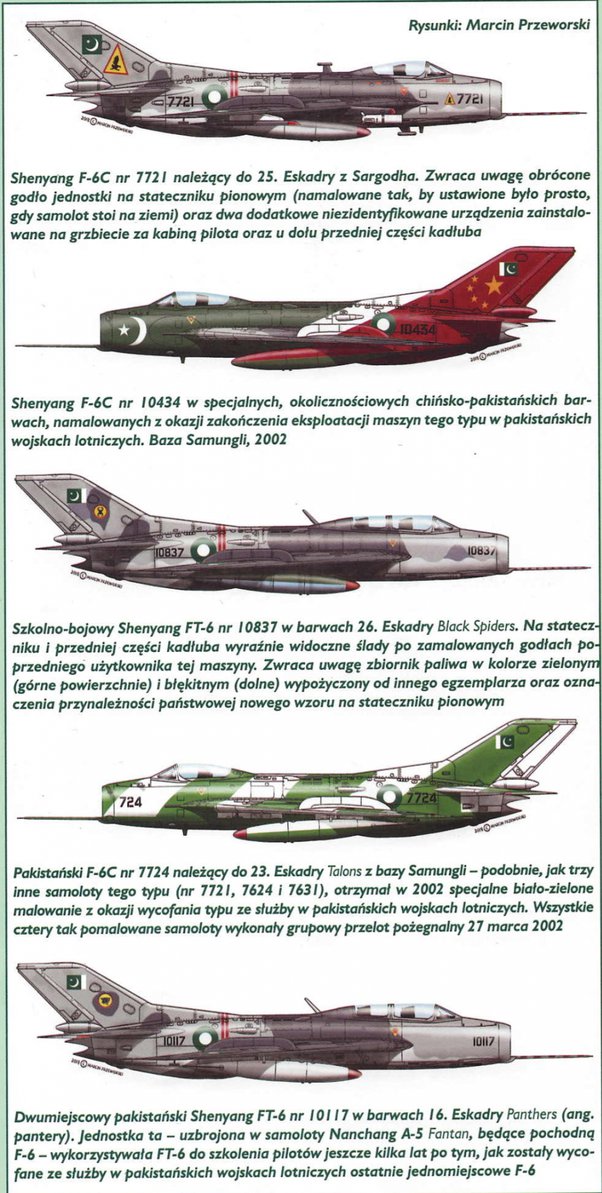
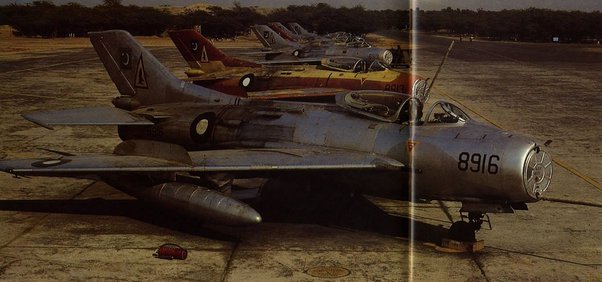
In 1961 the Chinese Shenyang works produced the first examples of an unlicensed copy of the MiG-19S, designated F-6. By the mid-1970s at least 1,800 F-6s had been built in China, including a few F-7s based on the MiG-19P. A substantial number of F-6s was supplied to Pakistan in 1965-66 and 1972; Vietnam, Albania and Tanzania have also taken delivery of similar aircraft.
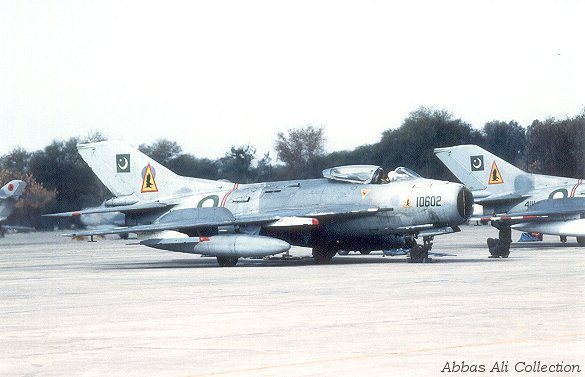
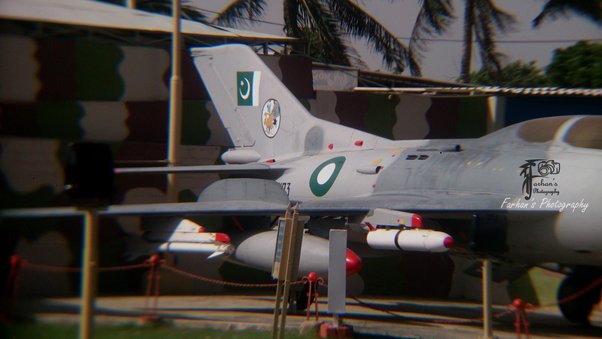
Pakistan had 74 Shenyang F-6s.The Pakistani aircraft have been modified with launch pylons for AIM-9 Sidewinder missiles. Equipped with three powerful guns and two AIM-9B Sidewinder missiles, the F-6 had enough firepower to fight the most rugged adversary aircraft.
==================================================
Powerplants: J-6 – Two 24.5kN (5730lb) dry and 31.9KN (7165lb) with afterburning Liming Wopen-6 (Tumansky R-9BF-811) turbojets.
Performance: J-6 – Max speed Mach 1.45 or 1540km/h (831 kt), cruising speed 950km/h (512kt). Max initial rate of climb over 30,000ft/min. Service ceiling 58,725ft. Combat radius with external fuel 685km (370nm).
Normal range 1390km (750nm), ferry range with external fuel 2200km (I187nm).
Weights: J-6 – Empty approx 5760kg (12,700lb), max takeoff approx 10,000kg (22,045lb).
Dimensions: J-6 – Wing span 9.20m (30ft 2in), length ine probe 14.90m (48ft 11 in), length exc probe 12.60m (41ft 4in), height 3.88m (12ft 9in). Wing area 25.0m2 (269.1 sq ft).
=====================================================
In 1969, PAF formed an aerobatics team named ‘Rattlers’. The team comprised four F-6 aircraft painted black. On 14 March, 1969, the team performed formation aerobatics in a thrilling display of speed control and co-ordination in an air display organized for the visiting Soviet Minister of Defence, Marshal Grechko.
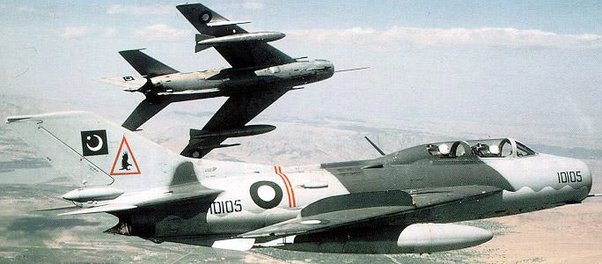
Pakistan Aeronautical Complex Kamra’s F-6 Rebuild Factory, which was inaugurated in 1980, has played a major role in giving the F-6 aircraft a new lease of life by completely over-hauling it.
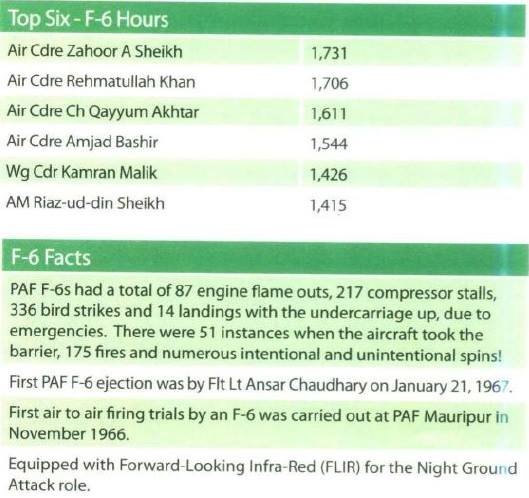
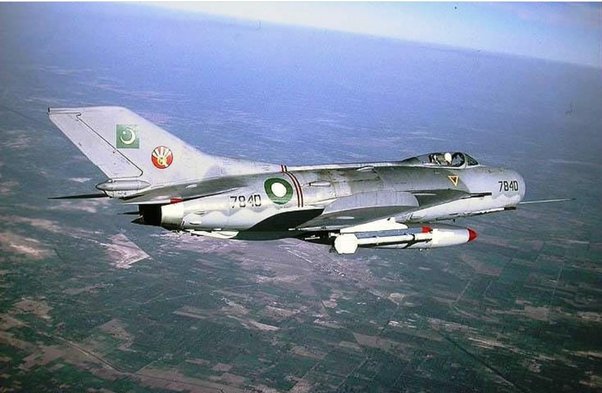
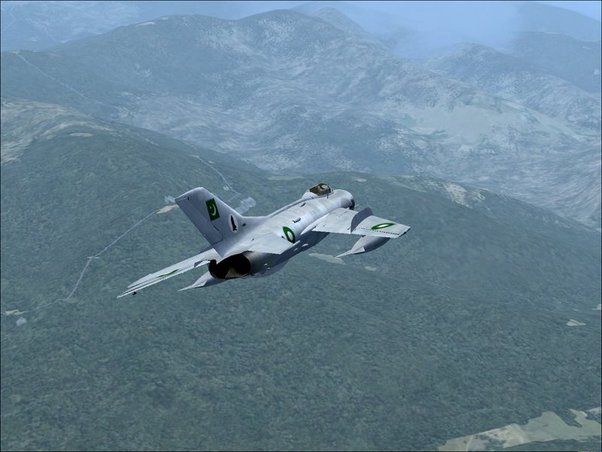
The F-6 was flown by the Pakistan Air Force from 1965 to 2002 ; The F-6 aircraft made its last flight on 27 March 2002 in the skies of Baluchistan during a spectacular air display participated by all major combat aircraft of the PAF.
=================================================
Umair Malik
· 6y
Why doesn't the Pakistan Air Force or Navy have any twin-engined fighter aircraft?
Twin engined fighters might not be the best idea if your aim is to reduce your heat signature and susceptibility to IRST detection. Fighters such as the F-22 are twin engined, but they had to install a host of very expensive counter measures to evade potential heat seeking missiles. The best argument in favour of twin engines is the increased range and payload afforded to the fighter relative to lighter, single engined aircraft. So it makes the most sense if what you have is a fighter bomber, an attack aircraft or what’s more commonly referred to nowadays as a multi role aircraft. In the case of Pakistan, they received the US made F-16s during the Cold War and have had both experience with, and a preference for, lighter single engine jets. More importantly, Pakistan’s conventional armed forces doctrine is purely defensive, with a focus on deterring India. Fighter bombers and other such offensive aircraft are not a priority. The emphasis has been one of striving towards better air to air abilities, stronger nuclear deterrence etc as the cornerstone of their defence posture. Costs are, of course an additional factor, but in no way the principal one. In general, for a multi engine jet fighter, the pros and cons are as follows: PROS * Longer range * Increased payload capability * Ability to sustain a heavier airframe * Ideal for a fighter bomber and air to ground attack * Increased redundancy with back up in case of engine failure CONS * Enhanced heat signature (all other things being equal) * Increased cost * Lower thrust to weight ratio and thus reduced manoeuvrability * Increased drag penalty * More maintenance intensive Note: In aviation in general, with advances in engine design and performance, more engines doesn’t necessarily translate into greater thrust. The two engines on a Boeing 777, for instance produce more thrust than all 4 engines on the Boeing 747 combined. Another factor is size. This is the twin engined F 15 : Now contrast that with the single engined F-16: Look at the ground engineers heads in relation to the leading edge of the wing on both planes. It’s clear the twin engined plane is larger. Some more comparative pics: In the pic above, Note the size difference between the single engined ‘Gnat’ and F-16, with the twin engined F-14 and Javelin. And for more recent aircraft: The multi engined F-22 dwarfs all 3 versions of the single engine F-35. This enhanced size has an upside in that you can carry more bombs, and a downside in that it creates more drag, leaving your fighter less manoeuvrable. So in conclusion, getting back to the case of Pakistan. Their identifiable adversary is India. With the latters inclusion of the Rafale, and it’s highly advanced IRST capabilities, twin engine fighters may not be desirable. Unless it comes equipped with stealth features, which are not at present attainable for them.
Azm also isn’t going to arriving today. Last i heard it would be at-least 10 years or so. By that hopefully CPEC kicked into full gear so we can afford 5th gen tech. 5th gen is not cheap.
Nanchang A-5 was also a twin-engined aircraft operated by the PAF.
Yes -it was a Twin Engine Bomber.
www.pdj.quora.com
It was NOT that PAF didn’t operate a Twin Engine Jet.
F-6 PAKISTAN AIRFORCE
The mach 1.4 F-6 Day Fighter is an export designation of the Chinese-built J-6 (Fighter aircraft 6) which was originally designed as MiG-19 in the USSR, its Soviet prototype having flown for the first time in September, 1953.Immediately after the 1965 Indo-Pak War, USA placed an embargo on the supply of weapons to both countries. Pakistani defence planners selected the F-6 aircraft as an addition to the PAF inventory. Subsequently F-6 Armed with three 30-mm cannon and Sidewinder missiles which underwent around 140 modifications & 10 combat squadrons of the PAF were equipped with 260 F-6 aircraft.
Powered by two Liming Wopen-6A (Tumansky RD-9B) afterburning turbojet engines, the J-6 or F-6 was recertified for production in 1964. Each engine can produce 36.78kN of thrust afterburner. The developer of WP-6 engine, the Shenyang Engine Factory, obtained the license in October 1961.
The aircraft design undergoing around 140 modifications to improve its capabilities in the interceptor and close air support roles.The major upgrade work by Pakistani Engineers with Chinese collaboration were centered around :
The provision of avionics, Martin Baker ejection seats, GAR-8 air-to-air missiles, AIM-9 Sidewinder air-to-air missile, French 68 mm rockets, underbelly 'gondola' fuel tanks and a special auxiliary power unit to instantly start the small fighter's twin engines in order to reduce scramble times.
F-6 was an export designation of the Chinese built J-6, originally designed as MiG-19 in Soviet Union. “The engines were powerful enough to get you out of a bad situation and the acceleration they provided was excellent, especially with after-burners.”
In 1961 the Chinese Shenyang works produced the first examples of an unlicensed copy of the MiG-19S, designated F-6. By the mid-1970s at least 1,800 F-6s had been built in China, including a few F-7s based on the MiG-19P. A substantial number of F-6s was supplied to Pakistan in 1965-66 and 1972; Vietnam, Albania and Tanzania have also taken delivery of similar aircraft.
Pakistan had 74 Shenyang F-6s.The Pakistani aircraft have been modified with launch pylons for AIM-9 Sidewinder missiles. Equipped with three powerful guns and two AIM-9B Sidewinder missiles, the F-6 had enough firepower to fight the most rugged adversary aircraft.
==================================================
Powerplants: J-6 – Two 24.5kN (5730lb) dry and 31.9KN (7165lb) with afterburning Liming Wopen-6 (Tumansky R-9BF-811) turbojets.
Performance: J-6 – Max speed Mach 1.45 or 1540km/h (831 kt), cruising speed 950km/h (512kt). Max initial rate of climb over 30,000ft/min. Service ceiling 58,725ft. Combat radius with external fuel 685km (370nm).
Normal range 1390km (750nm), ferry range with external fuel 2200km (I187nm).
Weights: J-6 – Empty approx 5760kg (12,700lb), max takeoff approx 10,000kg (22,045lb).
Dimensions: J-6 – Wing span 9.20m (30ft 2in), length ine probe 14.90m (48ft 11 in), length exc probe 12.60m (41ft 4in), height 3.88m (12ft 9in). Wing area 25.0m2 (269.1 sq ft).
=====================================================
In 1969, PAF formed an aerobatics team named ‘Rattlers’. The team comprised four F-6 aircraft painted black. On 14 March, 1969, the team performed formation aerobatics in a thrilling display of speed control and co-ordination in an air display organized for the visiting Soviet Minister of Defence, Marshal Grechko.
Pakistan Aeronautical Complex Kamra’s F-6 Rebuild Factory, which was inaugurated in 1980, has played a major role in giving the F-6 aircraft a new lease of life by completely over-hauling it.
In ’71 War- Squadrons No 11, 23 and 25 comprising of F-6s defensed the country by flying 945 sorties comprising 735 hours and destroying numerous enemy tanks, armoured cars and field guns during the close support missions. In air combat, F-6 pilots shot down eight Indian Air Force fighter aircraft including a superior MiG-21 and damaged five. PAF lost 5 F-6s - 3 in Aerial Combat and 2 in ground fire.
The F-6 was flown by the Pakistan Air Force from 1965 to 2002 ; The F-6 aircraft made its last flight on 27 March 2002 in the skies of Baluchistan during a spectacular air display participated by all major combat aircraft of the PAF.
=================================================
Umair Malik
· 6y
Why doesn't the Pakistan Air Force or Navy have any twin-engined fighter aircraft?
Twin engined fighters might not be the best idea if your aim is to reduce your heat signature and susceptibility to IRST detection. Fighters such as the F-22 are twin engined, but they had to install a host of very expensive counter measures to evade potential heat seeking missiles. The best argument in favour of twin engines is the increased range and payload afforded to the fighter relative to lighter, single engined aircraft. So it makes the most sense if what you have is a fighter bomber, an attack aircraft or what’s more commonly referred to nowadays as a multi role aircraft. In the case of Pakistan, they received the US made F-16s during the Cold War and have had both experience with, and a preference for, lighter single engine jets. More importantly, Pakistan’s conventional armed forces doctrine is purely defensive, with a focus on deterring India. Fighter bombers and other such offensive aircraft are not a priority. The emphasis has been one of striving towards better air to air abilities, stronger nuclear deterrence etc as the cornerstone of their defence posture. Costs are, of course an additional factor, but in no way the principal one. In general, for a multi engine jet fighter, the pros and cons are as follows: PROS * Longer range * Increased payload capability * Ability to sustain a heavier airframe * Ideal for a fighter bomber and air to ground attack * Increased redundancy with back up in case of engine failure CONS * Enhanced heat signature (all other things being equal) * Increased cost * Lower thrust to weight ratio and thus reduced manoeuvrability * Increased drag penalty * More maintenance intensive Note: In aviation in general, with advances in engine design and performance, more engines doesn’t necessarily translate into greater thrust. The two engines on a Boeing 777, for instance produce more thrust than all 4 engines on the Boeing 747 combined. Another factor is size. This is the twin engined F 15 : Now contrast that with the single engined F-16: Look at the ground engineers heads in relation to the leading edge of the wing on both planes. It’s clear the twin engined plane is larger. Some more comparative pics: In the pic above, Note the size difference between the single engined ‘Gnat’ and F-16, with the twin engined F-14 and Javelin. And for more recent aircraft: The multi engined F-22 dwarfs all 3 versions of the single engine F-35. This enhanced size has an upside in that you can carry more bombs, and a downside in that it creates more drag, leaving your fighter less manoeuvrable. So in conclusion, getting back to the case of Pakistan. Their identifiable adversary is India. With the latters inclusion of the Rafale, and it’s highly advanced IRST capabilities, twin engine fighters may not be desirable. Unless it comes equipped with stealth features, which are not at present attainable for them.
- Twin engine jets are a royal pain in the usb to maintain.
- PAF does need to cover massive distances as our country is relatively small.
- At the end of the day twin engine fighters will cost an arm and a leg more than our single engine crafts.
Azm also isn’t going to arriving today. Last i heard it would be at-least 10 years or so. By that hopefully CPEC kicked into full gear so we can afford 5th gen tech. 5th gen is not cheap.
Nanchang A-5 was also a twin-engined aircraft operated by the PAF.
Yes -it was a Twin Engine Bomber.
www.pdj.quora.com
"I Wish I would return without firing a shot"
On 19 September 1965, during the Indo–Pakistan War, the skies were filled with uncertainty, and every unidentified aircraft was treated as a potential enemy threat. That day, PAF Flying Officer Qais Hussain was scrambled in his F-86 Sabre after Ground Control detected an unidentified aircraft believed to be an Indian military reconnaissance plane. After intercepting the target, he reported what he observed and waited for further instructions. Ground Control ordered him to engage. Trusting the information available and carrying out his duty in the middle of an active war, he opened fire. Moments later, the aircraft crashed. Only after the mission did the heartbreaking truth emerge…it was not a military aircraft but an Indian civilian Beechcraft carrying Gujarat Chief Minister Balwantrai Mehta, his wife, the crew, and other civilian passengers. Eight innocent lives were lost. Although he had acted under wartime orders, the tragedy never left Qais Hussain. For the next 46 years, he lived with deep regret, knowing that innocent lives had been caught in the fog of war. In 2011, after searching for years, Qais Hussain finally found the email address of the Indian pilot's daughter, Farida Singh, and wrote to her. In his message, he explained that he had believed he was engaging a military target and had acted on Ground Control's orders during an active war. He expressed his deepest sorrow, offered heartfelt condolences, and said that the tragedy had remained with him throughout his life. Farida Singh replied with remarkable grace. She thanked him for reaching out after so many years and said she did not hold hatred toward him. She acknowledged that war forces people into impossible situations and chose understanding over bitterness. Her response brought a measure of peace to a burden that had been carried for nearly half a century. Sometimes the greatest stories of war are not about victories or defeats, they are about the courage to admit sorrow, the strength to forgive, and the humanity that survives even after the guns fall silent.
Credits: Falconvfx on Instagram
www.x.com
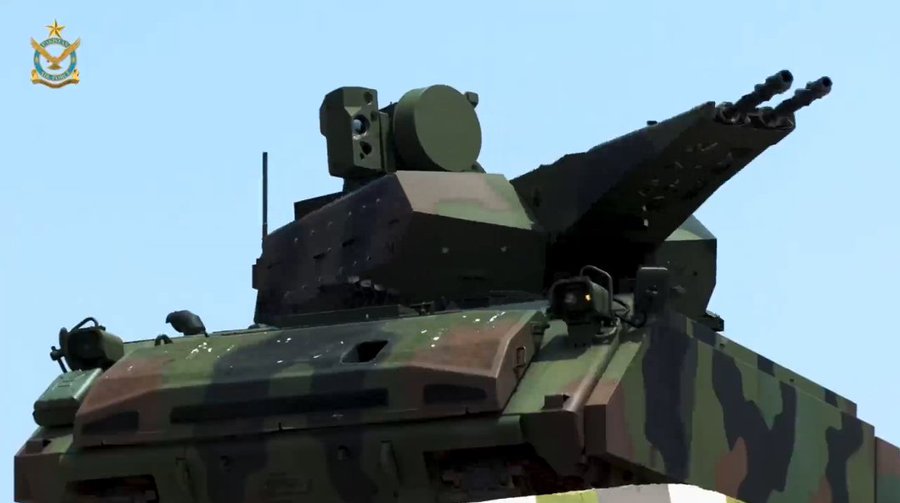
Pakistan Unveils KORKUT Drone-Killer as Türkiye Reshapes South Asia’s Air Defences - Defence Security Asia
Pakistan unveils KORKUT, HQ-17AE and ŞAHİN air defences as Turkish technology transforms its counter-drone strategy and regional force posture.
 share.google
The pilot may be referring to the F-16s in PAF inventory.


