• Forum restore complete (see latest announcement thread)

Pakistan Foreign Policy and Geopolitics

Fatman17

Experienced member
Moderator
Defence News Editor
Pakistan Moderator
Messages
2,588
Reactions
21 2,121
Nation of residence
Pakistan
Nation of origin
Pakistan
IMG-20260812-WA0029.jpg

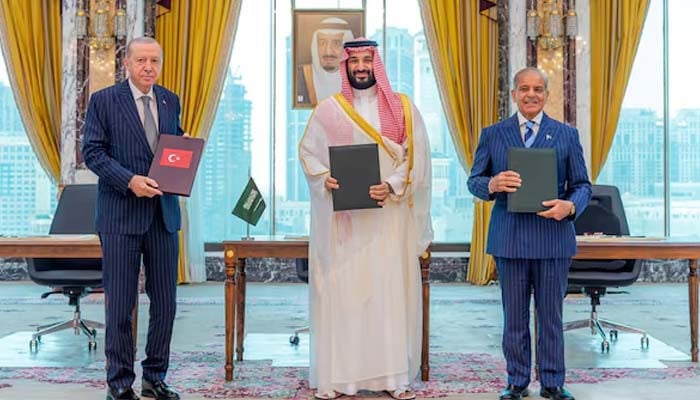
EDITORIAL: Over the past few days, Pakistan has been going the extra mile to assure Iran that the Makkah Joint Defence Agreement it signed last week with Saudi Arabia and Turkiye poses no threat to Tehran.

In a recent telephone call, Foreign Minister Ishaq Dar told his Iranian counterpart Abbas Araghchi that the pact is “not an instrument of confrontation”. Moreover, Prime Minister Shehbaz Sharif told the cabinet that the agreement is “entirely for defence purposes”.

Read more: https://www.dawn.com/news/2022312
 

Fatman17

Experienced member
Moderator
Defence News Editor
Pakistan Moderator
Messages
2,588
Reactions
21 2,121
Nation of residence
Pakistan
Nation of origin
Pakistan

Pakistan has reportedly asked the United States for a $10 billion currency-swap facility from the US Treasury’s Exchange Stabilisation Fund. The request arrived at an extraordinary moment: the United States is at war with Iran, Pakistan has become an important channel for diplomacy between Washington and Tehran, and Islamabad is again trying to turn geopolitical relevance into economic relief.
 

Fatman17

Experienced member
Moderator
Defence News Editor
Pakistan Moderator
Messages
2,588
Reactions
21 2,121
Nation of residence
Pakistan
Nation of origin
Pakistan

Mecca agreement: Why Saudi Arabia, Turkey and Pakistan teamed up​

Ahmed Altuwaijri
Published date: 19 August 2026 08:46 BST|
The best defence alliance is not one that makes a state dependent on its allies forever, but one that makes it more capable of relying on itself

The signing of the Mecca Joint Defence Agreement by Saudi Arabia, Pakistan and Turkey this month was not the product of Riyadh’s reaction to a specific, immediate threat, as many have assumed.
A deeper reading reveals a convergence of strategic interests among the three signatory countries, which differ in their geography, their sources of power, and the imminent threats and challenges faced by each.
Yet they share a growing realisation that the security order that governed the Middle East and Southwest Asia for decades is no longer capable of providing the same guarantees it once did.
Three regional powers with exceptional characteristics came together to sign this deal in Mecca: Saudi Arabia, with its religious, economic, energy and geopolitical weight; Turkey, with its military power, defence industries and geographical position, linking the Middle East with Europe, the Black Sea and the Eastern Mediterranean; and Pakistan, with its scientific and research capabilities, military power, nuclear armament, and strategic depth in South Asia.
The agreement should thus be understood as the beginning of a transformation in the region’s security philosophy: from reliance on the umbrella of a single external power, to a network of regional partnerships capable of distributing risks and maximising deterrence.

The agreement stipulates that an armed attack against any of the three countries shall be regarded as an attack against all three, in a formula approaching the collective defence logic of major military alliances, while the three countries have emphasised that the pact is defensive in nature and is not directed against any particular state.
Herein lies the significance of the agreement. The question is not who the three countries seek to deter. Rather, the question is: why did each country need the other two at this particular historical moment?

Saudi influence​

Naturally, Saudi Arabia is the country most prominently featured in discussions about the agreement. But it would be a mistake to view the nation’s security from a single perspective.
Saudi Arabia faces an exceptionally complex strategic environment, positioned at the heart of a region where numerous international and regional projects and powers intersect.
Saudi security is thus not merely about protecting borders; it encompasses the Gulf, the Red Sea, the Bab el-Mandeb Strait, energy routes, critical infrastructure, airspace, cybersecurity, supply chains, major economic projects, and much more.
It could create a regional defence-industrial base capable of transforming the arms market, particularly in the Muslim world - and ultimately around the globe
All of this gives cooperation with Turkey and Pakistan a distinct strategic value. Turkey provides highly advanced military, industrial and technological capabilities, while Pakistan provides military depth, operational experience, and longstanding defence relations with the kingdom.
Saudi Arabia, for its part, possesses religious and political influence, economic resources, and the capacity to invest in defence industries, markets, energy and infrastructure. This complementarity is one of the most important keys to understanding the Mecca agreement.
Bolstering the official line that the defence pact is not designed to target any individual state, Saudi-Iranian relations have thawed in recent years, amid efforts to reduce tensions and maintain channels of communication. It would thus be a strategic mistake for Riyadh to use the Mecca agreement as an instrument for initiating a fresh confrontation with Tehran.
The more logical interpretation is that Saudi Arabia wants to convey to all regional and international powers that the costs of attacking the kingdom can no longer be calculated on the basis of Saudi power alone, but must also take into account a broader network of capabilities and alliances.
That is the essence of deterrence: it does not mean that a state wants war. Rather, it is about making war sufficiently costly, so that an adversary will think long and hard before launching attacks.

Turkish foreign policy​

One might ask why Ankara needs a defence agreement with Saudi Arabia and Pakistan. Turkey is a member of Nato and possesses one of the largest militaries in the alliance, while its defence industry has been developing rapidly.
The answer is that Turkey has become increasingly independent in shaping its own foreign policy in recent years, coming to regard its regional surroundings as a direct sphere of its security interests - spanning Syria, Iraq, Lebanon, Libya, the Eastern Mediterranean, the Black Sea, the Caucasus, Russia, Iran and Europe.
At the same time, Turkey’s role in Syria, alongside Ankara’s criticism of Israeli policies, particularly with regards to the war on Gaza, have fuelled increased tensions with Tel Aviv.


Fatman17

Experienced member
Moderator
Defence News Editor
Pakistan Moderator
Messages
2,588
Reactions
21 2,121
Nation of residence
Pakistan
Nation of origin
Pakistan

Fatman17

Experienced member
Moderator
Defence News Editor
Pakistan Moderator
Messages
2,588
Reactions
21 2,121
Nation of residence
Pakistan
Nation of origin
Pakistan
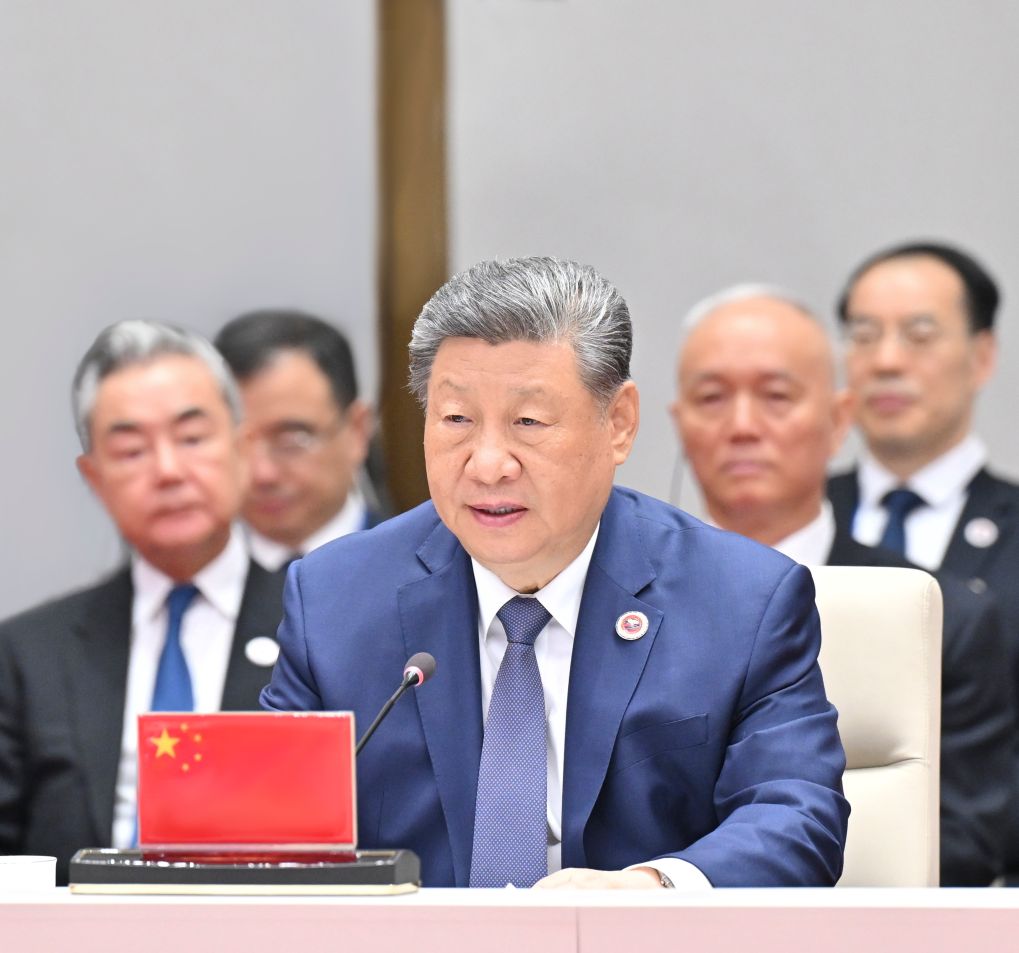
BISHKEK: Chinese President Xi Jinping on Tuesday called on the Shanghai Cooperation Organisation (SCO) to uphold the “Shanghai Spirit”, deepen development and security cooperation, strengthen people-to-people ties and promote a more equitable global governance system as the grouping marked 25 years since its establishment.

Addressing the 26th Meeting of the Council of Heads of State of the SCO in the Kyrgyz capital, Xi said the organisation had demonstrated “strong vitality and dynamism” over the past quarter century and evolved into a major regional cooperation platform spanning the world’s largest geographical area and population.
 

Fatman17

Experienced member
Moderator
Defence News Editor
Pakistan Moderator
Messages
2,588
Reactions
21 2,121
Nation of residence
Pakistan
Nation of origin
Pakistan
  • Summary
  • Pakistan delivers Saudi warning to Iran to rein in Houthis, sources say
  • Pakistani spokesman says no military response is under discussion
  • Pakistan and Kuwait signed narrower defence protocol than originally discussed
ISLAMABAD/DUBAI, Sept 11 (Reuters) - For much of the past year, Pakistan has played a dual role as Riyadh's defence partner and Washington's backchannel to Tehran but this week's fighting between Yemen's Iran-backed Houthi movement and Saudi forces is increasingly testing how long Islamabad can hold both positions at once.
The fighting represents the first major test of the mutual defence alliance that was signed between Pakistan, Saudi Arabia and Turkey last month, adding to ‌a pre-existing pact between Islamabad and Riyadh. Under the arrangement, an armed attack on any one of the three countries is to be regarded as an attack on all.
 

Fatman17

Experienced member
Moderator
Defence News Editor
Pakistan Moderator
Messages
2,588
Reactions
21 2,121
Nation of residence
Pakistan
Nation of origin
Pakistan
can the Makkah Pact be invoked? The answer is not straightforward. The Makkah Agreement says that an armed attack against one of its members shall be considered an attack against all. It does not say that every hostile act, economic measure or threat automatically triggers collective military action. Pakistan itself has emphasised that the agreement is defensive and not directed against any particular country.
regarding Pakistan’s involvement, it would be wrong to assume that the agreement automatically requires Pakistan to send combat troops to Yemen. Pakistan interprets the Makkah Accord as a framework for collective defence and deterrence. Its practical response could therefore take several forms, depending on the nature and scale of the attack. These could include intelligence sharing, surveillance, air-defence assistance, protection of Saudi infrastructure, maritime security cooperation, naval deployment, logistical support and, if circumstances warranted, direct military action.
 

Fatman17

Experienced member
Moderator
Defence News Editor
Pakistan Moderator
Messages
2,588
Reactions
21 2,121
Nation of residence
Pakistan
Nation of origin
Pakistan
Pakistan on Thursday said it remained committed “in intent and spirit” to implementing the Strategic Mutual Defence Agreement (SMDA) with Saudi Arabia and the trilateral Makkah Defence Alliance.

Foreign Office (FO) spokesperson Sajjad Haider Khan made the statement during his weekly briefing.

Read more: https://www.dawn.com/news/2030603
 

Fatman17

Experienced member
Moderator
Defence News Editor
Pakistan Moderator
Messages
2,588
Reactions
21 2,121
Nation of residence
Pakistan
Nation of origin
Pakistan
Bab al-Mandab may be far from Karachi, but the impact of its closure — if it happens — would be felt on our factory floors, in household budgets and in every vehicle that uses fuel. In Pakistan, the stakes are particularly high, as soaring shipping costs and delays to exports could put jobs at risk.

The Strait of Hormuz is already under stress and largely blocked to all ships, including tankers, while Houthi forces have escalated attacks on shipping and threatened a full naval blockade of Bab al-Mandab.
 

Fatman17

Experienced member
Moderator
Defence News Editor
Pakistan Moderator
Messages
2,588
Reactions
21 2,121
Nation of residence
Pakistan
Nation of origin
Pakistan
The pressure is now mounting on Pakistan, and particularly Munir. In August, the defence pact with Saudi Arabia was extended to include Turkey and renamed the Mecca joint defence agreement. The countries agreed that an armed attack on any one of them would be treated as an attack on all three.

A billboard above a busy road in Karachi. The sign says ‘Peace, security, stability’ and ‘Makkah joint defence agreement’ and shows pictures of the Saudi crown prince, Pakistan’s prime minister, Gen Asim Munir and the Turkish president
View image in fullscreen
A billboard in Karachi, Pakistan, marks the signing of the Mecca joint defence agreement in August. Photograph: Akhtar Soomro/Reuters
Ayesha Siddiqa, a defence analyst and senior fellow at King’s College London, said: “I don’t think Asim Munir properly calculated the threats the region was facing – and that Pakistan might need to put its troops on the line quite so soon.”
 
Last edited:

Fatman17

Experienced member
Moderator
Defence News Editor
Pakistan Moderator
Messages
2,588
Reactions
21 2,121
Nation of residence
Pakistan
Nation of origin
Pakistan
For decades, India has refused to recognise a Pakistan-China boundary in a disputed part of the Himalayas that Delhi claims as its own.


But last week, Pakistan and China formalised a boundary in a remote part of the mountainous region, drawing a sharp response from Delhi.
The two countries signed the Pakistan-China Boundary Joint Commission, an agreement which Pakistan described as a "significant milestone" that would deepen cooperation on border management, trade and connectivity between India's regional rivals.
Delhi rejected the move as having no legal basis, saying it did not recognise any Pakistan-China boundary located in territory it claims as Indian.
The announcement comes at a particularly sensitive moment.
India and China are seeking to stabilise their relationship after years of military tensions along the Line of Actual Control (LAC), the disputed line separating their forces along much of their Himalayan frontier. At the same time, Beijing and Islamabad are deepening cooperation along a neighbouring stretch of the frontier that India also claims.
 

Fatman17

Experienced member
Moderator
Defence News Editor
Pakistan Moderator
Messages
2,588
Reactions
21 2,121
Nation of residence
Pakistan
Nation of origin
Pakistan
IN a world awash with violence, where the old geopolitical rules of the game are being rapidly rewritten, there is a need for states to display maturity and rational behaviour in statecraft. This is all the more true in troubled regions such as South Asia, which have been witnessing friction for decades, and where nuclear weapons are part of the equation.
 

Fatman17

Experienced member
Moderator
Defence News Editor
Pakistan Moderator
Messages
2,588
Reactions
21 2,121
Nation of residence
Pakistan
Nation of origin
Pakistan
Since the signing of the Mecca Joint Defence Agreement (MJDA) in mid-August, the pact’s founding members – i.e., Saudi Arabia, Pakistan, and Türkiye – have faced tests from Iran and Yemen that increasingly suggest this new regional framework is likely to fail. Granted, one could foresee that the MJDA would not lead to joint combat operations (e.g., due to the absence of inter-services integration, expeditionary assets, and/or no joint headquarters or imperative for active wartime coalitions).

However, that in itself was not the MJDA’s gap; rather, as with the bilateral Saudi-Pakistani defence framework before it, it was the lack of real policy and concrete details regarding what the MJDA would achieve that was the problem. Instead of a clear-cut charter or even mission statement from the MJDA (i.e., as an institution), each of the member states (or, more specifically, certain officials from each) offered interpretations about the MJDA, but not concrete policy.


For example, Turkish officials spoke of plans and opportunities for joint production and industry integration. Pakistani officials reiterated that the MJDA was “not aggressive” in nature and it was built on the idea of “collective deterrence” (but without defining what the actual teeth for this deterrence would be). Finally, the Saudi intelligentsia apparently expected tangible support from Pakistan and Türkiye, while Riyadh continues doubling down on securing America’s security guarantees via massive multi-billion-dollar deals for fighters and munitions they can buy from Türkiye.

In one sense, the lack of direct military support (e.g., troops, aircraft, missiles, etc.) – especially for combat operations – was not surprising. Indeed, Quwa – albeit as an optimistic reading of the MJDA – argued that the framework offered a pathway for capacity building across all three countries. Yet, as with the preceding Strategic Mutual Defence Agreement (SMDA), no one – not even Islamabad or Rawalpindi – defined what tangible gains or benefits would make their way to Pakistan.
 

Fatman17

Experienced member
Moderator
Defence News Editor
Pakistan Moderator
Messages
2,588
Reactions
21 2,121
Nation of residence
Pakistan
Nation of origin
Pakistan
PRIME Minister Shehbaz Sharif stopped in London on his way to New York for the UN General Assembly session. It is his umpteenth foreign trip, and the deputy prime minister is once again inseparable from him. Meanwhile, the interior minister has been on yet another trip to Tehran, as part of Pakistan’s mediation efforts in the US-Iran war.

Pakistan’s leaders seem obsessed with being seen on the world stage while their country plunges deeper into political instability and a worsening internal security situation.
 
Top Bottom