Mecca agreement: Why Saudi Arabia, Turkey and Pakistan teamed up
Ahmed Altuwaijri
Published date: 19 August 2026 08:46 BST|
The best defence alliance is not one that makes a state dependent on its allies forever, but one that makes it more capable of relying on itself
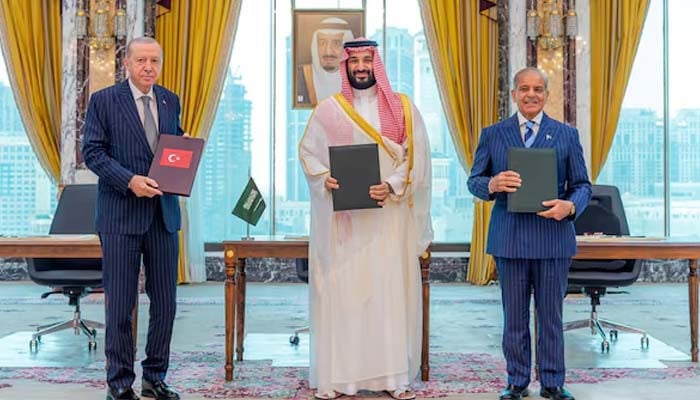
The signing of the
Mecca Joint Defence Agreement by
Saudi Arabia,
Pakistan and
Turkey this month was not the product of Riyadh’s reaction to a specific, immediate threat, as many have assumed.
A deeper reading reveals a convergence of strategic interests among the three signatory countries, which differ in their geography, their sources of power, and the imminent threats and challenges faced by each.
Yet they share a growing realisation that the security order that governed the Middle East and Southwest Asia for decades is no longer capable of providing the same guarantees it once did.
Three regional powers with exceptional characteristics came together to sign this deal in Mecca: Saudi Arabia, with its religious, economic, energy and geopolitical weight; Turkey, with its military power, defence industries and geographical position, linking the Middle East with Europe, the Black Sea and the Eastern Mediterranean; and Pakistan, with its scientific and research capabilities, military power, nuclear armament, and strategic depth in South Asia.
The agreement should thus be understood as the beginning of a transformation in the region’s security philosophy: from reliance on the umbrella of a single external power, to a
network of regional partnerships capable of distributing risks and maximising deterrence.
The agreement stipulates that an
armed attack against any of the three countries shall be regarded as an attack against all three, in a formula approaching the collective defence logic of major military alliances, while the three countries have emphasised that the pact is
defensive in nature and is not directed against any particular state.
Herein lies the significance of the agreement. The question is not who the three countries seek to deter. Rather, the question is: why did each country need the other two at this particular historical moment?
Saudi influence
Naturally, Saudi Arabia is the country most prominently featured in discussions about the agreement. But it would be a mistake to view the nation’s security from a single perspective.
Saudi Arabia faces an exceptionally complex strategic environment, positioned at the heart of a region where numerous international and regional projects and powers intersect.
Saudi security is thus not merely about protecting borders; it encompasses the Gulf, the Red Sea, the Bab el-Mandeb Strait, energy routes, critical infrastructure, airspace, cybersecurity, supply chains, major economic projects, and much more.
It could create a regional defence-industrial base capable of transforming the arms market, particularly in the Muslim world - and ultimately around the globe
All of this gives cooperation with Turkey and Pakistan a distinct strategic value. Turkey provides highly advanced military, industrial and technological capabilities, while Pakistan provides military depth, operational experience, and longstanding defence relations with the kingdom.
Saudi Arabia, for its part, possesses religious and political influence, economic resources, and the capacity to invest in defence industries, markets, energy and infrastructure. This complementarity is one of the most important keys to understanding the Mecca agreement.
Bolstering the official line that the defence pact is not designed to target any individual state, Saudi-
Iranian relations have thawed in recent years, amid efforts to
reduce tensions and maintain channels of communication. It would thus be a strategic mistake for Riyadh to use the Mecca agreement as an instrument for initiating a fresh confrontation with Tehran.
The more logical interpretation is that Saudi Arabia wants to convey to all regional and international powers that the costs of attacking the kingdom can no longer be calculated on the basis of Saudi power alone, but must also take into account a broader network of capabilities and alliances.
That is the essence of deterrence: it does not mean that a state wants war. Rather, it is about making war sufficiently costly, so that an adversary will think long and hard before launching attacks.
Turkish foreign policy
One might ask why Ankara needs a defence agreement with Saudi Arabia and Pakistan. Turkey is a member of
Nato and possesses one of the largest militaries in the alliance, while its defence industry has been developing rapidly.
The answer is that Turkey has become increasingly independent in shaping its own foreign policy in recent years, coming to regard its regional surroundings as a direct sphere of its security interests - spanning
Syria,
Iraq,
Lebanon,
Libya, the Eastern Mediterranean, the Black Sea, the Caucasus,
Russia, Iran and Europe.
At the same time,
Turkey’s role in Syria, alongside Ankara’s criticism of
Israeli policies, particularly with regards to the
war on Gaza, have fuelled increased tensions with Tel Aviv.
The best defence alliance is not one that makes a state dependent on its allies forever, but one that makes it more capable of relying on itself

www.middleeasteye.net