

Latest Thread
- Space Brazil ties up with India's Skyroot Aerospace to develop Satellite Launch Vehicle
- Bangladesh Opinion Bangladesh’s intelligence challenge
- Iran’s Long Game in Türkiye: From Political Islam to the Post-Erdoğan Era
- Open-source AI for exploiting cyber vulnerabilities
- Engineering Atomic Machines: Matter Compiler
You are using an out of date browser. It may not display this or other websites correctly.
You should upgrade or use an alternative browser.
You should upgrade or use an alternative browser.


What's this got to do with terrorism?
Drug smuggling pays for terrorism activitiesWhat's this got to do with terrorism?
Pakistan–Afghanistan border clashes are neither sudden nor unjustified.
When the Taliban took Kabul in 2021, the entire world vacated its embassies. Pakistan, which had hosted millions of Afghans for over four decades, kept its mission open and acted as a lifeline for evacuees during the chaotic withdrawal.
At the post-withdrawal UN-led conferences on Afghanistan, Pakistan was the loudest voice for unfreezing Afghanistan's $9 billion in assets. It even used regional forums like ECO to lobby for the same.
Pakistan hoped for peace and stability. Instead, the Taliban regime turned Afghanistan into a safe haven for the TTP.
Yet, despite repeated betrayals, Pakistan tried every peaceful route: religious, tribal, and official.
In July 2022, an 8-member ulema delegation led by Mufti Taqi Usmani went to Kabul to convince the Taliban and TTP to stop attacks. A few days later, a 17-member tribal jirga carried the same message.
On February 22, 2023, a high-level delegation led by Defence Minister Khawaja Asif and DG ISI Lt Gen Nadeem Anjum visited Kabul to push for peace.
In July 2024, Interior Minister Naqvi led another delegation for security cooperation.
Pakistan's diplomacy was not empty words. Special Envoy Muhammad Sadiq worked to build trade ties, leading to the Early Harvest Programme (EHP), which cut tariffs on eight key agricultural items for the benefit of both sides.
Pakistan kept talking even under fire. After the deadliest clashes in years in October 2025, it accepted a Qatar-mediated ceasefire and follow-up talks in Doha and Istanbul, which failed to produce a lasting agreement. In February 2026, Saudi mediation secured the release of three Pakistani soldiers captured by Afghanistan. Even after the war began, Pakistan sat down at China-mediated talks in Ürümqi in April. Its demands were minimal and fair: designate the TTP a terrorist organisation, dismantle its infrastructure, and provide verifiable proof. Even that was too much for the Taliban regime.
But what did Pakistan get in return?
According to Pakistan Institute for Peace Studies (PIPS) data:
• 2021: 89 attacks
• 2022: 262 attacks
• 2023: 306 attacks
• 2024: 521 attacks
• 2025: 699 attacks, killing at least 1,034 people
• 2026 (Jan–Aug): 3,150 deaths (including about 488 security personnel)
The worst betrayal came during Pakistan's 4-day war with India in May 2025. Afghanistan sent a 40-member TTP tashkeel, including the son of a Taliban official, to attack from the western front, stabbing Pakistan in the back while it was fighting its eastern enemy.
2026 has been the deadliest year for Pakistani security forces. By mid-year alone, 3,844 total fatalities, with 1,027+ security forces martyred.
In July 2026 alone, 112 security personnel were martyred, the highest monthly toll since January 2023. That month also saw eight suicide attacks; the most in a single month in a decade. Behind every number is a soldier, a policeman, a family.
What triggered Pakistan's latest strikes? Just one week is enough to understand.
A suicide bomber struck a mosque inside a police compound in Kohat. Eight gunmen then stormed the compound, and a 20-hour battle left at least 21 dead, mostly police officers, wounding over 100.
Days later, clashes in Hangu killed six Pakistani security personnel. The attackers were the TTP and its allied groups operating from Afghan soil. At the UN General Assembly, Foreign Minister Ishaq Dar told the world that more than two dozen anti-Pakistan militant groups are present in Afghanistan.
Pakistan's patience had run out.
On September 21, Pakistan struck three militant targets in Afghanistan killing 28 terrorists. The strikes were intelligence-based, targeted, and aimed only at the terrorists being hosted in Afghanistan.
How did the Taliban regime respond?
Not by acting against the terrorists, but by escalating. Taliban forces launched eight drones toward Kohat and Torkham and shelled Pakistani border posts.
www.x.com
When the Taliban took Kabul in 2021, the entire world vacated its embassies. Pakistan, which had hosted millions of Afghans for over four decades, kept its mission open and acted as a lifeline for evacuees during the chaotic withdrawal.
At the post-withdrawal UN-led conferences on Afghanistan, Pakistan was the loudest voice for unfreezing Afghanistan's $9 billion in assets. It even used regional forums like ECO to lobby for the same.
Pakistan hoped for peace and stability. Instead, the Taliban regime turned Afghanistan into a safe haven for the TTP.
Yet, despite repeated betrayals, Pakistan tried every peaceful route: religious, tribal, and official.
In July 2022, an 8-member ulema delegation led by Mufti Taqi Usmani went to Kabul to convince the Taliban and TTP to stop attacks. A few days later, a 17-member tribal jirga carried the same message.
On February 22, 2023, a high-level delegation led by Defence Minister Khawaja Asif and DG ISI Lt Gen Nadeem Anjum visited Kabul to push for peace.
In July 2024, Interior Minister Naqvi led another delegation for security cooperation.
Pakistan's diplomacy was not empty words. Special Envoy Muhammad Sadiq worked to build trade ties, leading to the Early Harvest Programme (EHP), which cut tariffs on eight key agricultural items for the benefit of both sides.
Pakistan kept talking even under fire. After the deadliest clashes in years in October 2025, it accepted a Qatar-mediated ceasefire and follow-up talks in Doha and Istanbul, which failed to produce a lasting agreement. In February 2026, Saudi mediation secured the release of three Pakistani soldiers captured by Afghanistan. Even after the war began, Pakistan sat down at China-mediated talks in Ürümqi in April. Its demands were minimal and fair: designate the TTP a terrorist organisation, dismantle its infrastructure, and provide verifiable proof. Even that was too much for the Taliban regime.
But what did Pakistan get in return?
According to Pakistan Institute for Peace Studies (PIPS) data:
• 2021: 89 attacks
• 2022: 262 attacks
• 2023: 306 attacks
• 2024: 521 attacks
• 2025: 699 attacks, killing at least 1,034 people
• 2026 (Jan–Aug): 3,150 deaths (including about 488 security personnel)
The worst betrayal came during Pakistan's 4-day war with India in May 2025. Afghanistan sent a 40-member TTP tashkeel, including the son of a Taliban official, to attack from the western front, stabbing Pakistan in the back while it was fighting its eastern enemy.
2026 has been the deadliest year for Pakistani security forces. By mid-year alone, 3,844 total fatalities, with 1,027+ security forces martyred.
In July 2026 alone, 112 security personnel were martyred, the highest monthly toll since January 2023. That month also saw eight suicide attacks; the most in a single month in a decade. Behind every number is a soldier, a policeman, a family.
What triggered Pakistan's latest strikes? Just one week is enough to understand.
A suicide bomber struck a mosque inside a police compound in Kohat. Eight gunmen then stormed the compound, and a 20-hour battle left at least 21 dead, mostly police officers, wounding over 100.
Days later, clashes in Hangu killed six Pakistani security personnel. The attackers were the TTP and its allied groups operating from Afghan soil. At the UN General Assembly, Foreign Minister Ishaq Dar told the world that more than two dozen anti-Pakistan militant groups are present in Afghanistan.
Pakistan's patience had run out.
On September 21, Pakistan struck three militant targets in Afghanistan killing 28 terrorists. The strikes were intelligence-based, targeted, and aimed only at the terrorists being hosted in Afghanistan.
How did the Taliban regime respond?
Not by acting against the terrorists, but by escalating. Taliban forces launched eight drones toward Kohat and Torkham and shelled Pakistani border posts.
www.x.com
Pakistan's forces neutralised the drones and hit back. On September 24, Pakistan struck 10 sites used to launch the drones. Pakistan's response was calibrated and proportionate; limited to identified military objectives.
We have seen this pattern before.
In October 2025, 11 soldiers, including a Lt Col and a Major, were martyred in an operation against TTP militants in Orakzai. Militants then attacked the Police Training School in D.I. Khan, martyring seven policemen. Then came a full-blown attack across the border. Pakistan lost 23 soldiers and killed more than 200 Taliban and affiliated fighters.
Even recent diplomatic outreach met the same disdain. According to a Kandahar source, Taliban ministers told Türkiye’s intelligence chief that issues could only be discussed in Kandahar. Invited there, the Taliban chief reportedly refused at the last minute, calling them “Western.” The meeting was shifted to an undiplomatic setting in Mullah Omar Mosque with the Kandahar governor. The Turkish chief later told Pakistan that expecting “sensible behaviour” from the Taliban means “fooling ourselves.”
Now decide for yourself.
Is Pakistan the aggressor, or a state defending its people from cross-border terrorism?
www.x.com
@tequieremos
We have seen this pattern before.
In October 2025, 11 soldiers, including a Lt Col and a Major, were martyred in an operation against TTP militants in Orakzai. Militants then attacked the Police Training School in D.I. Khan, martyring seven policemen. Then came a full-blown attack across the border. Pakistan lost 23 soldiers and killed more than 200 Taliban and affiliated fighters.
Even recent diplomatic outreach met the same disdain. According to a Kandahar source, Taliban ministers told Türkiye’s intelligence chief that issues could only be discussed in Kandahar. Invited there, the Taliban chief reportedly refused at the last minute, calling them “Western.” The meeting was shifted to an undiplomatic setting in Mullah Omar Mosque with the Kandahar governor. The Turkish chief later told Pakistan that expecting “sensible behaviour” from the Taliban means “fooling ourselves.”
Now decide for yourself.
Is Pakistan the aggressor, or a state defending its people from cross-border terrorism?
www.x.com
@tequieremos
PESHAWAR, Pakistan (AP) — Pakistan said it carried out airstrikes early Thursday on 10 sites in Afghanistan that it said were used to launch drone attacks against Pakistan a day earlier, a sharp escalation in fighting between the two countries that threatens international mediation efforts.

VickyIndian
Member

Pakistan is indeed facing a tough time. Terrorism has been brutal and has caused mayhem.
But this story doesn’t start and end as stated by many people. And it is not as black and white either.
Pakistan has used non state actors to further it’s cause in the past. Many Pak rulers have accepted it openly on camera. And they have tried to justify it too. Blaming the West while owning up nothing. Zia, Musharraf and even Sharif are few prominent ones who boasted about those days.
There was not even a hint of remorse at wrong policy decisions. Decisions to train vast numbers to fight sub-conventional wars is being justified as the necessity of that moment and that time.
Even today only those aspects are being highlighted that show Pakistan in positive light. That side where Pakistan is seen only as a victim with no responsibility for it’s past policies. Past policies that created and nurtured this monster that has come home to roost.
While it is really sad that innocent people are loosing life, but sadly it isn’t as simple and a major responsibility lies on Pakistan itself to creating it.
But this story doesn’t start and end as stated by many people. And it is not as black and white either.
Pakistan has used non state actors to further it’s cause in the past. Many Pak rulers have accepted it openly on camera. And they have tried to justify it too. Blaming the West while owning up nothing. Zia, Musharraf and even Sharif are few prominent ones who boasted about those days.
There was not even a hint of remorse at wrong policy decisions. Decisions to train vast numbers to fight sub-conventional wars is being justified as the necessity of that moment and that time.
Even today only those aspects are being highlighted that show Pakistan in positive light. That side where Pakistan is seen only as a victim with no responsibility for it’s past policies. Past policies that created and nurtured this monster that has come home to roost.
While it is really sad that innocent people are loosing life, but sadly it isn’t as simple and a major responsibility lies on Pakistan itself to creating it.

Discussions on terrorism
We need committees that are more active in debating national security.
www.dawn.com
I thought it was a great tradition that reminded everyone of the sacrifices made by the soldiers and sent a powerful message to the troops that their countrymen had the highest regard for them and their sacrifices.
Although Pakistan follows the British parliamentary system, almost all Pakistani prime ministers have avoided personally answering questions in parliament. As prime minister, Yousuf Raza Gilani used to answer many supplementary questions himself when he was in the House — but that was not a part of the set parliamentary procedure.
Imran Khan had promised to follow this British tradition when he was prime minister and personally answer questions. However, he neither tried to change the parliamentary rules nor did he ever answer any questions in parliament.
Both Houses and the provincial assemblies observe question hour but there is no parliamentary tradition of routinely acknowledging the sacrifices of the country’s shuhda and ghazis.
The president, prime minister, ministers and senior civil and military officers do issue statements, and legislatures occasionally pass resolutions honouring those fighting a bloody war against terrorism; but the possibility of a weekly tribute did cross my mind. After all, hardly a day passes without hearing of security personnel — in the armed forces, paramilitaries, police and other security bodies — who have lost their lives in the line of duty.
Almost all sources of information show that the number of violent terrorist incidents, casualties and fatalities in Pakistan have reached their highest level in a decade. In fact, 2025 was the bloodiest year since 2014. According to the South Asian Terrorism Portal, the number of violent terrorist incidents in 2025 was 1,077 with fatalities among the forces and civilians touching 1,229 and 655 respectively during the year.We need committees that are more active in debating national security.
The data gathered for 2026 points to even higher figures when compared to the average monthly figures for 2025. For example, the number of terrorism incidents increased to a monthly average of 118, compared to 90 in 2025.
Similarly, average monthly fatalities of civilian and security forces personnel in the first nine months of 2026 (up to Sept 21) have increased to 74 from 55 last year and to 114 from 102, respectively. These figures indicate a steep spike in attacks, particularly carried out by two major terrorist groups that the state aptly refers to as Fitna al-Khawarij and Fitna al-Hindustan.
We do not see the level of concern and debate within democratic institutions that is warranted by the rise in acts of terrorism. We have four key standing committees relating to the issue in parliament — separate Senate and National Assembly standing committees on defence and two other committees of the Senate and National Assembly on the interior.
In addition, each of the four provincial assemblies has a standing committee on home affairs. Whatever little record is available on these legislatures’ official websites does not indicate that the committees have been often and actively debating the rising incidence of terrorism in the country — especially in KP and Balochistan —in detail, which should have been done in view of the situation.
The plenaries of the six national and provincial legislatures have debated the issue on and off, and passed resolutions too. I am sure that more frequent discussions in the legislative bodies would not only contribute to finding more effective ways in which the menace of terrorism can be combated at the people’s level, but the attention given by the legislators to this issue would further boost security personnel’s morale.
In 2019, the Speaker of the National Assembly had constituted a joint (National Assembly and Senate) committee on national security under his own chairmanship and included the senior-most parliamentarians and ministers.
But since the last election in 2024, the committee has apparently ceased to exist. It doesn’t necessarily mean that we need a parliamentary committee on national security while the committees on defence and interior already exist. However, what we need are committees that are more active in debating national security.
The public should be confident that national security issues are being discussed and timely decisions being made at the appropriate forum. In this context, it is difficult to understand the relatively inactive state of the National Security Committee, which was created in 2013.
The Committee, which brings together the top civil and military leadership under the chairmanship of the prime minister, has not met even once during the current calendar year. Given the prevailing circumstances and the mandate of the NSC, it should meet more regularly, preferably on a monthly basis. Just for comparison, Britain’s National Security Council meets every week under the prime minister although the UK has far fewer security issues than Pakistan.
It is hoped that the National Counter Terrorism Authority — a very important body especially in the present context — will not only become more active under its new national coordinator Maj-Gen Faisal Naseer but will also attempt to raise its public profile by, for example, sharing at least a sanitised version of the progress on the implementation of the National Action Plan with the people, their representatives and the media. Extending its outreach will bolster public trust.
The writer is president of the Pakistan-based think tank Pildat.
[email protected]
X: @ABMPildat
Published in Dawn, September 26th, 2026
Taliban terrorist training centre recently destroyed. Note the AA guns and APCs destroyed
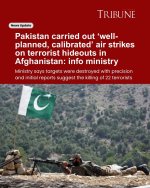
Pakistan carried out “well-planned and calibrated aerial strikes” against terrorist hideouts and safe havens in Afghanistan, with "initial reports suggesting 22 terrorists" had been killed, the Information Ministry said on Thursday.
The ministry, in a post on X, said, "In continuation of Operation Ghazab lil Haq and Pakistan’s resolve to eliminate terrorists, their networks and supporters, well-planned and calibrated aerial strikes against the hideouts and safe havens of terrorist organisations of Fitna al Khawarij and Fitna al Hindustan have been conducted, killing multiple terrorists".
For more: https://tribune.com.pk/story/2632385/1
#etribune #News #latest


