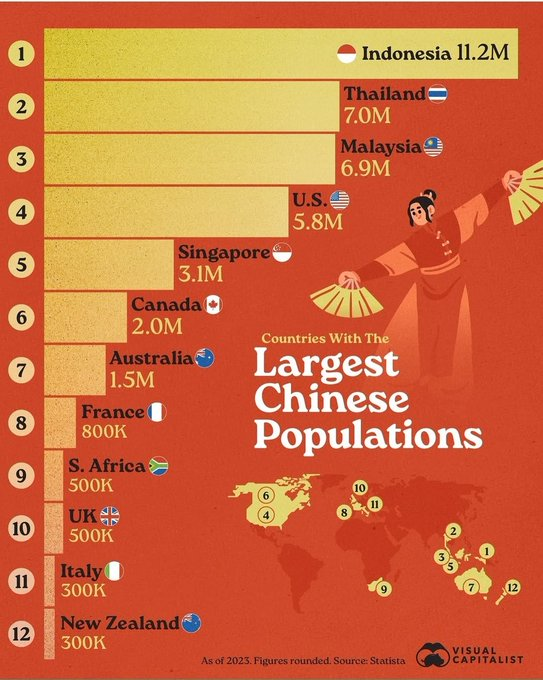
The Largest Chinese Diaspora Populations

S

santosh1976

Guest
The Largest Chinese Diaspora Populations

1776646755703.png


S

santosh1976

Guest
Vietnam: 800k -2 milion
Japan: 900k
South Korea : 840k
Philippines : 1.35 million A fair assessment is that probably, 10% of the Philippine population is ethnic Chinese, and that around 20-30% of the Philippine population have some form of Chinese ancestry. This 1.5% figure would then refer to those with Chinese nationality (PRC or ROC).
Thailand :7-10 million ethnic Chinese. The Thai linguist Luangthongkum claims the share of those having at least partial Chinese ancestry at about 40 percent of the Thai population

Myanmar :1.2 million mostly wa people from yunnan.
Cambodia 300-700k
Laos: 200k
Alot of countries are missing they are not doing a good job with research

 
S

santosh1976

Guest
The Indian diaspora in the USA, numbering over "5.1 million" as of 2023, is the largest in the world and forms a highly influential, educated, and affluent minority. Constituting about 1.6% of the U.S. population, Indian Americans are heavily concentrated in states like California, Texas, and New Jersey, and they excel in technology, management, and medicine.

Key Characteristics and Contributions:

Demographics: The population is a mix of foreign-born (approx. 2.9 million) and U.S.-born residents.

Economic Impact: Indian Americans hold a median household income of "$145,000", more than double the U.S. average. They have a significant presence in corporate leadership, with CEOs of Indian origin heading numerous major corporations (e.g., Google, Adobe).

Education: Roughly 78% of Indian Americans hold a bachelor's degree or higher, far exceeding the 36% U.S. national average.

Influence: They are highly influential in technology and research, with "13%" of U.S. scientific publications having an Indian-American co-author.

Political Engagement: The community has a growing, yet still developing, presence in U.S. politics at both local and national levels, including high-profile figures like Kamala Harris.
Cultural & Global Impact: They maintain strong ties to India, contributing significantly to remittances, which reached nearly $89.4 billion in 2021.

Google Search
.

 
S

santosh1976

Guest
because unlike the majority of people in Southeast Asia who were traditionally farmers, when the Chinese came to Southeast Asia, they didn’t have any land to start with, and so the only way to survive was by starting up a Business, to find some things that are in demand by the local people and sell. As such, while not all the Chinese were successful in business, those that were became rich and could give out loans to other Chinese newcomers that just came and were aspiring to open up their own business. This is where Chinese clan associations come into play: You see, in Southeast Asia, the Chinese tend to divide themselves by clans based on regional dialects and which home province they originated from. For example, there might be a Teochew association, Cantonese association, Hainanese association, Fujianese association and so on, and these associations were built to help those such as business owners that were in their association, and sometimes to mediate between businesses when there was competition

 
Top Bottom