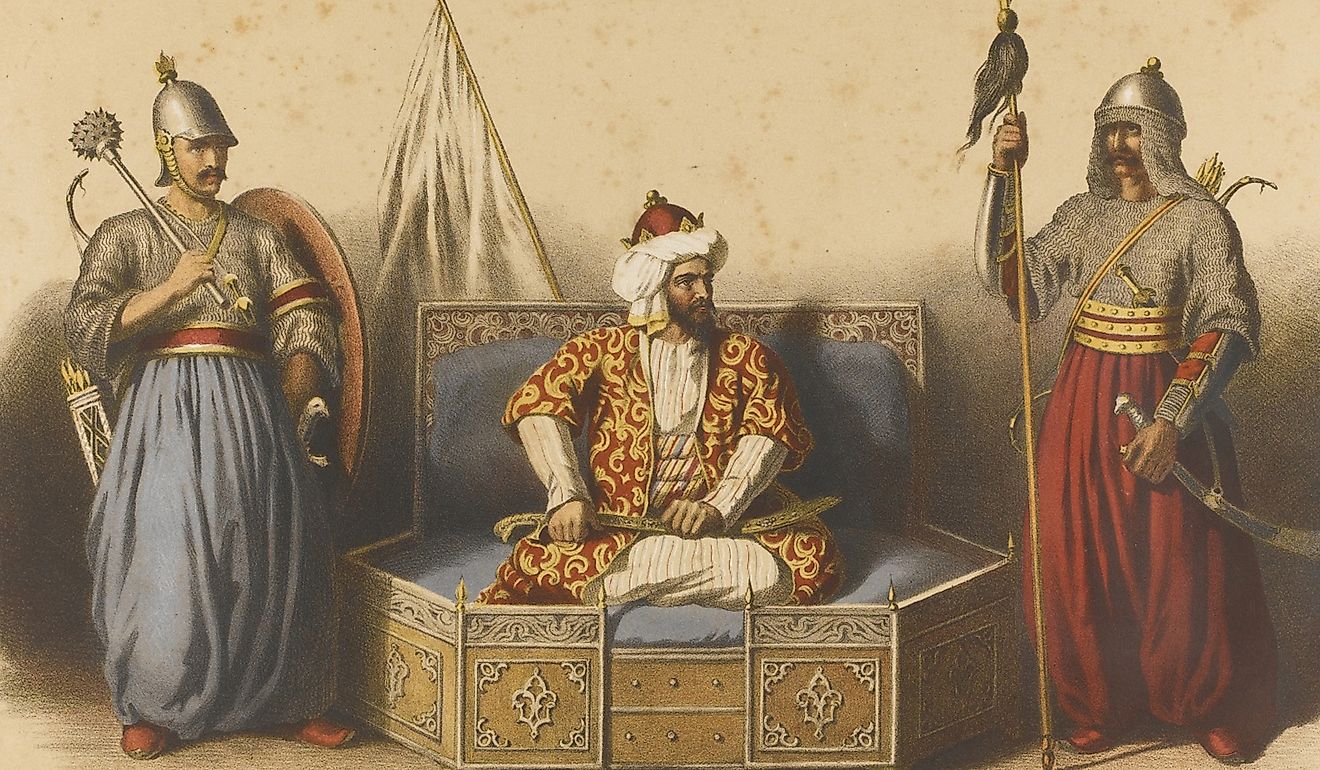
At its peak in the 1500s, the Ottoman Empire was one of the biggest military and economic powers in the world, controlling an expanse that included not just its base in Asia Minor but also much of southeastern Europe, the Middle East and North Africa. The empire controlled territory that stretched from the Danube to the Nile, with a powerful military, lucrative commerce, and impressive achievements in fields ranging from architecture to astronomy. But it didn’t last...
Though the Ottoman Empire persisted for 600 years, it succumbed to what most historians describe as a long, slow decline, despite efforts to modernize. Finally, after fighting on the side of Germany in World War I and suffering defeat, the empire was dismantled by treaty and came to an end in 1922, when the last Ottoman Sultan, Mehmed VI, was deposed and left the capital of Constantinople (now Istanbul) in a British warship. From the Ottoman Empire’s remains arose the modern nation of Turkey.
While the industrial revolution swept through Europe in the 1700s and 1800s, the Ottoman economy remained dependent upon farming. The empire lacked the factories and mills to keep up with Great Britain, France and even Russia, according to Michael A. Reynolds, an associate professor of Near Eastern Studies at Princeton University. As a result, the empire’s economic growth was weak, and what agricultural surplus it generated went to pay loans to European creditors. When it came time to fight in World War I, the Ottoman Empire didn’t have the industrial might to produce heavy weaponry, munitions and iron and steel needed to build railroads to support the war effort.
At its apex, the Ottoman Empire included Bulgaria, Egypt, Greece, Hungary, Jordan, Lebanon, Israel and the Palestinian territories, Macedonia, Romania, Syria, parts of Arabia and the north coast of Africa. Even if outside powers hadn’t eventually undermined the empire, Reynolds doesn’t think that it could have remained intact and evolved into a modern democratic nation. “The odds probably would have been against it, because of the empire’s tremendous diversity in terms of ethnicity, language, economics, and geography,” he says. “Homogenous societies democratize more easily than heterogeneous ones.”
The various peoples who were part of the empire grew more and more rebellious, and by the 1870s, the empire had to allow Bulgaria and other countries to become independent and ceded more and more territory. After losing the 1912-1913 Balkan Wars to a coalition that included some of its former imperial possessions, the empire was forced to give up its remaining European territory.
Despite efforts to improve education in the 1800s, the Ottoman Empire lagged far behind its European competitors in literacy, so by 1914, it’s estimated that only between 5 and 10 percent of its inhabitants could read. “The human resources of the Ottoman empire, like the natural resources, were comparatively undeveloped,” Reynolds notes. That meant the empire had a shortage of well-trained military officers, engineers, clerks, doctors and other professions.
#archaeohistories
X.com