

So they will have realized a miracle if they pull this off nicely. I will mark your words and maybe use them as compliments to our engineers if they make it happen.Maybe take-off ok but landing is not possible for most of aircrafts.

Latest Thread
You are using an out of date browser. It may not display this or other websites correctly.
You should upgrade or use an alternative browser.
You should upgrade or use an alternative browser.


in practice who sees who first and whose air to air missile has the better range?

in practice who sees who first and whose air to air missile has the better range?
KE will be a fighter platform that will be largely made of advanced composite materials. It will use the same level coating at least, and ED systems even if scaled. The most important issue that we can consider as a disadvantage may be the power it can give to the systems, but when we think together with the advances here, this disadvantage may be something that can be balanced. If a certain level of success can be achieved in the radar cooling and exhaust thermal chemical signature management of this aircraft, I think the probability of success of Rafale or similar 4+ fighter jets will definitely be below KE. Because first of all it will have lower detectability, perhaps tens of times less. Even if the KE will be a front-line fighter as single engine variant, it will be backed up by much larger radar and command - control platforms. In fact, while the enemy aircraft is actually engaging a Turkish F-16, the Turkish aircraft can relay the position of the enemy aircraft to the KE wing with a different flight profile within the common tactical picture.
In the in-sight air combat manoeuvring scenario, even if they start from an advantageous position, they will not have much chance. If the same level of structural strength limits can be achieved as existing fighters. I still attach great importance to dogfight situations, because in such a war scenario, the main battlefield will be the Aegean Sea. There will be subsonic and low altidude flight and very congested airspaces.
In my opinion, the most important advantage against a neighbouring force will be the variety of platforms that form a common tactical picture, and moreover, the ability of these attack platforms to engage as a whole. The other side is far from this experience not only in terms of infrastructure and system capacity, but also tactically. For example, in the near future, we will be able to apply tactics such as directing ammunition from platform A to platform B, or controlling an unlocked ammunition fired from platform B from platform A with great competence. And the main components of this system, including the carrier platforms, will have a production function with logistic continuity. In the past, each individual surface-to-air or A-A missile inventory was a major potential weakness. In other words, you cannot act on the assumption that a war will end in so X days, it is always necessary to maintain the stock of ammunition at a certain rate, and domestic production gives us the chance to break this weakness.
Last edited:


I'm sure you are correct. However, my hunch is that it will be the decoy Super Simsek or similar super stealthy surveillance platforms which will see the target 200km ahead of any of our weapons platforms arrives. Rafeal or any other 4gen fighter will not know what launched the missile. For all we know, the missile could have been launched from a fleet of unmanned surface/subsurface drones with medium-range AA strategically placed.in practice who sees who first and whose air to air missile has the better range?
War tactics are changing at tremendous speed and Turkey is one of the driving countries.

If looked in detail this plane can take off from a strip that is 122m long when it is empty. But it needs a runway of 152m to land.
If it has payload when landing it will need a much longer landing strip.
If it has full payload it needs a runway of 304m for take off, and if it has fuel for long endurance flight, it needs an air strip of 488m long.
There is the sea state conditions and the wobbly runway that needs to be considered as well. So as a reconnaissance plane and/or with limited payload it can still prove to be quite useful from many a western aircraft carrier. Albeit with some constraints.
Now if we look at our TCG Anadolu;
We have a recess at the back of the ship which detracts from the overall quoted length of 232m. There is also a huge lift at the back which further reduces the usable airstrip length. Then there is the ski-lift that can only be used in take-off. It has to be deducted from the usable length during landing. That will leave a usable landing runway of under 150m if one has to be safe.
I really look forward to seeing TB3 taking off and most importantly , landing on this ship. Because if we can muster it, it will be a huge force multiplier for it.


Baryshx
Contributor
It can be with a powerful landing gear and braking system, with a powerful engine for short take-off. I don't see much of a problem for automatic landing.If looked in detail this plane can take off from a strip that is 122m long when it is empty. But it needs a runway of 152m to land.
If it has payload when landing it will need a much longer landing strip.
If it has full payload it needs a runway of 304m for take off, and if it has fuel for long endurance flight, it needs an air strip of 488m long.
There is the sea state conditions and the wobbly runway that needs to be considered as well. So as a reconnaissance plane and/or with limited payload it can still prove to be quite useful from many a western aircraft carrier. Albeit with some constraints.
View attachment 57542
Now if we look at our TCG Anadolu;
View attachment 57543
We have a recess at the back of the ship which detracts from the overall quoted length of 232m. There is also a huge lift at the back which further reduces the usable airstrip length. Then there is the ski-lift that can only be used in take-off. It has to be deducted from the usable length during landing. That will leave a usable landing runway of under 150m if one has to be safe.
I really look forward to seeing TB3 taking off and most importantly , landing on this ship. Because if we can muster it, it will be a huge force multiplier for it.
We say it as if it is very simple, but of course it is not.

I'm sure you are correct. However, my hunch is that it will be the decoy Super Simsek or similar super stealthy surveillance platforms which will see the target 200km ahead of any of our weapons platforms arrives. Rafeal or any other 4gen fighter will not know what launched the missile. For all we know, the missile could have been launched from a fleet of unmanned surface/subsurface drones with medium-range AA strategically placed.
War tactics are changing at tremendous speed and Turkey is one of the driving countries.
I wonder if Turkiye conducts all sorts of wargames to see what works and what doesn't. I've got to imagine that before the idlib blitz the Turkish army must have practiced that style of warfare to see if it works or not.


Next on Baykar's agenda should be to continue it's expansion into the civilian market by development a cargo drone with a capacity of 1-2 tonnes and long-range.
Bulgarian Dronamics has developed the UAV below for Cargo transportation with 3.000km range and 350kg capacity. It promised $5 per kilogram in freight cost which is very lucrative.
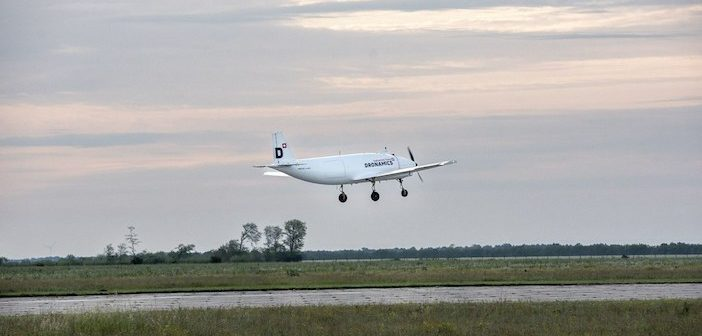
Bulgarian Dronamics has developed the UAV below for Cargo transportation with 3.000km range and 350kg capacity. It promised $5 per kilogram in freight cost which is very lucrative.
I personally believe that while Baykar and TAI are striving for the 10-15 year urgent requirements, this period has the conditions to enable this more company diversification. In this process, the remaining needs with low capital and human resources requirements should be solved with the diversity of companies to be provided. While TAI and Baykar evolve towards another league, space should be created in the lower league. This actually how aerospace things evolved in US during cold war.Next on Baykar's agenda should be to continue it's expansion into the civilian market by development a cargo drone with a capacity of 1-2 tonnes and long-range.
Bulgarian Dronamics has developed the UAV below for Cargo transportation with 3.000km range and 350kg capacity. It promised $5 per kilogram in freight cost which is very lucrative.
View attachment 57689
At this point, I think we should talk about the increase in the number of end system designers and system integrator companies. There are at least 2-3 institutions/companies in TR that can realise the heavy class cargo UAV you mentioned, other than Baykar. All electronics and mechanics that can be used on the aircraft are ready. There are more than ten companies that will produce its structures. They can use state resources/ state-owned hangars and airbases for final assembly and testing. Even without SSB support, the development of this type of aircraft can be projected as highly feasible. If there is SSB support, developing this type of vehicle will be a piece of cake for the Turkish aerospace industry. Especially on the UAV side, there is now a very serious ecosystem. In fact, it has such a wide spectrum that it has very few equivalents in the world. The reason why it is not so visible at the moment is that ambitious projects are centred around two or three main end-system manufacturers.
I personally believe that while Baykar and TAI are striving for the 10-15 year urgent requirements, this period has the conditions to enable this more company diversification. In this process, the remaining needs with low capital and human resources requirements should be solved with the diversity of companies to be provided. While TAI and Baykar evolve towards another league, space should be created in the lower league. This actually how aerospace things evolved in US during cold war.
At this point, I think we should talk about the increase in the number of end system designers and system integrator companies. There are at least 2-3 institutions/companies in TR that can realise the heavy class cargo UAV you mentioned, other than Baykar. All electronics and mechanics that can be used on the aircraft are ready. There are more than ten companies that will produce its structures. They can use state resources/ state-owned hangars and airbases for final assembly and testing. Even without SSB support, the development of this type of aircraft can be projected as highly feasible. If there is SSB support, developing this type of vehicle will be a piece of cake for the Turkish aerospace industry. Especially on the UAV side, there is now a very serious ecosystem. In fact, it has such a wide spectrum that it has very few equivalents in the world. The reason why it is not so visible at the moment is that ambitious projects are centred around two or three main end-system manufacturers.
Indeed 2nd tier companies should step up. Titra is one example, they just exported their 200kg capacity cargo helicopter to Malaysia.
the benefit of Baykar doing it is that it would instantly become an export success

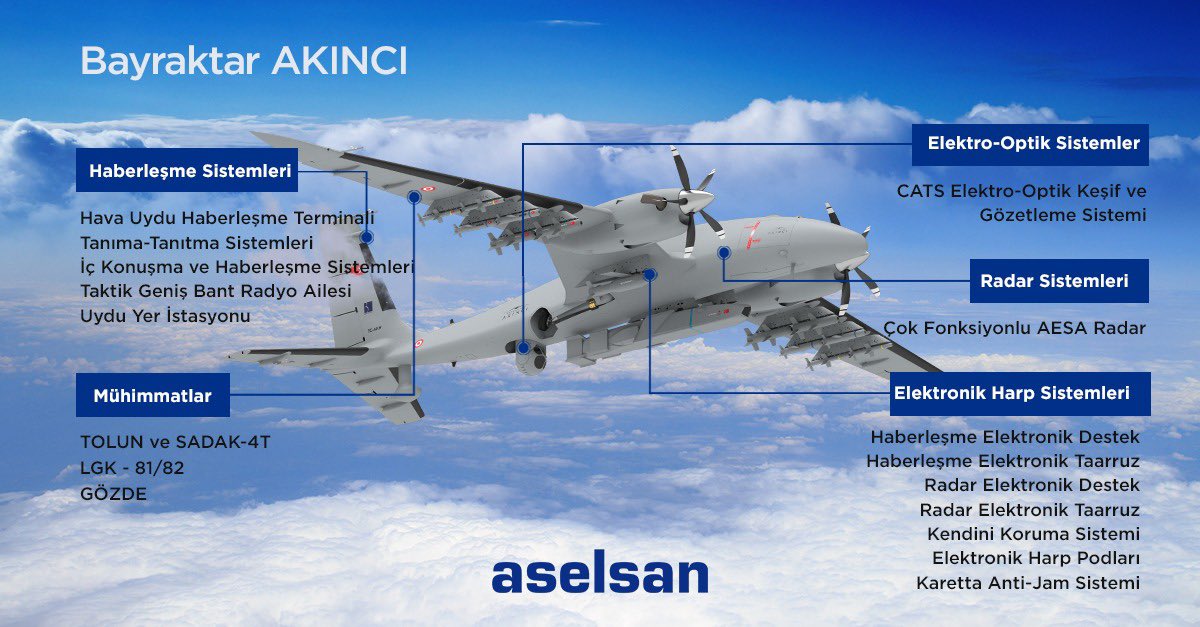
ASELSAN has developed special electronic warfare (communication electronic support, communication electronic attack, radar electronic support, radar electronic attack, self-protection systems, electronic warfare pods, Karetta Anti-Jam system) for AKINCI.
İbrahim Sünnetçi said, "Last year, I wrote that ELINT and EH Pods (which GM GÖRGÜN announced in December 2022 that it can confuse the radars of air defense systems from a distance of close to 100 km) will be used in AKINCI. AKINCI can meet the energy needs of this type of pod, thanks to its two powerful TP engines with a capacity of 750hp. ANKA and AKSUNGUR, on the other hand, can be equipped with EH Pods with lower output power and mixing range, such as ASELSAN's Mini Electronic Attack Pod, as they cannot meet the energy needs especially for the EH Pod."

Turkish Aerospace Industries (TUSAŞ) delivered 2 ANKA SİHAs, which Tunisia provided additionally, to the Tunisian Air Force. Thus, the total number of ANKA SİHAs delivered to Tunisia was 5.
TAI signed a contract with Tunisia for the export of ANKA SİHA in the past years. It was learned that the total cost of the agreement, which includes 3 ANKA SİHAs and 3 ground stations, is 80 million dollars.
In the news published in SavunmaSanayiST; TUSAŞ, which completed 3 ANKA SİHA orders for Tunisia last year, has also received a new order. Two additional ANKA ordered by Tunisia were delivered to Tunisian Air Force by TAI. Thus, TAI has so far delivered 5 ANKAs to Tunisia.
On the other hand, TAI continues its contacts with different countries regarding ANKA exports. The company has so far delivered 3 ANKAs to Kazakhstan, 2 AKSUNGURs to Kyrgyzstan, 2 ANKAs to Chad and 5 ANKAs to Tunisia. Indonesia ordered 12 ANKAs, Algeria 10 and Malaysia 9 ANKAs.
ANKA Unmanned Aerial Vehicle, developed by TAI with national resources, including day/night and bad weather conditions; It is equipped with payloads for real-time image intelligence, target destruction missions for reconnaissance, surveillance, fixed/moving target detection, identification, identification and tracking.
ANKA UAV can stay in the air for 24 hours at an altitude of 30,000ft and can carry 350+ kilograms of payload. While it is estimated that approximately 50 ANKA SİHAs have been delivered so far, the production activities of the same number continue.
"AESA Radar's radome has arrived. We are working very closely with BAYKAR. We will start flight tests on AKINCI soon."
— ASELSAN YKB Prof. Dr. @halukgorgun
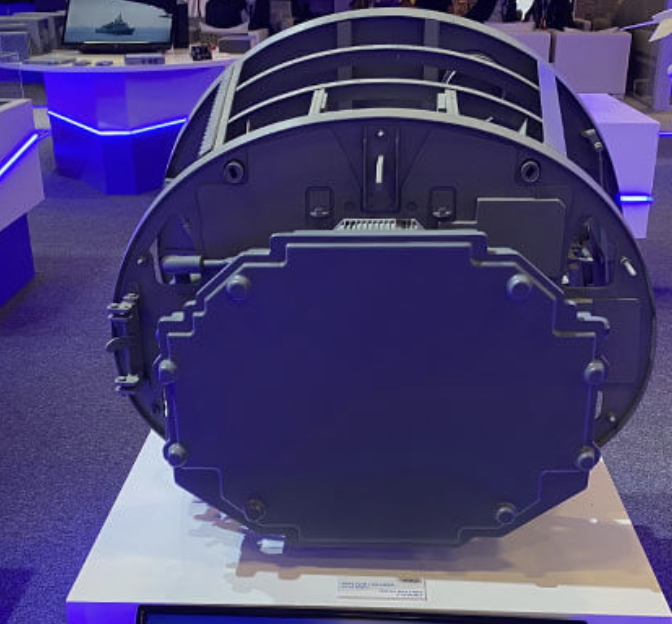


Weird. We already heard that it was already integrated and tested. They are now implementing feedback
"AESA Radar's radome has arrived. We are working very closely with BAYKAR. We will start flight tests on AKINCI soon."
— ASELSAN YKB Prof. Dr. @halukgorgun


