

The YJ-20 is China’s first sea-based hypersonic anti-ship missile to have entered mass production, giving the People’s Liberation Army a decisive strike advantage over all rival surface combatants worldwide.
The YJ-20, with its remarkable range, hypersonic speed and near-invulnerability to interception, has been tailor-made for the Chinese navy’s Type 055 destroyer’s 112-cell vertical launch system (VLS).
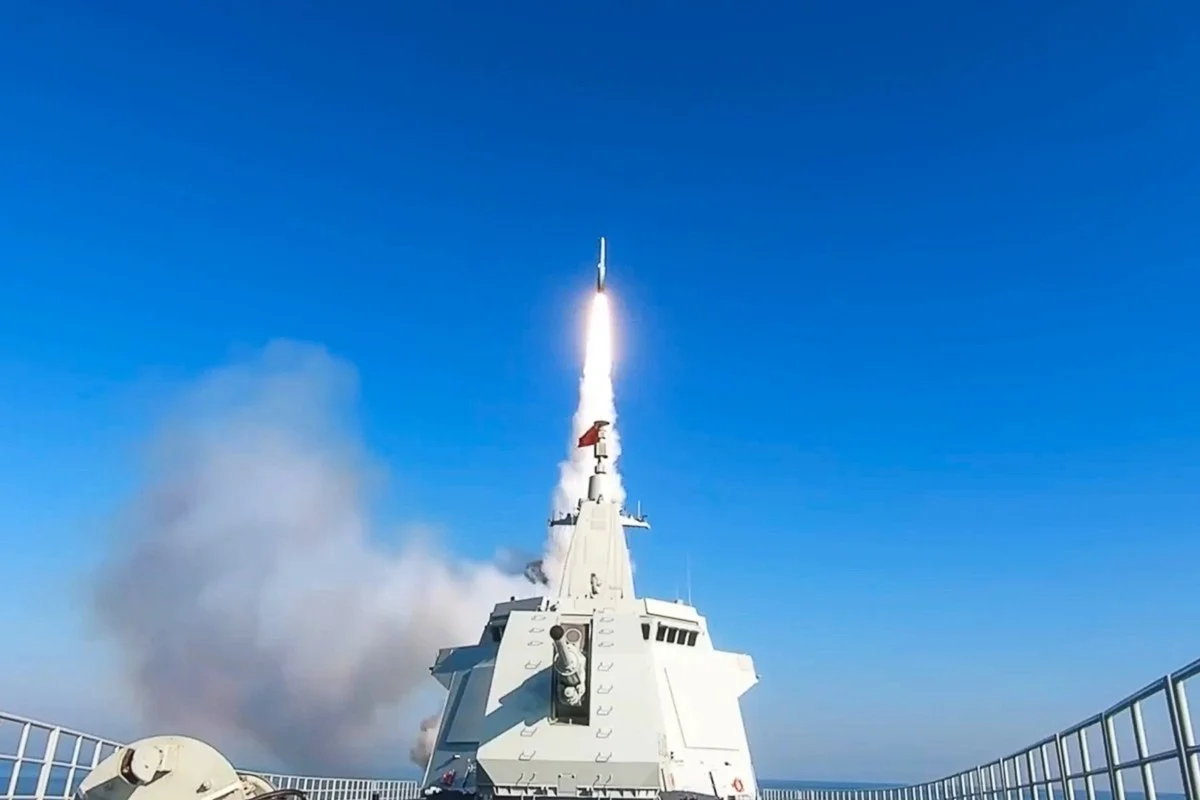
Also known as the Eagle Strike-20, the YJ-20 adopted the boost-glide flight regime and is highly manoeuvrable, with a distinctive biconic body design.
With an estimated length of a little under 9 metres (30 feet) and a diameter of less than 850mm (33.5 inches), the missile is tailored for the HT-1 VLS on both the Type 055 and modified Type 052D vessels.
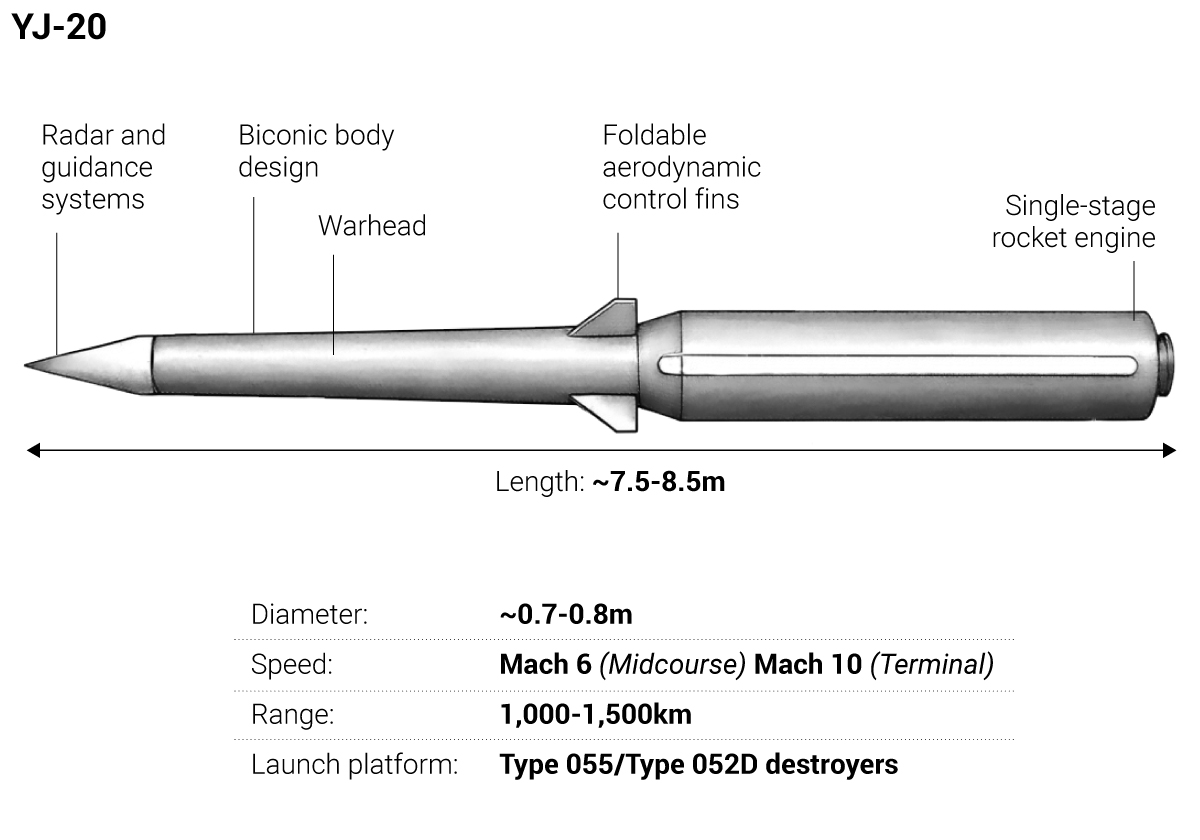
At this size, the YJ-20 is estimated to have a range of 1,000 to 1,500km (621 to 932 miles) and is believed to be capable of sinking a large surface combatant – even an aircraft carrier – with a single hit, combining both kinetic penetration and warhead detonation.
In comparison, the US Navy’s existing universal VLS – the 635mm (25-inch) Mark 41 and 711 mm Mark 57 – are too small for the larger hypersonic missiles under development, such as the Conventional Prompt Strike (CPS).
While smaller missiles could fit the existing cells – like the potential ship-based variant of the Hypersonic Air-breathing Weapon Concept (HAWC) – the size constraint would reduce range and payload, making them less powerful.
With a midcourse speed exceeding Mach 6, the YJ-20 can complete its 1,500km maximum range in just over 10 minutes, severely compressing the enemy’s reaction window. Its gliding altitude of 40-60km is also a blind spot for most early-warning radars, further reducing the enemy’s opportunity to respond.
The YJ-20 integrates a multi-mode guidance system that includes radar, inertial navigation and satellite transmissions, with some experts suggesting that it may be able to receive in-flight data updates.
During its final descent, the missile executes unpredictable lateral manoeuvres while accelerating to terminal velocities beyond Mach 10 – enough to penetrate enemy air defence systems, such as the ship-based Aegis used on US destroyers.
However, the YJ-20’s existence was hinted at much earlier. A 2022 video released by the PLA Navy showed a biconic-shaped missile being launched from a Type 055.
A similar missile, which appeared to be the same model, was spotted in another PLA video in 2024.
Neither was officially identified at the time and many defence observers incorrectly referred to the missile as the YJ-21 for several years, until its designation was clarified with the September 3 parade, when the ship-launched hypersonic anti-ship missile was formally introduced as the YJ-20.
The YJ-21 is an air-launched hypersonic anti-ship missile, which appeared in last year’s parade in the strategic missile formation alongside the road-mobile DF-17 and the intermediate-range DF-26D.
In December, China Military Bugle, a social media account run by the PLA, released footage of the YJ-20 being fired from the Type 055 destroyer Wuxi, marking a critical milestone in the missile’s development.
While the exact time and location of the launch were omitted, the labelling of the footage as the missile’s “finalisation test” was seen as a signal that the advanced weapon was ready for mass production.
The videos of the test showed that the YJ-20 employs a “cold-launch” ejection mechanism, which uses a gas generator to launch the missile before its solid-rocket engine ignites in mid-air.
This method protects the VLS cells from the engine’s exhaust heat as well as anything on the deck. It also maximises the available missile diameter, in contrast with a “hot-launch” missile that requires more space between the airframe and cell wall for plume venting.
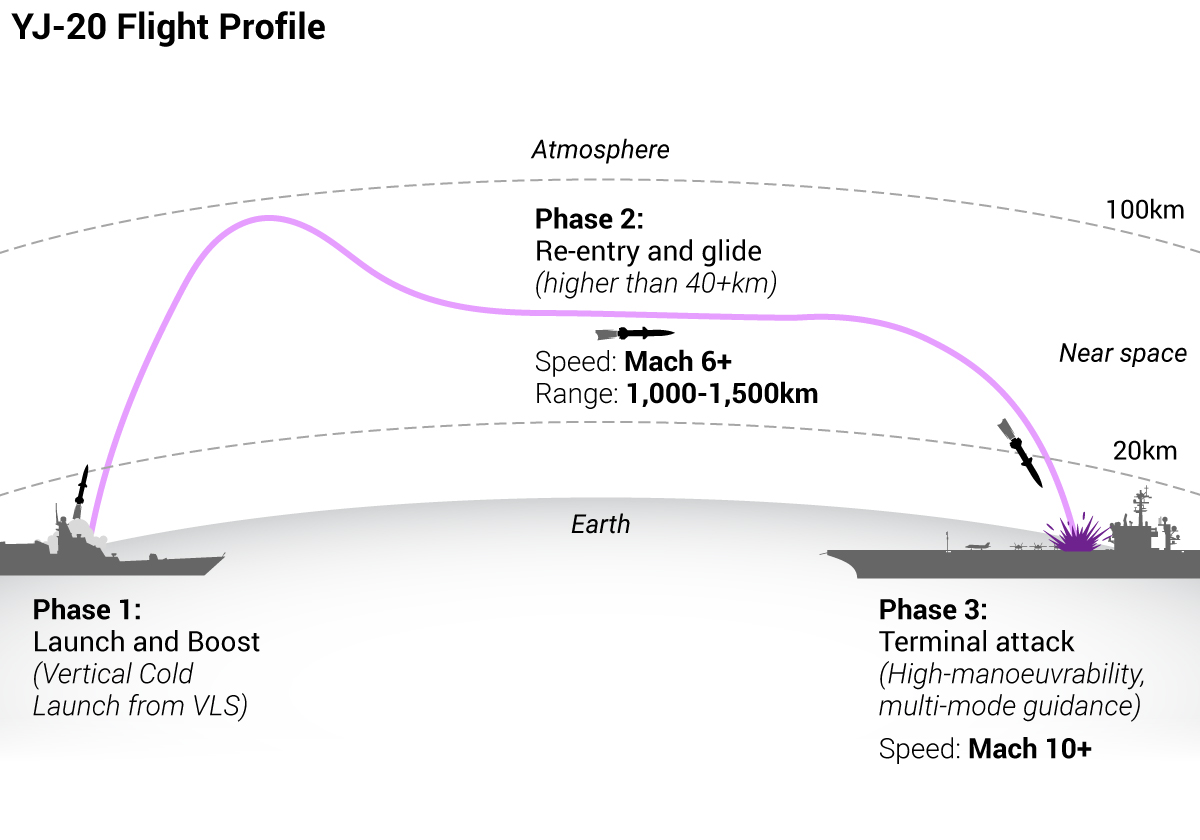
While its initial boost phase is similar to a traditional ballistic missile, the YJ-20’s trajectory does not follow a high parabolic trajectory into space, instead using a flight profile called the boost-glide regime.
On reaching the upper edge of the atmosphere, the missile descends slightly to re-enter the denser air, which generates aerodynamic lift, subsequently levelling off to an almost horizontal glide.
As it approaches the target in the terminal phase, the warhead reorients nose-down to perform a steep, Mach 10 dive.
The atmospheric-skimming glide not only enables a cruise speed exceeding Mach 6 but also offers important tactical advantages.
Conventional air-defence radars on modern warships typically monitor altitudes below 30km, while ballistic missile defence (BMD) systems are generally focused on exoatmospheric intercepts above 100km.
The YJ-20’s midcourse glide phase at altitudes of about 35-60km exploits this gap, which means it can remain just beyond the radar horizon for significantly longer durations.
This height also lies outside the effective engagement envelope of most current interceptors.
The US Patriot PAC-3 and SM-6 missile defence systems rely on aerodynamic control surfaces that require denser atmosphere below 30km to manoeuvre effectively, while the SM-3 is designed exclusively for engagements outside the atmosphere.
While the US-made THAAD (Terminal High Altitude Area Defence) is one of the few systems capable of covering YJ-20’s midcourse altitude, it was developed primarily to counter predictable ballistic trajectories and would face severe challenges tracking and intercepting its rapid, unpredictable lateral manoeuvres.
In contrast, the YJ-20’s axisymmetric biconic airframe is slightly less efficient than a waverider in generating aerodynamic lift, but its more compact design makes it more compatible with the universal VLS tubes on modern warships.
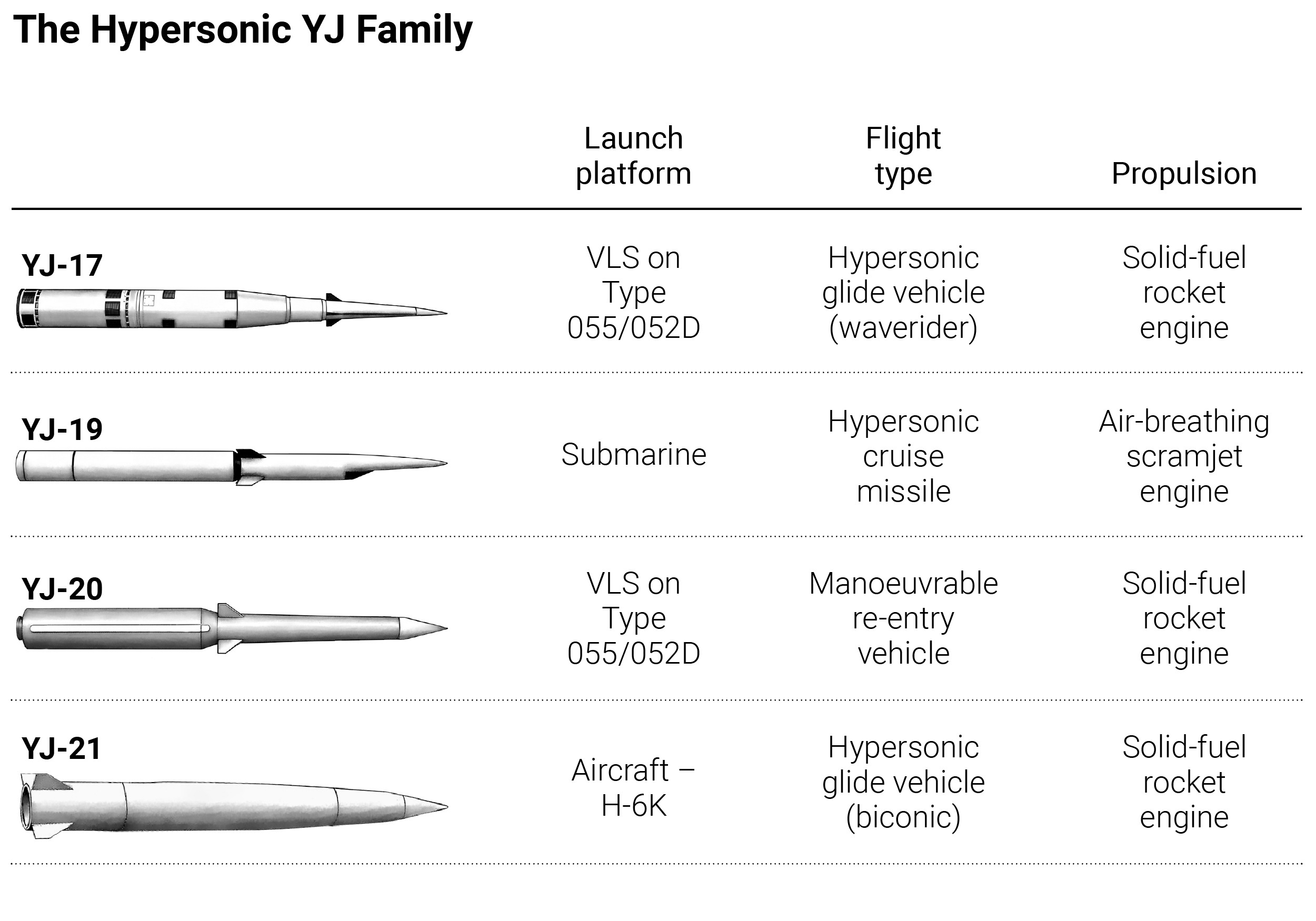
Following another technological path, the PLA Navy has also developed a scramjet-powered hypersonic cruise missile (HCM), the YJ-19, which is comparable to Russia’s Zircon and the US HAWC.
HCMs, powered by advanced air-breathing scramjet engines, benefit from sustained propulsion, enabling more stable flight and greater manoeuvrability throughout the trajectory.
Their compact size and lighter weight also make HCMs easier to deploy across a variety of platforms.
Meanwhile, HGVs typically achieve higher terminal speeds, are harder to intercept and are often larger so that they can accommodate heavier warheads for more lethal explosive and kinetic strikes.

 www.scmp.com
The YJ-20, with its remarkable range, hypersonic speed and near-invulnerability to interception, has been tailor-made for the Chinese navy’s Type 055 destroyer’s 112-cell vertical launch system (VLS).
Also known as the Eagle Strike-20, the YJ-20 adopted the boost-glide flight regime and is highly manoeuvrable, with a distinctive biconic body design.
With an estimated length of a little under 9 metres (30 feet) and a diameter of less than 850mm (33.5 inches), the missile is tailored for the HT-1 VLS on both the Type 055 and modified Type 052D vessels.
At this size, the YJ-20 is estimated to have a range of 1,000 to 1,500km (621 to 932 miles) and is believed to be capable of sinking a large surface combatant – even an aircraft carrier – with a single hit, combining both kinetic penetration and warhead detonation.
In comparison, the US Navy’s existing universal VLS – the 635mm (25-inch) Mark 41 and 711 mm Mark 57 – are too small for the larger hypersonic missiles under development, such as the Conventional Prompt Strike (CPS).
While smaller missiles could fit the existing cells – like the potential ship-based variant of the Hypersonic Air-breathing Weapon Concept (HAWC) – the size constraint would reduce range and payload, making them less powerful.
With a midcourse speed exceeding Mach 6, the YJ-20 can complete its 1,500km maximum range in just over 10 minutes, severely compressing the enemy’s reaction window. Its gliding altitude of 40-60km is also a blind spot for most early-warning radars, further reducing the enemy’s opportunity to respond.
The YJ-20 integrates a multi-mode guidance system that includes radar, inertial navigation and satellite transmissions, with some experts suggesting that it may be able to receive in-flight data updates.
During its final descent, the missile executes unpredictable lateral manoeuvres while accelerating to terminal velocities beyond Mach 10 – enough to penetrate enemy air defence systems, such as the ship-based Aegis used on US destroyers.
Emergence
The YJ-20 made its official public debut in September’s Victory Day military parade in Beijing, alongside some of the newest members of the Eagle Strike family – the supersonic YJ-15, the HGV-based YJ-17, and the hypersonic cruise missile YJ-19. This formation represents what is arguably the world’s most formidable anti-ship arsenal.However, the YJ-20’s existence was hinted at much earlier. A 2022 video released by the PLA Navy showed a biconic-shaped missile being launched from a Type 055.
A similar missile, which appeared to be the same model, was spotted in another PLA video in 2024.
Neither was officially identified at the time and many defence observers incorrectly referred to the missile as the YJ-21 for several years, until its designation was clarified with the September 3 parade, when the ship-launched hypersonic anti-ship missile was formally introduced as the YJ-20.
The YJ-21 is an air-launched hypersonic anti-ship missile, which appeared in last year’s parade in the strategic missile formation alongside the road-mobile DF-17 and the intermediate-range DF-26D.
In December, China Military Bugle, a social media account run by the PLA, released footage of the YJ-20 being fired from the Type 055 destroyer Wuxi, marking a critical milestone in the missile’s development.
While the exact time and location of the launch were omitted, the labelling of the footage as the missile’s “finalisation test” was seen as a signal that the advanced weapon was ready for mass production.
Flight profile
The videos of the test showed that the YJ-20 employs a “cold-launch” ejection mechanism, which uses a gas generator to launch the missile before its solid-rocket engine ignites in mid-air.
This method protects the VLS cells from the engine’s exhaust heat as well as anything on the deck. It also maximises the available missile diameter, in contrast with a “hot-launch” missile that requires more space between the airframe and cell wall for plume venting.
While its initial boost phase is similar to a traditional ballistic missile, the YJ-20’s trajectory does not follow a high parabolic trajectory into space, instead using a flight profile called the boost-glide regime.
On reaching the upper edge of the atmosphere, the missile descends slightly to re-enter the denser air, which generates aerodynamic lift, subsequently levelling off to an almost horizontal glide.
As it approaches the target in the terminal phase, the warhead reorients nose-down to perform a steep, Mach 10 dive.
The atmospheric-skimming glide not only enables a cruise speed exceeding Mach 6 but also offers important tactical advantages.
Conventional air-defence radars on modern warships typically monitor altitudes below 30km, while ballistic missile defence (BMD) systems are generally focused on exoatmospheric intercepts above 100km.
The YJ-20’s midcourse glide phase at altitudes of about 35-60km exploits this gap, which means it can remain just beyond the radar horizon for significantly longer durations.
This height also lies outside the effective engagement envelope of most current interceptors.
The US Patriot PAC-3 and SM-6 missile defence systems rely on aerodynamic control surfaces that require denser atmosphere below 30km to manoeuvre effectively, while the SM-3 is designed exclusively for engagements outside the atmosphere.
While the US-made THAAD (Terminal High Altitude Area Defence) is one of the few systems capable of covering YJ-20’s midcourse altitude, it was developed primarily to counter predictable ballistic trajectories and would face severe challenges tracking and intercepting its rapid, unpredictable lateral manoeuvres.
Other tech paths
China has deployed another type of hypersonic glide vehicle (HGV) – the wedge-shaped waverider – on its first operational hypersonic missile, the DF-17. A similar design has been adapted for the YJ-17.In contrast, the YJ-20’s axisymmetric biconic airframe is slightly less efficient than a waverider in generating aerodynamic lift, but its more compact design makes it more compatible with the universal VLS tubes on modern warships.
Following another technological path, the PLA Navy has also developed a scramjet-powered hypersonic cruise missile (HCM), the YJ-19, which is comparable to Russia’s Zircon and the US HAWC.
HCMs, powered by advanced air-breathing scramjet engines, benefit from sustained propulsion, enabling more stable flight and greater manoeuvrability throughout the trajectory.
Their compact size and lighter weight also make HCMs easier to deploy across a variety of platforms.
Meanwhile, HGVs typically achieve higher terminal speeds, are harder to intercept and are often larger so that they can accommodate heavier warheads for more lethal explosive and kinetic strikes.
Does YJ-20 hypersonic sea-based missile give China an edge over US carriers?
The highly manoeuvrable weapon is nearly invulnerable to interception and could sink an aircraft carrier with a single hit.
www.scmp.com


