
Latest Thread
You are using an out of date browser. It may not display this or other websites correctly.
You should upgrade or use an alternative browser.
You should upgrade or use an alternative browser.

S
SilverMachine
Guest
Have to admit, it's a little prettier to look at than the original F-35 it's cheap-imitating 15 years too late. A little less chunky, and the twin engines always looks better asthetically. No VTOL with this thing though, right? Not sure I see the point in dropping that, it's a big part of the 35's usefulness.

"Dropping" VTOL is a weird statement. But F35B variant carries significantly less fuel and munitions. This is the air force variant anywaysHave to admit, it's a little prettier to look at than the original F-35 it's cheap-imitating 15 years too late. A little less chunky, and the twin engines always looks better asthetically. No VTOL with this thing though, right? Not sure I see the point in dropping that, it's a big part of the 35's usefulness.

Because they dont need a VTOL fighter lol. Meanwhile the US Navy also prefers the F-35C over the B variant.Have to admit, it's a little prettier to look at than the original F-35 it's cheap-imitating 15 years too late. A little less chunky, and the twin engines always looks better asthetically. No VTOL with this thing though, right? Not sure I see the point in dropping that, it's a big part of the 35's usefulness.
Also how is it 15 years late? China didn't enter into any conflict with the US yet. Now they will mass produce their own domestic 5th gen carrier fighter.
S
SilverMachine
Guest
The point being the tech in this thing, being an F-35 knock-off, was impressive and cutting edge when the Joint trike Fighter team did it. By the time the Chinese are actually fielding this thing operationally, it'll be old news compared to the new variants & potentially even new early-stage airframe the wet will be coming up with. Yes, quality isn't everything and can sometimes be overcome with quantity, and China can no doubt do quantity. But plane-for-plane nobody's that worried about this thing.
And yeah that's a point I guess about VTOL, not like China has a lot of carriers to work with. Still, you'd figure being able to land/park them anywhere flat would be an advantage in any future conflict to break out.
In any case, 35s, OG real ones or off-brand copies alike, are pretty lame. 22's still for the win.
And yeah that's a point I guess about VTOL, not like China has a lot of carriers to work with. Still, you'd figure being able to land/park them anywhere flat would be an advantage in any future conflict to break out.
In any case, 35s, OG real ones or off-brand copies alike, are pretty lame. 22's still for the win.


China is like 3 years behind Taiwan in semiconductor technology and we all do know Japan or Taiwan are like number 1 in MMICs https://asia.nikkei.com/Business/Te...ities-just-3-years-behind-TSMC-teardown-shows So that is indeed impressive considering they were really behind before but closing the gap really fast. The rate they are going they might be equal to or surpassing Taiwan or Japan meaning if future avionics upgrades happen(which they usually do) the radar on the aircraft will more than likely be more advanced than US radars since they get their MMICs from either Japan or Taiwan.
Still undecided if the latest avionics on the Su-57 will receive photonic radars or not because 2024 was the timeframe the PIC production started while they have the newer Su-57s with new avionics and new engines set for 2025.
 technomoscow.ru

 www.rbc.ru

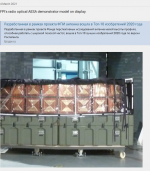
They have started producing PICs a little over a week ago.
Assuming this is used the radars will be using particles of light(photons) instead of electrons from radio waves for digital processing of information which would give radar readings more accurate readings with rumors the signal to noise ratio would improve by 100 times meaning if you can see a .01m2 target at 400kms instead of a 1m2 target, It can also operate with 100ghz frequencies without atmospheric conditions effecting range because of photons being used for the electronic processing instead of electrons which is used in conventional methods for radars that use MMICs. The radars are as thin as skin which can be bodied across the aircraft.
Lets say for the sake they wont use photonic radars but GaN(they made the modules for the Himalayas EW system in 2014) for the new 2025 radars. They already have 360 degree infrared and UV coverage, 360 degree radar coverage(I have Niip.ru and latest KRET news articles that state the back uses active radar detection for those interested that its no longer 240-degree detection but 360) with long wave 180-degree infrared detection because of their IRST. The MIRES uses data fusion of all of this for more pinpoint accuracy to deal with incoming missiles through situational awareness. Su-57 would utilize DIRCM to blind infrared homing heads and over like 2,200 AESA T/R modules with Himalayas for heavy suppression for anything X-band or lower on radar homing heads, and if worse comes to worst chaffs and flares for additional countermeasures will be used for infrared and radar homing heads.
The most underestimated feature is the aircrafts maneuverability. By trading speed for agility, the Su-57 can point its stealthiest aspect to the threat on a dime (distance of combat will shorten if 2 stealth aircrafts get closer and closer making maneuverability more important the closer they come), instantly cutting detection range. The reduced speed will also significantly reduce doppler returns as well as IR returns from skin friction heating.
Another interesting thing is that Link 16 is 300-500 nautical miles. S-108 has like a 800km max distance(s-107-1 data) S-111 boasts 1,500km range for Su-57, now they made a breakthrough where the distance can be 6000kms https://rostec.ru/media/news/razrab...ustoychivost-zagorizontnoy-svyazi-do-6000-km/
Still undecided if the latest avionics on the Su-57 will receive photonic radars or not because 2024 was the timeframe the PIC production started while they have the newer Su-57s with new avionics and new engines set for 2025.
Особая экономическая зона ТЕХНОПОЛИС МОСКВА
Центр развития высокотехнологичных производств
technomoscow.ru
Ученый назвал сроки испытания фотонного процессора в России
В России соберут экспериментальный образец фотонного процессора, который сможет обрабатывать информацию в сотни раз быстрее современных цифровых нейросетей. Об этом сообщил РИА Новости участник ...
www.rbc.ru
Scientists of the National Center for Physics and Mathematics Have Created a Sample of Analog Photonic Processor, with its Performance Close to the World Record
In the device, the information processing speed is close to the record for such processors – over five quadrillion (5.3 * 1015) bits per second
ssau.ru

They have started producing PICs a little over a week ago.
Assuming this is used the radars will be using particles of light(photons) instead of electrons from radio waves for digital processing of information which would give radar readings more accurate readings with rumors the signal to noise ratio would improve by 100 times meaning if you can see a .01m2 target at 400kms instead of a 1m2 target, It can also operate with 100ghz frequencies without atmospheric conditions effecting range because of photons being used for the electronic processing instead of electrons which is used in conventional methods for radars that use MMICs. The radars are as thin as skin which can be bodied across the aircraft.
Lets say for the sake they wont use photonic radars but GaN(they made the modules for the Himalayas EW system in 2014) for the new 2025 radars. They already have 360 degree infrared and UV coverage, 360 degree radar coverage(I have Niip.ru and latest KRET news articles that state the back uses active radar detection for those interested that its no longer 240-degree detection but 360) with long wave 180-degree infrared detection because of their IRST. The MIRES uses data fusion of all of this for more pinpoint accuracy to deal with incoming missiles through situational awareness. Su-57 would utilize DIRCM to blind infrared homing heads and over like 2,200 AESA T/R modules with Himalayas for heavy suppression for anything X-band or lower on radar homing heads, and if worse comes to worst chaffs and flares for additional countermeasures will be used for infrared and radar homing heads.
The most underestimated feature is the aircrafts maneuverability. By trading speed for agility, the Su-57 can point its stealthiest aspect to the threat on a dime (distance of combat will shorten if 2 stealth aircrafts get closer and closer making maneuverability more important the closer they come), instantly cutting detection range. The reduced speed will also significantly reduce doppler returns as well as IR returns from skin friction heating.
Another interesting thing is that Link 16 is 300-500 nautical miles. S-108 has like a 800km max distance(s-107-1 data) S-111 boasts 1,500km range for Su-57, now they made a breakthrough where the distance can be 6000kms https://rostec.ru/media/news/razrab...ustoychivost-zagorizontnoy-svyazi-do-6000-km/

T
TR_123456
Guest
How is it 5th gen,i still have my doubts about the J-20 being 5th gen?
Just show me the engine.
How is it 5th gen,i still have my doubts about the J-20 being 5th gen?
Just show me the engine.
J20A flying with 2x new WS-15 engines from late 2024.
Also both jets don't have or have only a limited flush air data sensing system (FADS) which means higher RCS, e.g. air data sensors sticking out near the nose.
That is deliberately false.
Don't you see those air data sensors sticking out like horns? Also do you say those HMD are on the same level as Gen III HMDS or TULGAR?
I am not talking about HMDs. Simply there is no way for us to know for sure. (But if I had to guess, I say they are probably similar based on what is available in PRC civilian tech sector today)
But how did you conclude, 'both jets don't have or have only a limited flush air data sensing system (FADS) which means higher RCS?'
Don't you see those air data sensors sticking out like horns?
F22 and F35 also has them. Whatever they are.


Imo both jets don't have or have only a limited flush air data sensing system (FADS) which means higher RCS, e.g. air data sensors sticking out near the nose. And it looks like they only use a basic helmet mounted display (HMD).
Flush air data sensors generally have more to do with hypersonic regimes (given induced drag forces, heating and so on):
Pitot tube RCS is not significant design driver in say <Mach 2 regimes I believe (especially reading this paper and the calibration and sensoring trade-offs, especially in lower speed less-laminar flow regime)... compared to conventional probe past boundary layer.
Compared to signature of the canopy, flight control surfaces (in operation) and curved surfaces etc. These tradeoffs (for the aerodynamics) bake in lot more RCS return than the pitot tubes I would assume.
I don't know if this author is an expert but it looks like that air data sensors/tubes do affect RCS.
Obviously, the B-2 carries no external/protruting pitot tubes (that would affect the aircraft’s Radar Cross Section – RCS – making it less stealthy); to check airspeed, the aircraft uses static ports set flush into the skin.
View attachment 76307
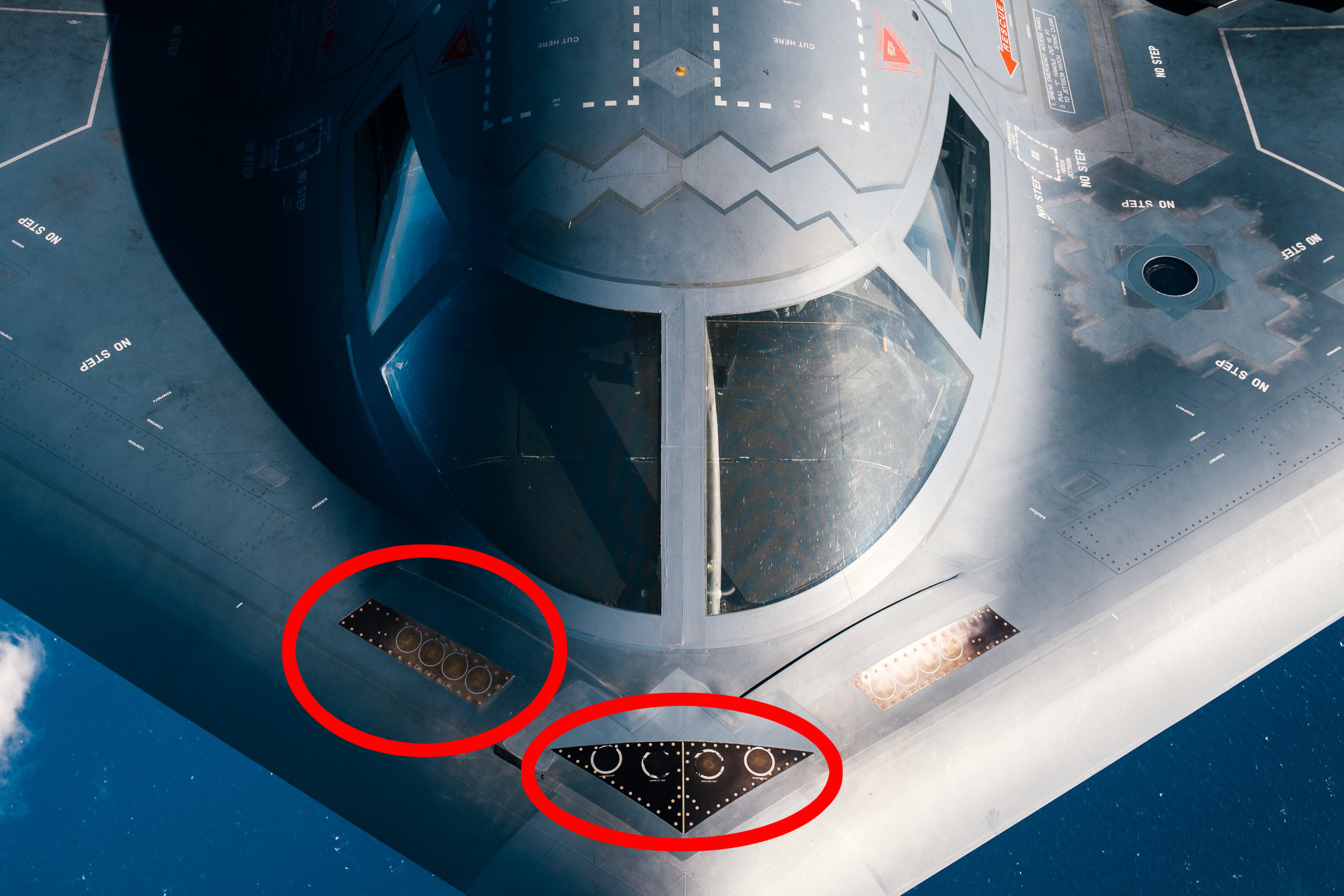
This Close Up Photograph of the B-2 Spirit Provides A Fantastic View On The Stealth Bomber's Air Data Ports
This shot exposes a few interesting details about some of the B-2's sensors. The U.S. Air Force has just released some interesting photographs of one oftheaviationist.com
Nice find. Yeah I guess the trade-off was worth it here, the B-2 does have a lot more capacity in avionics.
i.e The avionics cost being left more open ended (since only a squadron of B-2 planned or ended up being made I forget which) for B-2 compared to F-22 probably a factor here. To get that final few % increments in RCS improvement at greater cost etc, especially factoring in what is the size of the bird on hand at the nose area to host it too etc.
Per unit costs roughly:
B-2 : 2 billion USD
F-22: 350 million USD
(would have been somewhat lower if they produced a lot more of both, but the B-2 is especially capital cost loaded by low number etc)
From what I remember the F-22 avionics package started cutting down requirements early (to essentially focus on handling the radar primarily), so side mounted radars (what would eventually develop into DAS downroad for the F-35 etc along with EOTs) and even IRST were all given the chop. I'm unsure what's required onboard (that the B-2 clearly has with the price impact being less of a bar) for flush sensors here, though I would imagine its part of reason why it didnt make it to F-22 given what else was cut.
They are now looking to patch in IRST into the F-22 or example, a complicated effort:

F-22 Raptor To Get Distributed Infrared Search And Track System
Plans to add some form of increasingly critical infrared search and track system to the Raptors have been in the works for years now.
 www.twz.com
The F-117 (the high stealth design driver approach with really low compromise to aerodynamics) had its own compromises again (no radar at all and constrained avionics capacity optimized to FLIR instead), so again the trade off for flush sensors, IRST etc deemed not worth it.

Chinese aircraft manufacturer hosts first flights of 2026 for J-35 stealth fighter jet
An unpainted J-35 stealth fighter jet takes off at an airfield of the Shenyang Aircraft Corporation under the Aviation Industry Corporation of China (AVIC) in Shenyang, Northeast China's Liaoning Province on January 6, 2026. Photo: Official account of AVIC
China's top aircraft manufacturer, the Aviation Industry Corporation of China (AVIC), on Wednesday announced that it had hosted first flights of the new year for the J-35 carrier-based stealth fighter jet among other types of aircraft, accompanied by photos and a video. An expert said the move demonstrated China's confidence in its warplane production capabilities.
AVIC revealed in Weibo posts on Wednesday that a J-35 conducted its maiden flight of the new year on Tuesday at the AVIC Shenyang Aircraft Corporation in Shenyang, Northeast China's Liaoning Province.
The J-35 carrier-based stealth fighter jet has drawn widespread attention since making its debut at China's V-Day military parade in Beijing on September 3, 2025. Compared with its Air Force counterpart, the J-35A, the J-35, the naval variant, is specifically designed for aircraft carrier operations.
The J-35 was among the three types of aircraft that the Chinese People's Liberation Army (PLA) Navy announced on September 22, 2025 had completed initial catapult-assisted takeoff and arrested landing training aboard the Fujian, China's first electromagnetic catapult-equipped aircraft carrier. The Fujian later entered service with the PLA Navy on November 5.
Attached to the latest AVIC post, two photos and a video clip showed an unpainted J-35, coated in a green primer, lifting off from an airfield.
This was not the first time an unpainted J-35 had appeared in an official report. On October 5, 2025, China Central Television released footage showing unpainted J-35 and J-35A aircraft under construction at hangars of AVIC Shenyang Aircraft Corporation.
Wang Ya'nan, chief editor of the Beijing-based Aerospace Knowledge magazine, told the Global Times on Wednesday that the green primer indicates the J-35 has not yet been painted with tactical coating, meaning the aircraft is newly manufactured. The latest flight was likely a factory or pre-delivery test flight conducted before the aircraft is handed over to the PLA Navy, after which it would receive full tactical coatings.
AVIC also announced on Wednesday that two test aircraft took off from Yanliang Airfield in Xi'an, Northwest China's Shaanxi Province on Sunday, marking the launch of the year's first scientific research test flight mission. The company did not disclose the aircraft types or release imagery.
According to AVIC, other aircraft that have made their first flights of 2026 included the AG600 amphibious aircraft and multiple helicopter models produced by AVIC Harbin Aircraft Industry Group Co Ltd and AVIC Changhe Aircraft Industries Group.
Wang said that the Chinese aviation industry's concentrated release of information on aircraft development and production reflects a higher level of openness and signals growing confidence.
Now that advanced aircraft such as the J-35 have already been unveiled in previous events, it is natural that the public is seeing more details of the aircraft's production process, Wang said.
Wang Yongqing, the chief designer of multiple types of aircraft as well as the chief expert of the Shenyang Aircraft Design and Research Institute under AVIC, told the Global Times in an exclusive interview in June last year that the J-35 series, developed with an "air-sea twin configuration" approach and a "one aircraft, multiple variants" concept, is expected to enter large-scale production in the future, with the aircraft acting as a "point guard" in systematic combat operations and delivering outstanding performance.
Chinese aircraft manufacturer hosts first flights of 2026 for J-35 stealth fighter jet - China Military
AVIC revealed in Weibo posts on Wednesday that a J-35 conducted its maiden flight of the new year on Tuesday at the AVIC Shenyang Aircraft Corporation in Shenyang.
At this time, four naval J-35 confirmed by OSINT.

The real number of naval J-35 is hard to confirm, because they are deployed on CV-18 Fujian and only operation in ocean.
The first J-35 with external loads was appered in March 2026.
J-35 is also the first 5 gen carrier-based aircraft deployed on electromagnetic catapult carrier.
See:
Fujian carrier has launched & landed J-15T, J-35 & KJ-600 jets using electromagnetic catapults
Fujian carrier was commissioned in November 2025.
For the history of J-35, there is a report in TWZ:
 www.twz.com
It is said that, in order to meet the Air Force's needs and replace older models, the development and production of the land-based J-35(Also called J-35A) are being accelerated.
The real number of naval J-35 is hard to confirm, because they are deployed on CV-18 Fujian and only operation in ocean.
The first J-35 with external loads was appered in March 2026.
J-35 is also the first 5 gen carrier-based aircraft deployed on electromagnetic catapult carrier.
See:
Fujian carrier has launched & landed J-15T, J-35 & KJ-600 jets using electromagnetic catapults
Fujian carrier was commissioned in November 2025.
For the history of J-35, there is a report in TWZ:
China’s J-35A Stealth Fighter Officially Breaks Cover
The J-35A's development has been a meandering one but now it's clear China's Air Force has interest and export possibilities are significant. After being pitched as an export fighter, and a carrier-based aircraft, the J-35 is now officially of interest to the Chinese Air Force.
www.twz.com
It is said that, in order to meet the Air Force's needs and replace older models, the development and production of the land-based J-35(Also called J-35A) are being accelerated.


