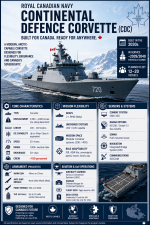
Canada Continental Defence Corvette

Ted Barnes

Active member
Naval Specialist
Professional
Messages
121
Reactions
2 140
Nation of residence
Canada
Nation of origin
Canada
The Continental Defence Corvette (CDC) is the Royal Canadian Navy’s emerging answer to replacing the aging Kingston-class while filling a much larger gap in the fleet. Originally conceived as the Canadian Multi-Mission Corvette, the project has evolved into something far more ambitious a true second tier combatant designed for continental defence, Arctic operations, and global deployments when required. What’s clear is this will not be a simple patrol vessel replacement. The RCN is aiming for a Canadian built, Canadian designed warship with significant combat capability, potentially approaching Halifax class utility in lower threat environments. Think a ship that can handle sovereignty patrols one day and plug into NATO or NORAD tasking the next.


What we know on capability is still evolving, but the direction is obvious. The CDC is expected to be multi-role and modular, able to conduct mine countermeasures, ASW support, SAR, interdiction, and disaster response, all while integrating unmanned systems and reduced crewing concepts. There is strong discussion around VLS fit and real combat punch, meaning this is not just a “coastal boat” but a credible fighting platform. At the same time, it will be smaller, cheaper, and more numerous than the River-class destroyers, filling that critical middle layer the fleet has been missing for decades. Bottom line the CDC is shaping up to be one of the most important programs in the RCN’s future fleet structure but it remains early days, with requirements still being defined and no final design locked in yet. This is a graphic based on open source information on what what the ship will be.
 

Attachments

  • 688b2197-3ca5-4858-ac96-fc5d5856f576.png
    688b2197-3ca5-4858-ac96-fc5d5856f576.png
    2 MB · Views: 114

NEKO

Experienced member
Indonesia Correspondent
Messages
3,484
Reactions
5 3,121
Nation of residence
Indonesia
Nation of origin
Indonesia
With that displacement its more fitting to be called (light) frigate.
 

oldcpu

Committed member
Messages
186
Reactions
12 311
Nation of residence
Thailand
Nation of origin
Canada
The main issue limiting the CDC warship's size/combat ability, as i see it, is the budget, where I read the number $5-billion Cdn $ being bandied about for 15 to 20 corvette's. That equates to only $250 million per corvette (if 20 procured) which very very seriously restricts the amount of expensive armament and expensive sensors that can be installed.

Hence one possibility (speculation really) is that the RCN could re-use equipment (refurbished) from Halifax class, as the Halifax class are decommissioned so to reduce procurement costs for such a Corvette. Examples of such (with my listing Halifax equipment in this speculation) could be:

  • Bofors 57mm gun .
  • Naval Remote Weapon Station (0.50 Cal NRWS).
  • MASS ECM launcher (munitions: Multispectral soft-kill, potentially including the ATD anti-torpedo kit in addition to chaff/IR).
  • RAMESES or RAVEN ECM (jammer/deceptive repeater)
  • AN/SRD-506 'Strongbow' SIGINT (Sovereignty and signal intelligence).
  • Elisra NS9003A-V2HC ESM (Digital passive detection).
  • Towed array sonar.
  • Mk 32 Torpedo Tubes (Hard-kill ASW capability).

Likely one could say 'refurbished' for all of the above equipment, to a greater or lessor extent, before any CDC install. Further there is likely more equipment that could be re-used from Halifax class than what I listed. Possibly not the newest gear, but better than nothing if the budget can not afford newer gear.

I think trying to fit a VLS in a corvette will be a real challenge, without extended the warship length by a lot. The same is true for helicopter deck / hanger(?) and even a towed array (with appropriate deployment/recovery gear). I am curious to read of the RCN requirements (if ad when such is ever released), and possibly instead of a helicopter planned to be embarked, there will be one or more UAVs operating off of a smaller flight deck with a smaller UAV hanger.

Clearly pure speculation by myself.
 

Ted Barnes

Active member
Naval Specialist
Professional
Messages
121
Reactions
2 140
Nation of residence
Canada
Nation of origin
Canada
The main issue limiting the CDC warship's size/combat ability, as i see it, is the budget, where I read the number $5-billion Cdn $ being bandied about for 15 to 20 corvette's. That equates to only $250 million per corvette (if 20 procured) which very very seriously restricts the amount of expensive armament and expensive sensors that can be installed.

Hence one possibility (speculation really) is that the RCN could re-use equipment (refurbished) from Halifax class, as the Halifax class are decommissioned so to reduce procurement costs for such a Corvette. Examples of such (with my listing Halifax equipment in this speculation) could be:

  • Bofors 57mm gun .
  • Naval Remote Weapon Station (0.50 Cal NRWS).
  • MASS ECM launcher (munitions: Multispectral soft-kill, potentially including the ATD anti-torpedo kit in addition to chaff/IR).
  • RAMESES or RAVEN ECM (jammer/deceptive repeater)
  • AN/SRD-506 'Strongbow' SIGINT (Sovereignty and signal intelligence).
  • Elisra NS9003A-V2HC ESM (Digital passive detection).
  • Towed array sonar.
  • Mk 32 Torpedo Tubes (Hard-kill ASW capability).

Likely one could say 'refurbished' for all of the above equipment, to a greater or lessor extent, before any CDC install. Further there is likely more equipment that could be re-used from Halifax class than what I listed. Possibly not the newest gear, but better than nothing if the budget can not afford newer gear.

I think trying to fit a VLS in a corvette will be a real challenge, without extended the warship length by a lot. The same is true for helicopter deck / hanger(?) and even a towed array (with appropriate deployment/recovery gear). I am curious to read of the RCN requirements (if ad when such is ever released), and possibly instead of a helicopter planned to be embarked, there will be one or more UAVs operating off of a smaller flight deck with a smaller UAV hanger.

Clearly pure speculation by myself.
I wouldn't get too caught up on this 5 Billion amount when we don't even know its capabilities or design. Its a place holder just as the 29 Billion amount was initiually given for the river class when we didn't even know what the design would be.

As for refurbishment of Halifax Class equipment, way easier to buy new. There are no plans to recycle equipment. In fact the 57mm's will go back to the OEM for credit just like the 76mm from the 280's.


The CDC will have the ability to launch Surface to Air Missiles, up to 16 in fact.
 

oldcpu

Committed member
Messages
186
Reactions
12 311
Nation of residence
Thailand
Nation of origin
Canada
I wouldn't get too caught up on this 5 Billion amount when we don't even know its capabilities or design. Its a place holder just as the 29 Billion amount was initiually given for the river class when we didn't even know what the design would be.

That is in my view a good point.

As near as I can tell the $5-billion originates in an Ottawa Citizen 23-April-2026 article: Canadian military to launch initial steps in new $5-billion warship project and the actual budgetted amount could be far different.

At present I can find no official, nor even 'semi-official' statement by RCN senior officers that confirm such a cost estimate number. Rather this Ottawa Citizen article is the earliest reference I have found to date, and other sources appeared to have picked up that number. So I agree one must be sceptical about such a number.
 

oldcpu

Committed member
Messages
186
Reactions
12 311
Nation of residence
Thailand
Nation of origin
Canada
I wouldn't get too caught up on this 5 Billion amount when we don't even know its capabilities or design. Its a place holder just as the 29 Billion amount was initiually given for the river class when we didn't even know what the design would be.

As I double check on my assessment as to what Corvette class warships cost, I took a look at some current corvettes around the world, dug up a bit on their procurement costs, and then added to such the cost for initial munitions, spares, support, and ship specific shore infrastructure).

I should also qualify this by saying I have a very very rough rule of thumb, the cost for a warship consists of:
- hull and warship platform - 20 to 35% of the cost
- mission systems (sensors, c3, fire-control, EW) - 45 to 60% of the cost
- weapons & initial munition - 10% to 20% of the cost
- training/spares/support/integration - 10% to 20% of the cost

And further, mission systems may exceed 60% of the costs by a substantial margin for highly specialized AAW or ASW combatants.

Clearly what I have is a very rough estimate in regard to the costs, but I do believe it supports what I suspect in regards to $5-billion CDN $. Its not enough for 15 to 20 corvettes. perhaps as mentioned to me elsewhere it may only be for the first batch, or for the costs ignoring initial munitions, spares, support, and ship specific shore infrastructure, although even then, I suspect $5-billion Canadian not enough (ie ~$ 3.7-billion US$).

Not most articles (IMHO) don't include initial munitions, spares, support, ship specific shore infrastructure in their per ship costs. However Canada tends to price things differently. Further, Canada is likely to modify any corvette with weapons and sensors selected by Canada, which typically always drives up the cost signficantly.

Anyway, arbirarly selecting different corvettes, my rough estimates of different corvette costs, including initial munitions, spares, support, ship specific shore infrastructure if not built in Canada (which clearly won't be the case) but delivered to Canada (with initial munitions, spares, support, ship specific shore infrastructure work) is below:

Visby-class corvette (Sweden) 650 tons.
- My estimated cost estimate (including munitions, spares, support, ship specific shore infrastructure) : US$ $250-to-$380 US$ million per ship

Gowind 2500 / 3100 (France/Egypt/UAE/Malaysia):
- estimated cost estimate GoWind 2500 (incl munitions, spares, support, ship specific shore infrastructure) : US$ $400 to $600 million per ship
- estimated cost estimate GoWind 3100 (incl munitions, spares, support, ship specific shore infrastructure) : US$ $$550 to $750 million per ship

Ada-class corvette (Turkey/Pakiston/Ukraine/Malaysia) 2,400 tons
- estimated cost (incl munitions, spares, support, ship specific shore infrastructure) : US$ $350-to-$450 million/ship

Tuo Chiang-class corvette (Flight-II onwards) (Taiwan) 732 tons
- estimated cost (incl munitions, spares, support, ship specific shore infrastructure) : US$ $250 to $400 million/ship

K130 Braunschweig-class corvette (Germany)
- estimated cost (incl munitions, spares, support, ship specific shore infrastructure) : US$ $500 to $700 million/ship

Baynunah-class corvette — (UAE) - 915 tons
- estimated cost (incl munitions, spares, support, ship specific shore infrastructure) : US$ $300 to $450 million/ship

Khareef-class corvette — Oman (built by BAE) - 2,660 tons
- estimated cost (incl munitions, spares, support, ship specific shore infrastructure) : US$ $280 to $360 million per ship

Sigma Corvette 9113 (Diponegoro-class corvette) — Indonesia - 1,700 tons
- estimated cost (incl munitions, spares, support, ship specific shore infrastructure) : US$ $250 to $350 million/ship

Sigma Corvette/Frigate 10514 - Martadinata-class (3,000 tons, 105 meter length)
- estimated cost (incl munitions, spares, support, ship specific shore infrastructure) : US$ $400 to $500 million per ship

Daegu-class frigate (South Korea) — 3,600 to 3,800 tons
- estimated cost (incl munitions, spares, support, ship specific shore infrastructure) : approximately US$ $500 million to $750 million per ship

Caveat:

Again, those costs are my estimates of total procurement plus initial munitions, spares, support, ship specific shore infrastructure averaged into per ship cost. And each of those corvettes have very different capabilities. I chose NOT to include a list of their capabilities, where the price dfferences start to make more sense when one looks at the capabilities of each class of corvette.

The least expensive appear to be the
- Visby class (Sweden)
- Tu Chiang class (Taiwan)
- Diponegoro-class corvette (Indonesia)

I note thou:
- Visby class (Sweden) - I think it has a range of 4,600 km which, I believe, is definitely on the short side for endurance (arctic patrols may require more) and it is being upgraded to include a Sea Ceptor / CAMM air defence system - where has no anti-air missile without such an upgrade.

- Tu Chiang class (Tawiwan) - range of 3,700km is likely too short for Canada. The ASW capability of this class is not very good.

- Diponegoro-class corvette (Sigma Corvette 9113) of Indonesia - possibly the best cost/capability ratio (from above list) if one wants both ASW and self defence AAW (ie missile/drone short range defense). And also one needs to assume my speculative numbers are correct. But this does not take into account Canadianization.

Having typed the above, my cost estimates could be very wrong. If one reads costs on the internet, typically such do NOT include initial munitions, spares, support, ship specific shore infrastructure in their estimates. I tried to include those costs.

I think thou I concluded (again) $5-billion Canadian (ie $3.7 billion US$) won't buy 20 corvettes.

If an off the shelf Diponegoro-class corvette (Sigma Corvette 9113) was chosen it might buy 14 corvettes. However once 'Canadianization' equipment plus building in Canada applied I suspect the number would fall to 10 or less.

 

NEKO

Experienced member
Indonesia Correspondent
Messages
3,484
Reactions
5 3,121
Nation of residence
Indonesia
Nation of origin
Indonesia
As I double check on my assessment as to what Corvette class warships cost, I took a look at some current corvettes around the world, dug up a bit on their procurement costs, and then added to such the cost for initial munitions, spares, support, and ship specific shore infrastructure).

I should also qualify this by saying I have a very very rough rule of thumb, the cost for a warship consists of:
- hull and warship platform - 20 to 35% of the cost
- mission systems (sensors, c3, fire-control, EW) - 45 to 60% of the cost
- weapons & initial munition - 10% to 20% of the cost
- training/spares/support/integration - 10% to 20% of the cost

And further, mission systems may exceed 60% of the costs by a substantial margin for highly specialized AAW or ASW combatants.

Clearly what I have is a very rough estimate in regard to the costs, but I do believe it supports what I suspect in regards to $5-billion CDN $. Its not enough for 15 to 20 corvettes. perhaps as mentioned to me elsewhere it may only be for the first batch, or for the costs ignoring initial munitions, spares, support, and ship specific shore infrastructure, although even then, I suspect $5-billion Canadian not enough (ie ~$ 3.7-billion US$).

Not most articles (IMHO) don't include initial munitions, spares, support, ship specific shore infrastructure in their per ship costs. However Canada tends to price things differently. Further, Canada is likely to modify any corvette with weapons and sensors selected by Canada, which typically always drives up the cost signficantly.

Anyway, arbirarly selecting different corvettes, my rough estimates of different corvette costs, including initial munitions, spares, support, ship specific shore infrastructure if not built in Canada (which clearly won't be the case) but delivered to Canada (with initial munitions, spares, support, ship specific shore infrastructure work) is below:

Visby-class corvette (Sweden) 650 tons.
- My estimated cost estimate (including munitions, spares, support, ship specific shore infrastructure) : US$ $250-to-$380 US$ million per ship

Gowind 2500 / 3100 (France/Egypt/UAE/Malaysia):
- estimated cost estimate GoWind 2500 (incl munitions, spares, support, ship specific shore infrastructure) : US$ $400 to $600 million per ship
- estimated cost estimate GoWind 3100 (incl munitions, spares, support, ship specific shore infrastructure) : US$ $$550 to $750 million per ship

Ada-class corvette (Turkey/Pakiston/Ukraine/Malaysia) 2,400 tons
- estimated cost (incl munitions, spares, support, ship specific shore infrastructure) : US$ $350-to-$450 million/ship

Tuo Chiang-class corvette (Flight-II onwards) (Taiwan) 732 tons
- estimated cost (incl munitions, spares, support, ship specific shore infrastructure) : US$ $250 to $400 million/ship

K130 Braunschweig-class corvette (Germany)
- estimated cost (incl munitions, spares, support, ship specific shore infrastructure) : US$ $500 to $700 million/ship

Baynunah-class corvette — (UAE) - 915 tons
- estimated cost (incl munitions, spares, support, ship specific shore infrastructure) : US$ $300 to $450 million/ship

Khareef-class corvette — Oman (built by BAE) - 2,660 tons
- estimated cost (incl munitions, spares, support, ship specific shore infrastructure) : US$ $280 to $360 million per ship

Sigma Corvette 9113 (Diponegoro-class corvette) — Indonesia - 1,700 tons
- estimated cost (incl munitions, spares, support, ship specific shore infrastructure) : US$ $250 to $350 million/ship

Sigma Corvette/Frigate 10514 - Martadinata-class (3,000 tons, 105 meter length)
- estimated cost (incl munitions, spares, support, ship specific shore infrastructure) : US$ $400 to $500 million per ship

Daegu-class frigate (South Korea) — 3,600 to 3,800 tons
- estimated cost (incl munitions, spares, support, ship specific shore infrastructure) : approximately US$ $500 million to $750 million per ship

Caveat:

Again, those costs are my estimates of total procurement plus initial munitions, spares, support, ship specific shore infrastructure averaged into per ship cost. And each of those corvettes have very different capabilities. I chose NOT to include a list of their capabilities, where the price dfferences start to make more sense when one looks at the capabilities of each class of corvette.

The least expensive appear to be the
- Visby class (Sweden)
- Tu Chiang class (Taiwan)
- Diponegoro-class corvette (Indonesia)

I note thou:
- Visby class (Sweden) - I think it has a range of 4,600 km which, I believe, is definitely on the short side for endurance (arctic patrols may require more) and it is being upgraded to include a Sea Ceptor / CAMM air defence system - where has no anti-air missile without such an upgrade.

- Tu Chiang class (Tawiwan) - range of 3,700km is likely too short for Canada. The ASW capability of this class is not very good.

- Diponegoro-class corvette (Sigma Corvette 9113) of Indonesia - possibly the best cost/capability ratio (from above list) if one wants both ASW and self defence AAW (ie missile/drone short range defense). And also one needs to assume my speculative numbers are correct. But this does not take into account Canadianization.

Having typed the above, my cost estimates could be very wrong. If one reads costs on the internet, typically such do NOT include initial munitions, spares, support, ship specific shore infrastructure in their estimates. I tried to include those costs.

I think thou I concluded (again) $5-billion Canadian (ie $3.7 billion US$) won't buy 20 corvettes.

If an off the shelf Diponegoro-class corvette (Sigma Corvette 9113) was chosen it might buy 14 corvettes. However once 'Canadianization' equipment plus building in Canada applied I suspect the number would fall to 10 or less.
Does it need strengthened hull for arctic operation?
 
Top Bottom