
You are using an out of date browser. It may not display this or other websites correctly.
You should upgrade or use an alternative browser.
You should upgrade or use an alternative browser.


India could very well reach 1 trillion in total exports this year. -500bn goods and 500 bn services etc.


The company L&T designed and manufactured their own Construction Machinery. Usually we see such being imported from established players.B1M finally covered this engineering feat in good detail!
My view summarized: The design inner layer is solid, but now India needs much more capital and infrastructure for production in important "mid + outer layer".

Qualcomm Tapes Out 2nm Chip, Underscoring India’s Rising Clout in Global Semiconductor Design - The Financial World
Bengaluru: In a landmark achievement for India’s fast-evolving semiconductor ecosystem, Qualcomm Technologies, Inc. has successfully taped out its advanced 2nm semiconductor design, reinforcing the country’s growing role at the forefront of global chip engineering. The milestone, delivered...
www.thefinancialworld.com
Rajendra Chola
Well-known member
India could very well reach 1 trillion in total exports this year. -500bn goods and 500 bn services etc.
Don’t think so. Our merchandise exports have plateaued. Since oil prices went down, our refinery exports have gone down in value. Thanks to IPhone exports, our overall exports haven’t contracted.
Other sectors have faired poorly like textiles, leather & steel products. Automobiles & engineering goods are ok. Labour intensive sectors needs vertical integration for lower input costs & support for more exports. Hopefully US and EU deal will see more. Plus our FTA utilization rates are poor 25%.
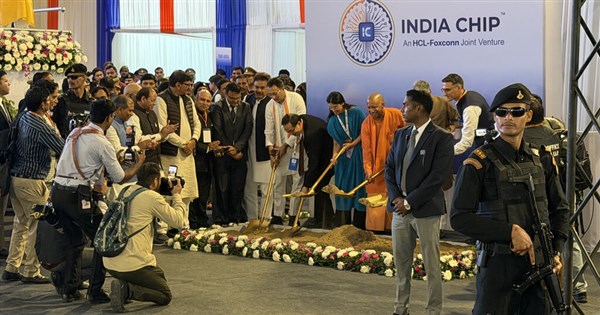
Foxconn, HCL break ground on NT$13.1 billion chip plant in India - Focus Taiwan
Taiwan-based manufacturing giant Hon Hai Technology Group (Foxconn) and India-based HCL Group held a groundbreaking ceremony for their joint-venture semiconductor facility in India on Saturday.
Costing about NT$13.1 billion (US$403 million), the facility will manufacture display driver integrated circuits, and will have a capacity of about 20,000 wafers per month, the Indian news outlets said.
Micron's First Shipment started to Dell India for its Laptops. Even though its mere ATMP, for a country that's basically zero before in memory, its a huge leap. After the expansion, this plant alone will supply 60% of India domestic needs.
Indian engineers already form a significant part of the Dutch tech workforce. According to statistics agency CBS, the number of Indians in the Netherlands tripled to 89,000 in 2024 from 2014, with more than 10,000 living in the Eindhoven region.
This chap goes bit further into it (technocrats always better than bureaucrat "babus" etc):
This chap goes bit further into it (technocrats always better than bureaucrat "babus" etc):


Govt sets up rare earth magnet pilot plant at ARCI, Hyderabad
The facility will support technology validation, industry collaboration and scaling of Nd-Fe-B magnet production amid rising demand from electric mobility and clean energy sectors.
L&T starts building team for semiconductor chip design
Larsen & Toubro (L&T) is building a team for its semiconductor chip design business, as it looks to foray into fabless semiconductor chip design and product ownership.
...J.D. Patil said LTST isn’t looking to be a mass manufacturer of processor or memory chips. Instead, it will play in the highly-engineered category. “This is not a space where everybody can compete. LTST will focus on customised chips,” he said. It will be a game of ASICs (Application Specific Integrated Circuit) and the firm will offer complete solutions. “A chip will be able to do what a full rack can achieve,” he said.
While the chip manufacturing will be outsourced, the design will be done in-house, Patil said. The chip design would look at the automotive and industrial chip segments.
++++
I expect to see more industrial enterprises with even a bit of capital in hand like L&T to venture into chip-design to take care of their own customized needs going forward. Especially those enterprises that deal in strategic sectors...so fully expect Godrej to follow suit at some point (unless they're already doing it?).
L&T's chip design division comes to the fore as the Govt takes steps to push Chinese CCTV makers out of the market:
News is focused on which camera brand replaces Hikvision. The more interesting story is who makes the chip inside the camera.
Until 2019, that answer was overwhelmingly HiSilicon, Huawei's semiconductor arm that dominated surveillance SoCs globally. US sanctions killed that supply chain overnight and the entire industry moved to Ambarella, Novatek, and Sigmastar. India's CCTV ban accelerates the same logic one layer deeper. Not just who assembles the camera, but who designs the silicon.
And that story is already further along than most people realize. L&T Semiconductor Technologies has signed a deal with CP Plus to supply indigenously designed Vision SoCs for 9 million IP cameras over three years. These aren't concept chips. They support 8MP imaging and this is the first time surveillance cameras will be made using chips from an Indian company. CP Plus is the largest domestic brand by market share, so this isn't a token pilot.
Beyond L&T Semi, there are at least four more startups building surveillance SoCs under the government's Design Linked Incentive scheme. Mindgrove Technologies has the V2600, a surveillance-grade edge AI chip targeting late 2026 commercial launch. BigEndian Semiconductors raised $3M from Vertex Ventures and partnered with Cadence on Project VASU, a secure-boot SoC with encryption baked into the silicon. 3rdiTech and Netrasemi round out the group. Collectively these four have raised over ₹300 crore and taped out test chips in 2025.
Two years ago none of this existed. Now you have five separate Indian chip efforts targeting the same market, with the largest one already locked into a volume manufacturing agreement. India did the same thing in telecom: kicked out Huawei, filled the gap with allied vendors, then started building its own stack with Tejas Networks.
Surveillance silicon is following the same script, and hopefully moving faster.

There is now a solid investment revival underway (~80 billion USD per month of private capex)

 www.fortuneindia.com
Private capex jumps 67% to ₹7.7 lakh crore in Sept 2025 as CII flags investment revival
The rise compares with ₹4.6 lakh crore in September 2024 and was driven by a sharp pickup in manufacturing and services investments, according to CII’s analysis of nearly 1,200 companies from the CMIE Prowess database.
www.fortuneindia.com

India's 3rd semiconductor plant to start in July, 4th facility to be up by Nov-Dec: Vaishnaw
India's semiconductor mission is gaining momentum. Two plants are operational, with two more set to begin production this July and later this year. The nation is also boosting data centers and AI manufacturing. This progress positions India to navigate global economic challenges and achieve...


