He also said, "Our work on this has been ongoing for quite some time. Now it's becoming even clearer. As our aircraft carrier takes shape, the needs will also be defined. This is a long-term project. And I can say from now on that it will be a completely different platform, different from HÜRJET. You will see that it will be different from HÜRJET. Because the requirements are different."
https://bigpara.hurriyet.com.tr/hab...dan-ihalara-yerli-ve-milli-beyin_ID102236610/
The phrase "a completely different aircraft is coming" may indicate that not just adapting a standard land-based aircraft to an aircraft carrier with just a "modification" or "addition" (hook attachment, wing folding, etc.), but rather that the aircraft's fundamental engineering, aerodynamics, and structural architecture are being redesigned from scratch or with very significant changes in some parts.
The first thing that comes to mind is that the fuselage skeleton, main support beams, and landing gear will be completely redesigned from scratch, becoming much thicker, heavier, and shock-absorbing. A change in the strength architecture to accommodate the instantaneous load on the nose during launch and on the tail during stopping is also a key expectation.
Another, more likely possibility, is a switch to a higher-thrust engine class. The F414-400 and EJ-200 are the first that come to mind. Since a twin-engine conversion would require a complete redesign of the main fuselage structure and fuel system, the expectation is that this new aircraft will likely remain single-engined. In any case, since the aircraft will have a STOBAR design, sudden and rapid thrust at sea level will be must. A transition to an engine capable of producing high thrust is necessary.
Although the F414 is an evolved version of the F404, and even stands out with its ready-to-marine variant, the air intakes and silhouette will be revised due to engine tunnel constraints. In this case, the air intakes will have to be largely revised, which can be somewhat related to Demiroğlu's statement that "it will be a completely different platform" to the changing silhouette of the aircraft. While the aircraft will never have an internal weapons bay due to volumetric constraints, it will have combat capabilities of a combat or at least naval-based MUM-T type. Therefore, with the experience of the KAAN project, the Hürjet-D is a more optimized RCS target, and I believe that new generation coating technologies similar to KAAN are among the main expectations. Frankly, what I'm most curious about is the tail structure. The aircraft's composite density will likely increase significantly. And higher corrosion resistance, which is among the standard naval requirements, will also be targeted. Although not a strict requirement, work is certainly being done on folding wings as well.
With a silhouette that is sharper to a certain extent... And perhaps we will see a thicker Hürjet. The weight penalty will be offset by higher thrust, a higher composite ratio, a single-pilot cockpit, and increased wing lift.



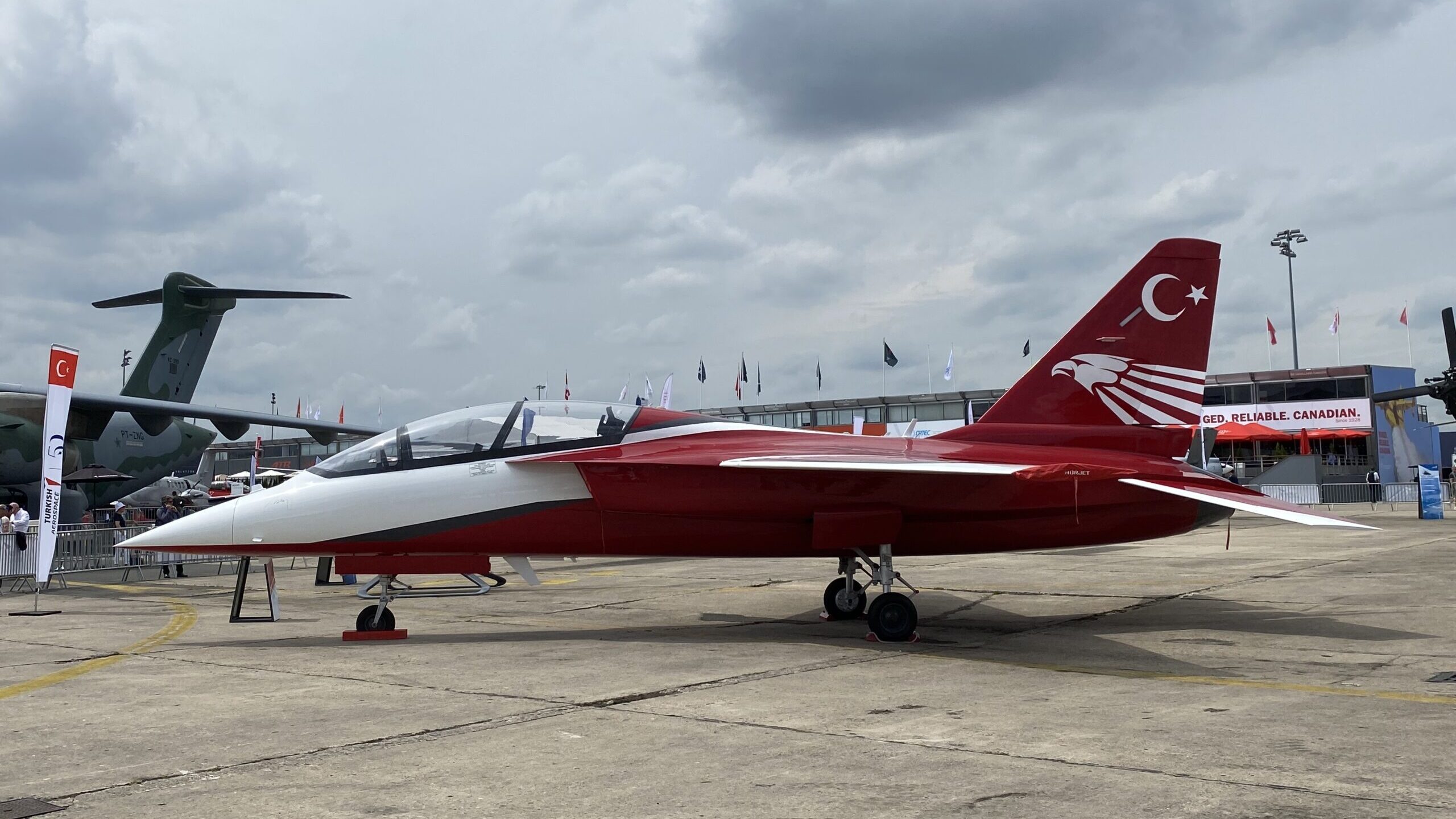


 The first HÜRJET – Turkey’s first jet trainer, developed by Turkish Aerospace Industries (TUSAŞ) using domestic capabilities under the coordination of the Presidency of Defence Industries – which is to be delivered to the Air Force Command, successfully completed its maiden flight on the 104th anniversary of the Great Victory.


