India Space Indian Space Program

Gessler

Contributor
Moderator
India Moderator
Messages
1,090
Reactions
68 2,546
Nation of residence
India
Nation of origin
India

Mission Drishti is the result of a journey that started years before the satellite itself. It is the culmination of years spent building, testing, validating, and evolving Earth observation systems across multiple platforms. The roadmap took us through India’s first DroneSAR, the world’s first HAPS SAR, in-orbit validation through the POEM mission, and years of pushing further with every iteration. Each milestone solved a different piece of the puzzle and came with its own set of unknowns. Different environments. Different operational demands. Different technical constraints. But they all asked the same thing of us: to stay with difficult problems long enough to build what didn’t yet exist.

Today, all of those learnings converge into Mission Drishti, the world’s first OptoSAR imaging satellite. None of these milestones existed in isolation. Each one was a step toward a larger goal: building Earth observation systems that are more reliable, more intuitive, and more useful for the world around us.

We’re only beginning to scratch the surface of what’s possible. And we’re excited to see where it leads next!

HHJA9uEaAAAWSoX.jpg


HHJBBQtaUAAvFkW.jpg


HHJBDIhacAAp6Gb.jpg


HHJBEBvboAAatjM.jpg


HHJBK-1bEAAynW9.jpg


Launch is tomorrow on a SpaceX Falcon 9!
 

Nilgiri

Experienced member
Staff member
Administrator
Aviation Specialist
Messages
10,878
Reactions
152 22,171
Nation of residence
Canada
Nation of origin
India
 

Nilgiri

Experienced member
Staff member
Administrator
Aviation Specialist
Messages
10,878
Reactions
152 22,171
Nation of residence
Canada
Nation of origin
India
GalaxEye's Mission Dristhti OptoSAR satellite successfully separated from SpaceX's Falcon 9. We took a tour of their facility to see what it's like to be at the cutting edge of spacetech.


Gessler

Contributor
Moderator
India Moderator
Messages
1,090
Reactions
68 2,546
Nation of residence
India
Nation of origin
India

(News from Pixxel's US-based business operations)


Pixxel Awarded NRO Strategic Commercial Enhancements Contract for Hyperspectral Remote Sensing Capabilities​


69f882fcf3ab0a2d1b05beb4_NRO%20X%20PIXXEL%20BANNER2.png

El Segundo, CA, USA, 05 May 2026: Pixxel, a leader in cutting-edge hyperspectral earth-imaging technology, has been awarded a contract by the National Reconnaissance Office (NRO) Commercial Systems Program Office (CSPO) under the Strategic Commercial Enhancements Commercial Solutions Opening (CSO) for advanced commercial remote sensing capabilities.

The award supports the US government's effort to evaluate, leverage, and integrate emerging commercial hyperspectral data sources into the agency's expanding remote sensing architecture. Leveraging its on-orbit Firefly constellation, Pixxel will demonstrate that hyperspectral imagery (HSI) capabilities can provide the kind of spectral insight that enables analysts to characterize materials, conditions, and activity that conventional imaging cannot reveal.

Execution will be handled by Pixxel Federal team, led by Allyson Jenkins. "Pixxel is excited for the opportunity to work with the NRO to advance the adoption of space-based hyperspectral data and demonstrate the unique value this phenomenology brings to the intelligence community," said Allyson Jenkins, VP, Public Sector, Pixxel. "Our Federal team is ready to deliver on this important mission and to support the NRO's vision for a more diverse, multi-phenomenology commercial remote sensing architecture."

"Pixxel is thrilled to support the National Reconnaissance Office in integrating commercial hyperspectral data into its framework. We're grateful for the opportunity and look forward to demonstrating our current and future capabilities in service of the United States mission requirements,"
said Ryan McKinney, Chief Revenue Officer, Pixxel.

With its Firefly constellation now operational, Pixxel is positioned to deliver hyperspectral data and analytics at the speed, scale, and precision demanded by the intelligence and national security communities, reflecting the growing role of commercial hyperspectral imagery as a foundational layer in the U.S. government's next-generation remote sensing architecture.


Gessler

Contributor
Moderator
India Moderator
Messages
1,090
Reactions
68 2,546
Nation of residence
India
Nation of origin
India

Dhruva Space Secures INR 105 Crores ($11 Million) RDIF Backing to Develop ‘Project Garud’, Advancing India’s Private-Sector 500 kg-Class Communications Satellite Capability for Constellation-Scale Missions​


6a055051831b522ca098d24d_RDIF PR Banner_Dhruva Space.png

[Thursday 14 May 2026] (New Delhi, INDIA) As India accelerates toward becoming a global Space power, the Government of India’s Research, Development & Innovation Fund (RDIF) has extended INR 105 Crores ($11 Million) to Hyderabad-based Dhruva Space for Project Garud, a next-generation flat-pack 500 kg-class communications satellite platform programme designed to enable constellation-scale sovereign and strategic satellite deployments for India and global markets, while strengthening the Nation’s indigenous Space infrastructure capabilities. The 500 kg-class architecture is positioned to bridge the gap between smaller experimental satellites and larger traditional systems, offering an optimised balance of payload capacity, scalability, launch efficiency, and multi-mission adaptability for constellation-scale deployment requirements.

Dhruva Space is among the first batch of companies to be awarded support under the RDIF initiative, marking a significant milestone in India’s push toward building a globally competitive commercial Space ecosystem. The 500 kg-class platform is being developed as a standardised, production-oriented spacecraft capable of supporting diverse applications across Telecommunications, National Security, Earth Observation, and emerging data-driven use cases, while enabling faster deployment cycles and greater manufacturing repeatability.

Through this grant, Dhruva Space will undertake the development and commercialisation of a next-generation satellite architecture designed to address a critical gap in India’s Space ecosystem. The initiative focuses on enabling a standardised, production-oriented system that can support a wide range of applications across Telecommunications, National Security, and emerging data-driven use cases.

Project Garud is structured to transition satellite development from bespoke, mission-specific builds to a repeatable and manufacturing-ready model. The platform introduces a flat-pack architecture that enables efficient launch stacking, faster system integration, and improved deployment timelines, making it suitable for large-scale satellite deployments.

Project Garud is intended to serve as a foundational layer in building India’s next-generation Space manufacturing ecosystem, with long-term applicability across LEO, MEO, and future GEO mission architectures.


DhruvaSpace_P-30_satellite2-948x533.jpeg

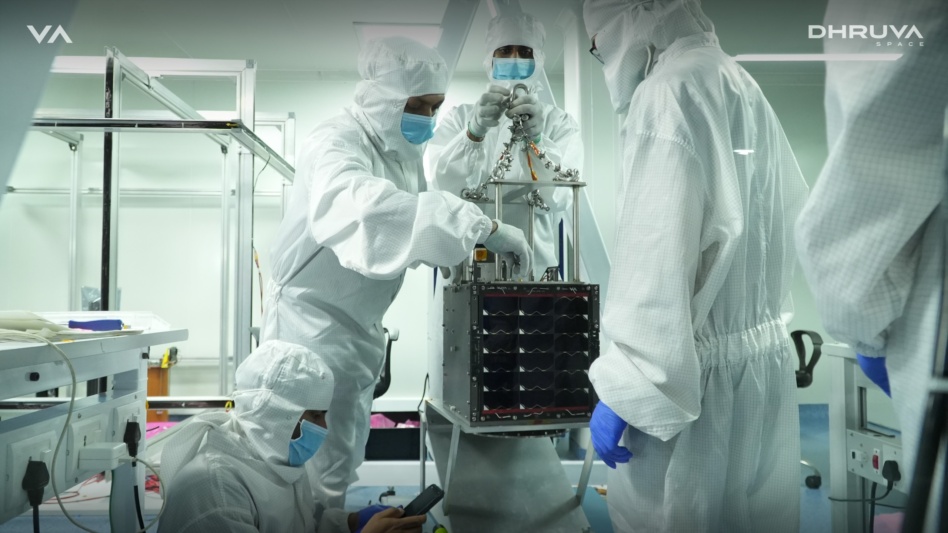
Dhruva Space's older P-30 satellite platform in clean room

The project is aimed at addressing the need for an indigenous, production-ready satellite platform in the 300 - 500 kg class that is optimised for scalable deployment. Existing systems are typically custom-built, resulting in extended development cycles and limited reusability. By establishing a Made-in-India architecture, Project Garud reduces reliance on foreign satellite platforms and subsystems while strengthening supply chain resilience for Communications and Intelligence infrastructure.

As part of the programme, Dhruva Space will also establish the infrastructure, tooling, and industrial processes required for high-volume satellite manufacturing at scale. The roadmap is designed around a production cadence capable of supporting up to 2 satellites per day, enabling an annualised manufacturing potential of approximately 500 - 600 satellites across multiple mission configurations. This manufacturing-first approach is intended to support the growing demand for sovereign and secure satellite constellations globally, while strengthening India’s position as a competitive OEM and spacecraft production hub within the global Space economy.

Commenting on the development, Abhay Egoor, CTO & Co-founder, Dhruva Space, said: “Project Garud represents the industrialisation of satellite manufacturing from India. The global market is rapidly moving toward constellation-scale deployments, but the supply side for reliable, production-ready spacecraft platforms remains constrained. Through RDIF, Dhruva Space is building an indigenous satellite communications platform and manufacturing ecosystem capable of supporting high-volume deployment requirements across communications, intelligence, and strategic applications. Our objectives are to build satellites for our own missions, and to position Dhruva Space as a globally competitive spacecraft OEM and subsystem supplier. The RDI programme strengthens India’s Space technology stack across Platform Architecture, Avionics, Power systems, and scalable manufacturing capabilities. Project Garud also speaks of our long-term vision toward enabling spacecraft solutions for higher orbital regimes, including MEO and GEO-class missions in the future.”

DhruvaSpaceFacility-1751966706492.jpg

Dhruva Space's upcoming 280,000-sqft satellite mass production facility in Hyderabad, India

The grant was formalised during the inaugural Enterprise Technology Evaluation (ETE) agreement signing and first fund disbursement under the Government of India’s ₹1 lakh crore ($10.4 billion) RDI Scheme, held on 13 May 2026 in New Delhi. Chaitanya Dora Surapureddy accepted the recognition on behalf of Dhruva Space. The ceremony was conducted in the presence of Hon’ble Minister for Science & Technology Dr. Jitendra Singh; Principal Scientific Advisor to Government of India, Prof. Ajay Kumar Sood; Secretary, Department of Science & Technology, and Chairperson, Technology Development Board (TDB), Prof. Abhay Karandikar; Chairman - Mission Governing Board, National Quantum Mission Dr. Ajai Chowdhry; and Chairperson, Investment Committee - TDB Padma Shri Dr. Saurabh Srivastava.

The RDI initiative builds on Dhruva Space’s existing work across spacecraft platforms and subsystems, extending proven capabilities from smaller satellite classes toward higher-mass systems and reinforcing its long-term vision of building the OEM backbone for India’s Space economy. The programme is expected to advance multiple subsystems toward flight-qualified readiness, supporting both platform deployment and subsystem-level commercialisation across domestic and global markets.

About Research, Development & Innovation Fund

The Research, Development & Innovation (RDI) Scheme is aimed at encouraging private sector involvement in cutting-edge research and innovation, while accelerating the development of strategic technologies critical to India’s long-term growth and global competitiveness. The initiative focuses on mission-critical sectors including energy security and transition, climate action, Deep Technologies such as Quantum Computing, Robotics and Space, Artificial Intelligence and its applications to Indian challenges, Biotechnology and Biomanufacturing, medical technologies, and the digital economy.

Aligned with the national vision of Atmanirbharta, the scheme is also intended to foster self-reliance and economic security by supporting indigenous technologies where domestic capability development is strategically essential. The framework additionally retains flexibility to support emerging sectors and technologies considered vital for public interest and National priorities.

About Dhruva Space
Dhruva Space Private Limited is a full-stack Space Engineering solutions provider based in Hyderabad, India. The company is active across Space, Launch, and Ground segments and supports Civilian and Defense clients worldwide.

Dhruva Space offers Satellite(s) coupled with Earth Station(s) and Launch Service(s) as an integrated solution or individually as technology solutions to power Space-based applications on Earth and beyond.


Nilgiri

Experienced member
Staff member
Administrator
Aviation Specialist
Messages
10,878
Reactions
152 22,171
Nation of residence
Canada
Nation of origin
India

Real interesting:

Pixxel’s partnership with Sarvam AI is aimed at proving that sovereign AI workloads can run directly in orbit.

The Pathfinder satellite will initially host only a small number of GPUs – Blackwell or H200 class GPU –, but the larger goal is technological validation, Awais Ahmed, CEO and co founder of Pixxel said.

Ahmed said most of the real testing will begin only after launch. “Once it’s in orbit, that’s the real test,” he said.

Agnikul Cosmos, meanwhile, is taking a more infrastructure-led approach.

Rather than building the data centre itself, the company wants to offer its launch systems and patented upper-stage platforms as orbital hosting infrastructure.

Typically, rocket upper stages become debris after satellite deployment.

Agnikul wants to convert those upper stages into long-duration orbital platforms capable of hosting compute payloads.
 
Top Bottom