• Forum restore complete (see latest announcement thread)

Saudi Armed Forces

Ghost soldier

Хижак
Messages
1,389
Reactions
3 3,810
Nation of residence
Morocco
Nation of origin
Moroco
F-15 SA
F-15 SA.PNG
 

Test7

Experienced member
Think Tank Analyst
Messages
4,794
Reactions
20 19,970
Nation of residence
United States of America
Nation of origin
Turkey
Saudi Arabia receives Kozak-5 armored vehicles from Ukraine

04d6115596f9fbe9-1.jpg

Photo courtesy of Practika company


The Kingdom of Saudi Arabia has taken delivery of a batch of Ukrainian-made Kozak-5 armored vehicles manufacturer Practika company.

Saudi Arabian special forces have acquired and already received an undisclosed number of Kozak-5 armored vehicles, the Practika’s CEO Oleg Vysotsky confirmed on 12 August.

“Praktika has implemented two export contracts this year, including with them (Saudi Arabia),” said Oleg Vysotsky, talking about the company’s plans to take part in the next major defense exhibition in the Kingdom of Saudi Arabia.

The company says the Kozak-5 is a lightweight armored vehicle for special forces, designed to perform police or auxiliary military tasks. Is intended for small groups transporting and using its body as armor screen in case of skirmishes. Also can be equipped by ladder for buildings assault.

The vehicle has a complex of anti-blast features that provides STANAG 4569 level 2 of blast protection, which is uncommon for vehicles of this class.

As noted by the company, the key feature – outstanding dynamic characteristics due to the extremely high power-to-weight ratio (34,5 HP/t). The maximum road speed of the vehicle is 150 km/h

Kozak 5 based on 4×4 truck Ford F550, chassis specially enforced (front axle strengthening, suspension and brakes enforcing, bigger wheels installing for armored vehicle building).


Test7

Experienced member
Think Tank Analyst
Messages
4,794
Reactions
20 19,970
Nation of residence
United States of America
Nation of origin
Turkey

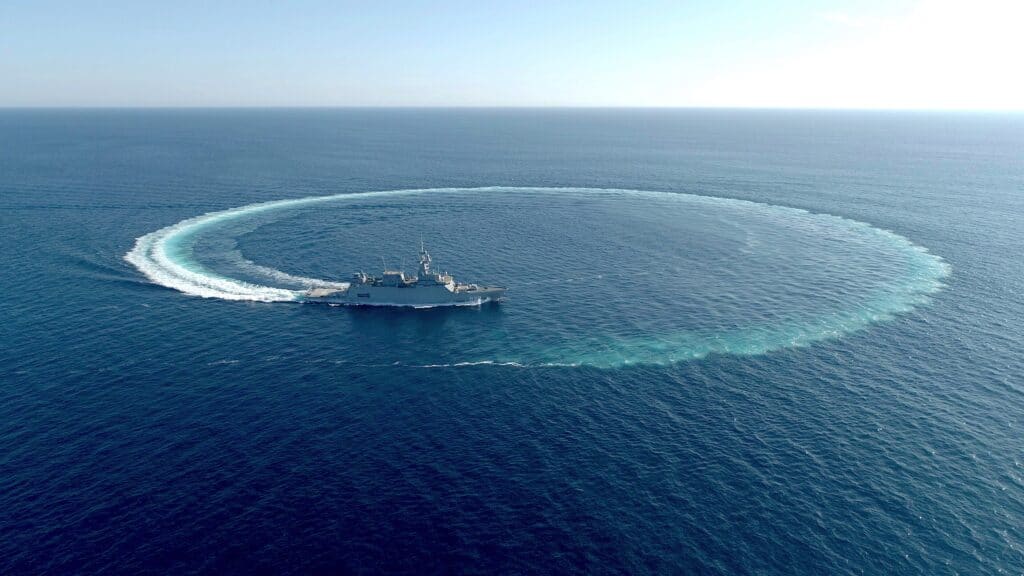
First Avante 2200 Corvette For Royal Saudi Navy Starts Sea Trials​

The ship NB 546 AL-JUBAIL, the first of five corvettes that Navantia builds for the Royal Saudi Naval Forces (RSNF), has begun its sea trials in the waters of the Bay of Cádiz in order to check the correct operation of all its systems.​


Navantia press release


Sea trials are carried out before delivery to the client in order to check the operation of both the platform and the different systems and test their compliance with the requirements specified in the contract with the client.


The trials last a total of two months, divided into two different periods. The current trial period will last about two weeks. Some 140 people participate in them, among them some 40 engineers from different specialties.


The trials are staffed by Navantia, partner Industries, Lloyds Register of Shipping and major equipment supplier companies. Likewise, the RSNF and members of the Spanish Navy participate on behalf of the client.


Once this period is over, AL-JUBAIL will have its combat system installed, prior to delivery of the ship. Launched in July 2020, delivery to the end customer is expected to occur within five months.


Al Jubail is the first of five corvettes being built by Navantia in the Avante 2200 program. It has a length of 104 meters, a beam of 14 and she will be able to transport a total of 102 people including crew and passengers.


The design of the corvettes is of the latest generation, maximizing the participation of Navantia by incorporating its own products, such as the CATIZ Combat System, the HERMESYS Integrated Communications System, the DORNA Firing Direction, the Integrated Platform Control System and the MINERVA Integrated Bridge, together with other equipment developed by Navantia under license, such as the MTU Engines or the RENK Reduction Gearboxes.


First Avante 2200 Corvette For Royal Saudi Navy Starts Sea Trials
Navantia picture

This contract, which came into force in November 2018, strengthens the immediate future of Navantia and benefits all the shipyards of the company and its auxiliary industry, especially the whole Bay of Cadiz.


Specifically, it means a global workload of around seven million hours, that is, 6,000 jobs during five years. Of these, more than 1,100 will be Navantia employees; more than 1,800, employees it the collaborators enterprises of Navantia and more than 3,000, indirect employees generated by other suppliers. There will be more than 100 companies that will collaborate in this project.


This program, whose last vessel must be delivered in 2024, includes, in addition to construction, Life Cycle Support for five years, from the delivery of the first vessel, with an option for another five years. On the other hand, the contract also includes the supply of several services such as, Integrated Logistic Support, Operational and Maintenance Training, Supply of Training and Education Centers for the Combat System and Platform Control System of the ships, the Life Cycle Support previously mentioned, and the systems for the maintenance of the ships in the Jeddah Naval Base. The training of the crews is already taking place in the recently inaugurated Navantia Training Centre (NTC).

1.png
2.png
3.png
4.png
 

Fatman17

Experienced member
Moderator
Defence News Editor
Pakistan Moderator
Messages
2,498
Reactions
18 2,074
Nation of residence
Pakistan
Nation of origin
Pakistan

Saudi F-15SA down in Yemen​

  1. Saudi F-15SA down in Yemen


By Mark Broadbent
18th September 2026
News

On September 16, 2026, Houthi forces in Yemen claimed they had shot down a Royal Saudi Air Force (RSAF) F-15.
The group claimed they brought down the fighter in Marib Governate, a region in central Yemen located approximately 107 miles (173km) northeast of the country’s capital Sanaa.
The group said they had downed the fighter using a locally produced surface-to-air missile.
Thus far official social media accounts of the Ministry of Defense of the Kingdom of Saudi Arabia had yet to formally confirm the loss of an F-15 or the fate of its two crewmembers.
RSAF F-15SA tail in Yemen
Part of the tail of a Royal Saudi Air Force F-15SA the Houthis claimed to have shot down. Houthis via social media

Houthis' video​

Three minutes of video footage posted to the social media network X by the Houthis (known formally as Ansar Allah) showed what appeared to be a surface-to-air missile launching from the ground into the night sky. There followed an infrared view of a missile hitting an F-15. The footage then presented burning wreckage on the ground in the darkness and smouldering aircraft debris in daylight.
Later in the video, Houthi fighters armed with guns are seen inspecting the wreckage. An F-15 tailfin bearing the flag of the Kingdom of Saudi Arabia wearing serial number 5539 indicates the aircraft involved was an F-15SA.
The Saudi F-15 shootdown in Yemen occurred as fighting escalated between Saudi Arabia-backed Yemen Government forces and the Iran-backed Houthis, who have increased missile and drone attacks on targets in Saudi Arabia.

Saudi F-15 Eagle background​

The Royal Saudi Air Force F-15s are operated by:
F-15C/D Eagle Squadrons
  • 2nd Squadron, King Faisal Air Base
  • 5th Squadron, King Fahd Air Base
  • 13th Squadron, King Abdulah Aziz Air Base
  • 34th Squadron, King Fahd Air Base
F-15S and F-15SA Squadrons
  • 6th Squadron, King Khalid Air Base
  • 29th Squadron, King Faisal Air Base
  • 55th Squadron, King Khalid Air Base
  • 92nd Squadron, King Saud Air Base
Saudi Arabia has received more than 220 Eagles since the early 1980s comprising older F-15C/D Eagles and more modern F-15S and F-15SA examples.
The country received an initial batch of 62 Eagles (46 F-15Cs and 16 F-15Ds) under the Peace Sun Foreign Military Sales programme from January 1982 to May 1983. The United States Congress denied subsequent requests by Saudi Arabia for more F-15s (48 aircraft in 1983 and 12 in 1989) but in the aftermath of Iraq invading Kuwait on August 2, 1990, the RSAF received 24 F-15C/Ds and then, from mid-1991, the 12 Eagles requested in 1989.
A Saudi order for 72 newer F-15s was approved in 1993, which led to the delivery of what became the F-15S (Saudi) under the Peace Sun IX Foreign Military Sales programme. The F-15S was a two-seat airframe based on the US Air Force F-15E Strike Eagle featuring both air-to-air and air-to-ground capabilities.
The F-15S Eagles were delivered between 1995 and 1999. The Saudis obtained 48 sets of a simplified version of the Low Altitude Navigation and Targeting Infrared for Night (LANTIRN) pod to equip these aircraft. In 2009, the Saudis ordered the Sniper Advanced Targeting Pods to replace the LANTIRN pods.

F-15 Saudi Advanced​

On December 29, 2011, Saudi Arabia reached an agreement with the US Government for the purchase of 84 of the F-15SA (Saudi Advanced) variant which would be new-build aircraft. The deal also included the upgrade of 68 F-15Ss (later reduced to 66) to F-15SA standard, plus weapons, systems and equipment.
The F-15SA version is powered by two GE Aviation F110GE-129 engines, has a fly-by-wire flight control system, advanced cockpit displays, a Raytheon AN/APG-63(V)3 active electronically scanned array radar, a digital electronic warfare system, AN/AAS-42 infrared search and track system, a joint helmet-mounted cueing system, and a Link-16 multifunctional information distribution system.
The F-15SA can carry the AN/AAQ-33 Sniper Advanced Targeting Pod and AN/AAQ-13 LANTIRN systems, AIM-9X Sidewinder short-range missile, AIM-120C-7 AMRAAM (advanced medium-range air-to-air missile), AGM-84H/K Stand-Off Land Attack Missile-Expanded Response missile, AGM-88 High-Speed Anti-Radiation Missile, GBU-24 Paveway III laser-guided bomb, Joint Direct Attack Munition, and Mk82 500lb and Mk84 2,000lb general-purpose bombs.
Saudi Arabia received the 84 F-15SAs from January 2017 to December 2020. Meanwhile, the Saudi firm Alsalam Aerospace Industries (AAI) was contracted to upgrade the F-15S to F-15SA standard in country under the F-15SR (Saudi Retrofit) programme. AAI accepted its first F-15S for conversion on October 21, 2018. The ‘SR’ upgrade included new wings, forward fuselages and pylons and updated avionics produced by the Riyadh-based Advanced Electronics.
www.keyaero.com
 
Top Bottom