Korea Aerospace Administration confirms successful Falcon 9 launch and 888 km sun-synchronous orbit insertion for 500 kg-class Earth observation satellite

www.dongascience.com
CAS500-4 Next-Generation Satellite Achieves First Contact and Target Orbit
The CAS500-4 next-generation medium-size satellite (hereafter CAS500-4), which will be used in public sectors such as agriculture and forestry management, disaster response, and climate change analysis, has successfully established its first communication with a ground station and settled into orbit.
The Korea Aerospace Administration, Rural Development Administration, and Korea Forest Service announced that CAS500-4, launched at 4:12 p.m. (Korea Standard Time) on July 7 from Vandenberg Space Force Base in California, USA, successfully made first contact with the Svalbard ground station in Norway at 7:05 p.m.
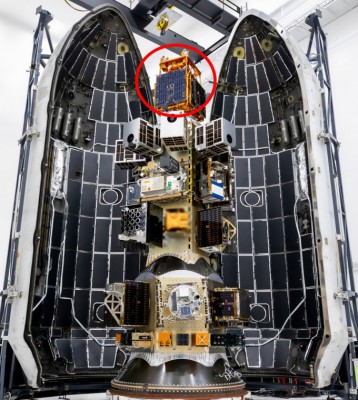
CAS500-4 separated normally from the launch vehicle at an altitude of about 888 km at 6:42 p.m., 2 hours and 30 minutes after liftoff, and successfully entered its target sun-synchronous orbit.
CAS500-4 is a medium-size Earth observation satellite developed under the leadership of Korea Aerospace Industries (KAI), based on the 500 kg-class standard platform technology secured in the first phase CAS500 program. More than 75% of the spacecraft bus and key payload components have been domestically produced.
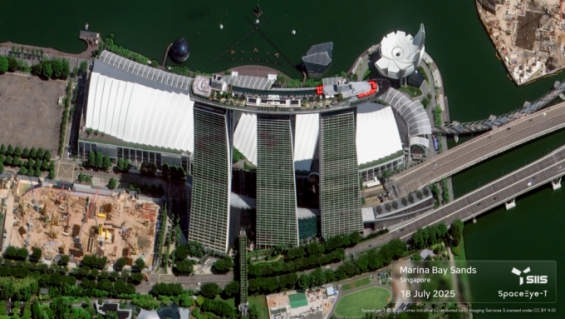
It is equipped with a wide-area observation camera developed using core domestic technologies. The satellite has a mass of about 514 kg and a mission lifespan of five years. With a spatial resolution of around 5 m and an observation swath wider than 120 km, it can image the entire country on a three-day cycle. By leveraging its wide swath, the satellite can capture the entire Korean Peninsula in just two to three passes.
CAS500-4 will undergo about four months of initial operations and in-orbit testing, and will begin full-scale missions in the first half of 2027.
Lee Seung-don, Administrator of the Rural Development Administration, said, “We are ushering in an era of monitoring agriculture from the sky,” adding, “By combining satellite imagery with artificial intelligence (AI), we will further advance crop yield forecasting and responses to agricultural disasters, and realize digital agriculture that farmers can tangibly experience in the field.”
Park Eun-sik, Korea Forest Service Commissioner, stated, “Using CAS500-4, we will rapidly and accurately monitor forests, proactively respond to forest disasters such as wildfires and landslides, and realize scientific forest management amid the climate crisis.”
Oh Tae-seok, Administrator of the Korea Aerospace Administration, said, “By independently securing data and image information needed for agriculture, forestry, climate, and disaster response, we have significantly strengthened the competitiveness of private-led satellite development and the nation’s satellite information utilization capabilities,” adding, “We will identify domestic and overseas satellite launch demand to further expand the use of Korea’s launch vehicles.”


 www.hanwha.co.kr