TR UAV/UCAV Programs | Anka - series | Kızılelma | TB - series

Yasar_TR

Experienced member
Staff member
Administrator
Messages
4,180
Reactions
252 21,827
Nation of residence
United Kingdom
Nation of origin
Turkey
Does 2 F110 engines on lower output have a less infrared signature than a F35 engine on higher output?
According to unconfirmed sources :

F110
non afterburner/dry exhaust temperature : 600-700 degrees C
Afterburner exhaust temperature : 1700-2000 degrees C

F135
non afterburner/dry exhaust temperature : 600-650 degrees C
Afterburner exhaust temperature : 1500-1700 degrees C

So in reality there isn’t much between them.

It depends on how well the aircraft disguises IR picture of engines is what matters.

In essence these values vary a great deal depending on RPM of engines and the length of time afterburners are applied

An aircraft’s skin temperature goes up drastically with its speed and altitude. At Higher altitudes air is thin the friction is less. Hence less heat develops .
But at higher altitudes planes can go faster. This increases friction and skin temperature climbs.

At mach2 and high altitude the skin temperature can be between 120 to 180 degrees C

I always remember the Russian IR picture of an f22 from 150km away.
 
Last edited:

TheInsider

Experienced member
Professional
Messages
4,878
Solutions
1
Reactions
49 16,980
Nation of residence
Turkey
Nation of origin
Turkey
I found the exact values for F110 it is 482 degree celcius 10 feet away from the nozzle and 935 degree celcius when measured from the exhaust thermocouple(inside the engine just before the afterburner), both at military power. Admittedly the first figure is more useful considering the IR signature.

f16.jpg
 
Last edited:

Yasar_TR

Experienced member
Staff member
Administrator
Messages
4,180
Reactions
252 21,827
Nation of residence
United Kingdom
Nation of origin
Turkey
I found the exact values for F110 it is 482 degree celcius 10 feet away from the nozzle and 935 degree celcius when measured from the exhaust thermocouple(inside the engine just before the afterburner), both at military power. Admittedly second figure is more useful considering the IR signature.

View attachment 81555

But interesting that nearly 300 metres away, the temperature is still 40 degrees C. At 15 metres from nozzle it is nearly 150 degrees C. That is a lot of IR signature.
Also this has a lot to do with staff safety around those engines. So it must be taken stationary on tarmac. I wonder what values it should give at high altitude.
Shame a similar test is not available for f135 to compare.
 

TheInsider

Experienced member
Professional
Messages
4,878
Solutions
1
Reactions
49 16,980
Nation of residence
Turkey
Nation of origin
Turkey
But interesting that nearly 300 metres away, the temperature is still 40 degrees C. At 15 metres from nozzle it is nearly 150 degrees C. That is a lot of IR signature.
Also this has a lot to do with staff safety around those engines. So it must be taken stationary on tarmac. I wonder what values it should give at high altitude.
Shame a similar test is not available for f135 to compare.
We can roughly estimate F-135 values from this.


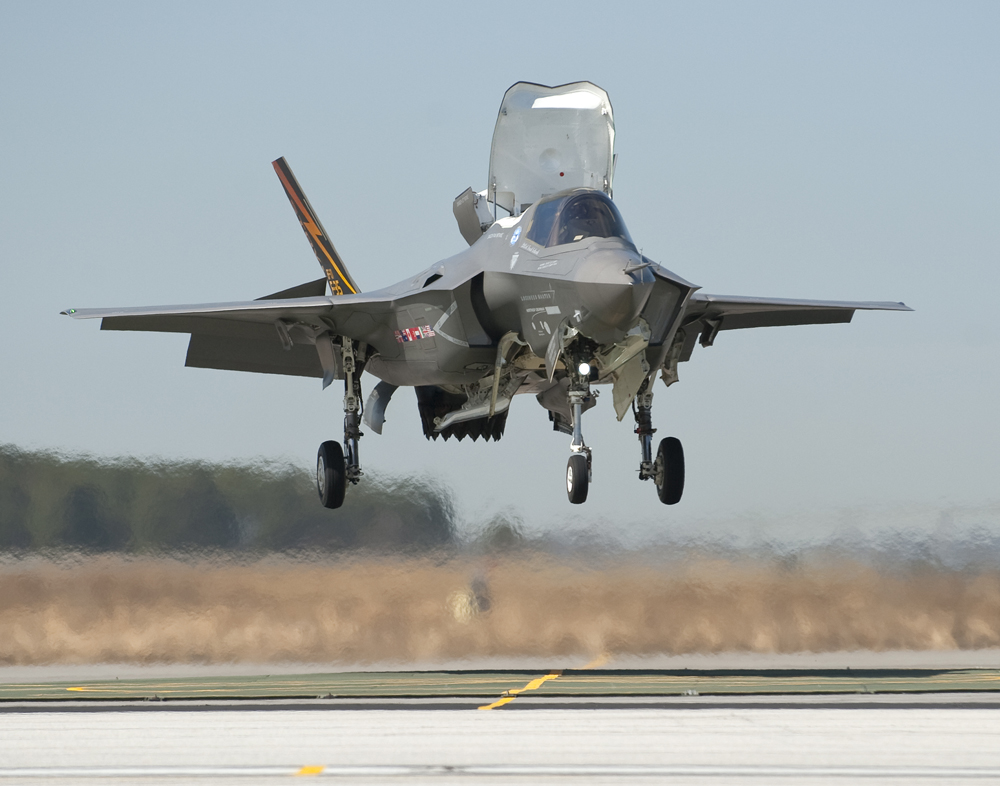
In the Introduction, it was explained that runways are exposed to very high temperatures during the vertical take-off and landing of F-35B combat aircraft. During a take-off or landing, heat is vertically applied to runways through a single direction and can reach up to 930 °C temperatures with a heating rate of 85 °C s−1.


The newly released document, hosted on a government building-design resource
site, outlines what base-construction engineers need to do to ensure that
the F-35B’s exhaust does not turn the surface it lands on into an
area-denial weapon. And it’s not trivial. Vertical-landing “pads will be
exposed to 1700 deg. F and high velocity (Mach 1) exhaust,” the report says.
The exhaust will melt asphalt and “is likely to spall the surface of
standard airfield concrete pavements on the first VL.

And lastly, IR recording at near idle thrust. Body of F-35 is dark as expected because it is painted with IR signature supressing paint. On the other hand nozzle is glowing and exhaust plume is a lot more visible.

https://www.reddit.com/r/aviation/comments/uz38e0
 

Huelague

Experienced member
Messages
5,287
Reactions
19 5,353
Nation of residence
Germany
Nation of origin
Turkey
We have some very advanced shit on our hands when it comes to RAM. Early studies probably go back 2 decades. There are clues for deduction for the careful eyes in academia, and Ergun Kırlıkovalı mentioned contributing to 4 next-generation RAM materials for the Kaan
I remember the discussion, especially in the field of Nano technology.
 

UkroTurk

Experienced member
Land Warfare Specialist
Professional
Messages
2,908
Reactions
58 5,198
Nation of residence
Turkey
Nation of origin
Turkey

The radar-absorbent material (RAM) coating designed to provide stealth capabilities for the KAAN has been manufactured in Ankara, has passed over 30 tests, and is ready for use.

It can be said that the KAAN's stealth level will surpass that of the F-35, thanks to innovations in RAM technology.

The radar-signal-absorbing coating used on the KAAN and ANKA-3 is superior to the coating used on American F-35 aircraft.

The next-generation coating developed for the KAAN and ANKA-3 was designed with more durable and modern components to overcome the chronic maintenance issues associated with the F-35.

The KAAN’s Radar Cross Section (RCS) value is 0.001 m²—roughly the size of a golf ball.

The KAAN incorporates millions of lines of code written by ASELSAN and HAVELSAN.
1784071400835.jpeg

1784071453318.jpeg

AFAIK Rafale and EF have 1m2 RCS. ( No idea frontal or from ground)


1784072050573.png

Anyways, under any surcamstances the seeker of missiles could not engage from long distances. If SM-3 engaged to those flighters, the thermal signature would be vital from long distances.
 
Last edited:
Top Bottom