
I always wondered why it's a big issue to throw weapons from internal bay, I think that sums it up..Yes, IWB releasing smart munitions, their accuracy can be adversely affected by :
Severe cavity aeroacoustics,
Unsteady shear-layer turbulence, and
High-pressure oscillations.
Lighter smart weapons are particularly sensitive to these dynamic forces .
As they are leaving there is a danger of the contact too . So they are pushed out by automated or mechanical means, which further excarcebate the issue.

Latest Thread
You are using an out of date browser. It may not display this or other websites correctly.
You should upgrade or use an alternative browser.
You should upgrade or use an alternative browser.
Maybe internal calibration systems are effected more?Tolun is not a free-fall munition. Therefore, it engages the target on its own after releasing from the aircraft, and the turbulence generated during the release does not affect it."


Aselsan's site says:Tolun is not a free-fall munition. Therefore, it engages the target on its own after releasing from the aircraft, and the turbulence generated during the release does not affect it."
TOLUN-P
TOLUN P is a INS/GNSS guided gliding all up round ready 250 lb. weapon system carried on Smart Pneumatic Quad Rack (SPQR) (SADAK-4T)
https://cdn.aselsan.com/aselsanweb-...ties/products/brochure/tolun-p/tolun-p-en.pdf
You should get your facts right mate.
Besides, even if it were turbojet powered, it wouldn't change anything. You would still have to deal with release dynamics.
EDIT
You would still have to deal with :
Seeker Acquisition problems: IIR, IR, or RF seekers can experience a delayed "lock-on" or distorted acquisition during going through this turbulent air beneath the aircraft fuselage.
Aeroacoustic problems: These causes high vibrations inside the open bay that would vibrate the internal seeker electronics, gyros, and inertial measurement units causing targeting faults before or during release.
Flow Disturbances: An abrupt transition from a calm internal bay to a near stormy air flowing bay would cause severe oscillations, and roll that could displace the munition off its intended initial trajectory.
Last edited:


Aselsan's site says:
TOLUN-P
TOLUN P is a INS/GNSS guided gliding all up round ready 250 lb. weapon system carried on Smart Pneumatic Quad Rack (SPQR) (SADAK-4T)
https://cdn.aselsan.com/aselsanweb-...ties/products/brochure/tolun-p/tolun-p-en.pdf
You should get your facts right mate.
Besides, even if it were turbojet powered, it wouldn't change anything. You would still have to deal with release dynamics.
I think the point is, it has control surfaces to make meaningful course correction long after its release as it glides for extend period of time to reach extended range. Hence adverse release dynamics shouldn't effect terminal accuracy.

Pokemonte13
Contributor

I think he means because tolun spends more time in the air gliding the effect shouldn't be the same compared to teber which falls directly and has less time to correct its heading. I think its not necessary because of the iwb guided munition do not always hit their marks we have seen that before with LGK.Aselsan's site says:
TOLUN-P
TOLUN P is a INS/GNSS guided gliding all up round ready 250 lb. weapon system carried on Smart Pneumatic Quad Rack (SPQR) (SADAK-4T)
https://cdn.aselsan.com/aselsanweb-...ties/products/brochure/tolun-p/tolun-p-en.pdf
You should get your facts right mate.
Besides, even if it were turbojet powered, it wouldn't change anything. You would still have to deal with release dynamics.
Re @Pokemonte13I think the point is, it has control surfaces to make meaningful course correction long after its release as it glides for extend period of time to reach extended range. Hence adverse release dynamics shouldn't affect terminal accuracy.
I think he means because tolun spends more time in the air gliding the effect shouldn't be the same compared to teber which falls directly and has less time to correct its heading. I think its not necessary because of the iwb guided munition do not always hit their marks we have seen that before with LGK.
See
EDIT
please
Laser guided munitions should hit moving targets with precision.
There is no excuse if they can’t hit a stationary target.
Last edited:


ANKA-3, F-35 and Patriot: Mathematical and Battlefield Realities
In recent days, an analysis that occasionally appears on social media, along with claims related to this analysis, has started circulating again:
Claim 1: “Geometrically, ANKA-3 is stealthier than the F-35.”
Claim 2: “Patriot C Band performance is 120 km → RCS 1.5 m²; ANKA-3 C Band RCS is 0.002 m²; the Patriot radar detects ANKA-3 at 23 km, while ANKA-3 can launch TOLUN from 100 km and silence the Patriot radar.”
Claim 3: “The F-35A aircraft cannot determine that ANKA-3 is approaching from farther than 29 km using its own radar.”
Although I partially agree with the claims, “stealth is not a number; it is a system”!
There is no need for analysis of what is written in Claim 1.
“Flying wing” geometries such as ANKA-3 (it does not even have a canopy) theoretically have a lower RF signature than geometries such as the F-35.
But stealth ≠ geometry!
Stealth as a whole consists of RF, IR, acoustic, visual, etc. signatures.
There are many technologies on the F-35, including its coatings; we do not know all of them.
Nor do we know those of ANKA-3!
For example, the F-35’s AN/ASQ-239 electronic warfare system passively maps and identifies enemy radars and enables active jamming!
The claim that ANKA-3’s C-band RCS is 0.002 m², mentioned in Claim 2, is the result of a simulation and probably applies to a full nose-on aspect!
In fact, RCS is not a single value; it continuously changes depending on the angle of arrival, radar polarization, operating frequency, and the aircraft’s instantaneous attitude.
At different positions, the RCS value can increase exponentially, and the detection range can increase accordingly.
I am setting these aside!
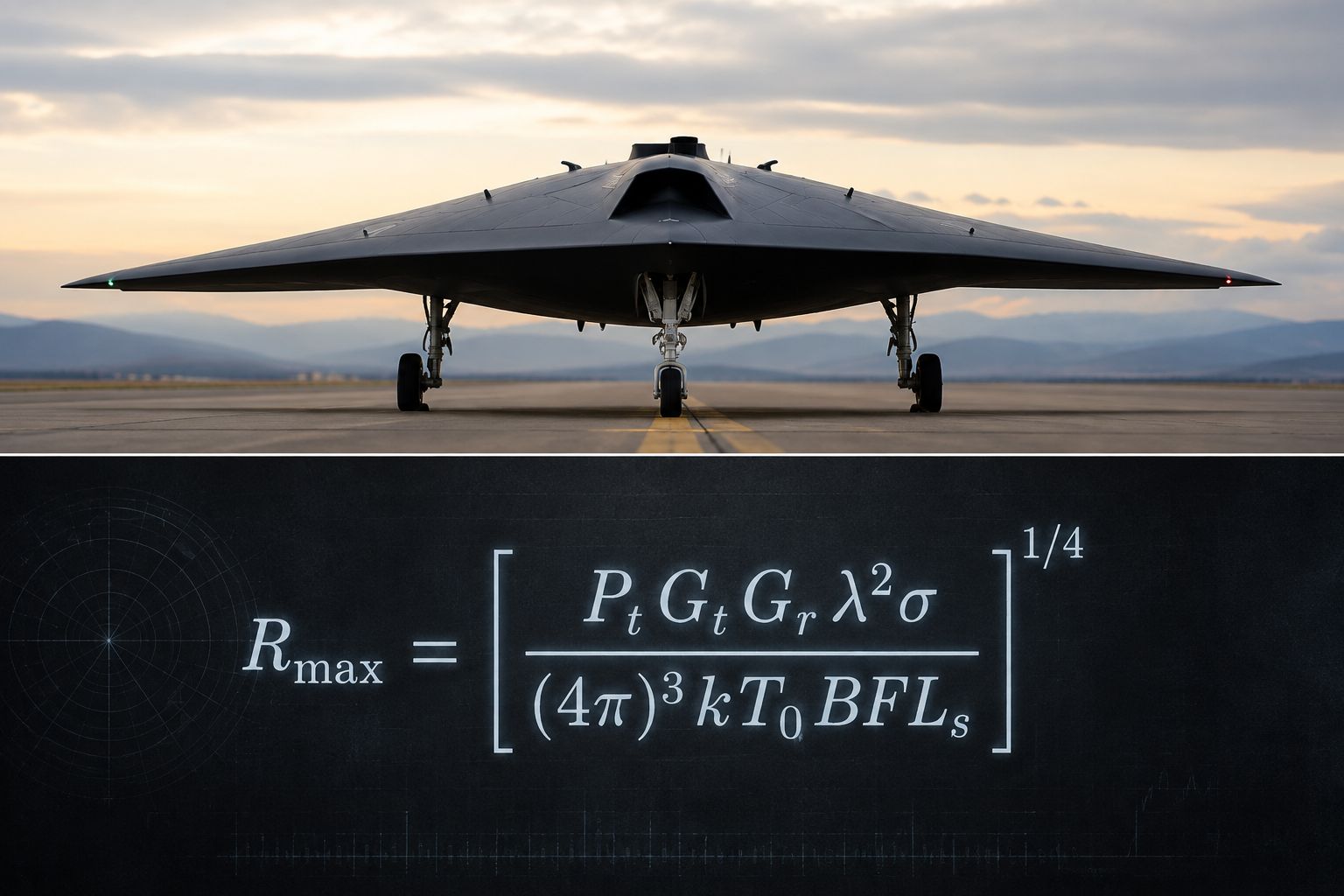
If we accept the values given for Patriot as correct, you can obtain 23 km by applying the fourth-root factor in the basic radar equation to the ratio.
However, what is not taken into account is that, in order to launch TOLUN munitions to 100 km, you need to be at an altitude of approximately 35,000 ft, meaning that your aspect angle is different.
And that you would directly enter the search angle of the Patriot radar!
And the RCS would spike as soon as you open the internal weapons-bay doors!
Patriot batteries generally do not consist of a single radar either; SHORAD (Short-Range Air Defense) systems and PAC-3 MSE interceptor missiles are also positioned around them.
And modern air warfare is no longer a battle between individual radars!
Coming to Claim 3, let us assume that the F-35A’s radar detects a standard 1 m² target at 160 km. If we take ANKA-3’s X-band RCS from a full nose-on aspect as 0.001 m², we can arrive at approximately 29 km.
The formula is correct, and the calculation is consistent!
However, the F-35 does not search using radar alone!
The moment ANKA-3 establishes a datalink, uses its RA, or activates an active sensor, the F-35’s electronic warfare system can theoretically determine its bearing from up to 300 km away!
So, although the mathematics may be correct, it may not always correspond to the realities of the battlefield.
On the battlefield, survivability is the sum of many factors.
And, as for the Patriots, I think they are not really the problem; there are many scenarios for taking them out!
I think the real point we should focus on is this:
Neither the F-35 nor ANKA-3 will be able to fly like a “Red Baron.”
Neither is an “individual actor”; each is a “node in the network.”
Very few countries in the world possess the ANKA-3, and alongside KAAN, it will be an excellent force multiplier!
 tolgaozbek.com
In recent days, an analysis that occasionally appears on social media, along with claims related to this analysis, has started circulating again:
Claim 1: “Geometrically, ANKA-3 is stealthier than the F-35.”
Claim 2: “Patriot C Band performance is 120 km → RCS 1.5 m²; ANKA-3 C Band RCS is 0.002 m²; the Patriot radar detects ANKA-3 at 23 km, while ANKA-3 can launch TOLUN from 100 km and silence the Patriot radar.”
Claim 3: “The F-35A aircraft cannot determine that ANKA-3 is approaching from farther than 29 km using its own radar.”
Although I partially agree with the claims, “stealth is not a number; it is a system”!
There is no need for analysis of what is written in Claim 1.
“Flying wing” geometries such as ANKA-3 (it does not even have a canopy) theoretically have a lower RF signature than geometries such as the F-35.
But stealth ≠ geometry!
Stealth as a whole consists of RF, IR, acoustic, visual, etc. signatures.
There are many technologies on the F-35, including its coatings; we do not know all of them.
Nor do we know those of ANKA-3!
For example, the F-35’s AN/ASQ-239 electronic warfare system passively maps and identifies enemy radars and enables active jamming!
The claim that ANKA-3’s C-band RCS is 0.002 m², mentioned in Claim 2, is the result of a simulation and probably applies to a full nose-on aspect!
In fact, RCS is not a single value; it continuously changes depending on the angle of arrival, radar polarization, operating frequency, and the aircraft’s instantaneous attitude.
At different positions, the RCS value can increase exponentially, and the detection range can increase accordingly.
I am setting these aside!
If we accept the values given for Patriot as correct, you can obtain 23 km by applying the fourth-root factor in the basic radar equation to the ratio.
However, what is not taken into account is that, in order to launch TOLUN munitions to 100 km, you need to be at an altitude of approximately 35,000 ft, meaning that your aspect angle is different.
And that you would directly enter the search angle of the Patriot radar!
And the RCS would spike as soon as you open the internal weapons-bay doors!
Patriot batteries generally do not consist of a single radar either; SHORAD (Short-Range Air Defense) systems and PAC-3 MSE interceptor missiles are also positioned around them.
And modern air warfare is no longer a battle between individual radars!
Coming to Claim 3, let us assume that the F-35A’s radar detects a standard 1 m² target at 160 km. If we take ANKA-3’s X-band RCS from a full nose-on aspect as 0.001 m², we can arrive at approximately 29 km.
The formula is correct, and the calculation is consistent!
However, the F-35 does not search using radar alone!
The moment ANKA-3 establishes a datalink, uses its RA, or activates an active sensor, the F-35’s electronic warfare system can theoretically determine its bearing from up to 300 km away!
So, although the mathematics may be correct, it may not always correspond to the realities of the battlefield.
On the battlefield, survivability is the sum of many factors.
And, as for the Patriots, I think they are not really the problem; there are many scenarios for taking them out!
I think the real point we should focus on is this:
Neither the F-35 nor ANKA-3 will be able to fly like a “Red Baron.”
Neither is an “individual actor”; each is a “node in the network.”
Very few countries in the world possess the ANKA-3, and alongside KAAN, it will be an excellent force multiplier!
ANKA-3, F-35 ve Patriot: Matematik ve harp sahası gerçekleri - Tolga Özbek
Son günlerde sosyal medyada ara ara çıkan bir analiz ve bu analize ilişkin iddialar tekrar dolanıyor:
tolgaozbek.com


Well, it’s not really a surprise. Anka-3 would be an exceptionally great asset when it finally becomes ready.
TEBER-82 & TOLUN-P Munition Firing Test from the Internal Weapons Bay
View attachment 81706
View attachment 81707
Last edited:


Not much with the external hardpoints and load

It looks like the nozzle moved into the body.
Pokemonte13
Contributor
NoIt looks like the nozzle moved into the body.

Şok Tedavisi
Active member
Why did tolun munition missed Its target by a great margin? What is the cep of tolun?
Check my posts at the top of this page and previous pageWhy did tolun munition missed Its target by a great margin? What is the cep of tolun?
Şok Tedavisi
Active member
We have seen mam-l perfectly hit moving targets countless times, It is weird to see teber and tolun miss by great margin just like you said there is no excuse for it.Re @Pokemonte13
I think he means because tolun spends more time in the air gliding the effect shouldn't be the same compared to teber which falls directly and has less time to correct its heading. I think its not necessary because of the iwb guided munition do not always hit their marks we have seen that before with LGK.
See
EDIT
please
Laser guided munitions should hit moving targets with precision.
There is no excuse if they can’t hit a stationary target.
Şok Tedavisi
Active member
@Yasar_TR again another munition misses its target while being fired from KE platform whats up with these misses all the time?LGK misses again but teber looks good

In the case of IWB release, looking at first instance it is not a failure. The whole system of internal weapon bay release worked well. Bombs left their release pylons and the plane, without hitting the plane. They even got close to hitting the target. But the missile should have hit the target closer. See below Anka-3 IWB drop last year.The important question is not , why they missed the target on a high accuracy. More important question is, why they post the obvious failure?
But as explained above a lot of other parameters need to be taken in to consideration. As mentioned in my previous post above there are many unforeseen forces that would affect precision targeting (as copied below). These will have to be taken in to consideration and calculated in to weapons release. So Baykar has a long way to go yet.
Seeker Acquisition problems: IIR, IR, or RF seekers can experience a delayed "lock-on" or distorted acquisition during going through this turbulent air beneath the aircraft fuselage.
Aeroacoustic problems: These causes high vibrations inside the open bay that would vibrate the internal seeker electronics, gyros, and inertial measurement units causing targeting faults before or during release.
Flow Disturbances: An abrupt transition from a calm internal bay to a near stormy air flowing bay would cause severe oscillations, and roll that could displace the munition off its intended initial trajectory.
But in the last video of @Pokemonte13 that @Şok Tedavisi has shared, LGK-82 missile has missed the square and Teber-82 missile just managed to hit inside by very little margin. But we don’t know what size those squares were. However looking at the nearby roads they are very large squares.
The LGK82 is Aselsan’s pure laser guidance kit munition.
Teber-82 is Roketsan’s hybrid GPS/INS and laser guidance munition
LGK-82 has a a CEP value of around 10 metres.
Teber-82 has a CEP value of less than 3 metres.
(Tolun-P has a CEP of less than10m too.)
So really being laser guided means, these are extra precision hitting missiles.
93.7% of LGK-82s should hit within 20 m, with 50% being inside 10 m.
93.7% of Teber-82 should hit within 6m, with 50% being inside 3m.
There seems to be something wrong with either the missiles‘ targeting or the KE’s release mechanism is affecting both missiles’ targeting systems.
Below is the first IWB release of Tolun munition from Anka-3 hitting target with a bulls eye. Showing KE how it is done. So there must be something to do with KE systems affecting the missile. I guess seeing is believing.
Last edited:


