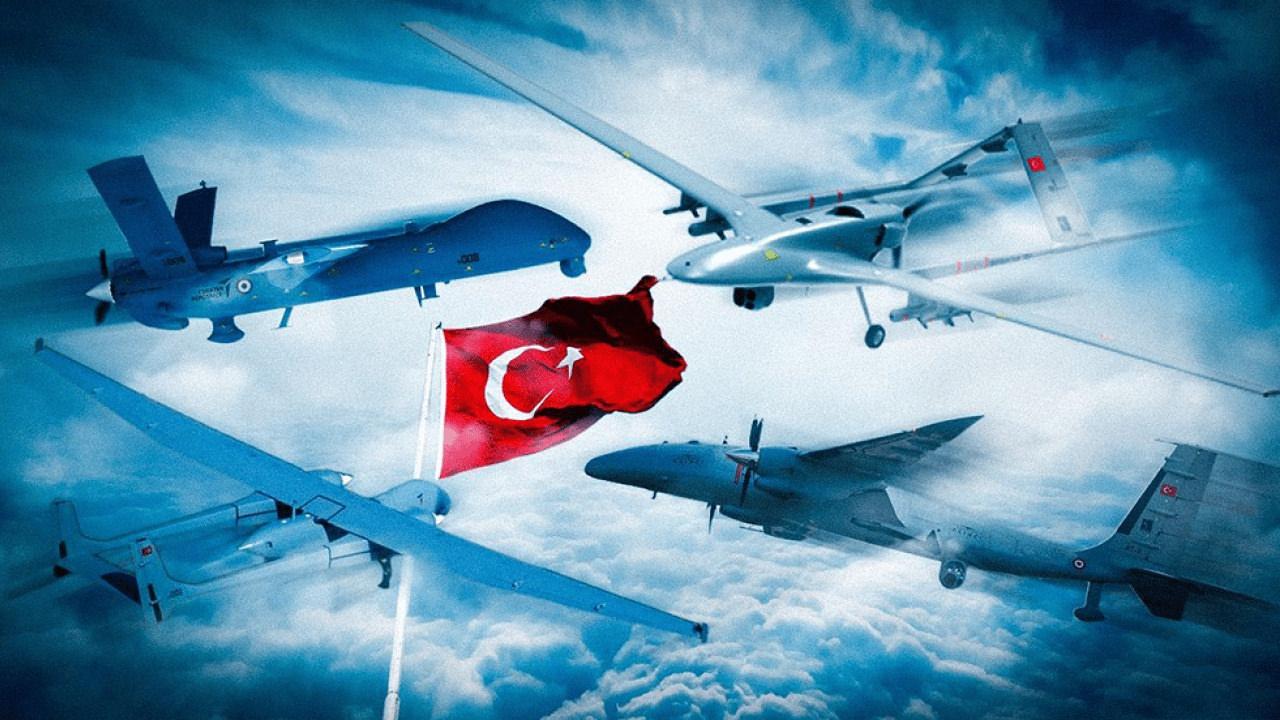
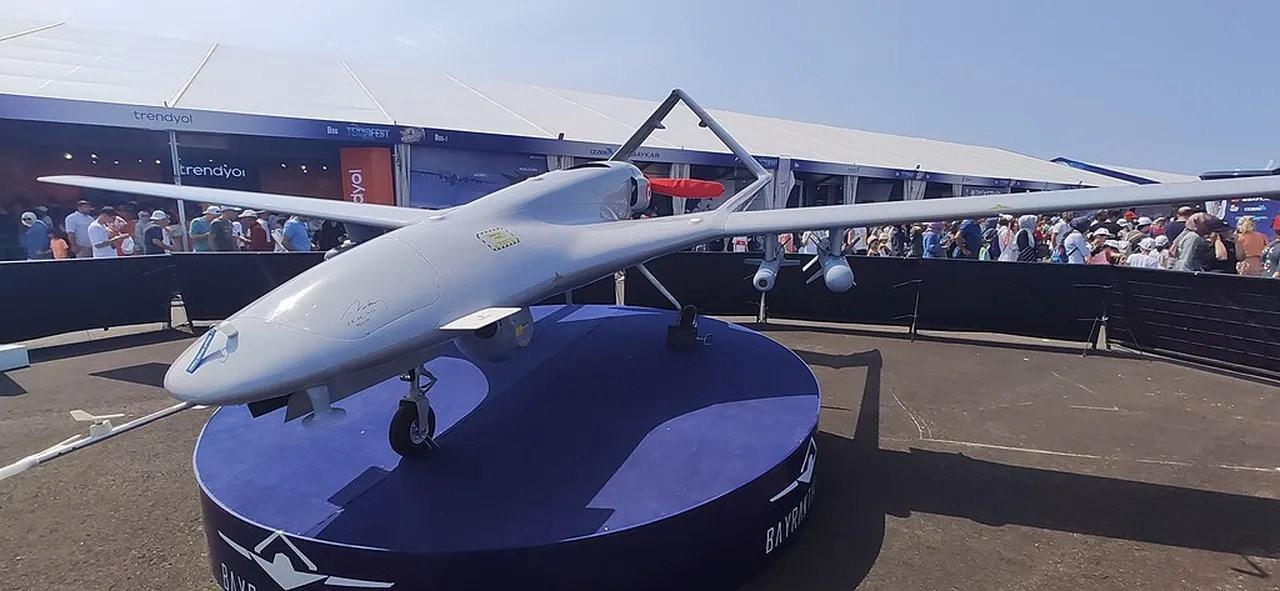
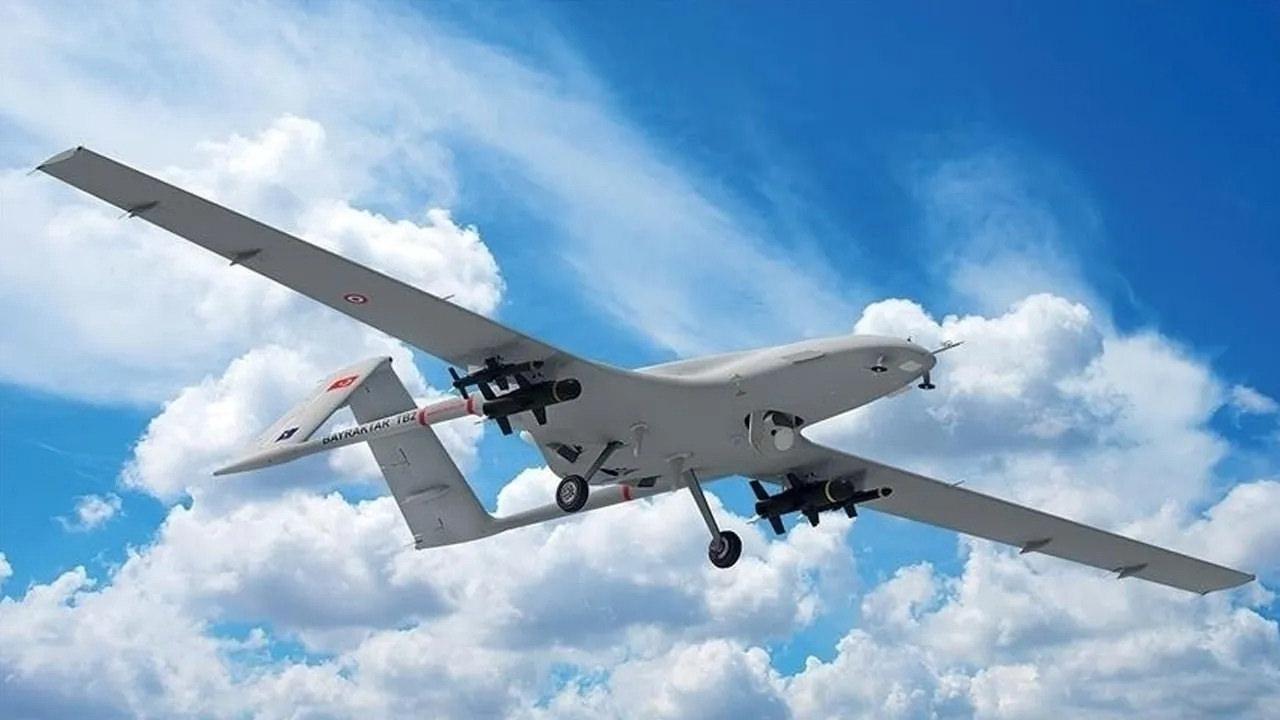
TR UAV/UCAV Programs | Anka - series | Kızılelma | TB - series

boredaf

Experienced member
Messages
2,011
Solutions
1
Reactions
39 5,942
Nation of residence
United Kingdom
Nation of origin
Turkey
So,what you're saying is that without a domestic engine all the fuss about how good the KE is is just a scene from a Sci-Fi movie?:unsure::unsure::unsure: (thinking).
Nah mate, I wouldn't go that far. Is it underpowered, no doubt about that, but as long as it can carry and lob missiles from a standoff range, it'll still be useful to us. I don't believe in dogfights, other than the usual pissing contest between us and the Greek twats, especially when it comes to low observability aircraft. If Murad delivers as good as they have been promising, KE should still be good against anything other than 5th gen aircraft even as it is.

It is kind of a squeaky bum time for us when it comes to KE and Anka-3, we are almost there and I don't think we can go any faster. And you know me mate, I'm an eternal optimist me, I think they are going to build first batches of KE and Anka-3 with engine change in mind so that they can swap them when ours is ready 2028 onwards.
 

Yasar_TR

Experienced member
Staff member
Administrator
Messages
3,919
Reactions
235 20,369
Nation of residence
United Kingdom
Nation of origin
Turkey
And the engine?
TF6000 is almost ready. It has already produced almost the required thrust. (I caught In an interview Mr Demiroglu mentioning 5970lbf thrust being achieved). By the time the first LRIP samples are ready, that engine will be ready too.
Inspite of the war and the bombing of the factory site, Motor Sich has been delivering enough engines to produce LRIP quantities.

the TF10000 though still needs some time.

I don’t know why Baykar is insisting on TF10000 so much? As per @boredaf ’s post, I also think at this stage any dogfight scenarios for KE is a futile and useless attempt that would waste resources. If it uses the afterburner it will only make itself more observable. The only advantage would be to help it take of from shorter runways and/or with more useful payload. (May be they haven’t given up on the notion of it taking off from TCG Anadolu)
 
Last edited:

Anmdt

Experienced member
Naval Specialist
Professional
Messages
5,712
Solutions
2
Reactions
138 26,316
Nation of residence
Turkey
Nation of origin
Turkey
You are correct. My bad. Forgot that.
In that case all they need to do is to ask TAI!
TAI and Baykar has wholly different approaches in platform development and R&D.

Baykar has luxury of trial and failure with plenty of prototypes, abundant amount of resources dedicated to this. They learn over failures and build upon, deliver in blocks and revisions after revisions. The latter is highly granted by political leverage which TAI lacks of having.

It was a turmoil when TAI lost a prototype - which somehow managed to glide and land, with minimal airframe damage, unflyable yet recoverable. That was all over the news with all images, meanwhile do we have any idea of how many prototypes Baykar lost?

All in all, TurAF expects Anka-III to be delivered almost in operable state with IWB, radars, automated command and control, while they are okaying KE to be delivered as an experimental product - like it happens with TB3 in a form faster flying Akıncı with higher payload and installed power to run more advanced components so i don't even expect IWB in first batch of KEs.
 

Anmdt

Experienced member
Naval Specialist
Professional
Messages
5,712
Solutions
2
Reactions
138 26,316
Nation of residence
Turkey
Nation of origin
Turkey
TF6000 is almost ready. It has already produced almost the required thrust. (I caught In an interview Mr Demiroglu mentioning 5970lbf thrust being achieved). By the time the first LRIP samples are ready, that engine will be ready too.
Inspite of the war and the bombing of the factory site, Motor Sich has been delivering enough engines to produce LRIP quantities.

the TF10000 though still needs some time.

I don’t know why Baykar is insisting on TF10000 so much? As per @boredaf ’s post, I also think at this stage any dogfight scenarios for KE is a futile and useless attempt that would waste resources. If it uses the afterburner it will only make itself more observable. The only advantage would be to help it take of from shorter runways and/or with more useful payload. (May be they haven’t given up on the notion of it taking off from TCG Anadolu)
Oh mate i would very doubt if TF6000 is in a ready state. It is yet to go platform integration stage which hasn't commenced yet, excluding all those flight tests.
 

Yasar_TR

Experienced member
Staff member
Administrator
Messages
3,919
Reactions
235 20,369
Nation of residence
United Kingdom
Nation of origin
Turkey
Oh mate i would very doubt if TF6000 is in a ready state. It is yet to go platform integration stage which hasn't commenced yet, excluding all those flight tests.
My wording wasn’t totally correct probably. It should have read :
TF6000 is “almost” ready for flying.
As mentioned by Dr Aksit, it already produces more thrust than current Motor Sich engine that flies Anka-3. .
Since it is an unmanned platform that it will fly, it can be integrated in to Anka-3 sooner than expected or before the engine has fully matured.
Besides as I explained in another post, the Motor Sich is providing enough engines to allow Tusas to have LRIP for these birds. By the time this process is completed, most probable that TF6000 will be ready to fly.
 

fushkee

Committed member
Messages
213
Reactions
6 326
Nation of residence
United Arab Emirates
Nation of origin
Turkey
I think Baykar has been studying at developing TF20000 while TEI has been developing TF10000.
I heard that somewhere but not remembering.
 

Fuzuli NL

Experienced member
Germany Correspondent
Messages
3,457
Reactions
50 9,721
Nation of residence
Germany
Nation of origin
Turkey
#Maroc & #Baykar: new drone factory! Located in Benslimane, operational in 2026, it will produce and maintain drones for the FAR. Strategic Morocco-Turkey partnership, creation of specialized jobs, and strengthening of the local military industry.


Baykar is establishing a $250 million production base in Africa: Recruitment announcements have been made!​


Baykar, the world's largest manufacturer of unmanned aerial vehicles (UAVs), is commissioning its first production facility in North Africa, located in Morocco. The base, to be named "Atlas Defense," will begin production this year.​

Baykar is establishing a $250 million production base in Africa: Recruitment announcements have been made!


ACCESSED 22.02.2026 20:27 UPDATE 22.02.2026 20:47


NSocial


Baykar, a leading company in the Turkish defense industry, is establishing a new production facility in Ben Slimane, Morocco, with a capital of $250 million.
The company, which will operate under the name "Atlas Defense," will be its first major production base in Africa.
Following the strategic cooperation agreement signed in December 2024, the construction process for the facility was initiated, and it is planned to begin production this year. The base will host the production of Bayraktar TB2 and Akıncı TİHA drones.
VqwWR_1771782350_2268.jpg

AFRICAN PRESS ANNOUNCES: RECRUITMENT HAS BEGUN.

in Moroccan and African media According to reports , Atlas Defense has begun its initial pre-production recruitment process. Publications such as Morocco Intel, African Manager, and Agenzia Nova wrote that preparations for the opening of the factory in Ben Slimane are accelerating.
The job postings included positions for mechanical technician, electronics technician, aviation painting technician, aviation structural technician, and test pilot.
ryMpv_1771782370_7407.jpg

PRODUCTION FOR THE ROYAL ARMED FORCES

Atlas Defense, a subsidiary based in Morocco, operates in the design, manufacture, and maintenance of unmanned aerial vehicles, as well as the production of technological components and systems for the defense industry.
The facility will focus on the production and maintenance of next-generation unmanned aerial vehicles to meet the needs of the Royal Moroccan Armed Forces. The project is described as a new phase in the strategic partnership between the two countries in the field of defense.
According to a decision published in the Moroccan Official Gazette, Atlas Defense, with a capital of $250 million, will be Baykar's first major production base on the continent.
WqnSD_1771782392_0199.jpg

Türkiye'S AFRICA INITIATIVE

Baykar's investment in Morocco stands out as one of the steps strengthening Türkiye's defense industry presence on the African continent. The company had previously delivered Bayraktar TB2 drones to Morocco.
With the production base to be established in Ben Slimane, the process of on-site production of Turkish-based defense technologies in Africa will begin.


IC3M@N FX

Contributor
Messages
552
Reactions
3 27 1,116
Nation of residence
Germany
Nation of origin
Turkey
So there is nothing official, and we can assume that this is fake news. We have not made any statements in this regard, let alone held a meeting between the Turkish and Moroccan defence ministers, which is usually how strategic matters are clarified. Therefore, the truthfulness of this report is 0.00%.

Before something like this happens, delegations exchange views several times and a memorandum of understanding is signed.
 

Knowledgeseeker

Experienced member
Moderator
Arab Moderator
Morocco Moderator
Messages
1,921
Reactions
22 4,941
Nation of residence
Norway
Nation of origin
Moroco
So there is nothing official, and we can assume that this is fake news. We have not made any statements in this regard, let alone held a meeting between the Turkish and Moroccan defence ministers, which is usually how strategic matters are clarified. Therefore, the truthfulness of this report is 0.00%.

Before something like this happens, delegations exchange views several times and a memorandum of understanding is signed.

Baykar mina have established its branch with the name Atlas Defense in Morocco. I have not published any news on the forum because we lack official data on the matter related to what will be produced. The only fact we know for now is that a 2.5 million USD injection has been made with the name Atlas Defense. Maintenance of existing platforms will be part of the program, aswell as production.
 

Anmdt

Experienced member
Naval Specialist
Professional
Messages
5,712
Solutions
2
Reactions
138 26,316
Nation of residence
Turkey
Nation of origin
Turkey
ADVENT 🤜🏻🤛🏻 Bayraktar TB3

✈️ Integration tests between the ADVENT Combat Management System and the Bayraktar TB3 UCAV have been successfully completed! 🛡️

The integration is limited for now, the semi-integrated ground control station (a.k.a. the uav operations room) lies within the hangar, with its organic, sensor, data-link and SATCOM infastructure scattered around the ship separately from ship's. The integration is made between drone operations room and CMS.

This is highly robust and fair approach from the perspective of drone manufacturer; minimum relience on ship's equipments, minimum knowledge of ship's control systems and using common gateways of CMS and Data management system to integrate one-way data relays, could also might be extended to two-way later easily. This is an effective approach for sales, and quick acquisitions by other Navies allowing integration to be carried out during a minor maintenance, even without docking, schedule without re-testing all the equipments. Even with pure ISR and light engagement the TB3 is a capability extender for amphibious assets; cheap, easy to integrate, unmatching ISR capability with long endurance and low operations costs, for being unmanned allowing high-risk zone deployments.

However, it is highly inadequent from perspective of the Navy. It is not visible for now since drone operations are mainly limited to ISR, light engagements and amphibious support but it will be more prominent in future when amphibious asset on ground (or transport helos, Special Forces, attack helos) may need to use drone for communication relay, or to obtain live-feed for situational awareness (same applies for fleet).

At the current stage, the integration most importantly eliminates the possibility of drone being engaged by accompanying ships, or Anadolu's own protection systems, recognizing it as an 'organic' asset.

There are shortcomings of drone operations room not being in physical integration with the operations room, and flight bridge but this would be luxury for what Anadolu has already been designed without thinking of this extension.

There is a long way to go;
  • Drone operations room sharing the same room with operations room; i.e. being designed in such a way to achieve secure flow of commands and situational awareness.
  • Drone-related equipment is being integrated more seamlessly alongside the bridge.
  • Drones supporting take-off and land without the visual assist (RF-IR based)
  • Drone control stations supporting two-way integration with CMS hence allowing commander to take over the control, or plot a course, select a zone, view - tilt the EO payload.
  • Better integration for further sensor payloads to combine the data with ship's sensors (such as ESM / ECM, SAR/MTI).
  • There is plenty more, such as; a maintenance rig and spare/inspection routines for naval deployments.
 

Sanchez

Experienced member
Moderator
Think Tank Analyst
DefenceHub Diplomat
Messages
3,749
Reactions
115 17,104
Nation of residence
Turkey
Nation of origin
Turkey
The integration is limited for now, the semi-integrated ground control station (a.k.a. the uav operations room) lies within the hangar, with its organic, sensor, data-link and SATCOM infastructure scattered around the ship separately from ship's. The integration is made between drone operations room and CMS.

This is highly robust and fair approach from the perspective of drone manufacturer; minimum relience on ship's equipments, minimum knowledge of ship's control systems and using common gateways of CMS and Data management system to integrate one-way data relays, could also might be extended to two-way later easily. This is an effective approach for sales, and quick acquisitions by other Navies allowing integration to be carried out during a minor maintenance, even without docking, schedule without re-testing all the equipments. Even with pure ISR and light engagement the TB3 is a capability extender for amphibious assets; cheap, easy to integrate, unmatching ISR capability with long endurance and low operations costs, for being unmanned allowing high-risk zone deployments.

However, it is highly inadequent from perspective of the Navy. It is not visible for now since drone operations are mainly limited to ISR, light engagements and amphibious support but it will be more prominent in future when amphibious asset on ground (or transport helos, Special Forces, attack helos) may need to use drone for communication relay, or to obtain live-feed for situational awareness (same applies for fleet).

At the current stage, the integration most importantly eliminates the possibility of drone being engaged by accompanying ships, or Anadolu's own protection systems, recognizing it as an 'organic' asset.

There are shortcomings of drone operations room not being in physical integration with the operations room, and flight bridge but this would be luxury for what Anadolu has already been designed without thinking of this extension.

There is a long way to go;
  • Drone operations room sharing the same room with operations room; i.e. being designed in such a way to achieve secure flow of commands and situational awareness.
  • Drone-related equipment is being integrated more seamlessly alongside the bridge.
  • Drones supporting take-off and land without the visual assist (RF-IR based)
  • Drone control stations supporting two-way integration with CMS hence allowing commander to take over the control, or plot a course, select a zone, view - tilt the EO payload.
  • Better integration for further sensor payloads to combine the data with ship's sensors (such as ESM / ECM, SAR/MTI).
  • There is plenty more, such as; a maintenance rig and spare/inspection routines for naval deployments.
Great write up. Wholly agree that it's basically a a shoe-in; adding something it was not supposed to have; but pretty good start in less than a year. I don't know how much of this Anadolu will be able to accommodate; but fares good for the future iteration aboard MUGEM; which is no doubt being planned with all this in mind; and now also with experience from it.

Makes me interested in seeing at least a design of a very light carrier; a bit bigger than what the Portuguese are doing, that doesn't also has to carry a marine brigade.
--
New EOTS flight from KE.
 

Anmdt

Experienced member
Naval Specialist
Professional
Messages
5,712
Solutions
2
Reactions
138 26,316
Nation of residence
Turkey
Nation of origin
Turkey
Great write up. Wholly agree that it's basically a a shoe-in; adding something it was not supposed to have; but pretty good start in less than a year. I don't know how much of this Anadolu will be able to accommodate; but fares good for the future iteration aboard MUGEM; which is no doubt being planned with all this in mind; and now also with experience from it.

Makes me interested in seeing at least a design of a very light carrier; a bit bigger than what the Portuguese are doing, that doesn't also has to carry a marine brigade.
--
New EOTS flight from KE.
I typed the post just so that we may have a bigger picture for what's needed with MUGEM; assuming that for the aircraft carrier both TAI and Baykar will provide drone systems and it would be illogical for each to introduce their own components and communication systems. There will be needed a holistic approach to enable manned and unmanned systems operated from the single flight operations room with common communication backbone.

For TB3, however, i don't see it a force multiplier as the KE/ANKAIII for MUGEM are; and it is acceptable to have standalone integration approach to extend capabilities of amphibious assets.

I also thought of a similar light carrier (or better to call multi-purpose platform) operated by minimal crew and serving both logistical needs of smaller fleets and providing the fleet ships with extended ISR capabilities and OTH protection for USVs, eliminating the reliance on SATCOM and GPS if needed by local network.

I bet they are working on a single-engine and similarly sized turbo-prop drone with higher payload and volume for further integration of systems and weapons.
 
Last edited:
Top Bottom