• Forum restore complete (see latest announcement thread)

TR F-16 Özgür | Hürkuş - Fighter Trainer Aircraft Projects

2033

Committed member
Messages
204
Reactions
4 417
Nation of residence
Turkey
Nation of origin
Turkey

Turkiye needs to start placing certain restrictions on equipment on these useless countries that cant even get security right.

Isis terrorists destroy a Hurkus plane. For isis pricks to even get inside the airport is more than embarassing. Where the hell is the security man
My friend, we are not responsible for the plane being blown up on the ground. Why did you react this way?
 

Ryder

Experienced member
Messages
11,417
Reactions
13 19,760
Nation of residence
Australia
Nation of origin
Turkey
My friend, we are not responsible for the plane being blown up on the ground. Why did you react this way?

It sucks thats all eventhough Turkiye had nothing to do with it. But seeing those terrorists just roam around destroy military equipment in a airport or airbase is just embarassing.
 

Yasar_TR

Experienced member
Staff member
Administrator
Messages
4,270
Reactions
258 22,300
Nation of residence
United Kingdom
Nation of origin
Turkey

It was announced that in 2025, the F-16 ÖZGÜR aircraft successfully launched the GÖKDOĞAN missile at an air target for the first time using AESA nose radar and data link guidance.

So our Ozgur-2 project is becoming more than just being on paper. But finding life in real time.
This coincides well with the given timeline that the 30+ Block 30 F16 planes will be delivered to TurAF between 2025 and 2027. Block 40 and 50 planes will go through Ozgur-2 modernisation between 2028 to 2030.
 

IC3M@N FX

Contributor
Messages
700
Reactions
3 30 1,432
Nation of residence
Germany
Nation of origin
Turkey
How is it realistically possible to modernise over 160–170 Block 40 and 50 F-16s within just two years? Logistically, this is virtually impossible. The Özgür II upgrade of the 30 or so Block 30 aircraft already demonstrates just how arduous and time-consuming the process is – even that has not yet been fully completed. At present, including prototypes and test platforms, the number of modernised aircraft is likely to be very small.
Added to this is a structural problem: Turkey does not have full access to the source codes for the Block 40 and 50 variants. Far-reaching modifications at the system, mission computer or software level are therefore only possible to a limited extent. Yet it is precisely these modifications that are essential for a comprehensive upgrade.
Against this backdrop, it seems far more realistic that only around 20 to 30 aircraft will be modernised by 2028 – perhaps 40 in the very best-case scenario. Anything beyond that currently seems more ambitious (unrealistic) than feasible.

Does anyone actually have a deeper understanding of the Özgür programme? I really hope I’m completely wrong… because if it’s just based on some PR statements or what Person XY said on Twitter or X, then it’s best to keep your distance.
 

Yasar_TR

Experienced member
Staff member
Administrator
Messages
4,270
Reactions
258 22,300
Nation of residence
United Kingdom
Nation of origin
Turkey
I know! Up until now there were vague insinuations about the use of Murad in conjunction with Gokdogan. This is the only source I came across that clearly states the successful use of Murad-100, Gokdogan and F16 Ozgur.

How is it realistically possible to modernise over 160–170 Block 40 and 50 F-16s within just two years? Logistically, this is virtually impossible. The Özgür II upgrade of the 30 or so Block 30 aircraft already demonstrates just how arduous and time-consuming the process is – even that has not yet been fully completed. At present, including prototypes and test platforms, the number of modernised aircraft is likely to be very small.
Added to this is a structural problem: Turkey does not have full access to the source codes for the Block 40 and 50 variants. Far-reaching modifications at the system, mission computer or software level are therefore only possible to a limited extent. Yet it is precisely these modifications that are essential for a comprehensive upgrade.
Against this backdrop, it seems far more realistic that only around 20 to 30 aircraft will be modernised by 2028 – perhaps 40 in the very best-case scenario. Anything beyond that currently seems more ambitious (unrealistic) than feasible.

Does anyone actually have a deeper understanding of the Özgür programme? I really hope I’m completely wrong… because if it’s just based on some PR statements or what Person XY said on Twitter or X, then it’s best to keep your distance.

I can understand your pessimism. But Aselsan has been developing and serially producing Murad in an LRIP state. They had to confirm the test results before going for full throttle serial production. The contract for Ozgur-2 covering Block 30, 40 and 50 was signed.


Also it has to be remembered that block 30 planes had to go through a structural modernisation program before becoming Ozgur. And they were the planes that the new avionics and Murad-100 was tested on. Once the integration of Radar to the new avionics is complete and successful, there is nothing holding mass production from going forward.
Ozgur means liberated. In other words, ÖZGÜR modernization project for Turkish F-16s involves significant changes to the avionics and mission computers, which directly affect the management and operational capabilities of the flight control systems. The project replaces existing mission computers with a domestic Turkish unit and integrates new Operational Flight Program software, which manages the aircraft's subsystems and weapon systems.

Turkey does not have full access to the original U.S. source codes for its F-16 Block 40 and 50 jets.
Instead, Turkey's Özgür modernization project bypasses this restriction by replacing the original US mission computer and software with an indigenous "National Mission Computer," allowing independent integration of Turkish avionics and weapons.

The Özgür Project replaces foreign-sourced mission computers and avionics with Turkish-developed systems, such as the MURAD AESA radar and flight software.
The program is designed to be compatible with Block 30, 40, and 50 aircraft.

.At least that is my understanding.
 

IC3M@N FX

Contributor
Messages
700
Reactions
3 30 1,432
Nation of residence
Germany
Nation of origin
Turkey
The direction is right, but technically and legally it is not as ‘free’ as is often portrayed.
The F-16 Özgür II is not about completely removing and replacing the original US mission computer, but about rebalancing the architecture. Turkey is integrating its own mission computer, avionics, IFF, MF displays, EW systems and data links, and is shifting as many functions as possible – particularly sensor fusion, weapons logic, mission data and interfaces – to this national level. However, the original F-16 computer and certain core systems remain in the system for safety-critical functions – indeed, they must remain in the system (e.g. flight control, basic weapon release logic, system coordination), as they are deeply embedded within the certified overall architecture. The US would prohibit modifications to the core module entirely; this would likely breach agreements relating to the purchase/sale contract (including licensed production).
What happens in practice, therefore, is more a case of ‘decoupling through overlay’: the Turkish computer becomes the leading system for mission logic, whilst the original computer continues to perform essential, safety-critical tasks in the background – the US computer is, in effect, stripped of its authority. This achieves a very high degree of operational sovereignty (own weapons, own data, own EW logic) without having to recertify the entire platform or intervene deeply in protected core areas.
It is important to note that even though much is possible without direct US integration, the whole system remains within technical and legal boundaries (e.g. interfaces, certification, export regulations). It is therefore not a case of a complete ‘replacement without authorisation’, but rather a clever system architecture in which Turkey controls the crucial part of the combat functionality itself, whilst the original core systems continue to run as a stable foundation.
The question is how this will be resolved for the Block 40 and 50 aircraft, as the source code is required to create a bypass for the Turkish avionics and mission computer, through which the data is either relayed or passed.
 

Yasar_TR

Experienced member
Staff member
Administrator
Messages
4,270
Reactions
258 22,300
Nation of residence
United Kingdom
Nation of origin
Turkey
The question is how this will be resolved for the Block 40 and 50 aircraft, as the source code is required to create a bypass for the Turkish avionics and mission computer, through which the data is either relayed or passed
The Özgür Project replaces foreign-sourced mission computers and avionics with Turkish-developed systems, such as the MURAD AESA radar and flight software.
The program is designed to be compatible with Block 30, 40, and 50 aircraft.

Instead, Turkey's Özgür modernization project bypasses this restriction by replacing the original US mission computer and software with an indigenous "National Mission Computer," allowing independent integration of Turkish avionics and weapons.


Instead, Turkey's Özgür modernization project bypasses this restriction.

Bypassing means it is not needing original source codes! That is the whole point of “bypassing”.

Aselsan has signed under a contract worth 2 billion dollars. Do you really think they would do that if their hands were tied by US codes?

The problem I see here is the timeline. Can they produce enough avionics and Murad to furnish 160+ aircrafts?
 
Last edited:

IC3M@N FX

Contributor
Messages
700
Reactions
3 30 1,432
Nation of residence
Germany
Nation of origin
Turkey
If it had been realistic to produce around 160–170 Özgür-II upgrades by 2028/29 and bring the majority of the F-16 fleet up to this standard in a timely manner, there would have been no need for Eurofighters as an interim solution from Qatar, Oman or the UK.
In such a scenario, some 220–230 modernised F-16s to the Özgür II standard, supplemented by 50–60 Kızılelma and Anka-3 drones, would be able to largely bridge the capability gap until the KAAN with TF-35000 reaches series production (from around 2033/34).

In addition, systems such as the Hürjet, TB2/TB3, K2 loitering UAVs, Anka-S, Aksungur and Akinci would take on a significant proportion of missions by 2033/34+ – both independently and in conjunction with other assets. This creates a transitional capability which, whilst not perfect, is operationally sufficient given that Kizilelma and Anka 3 would also be available.
In combination with existing air defence systems such as Korkut, Gürz, Sungur, Hisar, Siper, extensive drone swarms and a broad arsenal of ground-to-ground and stand-off weapons (TRG/TRLG series, Bora, Tayfun Block 1–4, Kara ATMACA etc.), a networked overall picture emerges by 2028/29+. This is difficult to neutralise, as a large proportion of the weapons can also be deployed from the air and from deep within our own territory with ranges of 500+ km, e.g. SOM, IHA 300 & Co.
Bottom line: Whilst the situation is not ideal, it is significantly more robust than is often portrayed – particularly thanks to the combination of manned aircraft, drones and long-range precision weapons operating in concert.
The only thing that worries me is how quickly the upgrade process will be implemented for the F-16, and whether we can produce enough disposable K2 kamikaze drones – 600–800 units – to prevent a cordon forming around us, as the French and Israelis are beginning to transfer equipment to the Aegean Sea around Cyprus and, because of Iran, have the opportunity to make arguments, however flimsy they may seem.
 

IC3M@N FX

Contributor
Messages
700
Reactions
3 30 1,432
Nation of residence
Germany
Nation of origin
Turkey

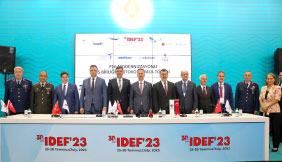
F-16 ÖZGÜR with MURAD Radar Completes GÖKDOĞAN Firing Test​


TÜBİTAK’s 2025 activity report included that F-16 with ÖZGÜR modernisation package and MURAD 100-A AESA radar fired GÖKDOĞAN BVRAAM with radar feed.
TÜBİTAK’s activity report has made the test of GÖKDOĞAN BVRAAM with F-16 ÖZGÜR using the MURAD 100-A AESA radar official. With this test, MURAD 100-A has been demonstrated on two platforms with the capability to support engagements with GÖKDOĞAN BVRAAM: F-16 ÖZGÜR and KIZILELMA unmanned fighter.
Air-to-air engagements at long ranges require midcourse updates from the radar, which makes the integration of GÖKDOĞAN with MURAD 100-A a necessity for the associated platforms.
Beyond the operational scope, the integration also carries significance on the way to GÖKHAN ramjet-powered BVRAAM, which will have its range extended compared to the initial requirements per the deal signed during IDEF2025, intended to become one of the longest ranged BVRAAMs in NATO.
 

Yasar_TR

Experienced member
Staff member
Administrator
Messages
4,270
Reactions
258 22,300
Nation of residence
United Kingdom
Nation of origin
Turkey
If it had been realistic to produce around 160–170 Özgür-II upgrades by 2028/29 and bring the majority of the F-16 fleet up to this standard in a timely manner, there would have been no need for Eurofighters as an interim solution from Qatar, Oman or the UK.
That is not quite correct. F16V70 and “Typhoon Tranche-3 and newer” are not in the same league. Typboons are much more potent fighting machines with better RCS and as air superiority fighter-jets they are miles ahead of the US plane. The only thing that will bridge KAAN to F16s are planes like Typhoons. Just check out @Sanchez ’s post regarding our pilots’ reaction to Qatar’s Typhoons and Rafales when they confronted them with our f16s.

F16 with SABR AN/APG-83 radar is a compromise. It is set up so that it will give F16 an AESA radar to improve on the current system. Same is the case for Murad to a certain degree.
Typhoon can supercruise at 1.5 Mach. It can go as high as 68000ft. Operational altitude is 55000+ft.
ECRS radars are in a different league with over 1600 T/R modules. (Especially the MK2 version with EW)
Twin engines in total can develop 31000lbf dry thrust in war setting for short periods and 27000lbf dry thrust continuous. (F16 can only manage 17700lbf dry thrust)

I can go on and on. But in short they are much more potent planes. We needed them.
KE and Anka-3 would. Not fill in the gap of fire power these planes can provide. Their uses are unique and different.
 

AlperTunga

Committed member
Messages
244
Reactions
5 324
Nation of residence
Switzerland
Nation of origin
Turkey
That is not quite correct. F16V70 and “Typhoon Tranche-3 and newer” are not in the same league. Typboons are much more potent fighting machines with better RCS and as air superiority fighter-jets they are miles ahead of the US plane. The only thing that will bridge KAAN to F16s are planes like Typhoons. Just check out @Sanchez ’s post regarding our pilots’ reaction to Qatar’s Typhoons and Rafales when they confronted them with our f16s.

F16 with SABR AN/APG-83 radar is a compromise. It is set up so that it will give F16 an AESA radar to improve on the current system. Same is the case for Murad to a certain degree.
Typhoon can supercruise at 1.5 Mach. It can go as high as 68000ft. Operational altitude is 55000+ft.
ECRS radars are in a different league with over 1600 T/R modules. (Especially the MK2 version with EW)
Twin engines in total can develop 31000lbf dry thrust in war setting for short periods and 27000lbf dry thrust continuous. (F16 can only manage 17700lbf dry thrust)

I can go on and on. But in short they are much more potent planes. We needed them.
KE and Anka-3 would. Not fill in the gap of fire power these planes can provide. Their uses are unique and different.
That's why I have been saying 20 EFs not sufficient. We need to have at least 40, and with the mighty radar Mk2. That is a beast and in EW capability within top 3 (maybe even the best) in the world. Given all the money we are paying for spare parts, training, infrastructure etc. we should increase the number of jets even though they are very expensive.

Regarding F16 modernization: Given that no structural upgrade needed (or should be left out given time constraints) for 40/50 versions, they just need to install the main computer and radar etc. Per jet, this should be doable in 2 weeks. If two groups of technicians work, then we can modernize at least 50 per year. So by end of 2029, we can realistically have 150 modernized F16. But we'd better hurry up.
 

Khagan1923

Contributor
Messages
1,275
Reactions
25 5,392
Nation of residence
Germany
Nation of origin
Turkey
That's why I have been saying 20 EFs not sufficient. We need to have at least 40, and with the mighty radar Mk2. That is a beast and in EW capability within top 3 (maybe even the best) in the world. Given all the money we are paying for spare parts, training, infrastructure etc. we should increase the number of jets even though they are very expensive.

Regarding F16 modernization: Given that no structural upgrade needed (or should be left out given time constraints) for 40/50 versions, they just need to install the main computer and radar etc. Per jet, this should be doable in 2 weeks. If two groups of technicians work, then we can modernize at least 50 per year. So by end of 2029, we can realistically have 150 modernized F16. But we'd better hurry up.
20 newly built + 20 option, possibly 24 from qatar (though who knows after this stupid war if qatar is willing to still part ways with their jets), possibly 12 from oman (to be modernized).

Thats 56-76 Planes.

If Omani and Qatari EF arrive over the next two years and Özgür 2 mod happens in the same timeframe (2028-2030) we would have on hand

36 Tranche 3A+
150-180 F-16TR

All equipped with AESA radars and cutting edge EW.

Depending on what happens with the F-16 deal and F-35 this number could even grow. (40 F-16 Block 70 + possibly 29 kits for Block 50+ on hand?/ 20-40 F-35?)

Even without anything happening on that front. This should serve as a decent gap until the first wings of Kaan achieve IOC.
 

AlperTunga

Committed member
Messages
244
Reactions
5 324
Nation of residence
Switzerland
Nation of origin
Turkey
20 newly built + 20 option, possibly 24 from qatar (though who knows after this stupid war if qatar is willing to still part ways with their jets), possibly 12 from oman (to be modernized).

Thats 56-76 Planes.

If Omani and Qatari EF arrive over the next two years and Özgür 2 mod happens in the same timeframe (2028-2030) we would have on hand

36 Tranche 3A+
150-180 F-16TR

All equipped with AESA radars and cutting edge EW.

Depending on what happens with the F-16 deal and F-35 this number could even grow. (40 F-16 Block 70 + possibly 29 kits for Block 50+ on hand?/ 20-40 F-35?)

Even without anything happening on that front. This should serve as a decent gap until the first wings of Kaan achieve IOC.
There will be no F16 or F35 deals with US. Israel won't allow this. I am even not sure we can buy the engines for the first batch of KAANs. We still couldn't get the 1.5bn we paid for F35s. I am astonished that there are some people who are optimistic about this. They should rather pray that the US carriers return straight back after Iran war and Trump suddenly does not decide to do one last favor for his buddy Bibi.
 

Pokemonte13

Contributor
Messages
1,163
Reactions
11 2,107
Nation of residence
Germany
Nation of origin
Turkey
There will be no F16 or F35 deals with US. Israel won't allow this. I am even not sure we can buy the engines for the first batch of KAANs. We still couldn't get the 1.5bn we paid for F35s. I am astonished that there are some people who are optimistic about this. They should rather pray that the US carriers return straight back after Iran war and Trump suddenly does not decide to do one last favor for his buddy Bibi.
F16 Deal has more to do with us than them. We want a lot of concession from them and they want a lot of money in return.
 

Sanchez

Experienced member
Moderator
Think Tank Analyst
DefenceHub Diplomat
Messages
4,181
Reactions
125 19,013
Nation of residence
Turkey
Nation of origin
Turkey
If it had been realistic to produce around 160–170 Özgür-II upgrades by 2028/29 and bring the majority of the F-16 fleet up to this standard in a timely manner, there would have been no need for Eurofighters as an interim solution from Qatar, Oman or the UK.
Two points. I don't expect those timelines, they will push through 2030s. Further, Özgür-1-2 are huge mod packages; each aircraft will spend at least 2 months at TAI. Air force is already strapped for jets and to meet the very heavy timelines of Özgür they set out also means pulling frontline fighters from service to modernize them. Air force wants to keep the number of airframes that will be tied to mod packages as low as possible, but it also wants to finish the mod package as soon as possible.

Özgürs will be potent fighters and will handle many duties well into 2050s, but they won't be our frontline fighters starting from 2030s. F-16 is a beast, it has done everything we asked of it over the last 35 years, but it is simply too small. F-16 will never be able to unlock the full potential of Murad-100 or FEWS for example. Same applies in our region. 5 years ago F-16 was the most modern and potent fighter Greece had, by 2030 it will be 3rd after F-35 and Rafale. Same for Egypt. It used to be the best they had, now it's second to Rafale. Same for UAE, who's getting Rafales. We also need a high performance, high flying, fast twin engine jet as a stopgap. EF is that.
 

Saithan

Experienced member
Moderator
Denmark Correspondent
DefenceHub Diplomat
Messages
9,843
Reactions
65 21,982
Nation of residence
Denmark
Nation of origin
Turkey
I still think we need a jet like F16 a workhorse, but the past few years has shown us that drones and low cost tech in massive numbers is a problem. So if the take off price of workhorses like F16 could be reduced it might still be very useful.

Also I've said it once before, but we need 400-500+ combat jets in Türkiye. Including trainerjet
 

Follow us on social media

Top Bottom