• Forum restore complete (see latest announcement thread)

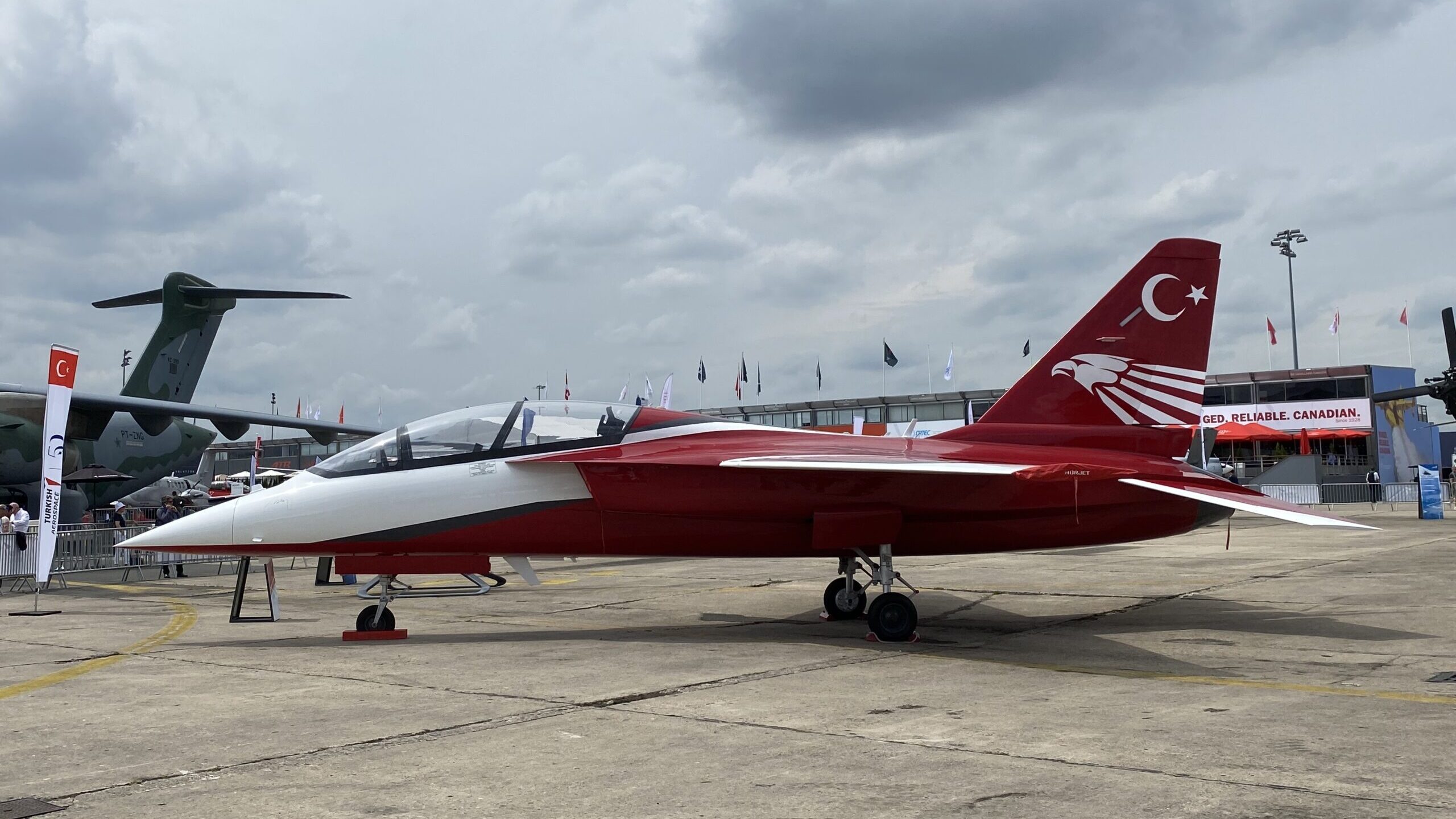
TR HÜRJET-Advanced Jet Trainer/ Light attack aircraft

Fatman17

Experienced member
Moderator
Defence News Editor
Pakistan Moderator
Messages
1,771
Reactions
13 1,629
Nation of residence
Pakistan
Nation of origin
Pakistan
BEIRUT — Turkish Aerospace (TA) is developing a maritime version of its light attack and trainer aircraft Hurjet, as the company eyes increased exports to NATO countries.

“We have recently started work on a navalized version of HÜRJET,” TA CEO Mehmet Demiroglu said at a Turkish naval expo today, according to a transcript the firm provided to Breaking Defense. “It is still too early to define exactly what the aircraft will look like. Maritime operating conditions are significantly more demanding than land-based operations, and the aircraft will also need a more powerful engine.”

He added that TA has been in discussions with the UK for its trainer procurement program for nearly a year now. “We will continue to do everything required on our side as the process moves forward,” Demiroglu said.
 

dBSPL

Experienced member
Think Tank Analyst
DefenceHub Ambassador
Messages
2,865
Reactions
123 14,486
Nation of residence
Turkey
Nation of origin
Turkey
BEIRUT — Turkish Aerospace (TA) is developing a maritime version of its light attack and trainer aircraft Hurjet, as the company eyes increased exports to NATO countries.

“We have recently started work on a navalized version of HÜRJET,” TA CEO Mehmet Demiroglu said at a Turkish naval expo today, according to a transcript the firm provided to Breaking Defense. “It is still too early to define exactly what the aircraft will look like. Maritime operating conditions are significantly more demanding than land-based operations, and the aircraft will also need a more powerful engine.”

He added that TA has been in discussions with the UK for its trainer procurement program for nearly a year now. “We will continue to do everything required on our side as the process moves forward,” Demiroglu said.
He also said, "Our work on this has been ongoing for quite some time. Now it's becoming even clearer. As our aircraft carrier takes shape, the needs will also be defined. This is a long-term project. And I can say from now on that it will be a completely different platform, different from HÜRJET. You will see that it will be different from HÜRJET. Because the requirements are different." https://bigpara.hurriyet.com.tr/hab...dan-ihalara-yerli-ve-milli-beyin_ID102236610/

The phrase "a completely different aircraft is coming" may indicate that not just adapting a standard land-based aircraft to an aircraft carrier with just a "modification" or "addition" (hook attachment, wing folding, etc.), but rather that the aircraft's fundamental engineering, aerodynamics, and structural architecture are being redesigned from scratch or with very significant changes in some parts.

The first thing that comes to mind is that the fuselage skeleton, main support beams, and landing gear will be completely redesigned from scratch, becoming much thicker, heavier, and shock-absorbing. A change in the strength architecture to accommodate the instantaneous load on the nose during launch and on the tail during stopping is also a key expectation.

Another, more likely possibility, is a switch to a higher-thrust engine class. The F414-400 and EJ-200 are the first that come to mind. Since a twin-engine conversion would require a complete redesign of the main fuselage structure and fuel system, the expectation is that this new aircraft will likely remain single-engined. In any case, since the aircraft will have a STOBAR design, sudden and rapid thrust at sea level will be must. A transition to an engine capable of producing high thrust is necessary.

Although the F414 is an evolved version of the F404, and even stands out with its ready-to-marine variant, the air intakes and silhouette will be revised due to engine tunnel constraints. In this case, the air intakes will have to be largely revised, which can be somewhat related to Demiroğlu's statement that "it will be a completely different platform" to the changing silhouette of the aircraft. While the aircraft will never have an internal weapons bay due to volumetric constraints, it will have combat capabilities of a combat or at least naval-based MUM-T type. Therefore, with the experience of the KAAN project, the Hürjet-D is a more optimized RCS target, and I believe that new generation coating technologies similar to KAAN are among the main expectations. Frankly, what I'm most curious about is the tail structure. The aircraft's composite density will likely increase significantly. And higher corrosion resistance, which is among the standard naval requirements, will also be targeted. Although not a strict requirement, work is certainly being done on folding wings as well.

With a silhouette that is sharper to a certain extent... And perhaps we will see a thicker Hürjet. The weight penalty will be offset by higher thrust, a higher composite ratio, a single-pilot cockpit, and increased wing lift.

 

Anmdt

Experienced member
Naval Specialist
Professional
Messages
5,791
Solutions
2
Reactions
145 26,821
Nation of residence
Turkey
Nation of origin
Turkey
There are two obstacles ahead for a naval-class jet aircraft:
1- Catapult
2- National engine

In the case of the engine you mentioned, there is a clear deficiency.
A navalized, corrosion-resistant, and sea salt-resistant design.
This requires a metallurgical-level redesign of the engine.
You cannot reduce the power of a TF-10000 or TF-35000 with a few modifications and navalize it.
All these design differences prolong the design process.

Without a catapult, you cannot use a navalized Hürjet at maximum power with a STOBAR aircraft carrier. Because the aircraft cannot take off with maximum load to accelerate during takeoff.

Naval-grade turbofan engines operating on aircraft carriers (especially CATOBAR and STOBAR systems) undergo specialized engineering modifications to survive three brutal factors: extreme salt-water corrosion, massive structural shock during landings, and aerodynamic instability during catapult launches. [1]
Unlike land-based airframe engines, these powerplants prioritize structural survival and rapid thermal-aerodynamic recovery over pure weight reduction.


1. Metallurgical & Anti-Corrosion Modifications
The marine environment triggers rapid hot corrosion (sulfidation) and galvanic corrosion due to high salt concentrations and humidity.
  • Advanced Superalloys: Multi-crystal and single-crystal nickel-based superalloys (like René N5 or CMSX-4) are heavily utilized in the high-pressure turbine stages to resist the chemical attack of sodium chloride mixed with sulfur in fuel.
  • Thermal Barrier & Chemical Coatings platinum-Aluminide or Yttria-Stabilized Zirconia (YSZ). These coatings form an impermeable ceramic barrier against vaporized sea salt.
  • Sacrificial Anodes & Seals: Internal galvanic isolation zones and specialized synthetic rubber/carbon seals are added around bearing compartments to prevent saltwater intrusion when the aircraft is parked on a humid, windy flight deck.

2. Structural Reinforcement for Extreme G-Shock
A carrier landing (arrested recovery) is essentially a controlled crash. The aircraft decelerates from ~240 km/h to zero in about two seconds, subjecting the engine to severe axial and vertical shock profiles up to 4.5G to 5G. [1]
  • Ruggedized Engine Mounts: The structural lugs and thrust mounts connecting the engine casing to the aircraft fuselage are heavily reinforced with thickened titanium or high-strength steel forgings to prevent the engine from tearing forward during deceleration.
  • Shaft & Bearing Deflection Resistance: Standard jet engines experience "case deflection" under high G-loads, causing the spinning rotor blades to rub against the outer casing. Naval engines use shortened, thicker main shafts, heavy-duty duplex ball/roller bearings, and stiffer engine casings to prevent catastrophic blade-to-case rubs.
  • Abradable Liners: The internal casing walls utilize thicker, soft abradable coatings. If G-forces cause a minor rotor deflection, the blade tips safely carve a groove into the coating without fracturing. [1]

3. Aerodynamic Stability Modifications for Catapult Launches
During a CATOBAR launch, the aircraft accelerates from zero to flying speed in under 3 seconds. The massive g-force combined with turbulent crosswinds whipping across the carrier deck drastically distorts the airflow entering the engine intake.
  • Expanded Stall/Surge Margins: To prevent the engine from suffocating and stalling (compressor stall) at the exact moment of launch, the compressor blades feature modified aerodynamic geometries. This design sacrifices a small percentage of peak efficiency to secure a wider operational buffer.
  • Naval FADEC Logic: The Full Authority Digital Engine Control (FADEC) software contains dedicated carrier-launch algorithms. When the system detects a catapult sequence, it alters variable stator vane (VSV) angles and adjusts fuel schedules instantly to prevent pressure spikes from choking the engine.

View attachment 82254

These are the technical aspects of a carrier based jet fighter, there is more to that in terms of operation and upkeeping.

Sets of procedures for deck operations, flight preparation, and safety that will be fine tuned through failures.
Maintenance of the aircraft will have to be done on the ship, this also covers beyond the minimal maintenance as far as i know. Also requires training of the new technicians in a whole different environment.
Munition handling, it is easy on the land, it will follow whole new set of procedures.
Training, we know a lot for the land based procedures a sea training is something else.
Structure of command and hierarchy. We will need to set something proper to handle the extensive flight wing, a hard transition for navies like ours with decades of solid traditions where the flight wing often seen as appendages of the platform, now it gains the main role.
 

Anmdt

Experienced member
Naval Specialist
Professional
Messages
5,791
Solutions
2
Reactions
145 26,821
Nation of residence
Turkey
Nation of origin
Turkey
He also said, "Our work on this has been ongoing for quite some time. Now it's becoming even clearer. As our aircraft carrier takes shape, the needs will also be defined. This is a long-term project. And I can say from now on that it will be a completely different platform, different from HÜRJET. You will see that it will be different from HÜRJET. Because the requirements are different." https://bigpara.hurriyet.com.tr/hab...dan-ihalara-yerli-ve-milli-beyin_ID102236610/

The phrase "a completely different aircraft is coming" may indicate that not just adapting a standard land-based aircraft to an aircraft carrier with just a "modification" or "addition" (hook attachment, wing folding, etc.), but rather that the aircraft's fundamental engineering, aerodynamics, and structural architecture are being redesigned from scratch or with very significant changes in some parts.

The first thing that comes to mind is that the fuselage skeleton, main support beams, and landing gear will be completely redesigned from scratch, becoming much thicker, heavier, and shock-absorbing. A change in the strength architecture to accommodate the instantaneous load on the nose during launch and on the tail during stopping is also a key expectation.

Another, more likely possibility, is a switch to a higher-thrust engine class. The F414-400 and EJ-200 are the first that come to mind. Since a twin-engine conversion would require a complete redesign of the main fuselage structure and fuel system, the expectation is that this new aircraft will likely remain single-engined. In any case, since the aircraft will have a STOBAR design, sudden and rapid thrust at sea level will be must. A transition to an engine capable of producing high thrust is necessary.

Although the F414 is an evolved version of the F404, and even stands out with its ready-to-marine variant, the air intakes and silhouette will be revised due to engine tunnel constraints. In this case, the air intakes will have to be largely revised, which can be somewhat related to Demiroğlu's statement that "it will be a completely different platform" to the changing silhouette of the aircraft. While the aircraft will never have an internal weapons bay due to volumetric constraints, it will have combat capabilities of a combat or at least naval-based MUM-T type. Therefore, with the experience of the KAAN project, the Hürjet-D is a more optimized RCS target, and I believe that new generation coating technologies similar to KAAN are among the main expectations. Frankly, what I'm most curious about is the tail structure. The aircraft's composite density will likely increase significantly. And higher corrosion resistance, which is among the standard naval requirements, will also be targeted. Although not a strict requirement, work is certainly being done on folding wings as well.

With a silhouette that is sharper to a certain extent... And perhaps we will see a thicker Hürjet. The weight penalty will be offset by higher thrust, a higher composite ratio, a single-pilot cockpit, and increased wing lift.
imo he is referring to dual engines, as the aircraft needing more power to function.
 
Top Bottom