
Latest Thread
- Bangladesh Seoul welcomes Dhaka's interest in strengthening defence ties
- Bangladesh Modernise armed forces, replace outdated machinery: Parliamentary body
- Piercing the illusion of the 'Indian Century', the Indian economy shows a fragile background
- Kyrgyzstan rejects European proposal to accept migrants
- Russia Project 885M nuclear-powered submarine *Novosibirsk* strikes a target at a range of 1,200 km with a Kalibr missile.
You are using an out of date browser. It may not display this or other websites correctly.
You should upgrade or use an alternative browser.
You should upgrade or use an alternative browser.
TR Industry, Science and Technology
- Thread starter Cabatli_TR
- Start date


That is one of the main reasons why the population around the world is going down, getting rid of it will support population growth.Then there won't be any more Porn Videos as Stream on your Smartphone
A
Ahlatshah
Guest
I will not argue who had fault about these issues, but at the end of the day we couldnt hold on to the followings as a nation:
#Aselsan and #TürkTelekom are developing a 6G-compatible #Securephone.
The agreement between Türk Telekom and ASELSAN targets both the civilian consumer market (B2C) and the public sector (B2B). However, since the project only officially launched on May 18, 2026, exact specifications (such as processor type, RAM size, or camera megapixels) have not yet been released to the public.
The current status regarding sales and technical specifications is as follows:
* Broad market launch via Türk Telekom: As Türk Telekom is the driving force behind commercial distribution, the new smartphones will be available to regular consumers. Distribution is planned via Türk Telekom's online channels and physical stores.
* Financing options: As is common with other brands, the device is expected to be offered to end users in Turkey with convenient installment plans linked to the monthly mobile phone bill.
* Initial phase for the public sector: Although end users will be able to purchase the devices, the first production wave is expected to be delivered to ministries, military personnel, police, and operators of critical infrastructure, as the need for secure devices is most urgent there.
## Known core technical components & standards
Although exact model names are still pending, the technical guidelines of the ASELSAN specifications are already defined:
* Connectivity: Full support for 5G and an integrated hardware architecture that can be upgraded directly to the upcoming 6G standard via software updates.
* Processor & AI: Integration of a dedicated NPU (Neural Processing Unit) to perform advanced on-device AI applications (such as offline translations or hardware-encrypted voice assistants) without relying on external cloud queries.
* Security Chip (Secure Element): A physically isolated crypto chip on the motherboard, developed by ASELSAN, stores passwords, biometric data, and encryption keys separately from the main processor to block hardware spyware.
* Operating System & Software: A modified and hardened Android base (or a completely custom user interface) that is free of Google or third-party trackers that typically send data to servers abroad.
* Network Compatibility: The devices are technologically optimized for the Open RAN networks of Türk Telekom subsidiaries Netsia and Argela, ensuring improved reception and battery life on the Turkish mobile network.
Once the partners reveal the first prototype specifications, we will know more about the display and cameras.
Although details of the project have not yet been confirmed, some rumors are circulating in this way.
- Vecihi Hürkuş: Vecihi K14 and many more
- Nuri Demirağ: Nu. D 36 and Nu.D 38 planes
- THK, Etimesgut Aircraft Production facilities: THK 5 (export success, to Denmark), THK 16
- Tulomsaş: Devrim Automobile (1961, 6 years before foundation of Hyundai)
- Koc Otosan: Anadol (It was actually made of Fiberglass. There are a lot of people who still believe to the slander that donkeys and cows eat the bonnet because it was made of straw!)
- Aselsan: 1919 and 1920 Mobile phones
The list can be expanded of course.
None of them were perfect products. But each of them could have been the foundation of a something great with support as years passed by. And we have been paying those mistakes dearly. Billions of dollars are going to abroad, for limiting imports (and other reasons of course), we are paying heavy taxes specifically for phones and cars, because we cannot produce.
That is why TOGG is very important. The success of this phone enterprise is also vital. Noone could ask to ordinary people to get inferior phone for the same price with hard earned money, just sake of support. That is because I hope this phone's price, specifications and cameras are able to compete with other companies' equivalent products of price ranges.
I also hope that those who constantly disparage and belittle everything produced in our country, even if they do not offer their support, just remain silent rather than influencing public perception negatively, just one time...

"We don't have any OLED or LCD manufacturers," they say. And I say, if Türkiye can produce military-grade AMOLED screens, it can also produce a civilian version if it wants to.

 www.aa.com.tr
Karabük Üniversitesi, askeri amaçlı yüksek çözünürlüklü yerli ve milli ekran teknolojisi üretecek
Karabük Üniversitesi ve ASELSAN işbirliğiyle yürütülen proje kapsamında, askeri alanda kullanılacak Türkiye'nin yüksek çözünürlüklü ilk ekran teknolojisinin prototip haline getirilmesi ve seri üretime geçilmesi hedefleniyor. | Anadolu Ajansı
mehmed beg
Contributor


What's is going down? Yesterday in London, I was sitting in front of a mosque. One Somali women passed with 7 kids than another a minute later with 4 .That is one of the main reasons why the population around the world is going down, getting rid of it will support population growth.
" Geniuses" are multiplying like never before. It is only that the clever ones are not.
So when I hear the words like Ummah or Muslim unity , I want to vomit.
Oh , I can't wait to buy Aselsan phone


Mükemmel / PerfectChip development

Empa-YONGATEK Alliance: Ushering Domestic Chips into Smart Devices
A new era begins in Turkey's smart device and domestic chip ecosystem. Discover the details of the Empa 2.0 vision and the strategic technology network established with YONGATEK.
 www.yuzde100yerli.com
found this article too. I'm so glad and I will buy a device using Yongatek chip as soon as I can when I go to Türkiye. Just to have it. (hope it's small enough to be packed in a luggage
 )
)That is the problem of UK, not a worry for anyone else.What's is going down? Yesterday in London, I was sitting in front of a mosque. One Somali women passed with 7 kids than another a minute later with 4 .
" Geniuses" are multiplying like never before. It is only that the clever ones are not.
So when I hear the words like Ummah or Muslim unity , I want to vomit.
Oh , I can't wait to buy Aselsan phone
The UK enjoyed colonial power and they have to pay back.
And your look towards muslims is disgusting.
A
Ahlatshah
Guest
Actually, there is a company in Amasya which produces LED screens: TAGLIG. They are even exporting products more than whopping 70+ countries."We don't have any OLED or LCD manufacturers," they say. And I say, if Türkiye can produce military-grade AMOLED screens, it can also produce a civilian version if it wants to.
Karabük Üniversitesi, askeri amaçlı yüksek çözünürlüklü yerli ve milli ekran teknolojisi üretecek
Karabük Üniversitesi ve ASELSAN işbirliğiyle yürütülen proje kapsamında, askeri alanda kullanılacak Türkiye'nin yüksek çözünürlüklü ilk ekran teknolojisinin prototip haline getirilmesi ve seri üretime geçilmesi hedefleniyor. | Anadolu Ajansı
With support and collaboration, so why not?
"As Taglig, the LED screens we produce using the latest technologies stand out with their modern designs, superior image quality, and long-lasting durability. With our customer-centric approach, we continuously improve our products and strive to maintain the highest level of customer satisfaction. Taglig LED Screen Panels currently export to over 70 countries and have a strong dealership network worldwide. "

TAGLIG - LED Screen & LED Panel Manufacturer
As TAGLIG, we offer high-quality indoor and outdoor LED screen solutions to many countries worldwide. 📞 Contact us at +90 (212) 276 41 00 - [email protected]
 taglig.com
mehmed beg
Contributor
Oh the same old story?That is the problem of UK, not a worry for anyone else.
The UK enjoyed colonial power and they have to pay back.
And your look towards muslims is disgusting.
"We don't have any OLED or LCD manufacturers," they say. And I say, if Türkiye can produce military-grade AMOLED screens, it can also produce a civilian version if it wants to.
Karabük Üniversitesi, askeri amaçlı yüksek çözünürlüklü yerli ve milli ekran teknolojisi üretecek
Karabük Üniversitesi ve ASELSAN işbirliğiyle yürütülen proje kapsamında, askeri alanda kullanılacak Türkiye'nin yüksek çözünürlüklü ilk ekran teknolojisinin prototip haline getirilmesi ve seri üretime geçilmesi hedefleniyor. | Anadolu Ajansı
Here we were discussing AMOLED screen technologies. However, we have even more advanced QLED screen technologies. And an academic paper on the subject was published this year.View attachment 64038
Turkish researchers will bring high image quality to digital displays with "nanocrystals"

Türk araştırmacılar dijital ekranları "nanokristallerle" yüksek görüntü kalitesine kavuşturacak
ODTÜ'lü bilim insanları, zengin renk ve görüntü kalitesine sahip yeni nesil dijital ekran teknolojilerinin geliştirilmesi için "inorganik nanokristal" tabanlı malzemeler üretiyor. - Anadolu Ajansıwww.aa.com.tr
Performance boost in QLEDs using octanethiol-capped core/shell/shell quantum dots
I was a bit curious so I tried searching for info on our domestic semiconductor marked and got this.

 www.mordorintelligence.com
Turkey Semiconductor Market Size and Share
*Disclaimer: Major Players sorted in no particular order
Turkey Semiconductor Market Analysis by Mordor Intelligence
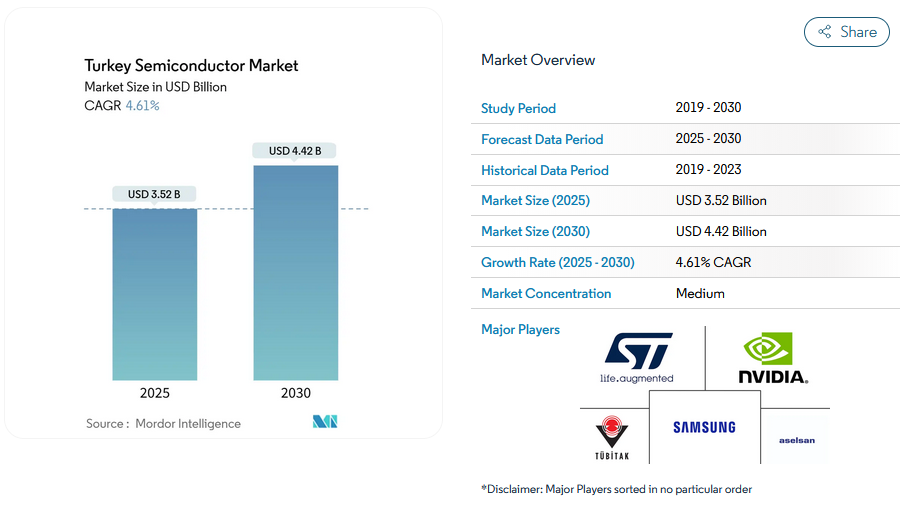
The Turkey semiconductor market size stood at USD 3.52 billion in 2025 and is forecast to reach USD 4.42 billion by 2030, reflecting a 4.61% CAGR over the period. Geopolitical supply-chain diversification under the EU Chips Act, generous domestic incentives, and a customs-union bridge to Europe are positioning the country as a preferred near-shoring destination for chip manufacturing. Government programs allocate USD 5 billion in investment support, while Horizon Europe unlocks EUR 4.175 billion in potential R&D funding, tightening the link between Turkish fabs and European demand. [1] Rapid electric-vehicle (EV) adoption, 5G rollout plans, and expanding defense-electronics programs are multiplying local chip requirements across power management, RF, and sensor categories. International automakers and telecom vendors are accelerating joint ventures to leverage Turkey’s cost advantages and tariff-free EU access. Meanwhile, medium-node fabrication limits and export-control headwinds temper near-term upside by constraining sub-10 nm capacity and equipment availability.
Key Report Takeaways
By device type, integrated circuits held an 85.2% share of the Turkey semiconductor market size in 2024, while sensors and MEMS are advancing at a 6.3% CAGR through 2030.
By business model, IDM players accounted for 60.3% of the Turkey semiconductor market share in 2024; design and fabless vendors are expanding at a 5.6% CAGR to 2030.
By end-user industry, automotive commanded 27.81% of the Turkey semiconductor market size in 2024, whereas artificial-intelligence applications are projected to grow at a 6.5% CAGR to 2030.
Turkey Semiconductor Market Trends and Insights
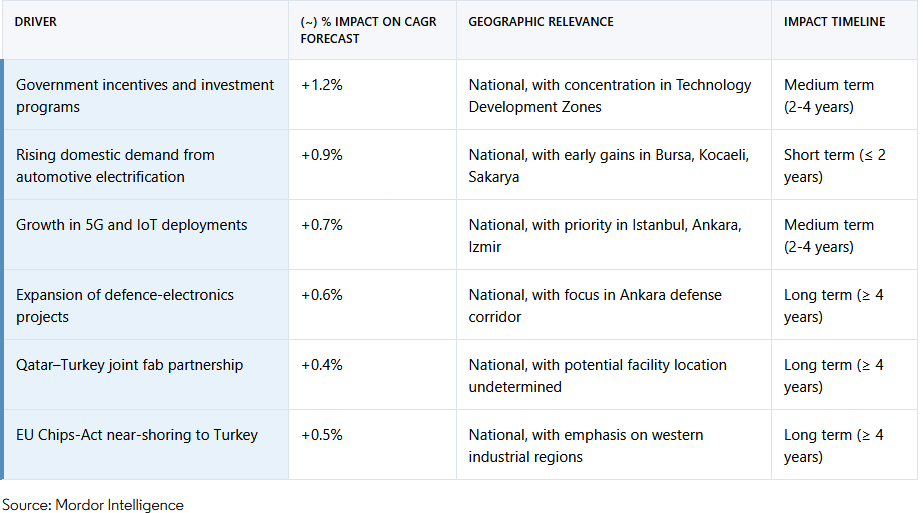
Turkey’s High Technology Investment Program sets aside USD 5 billion exclusively for semiconductor development within a broader USD 30 billion incentive framework, granting tax exemptions for R&D across 101 Technology Development Zones. [2] Rather than direct subsidies, the scheme embeds support in infrastructure and fiscal relief, accelerating fab expansions and attracting startups backed by TÜBİTAK BiGG and the Turcorn program. The state aims to lift its share of global FDI inflows to 1.5% by 2028 through these measures. Early evidence shows an uptick in seed-round deal values for local chip design ventures that co-locate near university clusters. Sustaining the driver depends on maintaining macro-economic stability that reassures foreign partners about long-term asset safety.
Rising Domestic Demand from Automotive Electrification
EV sales overtook diesel models in 2024, reaching 99,849 units and 10.1% domestic share, a turning point that multiplies semiconductor content per vehicle. Chinese automaker BYD committed USD 1 billion to a 150,000-unit annual plant, exploiting Turkey’s customs-union status for tariff-free EU exports. Chery Automobile followed with a USD 1.5 billion plan for 200,000 units, cementing a regional EV hub. This inflow forces Tier-1 suppliers to localize advanced power-management ICs, high-voltage SiC devices, and battery-monitoring microcontrollers. The automotive cluster, exporting 70% of output to Western Europe, now retools for electronic architectures, expanding domestic test-handling and back-end assembly capacity.
Growth in 5G and IoT Deployments
Authorities will auction 5G spectrum in August 2025, propelling demand for RF front-ends, base-station SoCs, and edge AI accelerators. Ericsson and Türk Telekom’s 6G research‐sharing pact widens the pipeline for telecom-grade semiconductors adapted to local operating bands. Turkey’s ICT market rose from USD 15 billion in 2021 to USD 25 billion in 2023, reflecting widespread digitalization. A USD 5 billion earmark for 5G infrastructure includes localization quotas that favor domestically designed chipsets. Parallel industrial IoT rollouts, such as ULAQ-TÜRKSAT private 5G networks, lift sensor and secure-element volumes for shipyards, ports, and smart-factory projects.
Expansion of Defence-Electronics Projects
ASELSAN spent USD 329 million—7% of revenue—on R&D in 2024, focusing on gallium-nitride AESA radar chips and infrared detector arrays. Defense programs covering UAV avionics, secure communications, and naval fire-control systems increasingly rely on locally fabricated mixed-signal ASICs to avoid export controls. Havelsan’s simulation suites and Turkish Aerospace’s Kaan fighter advance the demand for high-temperature, radiation-hardened semiconductors. Export growth in defense electronics underpins volume scaling: ASELSAN targets a top-30 global ranking by 2030, widening its supplier ecosystem for RF MMICs and power modules.
Restraints Impact Analysis
Limited Advanced-Node Manufacturing Capability
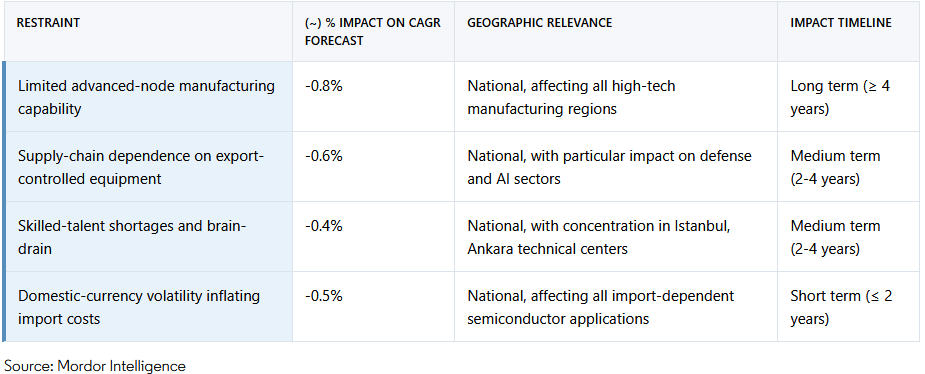
Domestic production remains stuck above 28 nm; TÜBİTAK’s 250 nm line and the planned Qatar-Turkey 110/65 nm fab trail global leaders by several generations. [3] AI accelerators and 5G chipsets developed locally must therefore tape-out at overseas foundries, raising lead-times and currency-risk-adjusted costs. Participation in EU Chips Act projects could accelerate technology transfer, but doing so requires strict IP-sovereignty compliance that may clash with existing Sino-Turkish alliances. The capability gap constrains the Turkey semiconductor market when bidding for sub-10 nm automotive ADAS or data-center ASIC mandates and slows the diffusion of advanced lithography skills.
Supply-Chain Dependence on Export-Controlled Equipment
U.S. BIS rules issued in December 2024 curtail Turkey’s access to advanced lithography tools, high-bandwidth-memory IP, and specialized EDA software if U.S.origin content exceeds de-minimis levels. The Foreign Direct Product regime complicates servicing of older Chinese equipment, forcing maintenance delays and component cannibalization. Compliance burdens weigh especially on defense and AI vendors that need dual-use items, resulting in longer prototyping cycles and inflated BOM costs. ASELSAN’s workaround—developing ASELFLIR-500 after a camera embargo—illustrates resilience but also the expense of substituting restricted imports.
Segment Analysis
By Device Type: Integrated Circuits Drive Market Consolidation
Integrated circuits accounted for 85.2% of Turkey's semiconductor market share in 2024, underpinned by automotive microcontrollers, defense RF MMICs, and telecom SoCs. Analog and MCU categories enjoy robust pull from battery management and body-electronics upgrades, while logic and memory benefit from nascent cloud and AI clusters. Discrete power devices remain indispensable for EV traction inverters and renewable-energy converters. Optoelectronics demand centers on LiDAR and night-vision modules for military and industrial automation projects.
Sensors and MEMS, though smaller, are posting a 6.3% CAGR to 2030—the fastest within the Turkey semiconductor market. Industrial IoT modernization pushes factory owners to deploy pressure, magnetic, and accelerometer units tied to edge gateways. The National AI Strategy also calls for localized sensor fusion at the network edge, spawning demand for embedded MEMS packages co-designed with domestic AI processors.
Turkey Semiconductor Market: Market Share by Device Type
Image © Mordor Intelligence. Reuse requires attribution under CC BY 4.0.
Turkey Semiconductor Market: Market Share by Device Type
By Business Model: Design Capabilities Reshape Value Creation
IDM enterprises captured 60.3% of Turkey semiconductor market size in 2024 thanks to vertically integrated leaders such as ASELSAN and the Turkish unit of STMicroelectronics. Their ability to align design, fab, and packaging accelerates time-to-deployment for mission-critical applications. The model’s capital intensity is offset by secure supply; defense contractors prize in-house fabs that bypass export licenses.
Design and fabless outfits are expanding at a 5.6% CAGR to 2030, a sign of the Turkey semiconductor market moving up the value chain into IP creation. Electra IC and HEX Microchip leverage university-linked incubators to tape-out MCU cores and mixed-signal blocks at TSMC and GlobalFoundries. The customs-union accord grants these firms tariff-free shipment of packaged devices into Europe, sharpening cost competitiveness without owning fabs. Their success, however, depends on sustained wafer allocation from overseas partners while domestic node gaps persist.
By End-User Industry: Automotive Electrification Accelerates Demand
Automotive held 27.81% of Turkey semiconductor market size in 2024, anchored by a USD 23.9 billion export engine that now pivots from internal-combustion to electric drivetrains. Every EV carries battery-monitoring ICs, SiC power modules, ADAS processors, and connectivity chipsets—driving per-car semiconductor value far above traditional models. Upcoming BYD and Chery plants will scale local demand for on-board chargers, vehicle-control domain controllers, and solid-state LiDAR driver ASICs.
Artificial-intelligence deployments represent the fastest-growing slice at 6.5% CAGR, supported by the National AI Strategy and emergent data-center projects. Defense AI labs require edge accelerators for drone swarms and autonomous naval craft, while telcos trial 5G Open RAN units powered by AI inference ASICs. Industrial automation adds steady uptake for machine-vision SoCs and predictive-maintenance sensor hubs, integrating domestic AI silicon when available.
Turkey Semiconductor Market: Market Share by End-User Industry
Image © Mordor Intelligence. Reuse requires attribution under CC BY 4.0.
Turkey Semiconductor Market: Market Share by End-User Industry
Geography Analysis
Turkey’s customs-union link to Europe gives fabricators tariff-free access to 450 million consumers, a lure amplified by EU efforts to double regional semiconductor self-sufficiency by 2030. Bursa, Kocaeli, and Sakarya anchor automotive clusters; Ankara houses a defense-electronics corridor, and Istanbul leads in telecom and design services. Horizon Europe grants worth EUR 4.175 billion channel R&D funds into joint projects that tie Turkish fabs to German and French design houses. Meanwhile, proximity to the Middle East and Central Asia offers alternative export corridors, diversifying revenue streams.
Regional fabs benefit from lower energy tariffs and an industrial electricity grid that already powers large white-goods plants. Amazon’s decision to build satellite parts locally signals confidence in advanced-manufacturing reliability, indirectly expanding aerospace-grade semiconductor demand. [4] Currency swings remain a short-term challenge but are partly hedged by revenues denominated in EUR and USD from export contracts.
Competitive Landscape
Global majors—STMicroelectronics, Samsung Electronics, and NVIDIA—supply advanced logic, memory, and GPU accelerators to Turkish OEMs, usually through regional distribution hubs. Indigenous companies such as ASELSAN, TÜBİTAK BİLGEM, and Anka Mikroelektronik specialize in defense and industrial ASICs, leveraging government offsets and export-license exemptions to secure niche positions. Competitive advantage increasingly hinges on application-specific IP rather than wafer volumes. ASELSAN’s GaN-based AESA radar chip, flight-tested on F-16s in July 2025, illustrates home-grown breakthroughs that also feed into export campaigns to Azerbaijan and Gulf allies.
Domestic design houses form consortiums with European research institutes to co-develop RISC-V cores and automotive functional-safety libraries. The rise of such alliances reflects Turkey’s twin strategy: capture value at the design level while courting EU fabs for wafer supply under the Chips Act funding umbrella.
Turkey Semiconductor Industry Leaders
STMicroelectronics International N.V.
Samsung Electronics Co., Ltd.
NVIDIA Corporation
ASELSAN Elektronik Sanayi ve Ticaret A.Ş.
Türkiye Bilimsel ve Teknolojik Araştırma Kurumu (TÜBİTAK) BİLGEM
*Disclaimer: Major Players sorted in no particular order
Source: https://www.mordorintelligence.com/industry-reports/turkey-semiconductor-market
Turkey Semiconductor Market Size, Share, 2025-2030 Outlook
The Turkey Semiconductor Market is expected to reach USD 3.52 billion in 2025 and grow at a CAGR of 4.61% to reach USD 4.42 billion by 2030. STMicroelectronics International N.V., Samsung Electronics Co., Ltd., NVIDIA Corporation, ASELSAN Elektronik Sanayi ve Ticaret A.Ş. and Türkiye Bilimsel ve...
Turkey Semiconductor Market Size and Share
*Disclaimer: Major Players sorted in no particular order
Turkey Semiconductor Market Analysis by Mordor Intelligence
The Turkey semiconductor market size stood at USD 3.52 billion in 2025 and is forecast to reach USD 4.42 billion by 2030, reflecting a 4.61% CAGR over the period. Geopolitical supply-chain diversification under the EU Chips Act, generous domestic incentives, and a customs-union bridge to Europe are positioning the country as a preferred near-shoring destination for chip manufacturing. Government programs allocate USD 5 billion in investment support, while Horizon Europe unlocks EUR 4.175 billion in potential R&D funding, tightening the link between Turkish fabs and European demand. [1] Rapid electric-vehicle (EV) adoption, 5G rollout plans, and expanding defense-electronics programs are multiplying local chip requirements across power management, RF, and sensor categories. International automakers and telecom vendors are accelerating joint ventures to leverage Turkey’s cost advantages and tariff-free EU access. Meanwhile, medium-node fabrication limits and export-control headwinds temper near-term upside by constraining sub-10 nm capacity and equipment availability.
Key Report Takeaways
By device type, integrated circuits held an 85.2% share of the Turkey semiconductor market size in 2024, while sensors and MEMS are advancing at a 6.3% CAGR through 2030.
By business model, IDM players accounted for 60.3% of the Turkey semiconductor market share in 2024; design and fabless vendors are expanding at a 5.6% CAGR to 2030.
By end-user industry, automotive commanded 27.81% of the Turkey semiconductor market size in 2024, whereas artificial-intelligence applications are projected to grow at a 6.5% CAGR to 2030.
Turkey Semiconductor Market Trends and Insights
Turkey’s High Technology Investment Program sets aside USD 5 billion exclusively for semiconductor development within a broader USD 30 billion incentive framework, granting tax exemptions for R&D across 101 Technology Development Zones. [2] Rather than direct subsidies, the scheme embeds support in infrastructure and fiscal relief, accelerating fab expansions and attracting startups backed by TÜBİTAK BiGG and the Turcorn program. The state aims to lift its share of global FDI inflows to 1.5% by 2028 through these measures. Early evidence shows an uptick in seed-round deal values for local chip design ventures that co-locate near university clusters. Sustaining the driver depends on maintaining macro-economic stability that reassures foreign partners about long-term asset safety.
Rising Domestic Demand from Automotive Electrification
EV sales overtook diesel models in 2024, reaching 99,849 units and 10.1% domestic share, a turning point that multiplies semiconductor content per vehicle. Chinese automaker BYD committed USD 1 billion to a 150,000-unit annual plant, exploiting Turkey’s customs-union status for tariff-free EU exports. Chery Automobile followed with a USD 1.5 billion plan for 200,000 units, cementing a regional EV hub. This inflow forces Tier-1 suppliers to localize advanced power-management ICs, high-voltage SiC devices, and battery-monitoring microcontrollers. The automotive cluster, exporting 70% of output to Western Europe, now retools for electronic architectures, expanding domestic test-handling and back-end assembly capacity.
Growth in 5G and IoT Deployments
Authorities will auction 5G spectrum in August 2025, propelling demand for RF front-ends, base-station SoCs, and edge AI accelerators. Ericsson and Türk Telekom’s 6G research‐sharing pact widens the pipeline for telecom-grade semiconductors adapted to local operating bands. Turkey’s ICT market rose from USD 15 billion in 2021 to USD 25 billion in 2023, reflecting widespread digitalization. A USD 5 billion earmark for 5G infrastructure includes localization quotas that favor domestically designed chipsets. Parallel industrial IoT rollouts, such as ULAQ-TÜRKSAT private 5G networks, lift sensor and secure-element volumes for shipyards, ports, and smart-factory projects.
Expansion of Defence-Electronics Projects
ASELSAN spent USD 329 million—7% of revenue—on R&D in 2024, focusing on gallium-nitride AESA radar chips and infrared detector arrays. Defense programs covering UAV avionics, secure communications, and naval fire-control systems increasingly rely on locally fabricated mixed-signal ASICs to avoid export controls. Havelsan’s simulation suites and Turkish Aerospace’s Kaan fighter advance the demand for high-temperature, radiation-hardened semiconductors. Export growth in defense electronics underpins volume scaling: ASELSAN targets a top-30 global ranking by 2030, widening its supplier ecosystem for RF MMICs and power modules.
Restraints Impact Analysis
Limited Advanced-Node Manufacturing Capability
Domestic production remains stuck above 28 nm; TÜBİTAK’s 250 nm line and the planned Qatar-Turkey 110/65 nm fab trail global leaders by several generations. [3] AI accelerators and 5G chipsets developed locally must therefore tape-out at overseas foundries, raising lead-times and currency-risk-adjusted costs. Participation in EU Chips Act projects could accelerate technology transfer, but doing so requires strict IP-sovereignty compliance that may clash with existing Sino-Turkish alliances. The capability gap constrains the Turkey semiconductor market when bidding for sub-10 nm automotive ADAS or data-center ASIC mandates and slows the diffusion of advanced lithography skills.
Supply-Chain Dependence on Export-Controlled Equipment
U.S. BIS rules issued in December 2024 curtail Turkey’s access to advanced lithography tools, high-bandwidth-memory IP, and specialized EDA software if U.S.origin content exceeds de-minimis levels. The Foreign Direct Product regime complicates servicing of older Chinese equipment, forcing maintenance delays and component cannibalization. Compliance burdens weigh especially on defense and AI vendors that need dual-use items, resulting in longer prototyping cycles and inflated BOM costs. ASELSAN’s workaround—developing ASELFLIR-500 after a camera embargo—illustrates resilience but also the expense of substituting restricted imports.
Segment Analysis
By Device Type: Integrated Circuits Drive Market Consolidation
Integrated circuits accounted for 85.2% of Turkey's semiconductor market share in 2024, underpinned by automotive microcontrollers, defense RF MMICs, and telecom SoCs. Analog and MCU categories enjoy robust pull from battery management and body-electronics upgrades, while logic and memory benefit from nascent cloud and AI clusters. Discrete power devices remain indispensable for EV traction inverters and renewable-energy converters. Optoelectronics demand centers on LiDAR and night-vision modules for military and industrial automation projects.
Sensors and MEMS, though smaller, are posting a 6.3% CAGR to 2030—the fastest within the Turkey semiconductor market. Industrial IoT modernization pushes factory owners to deploy pressure, magnetic, and accelerometer units tied to edge gateways. The National AI Strategy also calls for localized sensor fusion at the network edge, spawning demand for embedded MEMS packages co-designed with domestic AI processors.
Turkey Semiconductor Market: Market Share by Device Type
Image © Mordor Intelligence. Reuse requires attribution under CC BY 4.0.
Turkey Semiconductor Market: Market Share by Device Type
By Business Model: Design Capabilities Reshape Value Creation
IDM enterprises captured 60.3% of Turkey semiconductor market size in 2024 thanks to vertically integrated leaders such as ASELSAN and the Turkish unit of STMicroelectronics. Their ability to align design, fab, and packaging accelerates time-to-deployment for mission-critical applications. The model’s capital intensity is offset by secure supply; defense contractors prize in-house fabs that bypass export licenses.
Design and fabless outfits are expanding at a 5.6% CAGR to 2030, a sign of the Turkey semiconductor market moving up the value chain into IP creation. Electra IC and HEX Microchip leverage university-linked incubators to tape-out MCU cores and mixed-signal blocks at TSMC and GlobalFoundries. The customs-union accord grants these firms tariff-free shipment of packaged devices into Europe, sharpening cost competitiveness without owning fabs. Their success, however, depends on sustained wafer allocation from overseas partners while domestic node gaps persist.
By End-User Industry: Automotive Electrification Accelerates Demand
Automotive held 27.81% of Turkey semiconductor market size in 2024, anchored by a USD 23.9 billion export engine that now pivots from internal-combustion to electric drivetrains. Every EV carries battery-monitoring ICs, SiC power modules, ADAS processors, and connectivity chipsets—driving per-car semiconductor value far above traditional models. Upcoming BYD and Chery plants will scale local demand for on-board chargers, vehicle-control domain controllers, and solid-state LiDAR driver ASICs.
Artificial-intelligence deployments represent the fastest-growing slice at 6.5% CAGR, supported by the National AI Strategy and emergent data-center projects. Defense AI labs require edge accelerators for drone swarms and autonomous naval craft, while telcos trial 5G Open RAN units powered by AI inference ASICs. Industrial automation adds steady uptake for machine-vision SoCs and predictive-maintenance sensor hubs, integrating domestic AI silicon when available.
Turkey Semiconductor Market: Market Share by End-User Industry
Image © Mordor Intelligence. Reuse requires attribution under CC BY 4.0.
Turkey Semiconductor Market: Market Share by End-User Industry
Geography Analysis
Turkey’s customs-union link to Europe gives fabricators tariff-free access to 450 million consumers, a lure amplified by EU efforts to double regional semiconductor self-sufficiency by 2030. Bursa, Kocaeli, and Sakarya anchor automotive clusters; Ankara houses a defense-electronics corridor, and Istanbul leads in telecom and design services. Horizon Europe grants worth EUR 4.175 billion channel R&D funds into joint projects that tie Turkish fabs to German and French design houses. Meanwhile, proximity to the Middle East and Central Asia offers alternative export corridors, diversifying revenue streams.
Regional fabs benefit from lower energy tariffs and an industrial electricity grid that already powers large white-goods plants. Amazon’s decision to build satellite parts locally signals confidence in advanced-manufacturing reliability, indirectly expanding aerospace-grade semiconductor demand. [4] Currency swings remain a short-term challenge but are partly hedged by revenues denominated in EUR and USD from export contracts.
Competitive Landscape
Global majors—STMicroelectronics, Samsung Electronics, and NVIDIA—supply advanced logic, memory, and GPU accelerators to Turkish OEMs, usually through regional distribution hubs. Indigenous companies such as ASELSAN, TÜBİTAK BİLGEM, and Anka Mikroelektronik specialize in defense and industrial ASICs, leveraging government offsets and export-license exemptions to secure niche positions. Competitive advantage increasingly hinges on application-specific IP rather than wafer volumes. ASELSAN’s GaN-based AESA radar chip, flight-tested on F-16s in July 2025, illustrates home-grown breakthroughs that also feed into export campaigns to Azerbaijan and Gulf allies.
Domestic design houses form consortiums with European research institutes to co-develop RISC-V cores and automotive functional-safety libraries. The rise of such alliances reflects Turkey’s twin strategy: capture value at the design level while courting EU fabs for wafer supply under the Chips Act funding umbrella.
Turkey Semiconductor Industry Leaders
STMicroelectronics International N.V.
Samsung Electronics Co., Ltd.
NVIDIA Corporation
ASELSAN Elektronik Sanayi ve Ticaret A.Ş.
Türkiye Bilimsel ve Teknolojik Araştırma Kurumu (TÜBİTAK) BİLGEM
*Disclaimer: Major Players sorted in no particular order
Source: https://www.mordorintelligence.com/industry-reports/turkey-semiconductor-market
Last edited:


Interesting, but what are all the writings on the wall for.
This makes UCAV jets much more viable
altitude will be 350km vs 550km, so min latency can be cut in half. Light travels 300km/ms in space, so physics round trip min latency drops to <5ms.


So it seems Assan being sold by TMSF with estimated value was set at USD 416,500,000, which is peanuts for Assan.

I hope it won't be bought by Saudi/UAE/Qatari investors. I wouldn't even like partnership with them.
So it seems Assan being sold by TMSF with estimated value was set at USD 416,500,000, which is peanuts for Assan.


How China's BYD saw its $1bn Turkey EV plant deal unravel
After a high-profile launch with Erdogan, the promised Chinese electric car factory remains unbuilt and Ankara is weighing penalties against BYD
 www.middleeasteye.net
Good job!we don't need any BYD bomb car!
I can't understand why so many stupid people buy BYD bomb car in the world,they would regret within 5 year
Didn't we give tax exemption for their cars in return for them making a factory in Turkey? Seems like we are getting played by a foreign company.
Good to let them buy BYD and regret,we don't need Chinese car factory in Turkey

Tabmachine
Committed member


I can't understand why so many stupid people buy BYD bomb car in the world,they would regret within 5 year
Good to let them buy BYD and regret,we don't need Chinese car factory in Turkey
The cars seem to be good quality, and they are significantly more affordable than western-made EV's. They will probably do well when they come to Canada.
There's a bit of noise in that article I think in terms of the reasons provided, I don't think the decision is political having to do with the Uyghurs or air defence systems.... This is treated as a side note but it really is more convincing as to why there is pivot:
The investment became even more complicated when the European Union last year began drafting “Made in Europe” legislation that could exclude vehicles produced in Turkey from major government tenders across the bloc.


