
It's the same for TAI and private shipyards that build military ships as well. It's been like this for the last few months; before then, basically everywhere was horrible quality.Interestingly, Baykar's assets are now being blurred on Google Maps. This is while TurAF assets remain unblurred. (I know that you can easily access non-blurred maps of these assets on other services, but still interesting.
Picture from Tekirdag.
View attachment 78526
And Kesan.
View attachment 78527

Latest Thread
You are using an out of date browser. It may not display this or other websites correctly.
You should upgrade or use an alternative browser.
You should upgrade or use an alternative browser.

Retired Air Vice-Marshal Erdoğan Karakuş:
 We discussed this with Selçuk Bayraktar. There will be four types of KIZILELMA. KIZILELMA will be capable of performing the same functions as the F-35.TAI also has the TİSU (UCAV). It has an offensive unmanned combat aircraft.
  We are also considering the construction of an electronic warfare UAV.We will become a formidable deterrent against threats.
Music to my ears!

Last edited:

Pokemonte13
Contributor

1. Kizilelma with one TF1000/TF6000 engine
2. Kizilelma with one Baykars engin(20000Lbf)
3. Kizilelma with twin engines
4. Naval Kizilelma
TAI Tisu=Anka 3/(4)
Electronic Warfare Uav-> Aselsan ew pods/Asoj 234U
But i would be careful with believing everything he said. My boy literally said air to air laser guided rocket(i know Cirit exists) and that Kizilelma will have air to air variants and air to ground variants. Most of these ’’news channel‘‘ spread lies its basically propaganda.
You want somewhat credible information watch Tolga Özbek, Kozan Selçuk Erkan, Kaner Kurt, Defence Turk, Savunmasanyist or Turdef.
2. Kizilelma with one Baykars engin(20000Lbf)
3. Kizilelma with twin engines
4. Naval Kizilelma
TAI Tisu=Anka 3/(4)
Electronic Warfare Uav-> Aselsan ew pods/Asoj 234U
But i would be careful with believing everything he said. My boy literally said air to air laser guided rocket(i know Cirit exists) and that Kizilelma will have air to air variants and air to ground variants. Most of these ’’news channel‘‘ spread lies its basically propaganda.
You want somewhat credible information watch Tolga Özbek, Kozan Selçuk Erkan, Kaner Kurt, Defence Turk, Savunmasanyist or Turdef.
They should make a deal with RR and equip the drones with EJ200 engine. That airframe screams for more power.
Retired Air Vice-Marshal Erdoğan Karakuş:
Music to my ears!

YeşilVatan
Contributor
Might be slightly off-topic, but forum elders (abiler lol) need to compile a list of trusted sources. trmilitary had a banned sources list. Might be considered. I believe it wpuld greatly improve quality of posts.1. Kizilelma with one TF1000/TF6000 engine
2. Kizilelma with one Baykars engin(20000Lbf)
3. Kizilelma with twin engines
4. Naval Kizilelma
TAI Tisu=Anka 3/(4)
Electronic Warfare Uav-> Aselsan ew pods/Asoj 234U
But i would be careful with believing everything he said. My boy literally said air to air laser guided rocket(i know Cirit exists) and that Kizilelma will have air to air variants and air to ground variants. Most of these ’’news channel‘‘ spread lies its basically propaganda.
You want somewhat credible information watch Tolga Özbek, Kozan Selçuk Erkan, Kaner Kurt, Defence Turk, Savunmasanyist or Turdef.

Possibly guided by F-18, and likely they are trying MUM-T. The chances that F-18 missing target is pretty slim.
Autonomous as in the being "automated", yes it is (per the tweet states) the platform took command and flown with F-18 and launched the missile towards target. Autonomous as in being independently on its own (search, track, lock-on) it seems less-likely to me.But is it then really autonomous like stated in the tweet?


Key mission highlights:
- The MQ-28, E-7A and F/A-18F launched from separate locations.
- Once airborne, an E-7A operator took custodianship of the MQ-28 ensuring safety and engagement oversight.
- The F/A-18F teamed with the MQ-28 in combat formation to provide sensor coverage, and once the Super Hornet identified and tracked the target, targeting data was shared across all three platforms.
- The MQ-28 adjusted its position and received authorization from the E-7A to engage and successfully destroy the target using a Raytheon AIM-120 AMRAAM missile.

Do not even use its own radar....
Doesn't have it.
Sudan Tb2/Akinci action...
1 lucky guy..
1 lucky guy..
Kind of pointless, F18 has a good radar, but it can also carry very long range missiles. The uav needs to have its own radar and be able to engage itself, this is the only way to really extend the engagement distance for the F18, otherwise you are limited by the F18 radar like before and drone is just a mule. For F35 it can be useful as a stealthy missile pod at best. Useful to boost numbers, not too useful for new doctrine

I agree i think wingman needs its own sensors. There should be IRST and passive RF sensors at the least. Radar and jammer adds another layer of capability distributing active sensors. Wingman can get closer and jam enemy aircraft better as jamming is more successfull when the jammer is closer to the target. Same thing with radar. Manned aircraft can keep RF silence and offload these missions to the wingman. If a manned aircraft fires at a wingman, it gives its position.


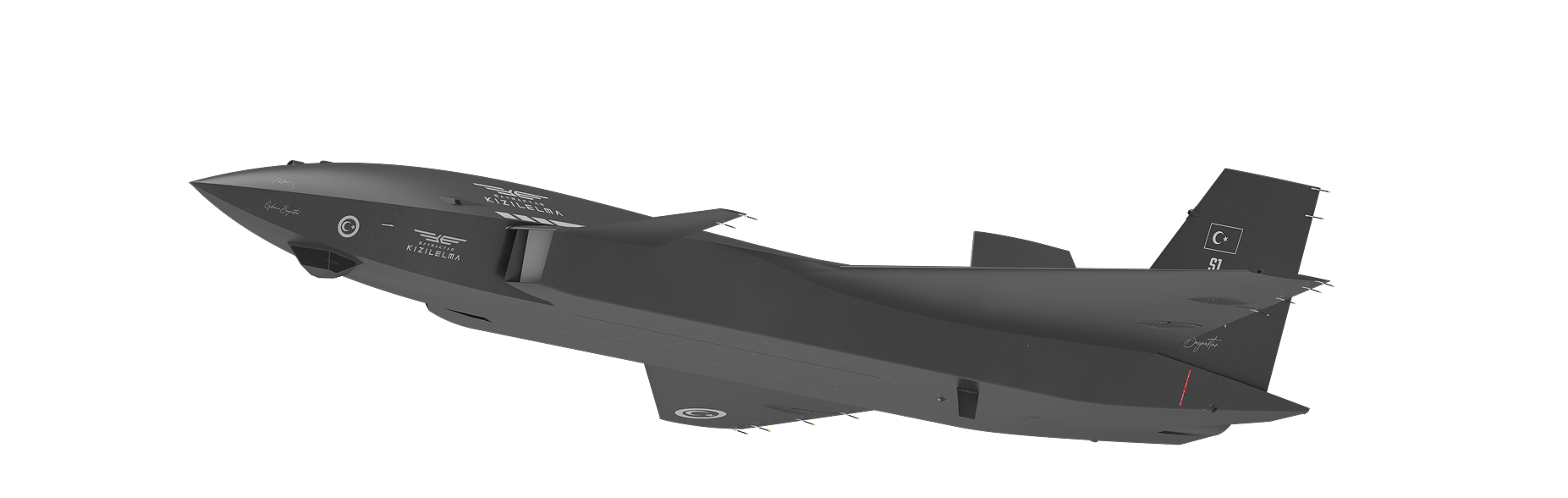
Baykar has updated the illustrations of KE. Landing gear covers are visible now. In general, KE looks a lot more stealth now.
This is probably the serial production configuration.
 baykartech.com
This is probably the serial production configuration.
KIZILELMA
The KIZILELMA Unmanned Fighter Aircraft (UFA), developed by Baykar, builds upon the groundbreaking success of Bayraktar drones and integrates next-gen
baykartech.com


Pokemonte13
Contributor
Still waiting for elint and asw variant

Key mission highlights:
https://boeing.mediaroom.com/2025-12-09-Boeing,-RAAF-Achieve-CCA-Missile-Fire-from-MQ-28-Ghost-Bat
- The MQ-28, E-7A and F/A-18F launched from separate locations.
- Once airborne, an E-7A operator took custodianship of the MQ-28 ensuring safety and engagement oversight.
- The F/A-18F teamed with the MQ-28 in combat formation to provide sensor coverage, and once the Super Hornet identified and tracked the target, targeting data was shared across all three platforms.
- The MQ-28 adjusted its position and received authorization from the E-7A to engage and successfully destroy the target using a Raytheon AIM-120 AMRAAM missile.
When communication jamming actually occurs, I am genuinely curious about the operational effectiveness of these wingman concepts. When two air forces with equally high electronic warfare capabilities face each other, especially during a night in full stealth profile, dozens of these possible vulnerabilities tested (and untested) during peacetime may need to be multiplied over tens. In any case, I believe that an approach that addresses combine the internal sensors of unmanned systems with internal decision-making (AI) and mission autonomy capabilities will prove to be a more suitable approach for real combat conditions. Perhaps not for different types of unmanned aerial vehicles, but when it comes to air-to-air warfare, unmanned jets will also need increasingly sophisticated sensor packages and decision-making systems to replace the pilot, if not as ammunition payloads as heavy fighters.
I am not an expert on the subject, but my limited view is that the main approach here will eventually have to be based on standalone capable platforms. The Wingman concept may involve reusable systems that can be carried under the wing, focused on sensors/payloads (illumination, jamming, EW).
Side note, I also do not believe that the transition to unmanned systems will reduce the air force's system replacement costs.
YeşilVatan
Contributor
The basic assumption about contemporary aerial warfare is; a lot of non-stealth aircraft can be 'sniped' with BVR missiles and AESA radars. This combo means opposition will have to keep their non-stealth platforms grounded, while you can keep yours in the air, if they are stealth. This combination of stealth+BVR+AESA is a silver bullet for countering what is essentially %90 of the existing air forces. The role of older aircraft in any scenario where this combo exists is very limited during the opening stages of a conflict. It is either wait on the ground for air supremacy to be achieved, or serve as bait to lure out or deplete missile stockpile (if unmanned).
This is a convoluted way of saying non-stealth aircraft will lose their A2A role in this new way of aerial warfare. I know tihs sounds pretentious, and I concede that this change of role will be gradual and slow, but I think this paradigm shift is coming and it's coming fast. I believe in the medium term, Non-LO aircraft will have two main functions: Bait, which I believe is a very important role; or doing things in uncontested airspace.
We already have a range of UAVs that can do a terrible amount of damage in uncontested airspace, as Assad found out in Spring Shield. That's one role fulfilled. For the other; the main point of this post is to highlight the need for dedicated decoy drones. We need them, we need them in numbers, we need them reusable, we need to craft a central position for them in our doctrine. They are very underrated IMHO, considering missiles are the most precious resource any opposition has in such conflict, maybe other than pilots.
A minor point about AESA+BVR+Stealth combo; when you throw in a stealth unmanned fighter like Kızılelma into the mix, it disrupts this relatively simple formula. Just to be clear, I'm sure KE will be VLO at some point. So there will be a platform that can get closer and actually score some hits against formerly untouchable BVR missile firing platforms, without risking a pilot's life. This alone is a considerable capability that doesn't exist for any nation AFAIK.
This is my read on this as an unprofessional afficionado for this stuff so feel free to correct me.
This is a convoluted way of saying non-stealth aircraft will lose their A2A role in this new way of aerial warfare. I know tihs sounds pretentious, and I concede that this change of role will be gradual and slow, but I think this paradigm shift is coming and it's coming fast. I believe in the medium term, Non-LO aircraft will have two main functions: Bait, which I believe is a very important role; or doing things in uncontested airspace.
We already have a range of UAVs that can do a terrible amount of damage in uncontested airspace, as Assad found out in Spring Shield. That's one role fulfilled. For the other; the main point of this post is to highlight the need for dedicated decoy drones. We need them, we need them in numbers, we need them reusable, we need to craft a central position for them in our doctrine. They are very underrated IMHO, considering missiles are the most precious resource any opposition has in such conflict, maybe other than pilots.
A minor point about AESA+BVR+Stealth combo; when you throw in a stealth unmanned fighter like Kızılelma into the mix, it disrupts this relatively simple formula. Just to be clear, I'm sure KE will be VLO at some point. So there will be a platform that can get closer and actually score some hits against formerly untouchable BVR missile firing platforms, without risking a pilot's life. This alone is a considerable capability that doesn't exist for any nation AFAIK.
This is my read on this as an unprofessional afficionado for this stuff so feel free to correct me.
Why decoy drones? Can we make A2A jet drones that just chase and collide like a modified süper Şimşek? Maybe a final stage booster against faster aircraft. Better than pure decoyThe basic assumption about contemporary aerial warfare is; a lot of non-stealth aircraft can be 'sniped' with BVR missiles and AESA radars. This combo means opposition will have to keep their non-stealth platforms grounded, while you can keep yours in the air, if they are stealth. This combination of stealth+BVR+AESA is a silver bullet for countering what is essentially %90 of the existing air forces. The role of older aircraft in any scenario where this combo exists is very limited during the opening stages of a conflict. It is either wait on the ground for air supremacy to be achieved, or serve as bait to lure out or deplete missile stockpile (if unmanned).
This is a convoluted way of saying non-stealth aircraft will lose their A2A role in this new way of aerial warfare. I know tihs sounds pretentious, and I concede that this change of role will be gradual and slow, but I think this paradigm shift is coming and it's coming fast. I believe in the medium term, Non-LO aircraft will have two main functions: Bait, which I believe is a very important role; or doing things in uncontested airspace.
We already have a range of UAVs that can do a terrible amount of damage in uncontested airspace, as Assad found out in Spring Shield. That's one role fulfilled. For the other; the main point of this post is to highlight the need for dedicated decoy drones. We need them, we need them in numbers, we need them reusable, we need to craft a central position for them in our doctrine. They are very underrated IMHO, considering missiles are the most precious resource any opposition has in such conflict, maybe other than pilots.
A minor point about AESA+BVR+Stealth combo; when you throw in a stealth unmanned fighter like Kızılelma into the mix, it disrupts this relatively simple formula. Just to be clear, I'm sure KE will be VLO at some point. So there will be a platform that can get closer and actually score some hits against formerly untouchable BVR missile firing platforms, without risking a pilot's life. This alone is a considerable capability that doesn't exist for any nation AFAIK.
This is my read on this as an unprofessional afficionado for this stuff so feel free to correct me.


