• Forum restore complete (see latest announcement thread)

TR Air Defence Programs

Afif

Experienced member
Moderator
Bangladesh Correspondent
DefenceHub Diplomat
Bangladesh Moderator
Messages
5,139
Reactions
104 10,047
Nation of residence
Bangladesh
Nation of origin
Bangladesh
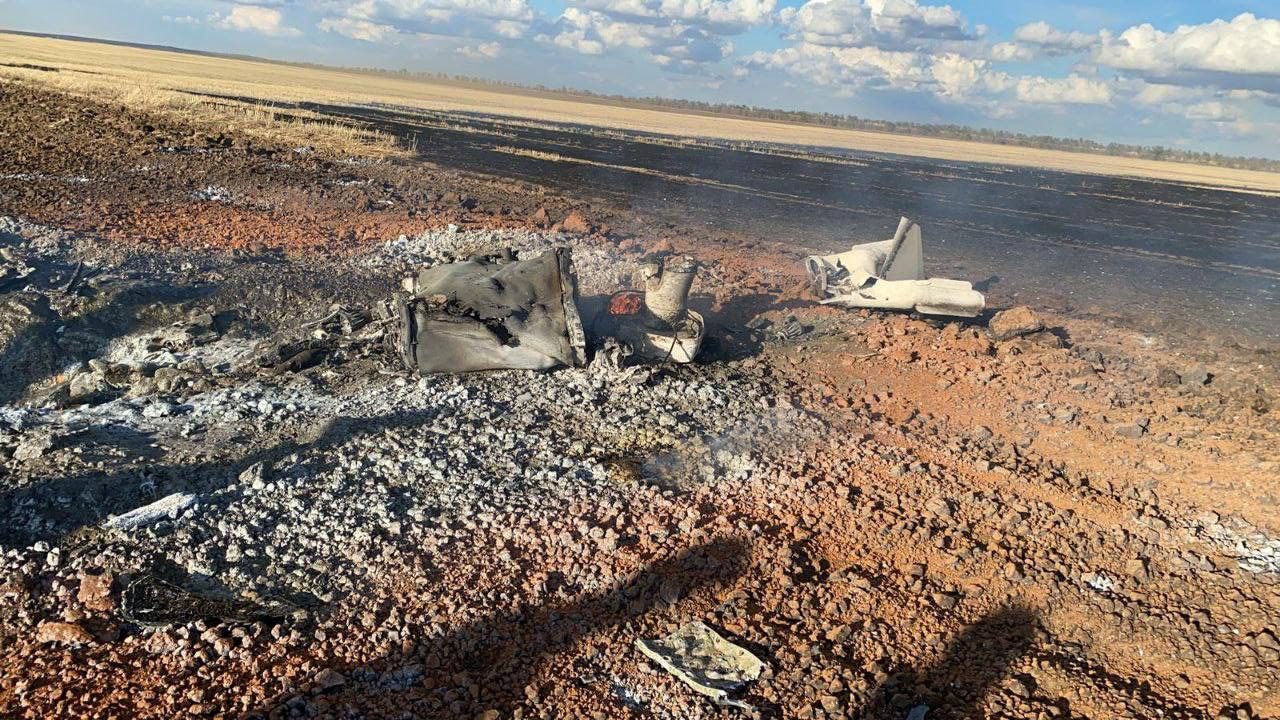
Second picture shown as a proof for warhead was first posted by Ukraine Military as a crashed P-800


That Hypothesis about it being P-800 is not convincing.
because P-800 oink has seeker head in the front. And i am not sure if it is feasible to put radar seeker behind 3 inch thick steel casing.

In the second picture it is probably Iskander’s nose cone, not the warhead. (Given warheads posses its own casing)
 

Radko

Experienced member
Messages
1,521
Reactions
14 2,872
Nation of residence
Turkey
Nation of origin
Bosnia & Herzegovina
That Hypothesis about it being P-800 is not convincing.
because P-800 oink has seeker head in the front. And i am not sure if it is feasible to put radar seeker behind 3 inch thick steel casing.

In the second picture it is probably Iskander’s nose cone, not the warhead. (Given warheads posses its own casing)
Well that is Ukrainian military
 

Cabatli_TR

Experienced member
Administrator
Messages
5,362
Reactions
81 45,473
Nation of residence
Turkey
Nation of origin
Turkey
It wouldn't be fair to say that GÖKDOĞAN is state of the art compared to HİSAR O+/HİSAR RF. Those missiles have differences in their operation for surface launch.

  • GÖKDOĞAN won't be vertically launched and launcher will have to be directed at target (Despite that, TÜBİTAK SAGE is working on cold launch and thrusters option). HİSARs on the other hand are made for vertical launch from the beginning with the provision for angled launch. Thrust vectoring and general layout play a big role in that suitability.
  • GÖKDOĞAN will be a cheaper missile compared to larger and somewhat more complex HİSAR RF. If you think about it, seekers are identical but HİSAR RF also has thrust vectoring and a dual pulse engine driving up the costs. Put that together with 8 missiles per launcher and you get yourself a nice alternative to support HİSARs against saturation attacks of lower end threats.


Of course, I totally agree with what you said about differences between missiles in a technical aspect but what is mentioned in terms of usage concept does not make Gökdemir less sophisticated/state of art or less effective. TVC control is a sophisticated tech for missiles indeed but according to design parameters, not every missile has to have TVC to have similar maneuverability. For example, Tamir or Stunner missiles can perform maneuvrability thanks to fore fins integrated in a position close to the head just like Gökdoğan instead of TVC and actuator sensitivity achieve similar maneuvrability at more cost-effective prices.

In addition, angled launch missiles are no less state of art than VLCs. The important issue here is related to the purpose of design and usage concept. Because of the Patriot or NASAMS are angled missiles, they are no less state of art than VL-Mica or Asters series. Each capability comes with its pros and cons. VLC provides more flexibility compared to angled launch missiles.

Apart from this, dual pulse rocket motors will of course have technological superiority in terminal phase and Hisars will be superior to Gokdemir in terms of this capability but as you also mentioned, the cost/effectiveness will come to the fore and cost per missile will be cheaper in Gökdemir side. Mobility will also play more important role because of weight and size differences in Gokdemir side.

 

Quasar 

Contributor
Moderator
Messages
920
Reactions
54 4,037
Nation of residence
Nethelands
Nation of origin
Turkey
F4dLOsSXwAAX_xW
 

UkroTurk

Experienced member
Land Warfare Specialist
Professional
Messages
2,968
Reactions
61 5,303
Nation of residence
Turkey
Nation of origin
Turkey
İt seems SİPER B2 might be quadpacked in MK-41...Damn...But 100% could be dual packed

IMG_20230827_014627.jpg

1693091404312.png

İ am looking forward to filling MIDLAS.
 
Last edited:

BalkanTurk90

Contributor
Messages
921
Reactions
5 1,355
Nation of residence
Albania
Nation of origin
Turkey
Can someone explain what tech did USA use to build SM3 that accroding to wikipedia it says have range of 1200 km altitude 1000km, mach 8-13 ! aslo can shoot down satellites and its not big only 6.5 meter and 343mm -533mm diameter very similar in size with other missiles like pac 3 , SM2 , Aster 30 etc have range only 100-150km ?
 

Afif

Experienced member
Moderator
Bangladesh Correspondent
DefenceHub Diplomat
Bangladesh Moderator
Messages
5,139
Reactions
104 10,047
Nation of residence
Bangladesh
Nation of origin
Bangladesh
The age of Standard missile family is over 50 years. The same design has been modified and upgraded inside out countless times to the perfection. Resulting in various members of SM family each with their own multiple variants.

Maybe @Anmdt could tell us further about how despite using same booster and rocket motor of SM-2ER block IV and SM-6 (Mk-72 booster and MK-104 rocket motor) SM-3 block IA/IB can reach such high altitude and longer range? Yet SM-2ER block IV and SM-6 only reaches 33-35km effective altitude. Apparently, just an additional small third stage shouldn’t get you that far high.
 
Last edited:

TheInsider

Experienced member
Professional
Messages
4,894
Solutions
1
Reactions
51 17,040
Nation of residence
Turkey
Nation of origin
Turkey
If the diameter of Siper-2 is ≤450mm it will be possible to use it as a dual pack from MIDLAS.
 

Quasar 

Contributor
Moderator
Messages
920
Reactions
54 4,037
Nation of residence
Nethelands
Nation of origin
Turkey
Can someone explain what tech did USA use to build SM3 that accroding to wikipedia it says have range of 1200 km altitude 1000km, mach 8-13 ! aslo can shoot down satellites and its not big only 6.5 meter and 343mm -533mm diameter very similar in size with other missiles like pac 3 , SM2 , Aster 30 etc have range only 100-150km ?
SM3 is an exo atmospheric missile, it has solid rocket booster + dual thrust rocket motor + third stage rocket motor + and finally kinetic warhead since at the final stage after the speration of booster and dual thrust motor, third stage rocket motor places the kinetic warhead into orbit since kinetic warhead operates in the vacuum of space SM3 reachs this ranges and speeds, basicly you are sending a kinetic warhead to orbit. Further not the missile itself but the kinetic warhead has the range and speed.
 
Last edited:

UkroTurk

Experienced member
Land Warfare Specialist
Professional
Messages
2,968
Reactions
61 5,303
Nation of residence
Turkey
Nation of origin
Turkey
If the diameter of Siper-2 is ≤450mm it will be possible to use it as a dual pack from MIDLAS.
I don't think Siper B2's diameter is larger than 300mm.


Imagine, ESSM block2 but 50% longer around 5,5 meter.

If the missile diameter enables quadpacking, there could be 2 variants.

The first: dual thrust/ longer range

The second: single thrust / shorter range.
(Like Barak MX )


IMO If Siper B2 could be quadpacked, there wouldn't be Hisar-D.
 
Last edited:

TheInsider

Experienced member
Professional
Messages
4,894
Solutions
1
Reactions
51 17,040
Nation of residence
Turkey
Nation of origin
Turkey
Well from what I saw the diameter of Siper might be 400 to 450mm. If this is the case it can't be quadpacked but it can be doublepacked.
 

UkroTurk

Experienced member
Land Warfare Specialist
Professional
Messages
2,968
Reactions
61 5,303
Nation of residence
Turkey
Nation of origin
Turkey
Mathematically You couldn't dualpack two missiles larger than 395mm in 22'x22' VLS cell.

MK-41 and Slyver VLS cells dimensions:22'x22'
IMG_20230827_041801.jpg


Diagonal:790mm
IMG_20230827_043838.png

Experience showed us two missiles larger than 343mm couldn't be dualpacked in MK-41 .


Anyway i don't think Siper B2 larger than 300mm.

D: 400-450mm is İmpossible
 
Last edited:

BalkanTurk90

Contributor
Messages
921
Reactions
5 1,355
Nation of residence
Albania
Nation of origin
Turkey
SM3 is an exo atmospheric missile, it has solid rocket booster + dual thrust rocket motor + third stage rocket motor + and finally kinetic warhead since at the final stage after the speration of booster and dual thrust motor, third stage rocket motor places the kinetic warhead into orbit since kinetic warhead operates in the vacuum of space SM3 reachs this ranges and speeds, basicly you are sending a kinetic warhead to orbit. Further not the missile itself but the kinetic warhead has the range and speed.
Yeah now i understand , the 1200km range is for outer space when air absent and missile or its warhead can still go on with high speed and reach 13 mach and 1000+ km just like other space objects that with little force can travel indefinetely so if US navy use it inside air 10km altitude can not pass 400km range since wiki says its based on SM2 Block4 and it has 370km range !?
Wiki aslo should explain that 1200km is only for outer space 🤦‍♂️
 
Top Bottom