• Forum restore complete (see latest announcement thread)

TR Navy ULAQ ¦ SANCAR ¦ MIR ¦ SALVO | Unmanned Surface Vehicles, News and Updates

Anmdt

Experienced member
Naval Specialist
Professional
Messages
5,804
Solutions
2
Reactions
148 26,907
Nation of residence
Turkey
Nation of origin
Turkey
I hadn't seen these brochures for Aselsan's USVs before on their website:


Looking at their payload options makes it very obvious that each USV will have very clearly defined roles. Instead of one platform that can be used for different purposed with modular structure.
Marlin started as a project to supply an USV for SSB's USV acquisition (and related tender). More as a demonstrator to achieve milestones in the related project.

Mir has started, in parallel, as an R&D project to study modularization of the payload, as well as modularization of the hull configuration.

There is another iteration following these two, that will be the actual product delivered to TN with the acquisition programme.

Mir and Marlin shares components in great extends with different designs.

Albatros is, however, a different story that has been Aselsan's USV development path. And until now has been used as an R&D platform.
 

boredaf

Experienced member
Messages
2,265
Solutions
1
Reactions
42 6,641
Nation of residence
United Kingdom
Nation of origin
Turkey
Marlin started as a project to supply an USV for SSB's USV acquisition (and related tender). More as a demonstrator to achieve milestones in the related project.

Mir has started, in parallel, as an R&D project to study modularization of the payload, as well as modularization of the hull configuration.

There is another iteration following these two, that will be the actual product delivered to TN with the acquisition programme.

Mir and Marlin shares components in great extends with different designs.

Albatros is, however, a different story that has been Aselsan's USV development path. And until now has been used as an R&D platform.
I noticed Mir and Marlin's shared components as well, and Albatros' difference. It doesn't seem like it has a defined role so far, other than it has swarm capabilities and has target USV iterations on Aselsan's website. It looks to me like it is something we can use in training and could be used as decoys to force enemy to engage them along with actual USV.

This another iteration you mention, will it still be two specialized version like now, or do you think it is going to be single platform with modular structure that can be configured for different missions like surface or submarine warfare?
 

Sanchez

Experienced member
Moderator
Think Tank Analyst
DefenceHub Diplomat
Messages
4,181
Reactions
125 19,013
Nation of residence
Turkey
Nation of origin
Turkey
Chinese People's Liberation Army Daily newspaper:

Türkiye attempts coordinated operations with drones and unmanned boats​


Not long ago, the Turkish Ministry of Defense announced that it had carried out the world’s first joint operation of unmanned surface ships and drones. It is reported that the operation was set near the Eastern Mediterranean. A 22-meter-long target ship was first detected by the Bayraktar TB2 drone. The target information was then transmitted to the Albatros-S, which consists of 8 Albatros unmanned boats. A group of surface ships, one of which sank the target ship.

In recent years, the development of unmanned equipment has entered the fast lane. Generally speaking, the advantages of drones are large search range and long communication distance, but their limitation is short endurance time; the advantage of unmanned boats is long endurance time, but small search range and short communication distance. UAV and UAV cooperative operations can combine the advantages of both to form an air-sea three-dimensional collaborative system to enhance the ability of unmanned systems to complete complex tasks. In the absence of manned vessels such as frigates, destroyers, and conventional submarines, the effective collaboration of drones and unmanned boats can carry out intelligence, surveillance, reconnaissance, attack and other tasks for a long time.

The application prospects of UAV-boat collaboration are very broad. Theoretically, where drones can be used in water combat areas, it is possible to achieve coordinated operations between aircraft and boats. Therefore, countries around the world have invested in the research and development of corresponding equipment and technologies for UAV and boat collaboration, and have verified the operability of the concept of UAV and boat collaborative operations. In this test, Turkey used the Bayraktar TB2 drone developed by Baykar Company and the Albatros unmanned boat developed by Aselsan Company.

For UAVs and boats to cooperate in combat, the combat platform must first have the ability to communicate beyond visual range. The TB2 UAV communication range is 300 kilometers, and the Albatross UAV is equipped with a radio frequency communication system, a narrowband satellite communication system and a 4.5G/LTE communication system for short-range and over-the-horizon command and control within the group.

The ability of autonomous collaborative control is the key to collaborative operations of UAVs. TB2 can achieve safe and autonomous flight operations. Its sensor fusion algorithm has an inertial navigation system, which can achieve precise navigation and automatic landing even without global positioning signals. The Albatross UAV can operate in a swarm formation or independently navigate and perform missions. Its control system can adjust navigation according to different formations, avoid obstacles, and can complete the mission even when the number of swarms may be reduced; At the same time, tasks can also be allocated autonomously among clusters, and its autonomous capabilities extend to task planning, task allocation, sensor fusion and dynamic route planning, allowing autonomous adjustments or ending tasks according to various surrounding environmental conditions.

Taken together, Turkey's coordinated attack by drones and unmanned boats reflects a new way of coordinated operations of unmanned systems in future sea and air battlefields, such as using drones to detect and capture targets, and unmanned boat clusters to carry out attacks. Of course, cooperative operations between drones and unmanned boats also face some practical problems: limited by the level of energy technology, the duration of coordinated operations is restricted, artificial intelligence and algorithm capabilities limit the number of controllable unmanned systems, and UAVs and unmanned boats Communication between manned vessels is susceptible to interference, and unmanned vessels can carry limited ammunition on a single platform, etc.

 

Anmdt

Experienced member
Naval Specialist
Professional
Messages
5,804
Solutions
2
Reactions
148 26,907
Nation of residence
Turkey
Nation of origin
Turkey
Ares Shipyard CEO:

Expecting to deliver good news on large batch export of ULAQ USV to a Gulf State.

Expecting to win a tender in the Gulf, with a local partner shipyard, competing against a European shipyard that has been losing few tenders against Ares in multiple fields. 90% of the project will be covered by Ares shipyard. *


*Referring to partnership with ADSB, therefore delivering new OPVs to the UAE.
The same news also state that Ares is in collaboration with a foreign company and local institute to incorporate robotic welding in shipbuilding and automation in boat building (for the boats like Kama, specifically). From this perspective, if we may achieve a low-cost solution for the electronics, auxiliaries and propulsion unit Kama may turn out to be as affordable as an Anti-ship missile.
 

Bogeyman 

Experienced member
Professional
Messages
9,910
Reactions
76 33,059
Website
twitter.com
Nation of residence
Turkey
Nation of origin
Turkey
GDL9doWXkAAuSJO


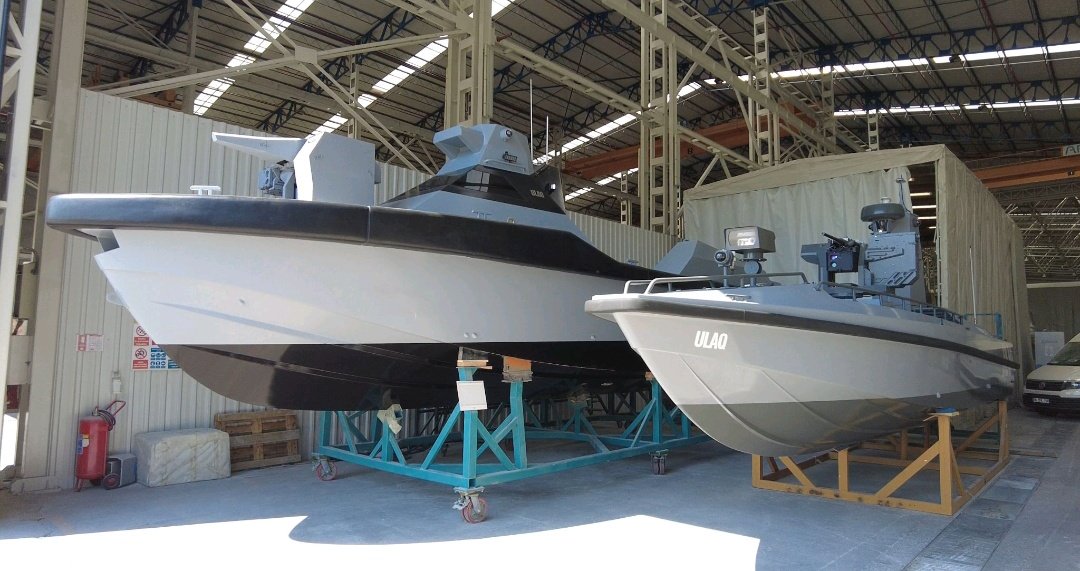
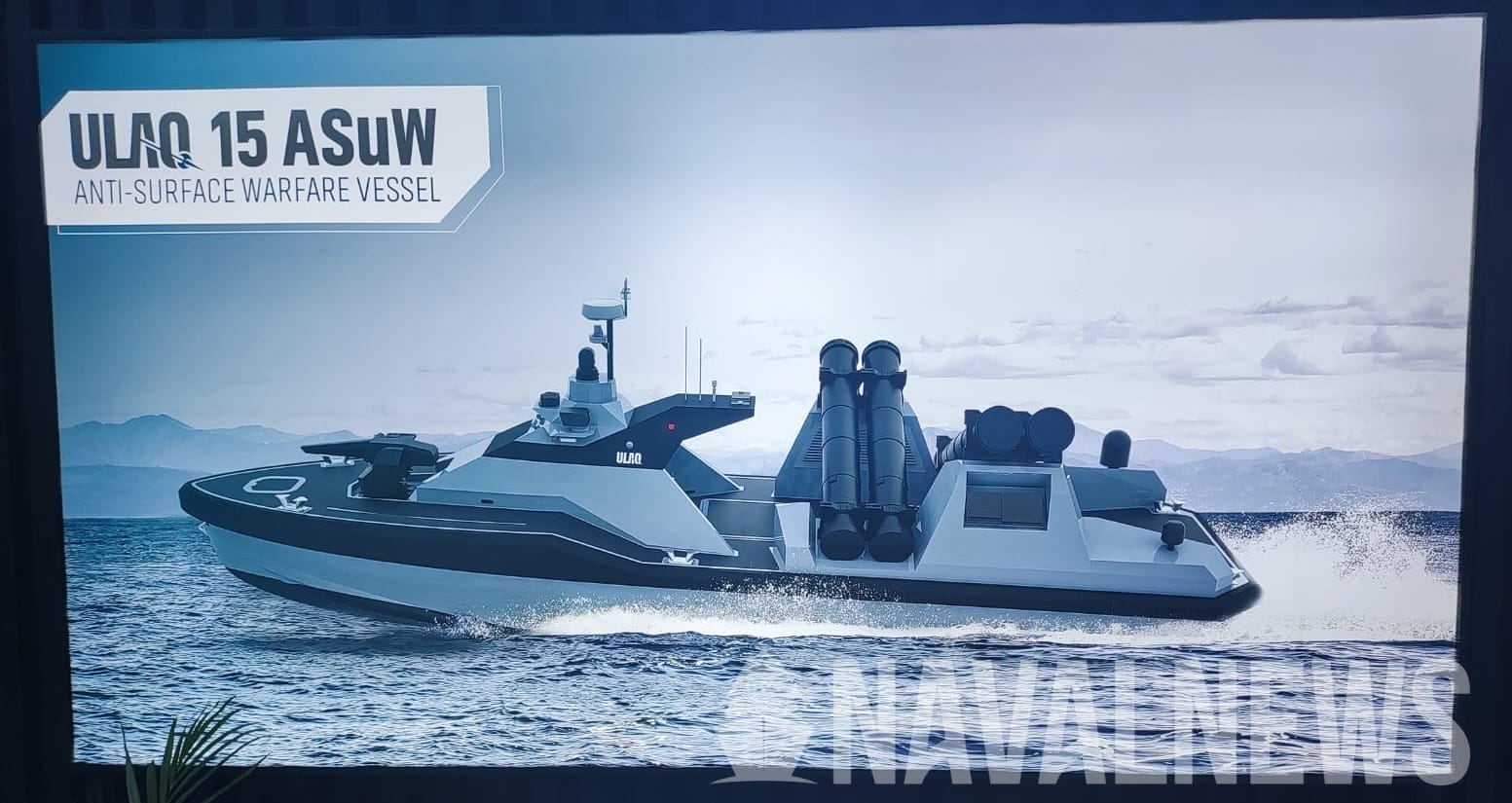
The 12-meter ULAQ USV is coming.
 

Sanchez

Experienced member
Moderator
Think Tank Analyst
DefenceHub Diplomat
Messages
4,181
Reactions
125 19,013
Nation of residence
Turkey
Nation of origin
Turkey
GDL9doWXkAAuSJO


The 12-meter ULAQ USV is coming.
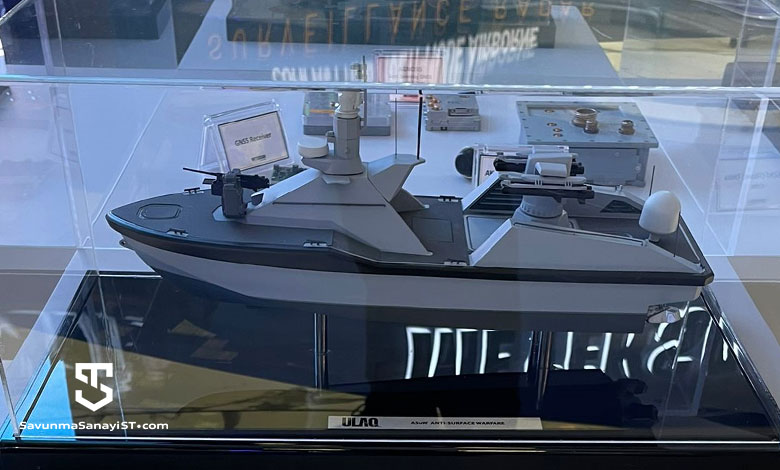
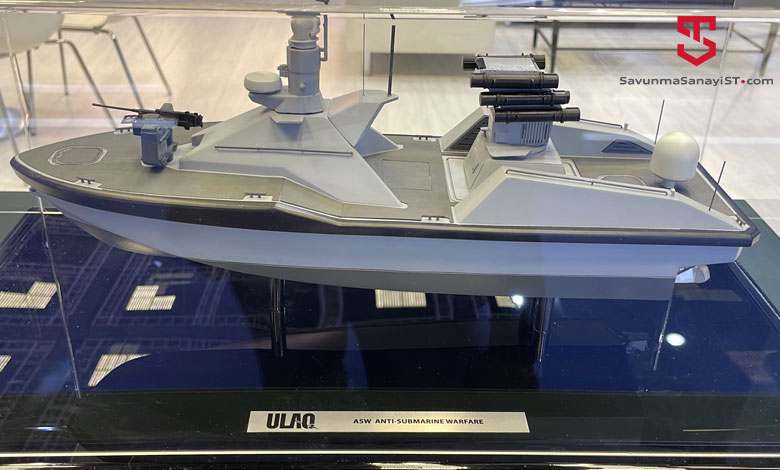
Looks like design language changed a bit from the original 3D artwork and they are following the models from 2022 now. Wonder if it will be the ASW or ASuW variant.
uYimgzE.jpeg


apDGVC7.jpeg


boredaf

Experienced member
Messages
2,265
Solutions
1
Reactions
42 6,641
Nation of residence
United Kingdom
Nation of origin
Turkey
Looks like design language changed a bit from the original 3D artwork and they are following the models from 2022 now. Wonder if it will be the ASW or ASuW variant.
uYimgzE.jpeg


apDGVC7.jpeg

I hope they'll at least integrate Çakır in the surface variant.
 

Anmdt

Experienced member
Naval Specialist
Professional
Messages
5,804
Solutions
2
Reactions
148 26,907
Nation of residence
Turkey
Nation of origin
Turkey
1705827828650.jpeg


Stamp-2L foundation is minimal and the system overally looks tiny. Could be the ultimate solution even for the smallest boats to replaces manned MGs.
 

Anmdt

Experienced member
Naval Specialist
Professional
Messages
5,804
Solutions
2
Reactions
148 26,907
Nation of residence
Turkey
Nation of origin
Turkey
Is this a new version? I don't remember a Stamp variant this small, that looks awesome.
There was a Stamp-L, made light for platforms which require it and this is adoption of such philisophy for Stamp-2. I would expect the same for others too.
 

Anmdt

Experienced member
Naval Specialist
Professional
Messages
5,804
Solutions
2
Reactions
148 26,907
Nation of residence
Turkey
Nation of origin
Turkey

1707131016334.jpeg


Spectacular, but not very pleasant. I would still like to see forward facing launchers on a high speed platform.

Roketsan needs a smaller footprint, modular, easy to install-remove box launcher for Çakır, cylindirical launchers are not feasible or fancy to the eye. Similar to the following technique; 2 or 4 of the missiles should be replenished at once by removing a module, thus shortening the replenishment time on land.
 

Sanchez

Experienced member
Moderator
Think Tank Analyst
DefenceHub Diplomat
Messages
4,181
Reactions
125 19,013
Nation of residence
Turkey
Nation of origin
Turkey

View attachment 65346

Spectacular, but not very pleasant. I would still like to see forward facing launchers on a high speed platform.

Roketsan needs a smaller footprint, modular, easy to install-remove box launcher for Çakır, cylindirical launchers are not feasible or fancy to the eye. Similar to the following technique; 2 or 4 of the missiles should be replenished at once by removing a module, thus shortening the replenishment time on land.
I agree, but side facing launchers shouldn't be this big of an issue for standoff ranges of 40+ kms, no? For Kuzgun however....
 

boredaf

Experienced member
Messages
2,265
Solutions
1
Reactions
42 6,641
Nation of residence
United Kingdom
Nation of origin
Turkey

View attachment 65346

Spectacular, but not very pleasant. I would still like to see forward facing launchers on a high speed platform.

Roketsan needs a smaller footprint, modular, easy to install-remove box launcher for Çakır, cylindirical launchers are not feasible or fancy to the eye. Similar to the following technique; 2 or 4 of the missiles should be replenished at once by removing a module, thus shortening the replenishment time on land.
At this point, I'm just glad they are using Çakır instead of just Umtaş. Maybe they can come up with something like Hisar's launcher?
 

Anmdt

Experienced member
Naval Specialist
Professional
Messages
5,804
Solutions
2
Reactions
148 26,907
Nation of residence
Turkey
Nation of origin
Turkey
I agree, but side facing launchers shouldn't be this big of an issue for standoff ranges of 40+ kms, no? For Kuzgun however....
I am concerned from these two points, first two strong, latter is weak;
- Time spent for replenishment at shore, a box module may shorten it or make it easy if done on a mothership, even automated.
- Footprint of the launcher in comparison to missile size will be smaller (this, Roketsan needs to work on, maybe with foldable air intake).
- RCS of the canisters (forward angle)
 

Anmdt

Experienced member
Naval Specialist
Professional
Messages
5,804
Solutions
2
Reactions
148 26,907
Nation of residence
Turkey
Nation of origin
Turkey
This can't be something that Roketsan can't do. Maybe they would introduce something like that in a later stage? :unsure:
Latter block (from 2025-26+) of Cakir was told to have stealth form (same or better than rivals), that would naturally come with more compact, box shaped launcher and possibly one that can be loaded in multiple counts at once, as i told. Frankly i was expecting them to commonize launcher from now for compatibility with latter block, and ease conversion. They rather opted with available know-how and ease - low cost of making cylindirical shaped canisters.

Nevertheless we have Cakir on USV, now let them think of this CONOPS.

Why do i insist on more compact canisters than the available one, is particularly for making payload / occupied deck area ratio of FACs and Corvettes. If they could enable 4 Atmaca to be replaced by 8 Cakir this would have been a nice replacement without sacrificing payload and increasing number of missiles. 4 to 6 is not a sufficient ratio to me.
 

Slayer

Committed member
Messages
210
Reactions
2 377
Nation of residence
Denmark
Nation of origin
Turkey

View attachment 65346

Spectacular, but not very pleasant. I would still like to see forward facing launchers on a high speed platform.

Roketsan needs a smaller footprint, modular, easy to install-remove box launcher for Çakır, cylindirical launchers are not feasible or fancy to the eye. Similar to the following technique; 2 or 4 of the missiles should be replenished at once by removing a module, thus shortening the replenishment time on land.
I think forward facing launchers might impose problems with the overall dimensions of the hull.
 

Kaan Azman 

Contributor
DH Visual Specialist
Messages
609
Reactions
30 2,428
Nation of residence
Turkey
Nation of origin
Turkey
Latter block (from 2025-26+) of Cakir was told to have stealth form (same or better than rivals), that would naturally come with more compact, box shaped launcher and possibly one that can be loaded in multiple counts at once, as i told. Frankly i was expecting them to commonize launcher from now for compatibility with latter block, and ease conversion. They rather opted with available know-how and ease - low cost of making cylindirical shaped canisters.

Nevertheless we have Cakir on USV, now let them think of this CONOPS.

Why do i insist on more compact canisters than the available one, is particularly for making payload / occupied deck area ratio of FACs and Corvettes. If they could enable 4 Atmaca to be replaced by 8 Cakir this would have been a nice replacement without sacrificing payload and increasing number of missiles. 4 to 6 is not a sufficient ratio to me.
Nice, I think a stealth framed ÇAKIR should be my next project, gonna inspect NSM and SOM J as references
 

Follow us on social media

Top Bottom