• Forum restore complete (see latest announcement thread)

Live Conflict Israel-US vs Iran War (2026)

Oublious

Experienced member
The Netherlands Correspondent
Messages
2,782
Reactions
15 6,123
Nation of residence
Nethelands
Nation of origin
Turkey
I can not imagine the amount casulties American will face when they go to ground operations in Iran. Give Hamas weapons like this and the ouctcome in Gaza would be different. The dead soldiers idf is sky high, they did put total censorship on this matter.
 

blackjack

Experienced member
Moderator
Russia Correspondent
Russia Moderator
Messages
1,667
Reactions
10 975
Nation of residence
United States of America
Nation of origin
Russia
1774807817489.png
1774809003876.png


The problem is there is no re-assurance or evidence any objectives would be met in Iran. How do we know that sending ground troops to Iran will make the US reach their objectives and that we won't change our minds in the last minute after nearly all those US ground troops possibly get killed? The US has changed its mind before on Ukraine where we also had no re-assurance or evidence on how many Russian troops or equipment are left for Ukraine to win, so how do we know that won't happen again with Iran?

How many missiles does Iran have? how much artillery do they have? how many kamikaze drones do they have? how much ground troops do they have? How many of those ground troops are UAV operators like Rubicon? If none of this is getting answered publicly we have no assurance the US entering this conflict with Israel would win their objectives.
 

Spitfire9

Contributor
Think Tank Analyst
Messages
1,284
Reactions
17 1,667
Nation of residence
United Kingdom
Nation of origin
United Kingdom

Trump says he is considering seizing Iran's Kharg Island, as oil price rises​


I would love to play chess with Trump - someone who appears incapable of thinking one move ahead - perhaps because he cannot, perhaps because that is of no interest to him. I doubt he has thought through the ramifications of taking Kharg Island.

If the attraction of taking Kharg Island is to deny Iran revenue from crude sales, why not board and seize vessels loaded at Kharg when they have exited the Gulf? That would preserve Kharg's capacity to export crude when hostilities cease, capacity that may be needed to keep crude prices in check for the benefit of the world economy.
 

contricusc

Contributor
Think Tank Analyst
Messages
828
Reactions
17 1,262
Nation of residence
Panama
Nation of origin
Romania
If the attraction of taking Kharg Island is to deny Iran revenue from crude sales, why not board and seize vessels loaded at Kharg when they have exited the Gulf? That would preserve Kharg's capacity to export crude when hostilities cease, capacity that may be needed to keep crude prices in check for the benefit of the world economy.

Trump is almost 80 years old, with signs of dementia and lack of sleep. Don’t expect strategy from him. He probably has trouble remembering how he got into this war in the first place.
 

Passenger

Contributor
Moderator
China Moderator
Messages
553
Reactions
18 980
Nation of residence
China
Nation of origin
China
Israel, for the first time, is planning to propose to the Trump Administration the development of U.S. military bases on its soil, including the construction of new bases and the relocation of existing military bases in countries across the Middle East, senior officials tell Israel’s Channel 12.

 
A

Asena_great

Guest
If the attraction of taking Kharg Island is to deny Iran revenue from crude sales, why not board and seize vessels loaded at Kharg when they have exited the Gulf? That would preserve Kharg's capacity to export crude when hostilities cease, capacity that may be needed to keep crude prices in check for the benefit of the world economy.
this is what they should have done from 1st day before the war their economy was tanking they sold barely 1 million barrel for 47 dollar way blow the market price ! now the sanctions are lifted they are selling 1.5 million barrel for 112 dollar per barrel while gulf state have zero income and their energy facilities are bombed. beside Iranians now allowing some ships to pass on conditions that each ship pays 2 million dollar for crossing the water way

what a mess US and Israel have made of the region
 

Slayer

Committed member
Messages
210
Reactions
2 377
Nation of residence
Denmark
Nation of origin
Turkey
Israel never supported PKK. PKK is a product of Assad - best friend of Ayatulas.
That is simply not true. We found ample of evidence that Israel supported the PKK. Hell even Ocalan verified that they had contact with the Mossad.

Israel sees Turkiye as an enemy (next Iran) of course they are going to use the PKK. Its naive to think otherwise.
 

Saithan

Experienced member
Moderator
Denmark Correspondent
DefenceHub Diplomat
Messages
9,866
Reactions
67 22,010
Nation of residence
Denmark
Nation of origin
Turkey
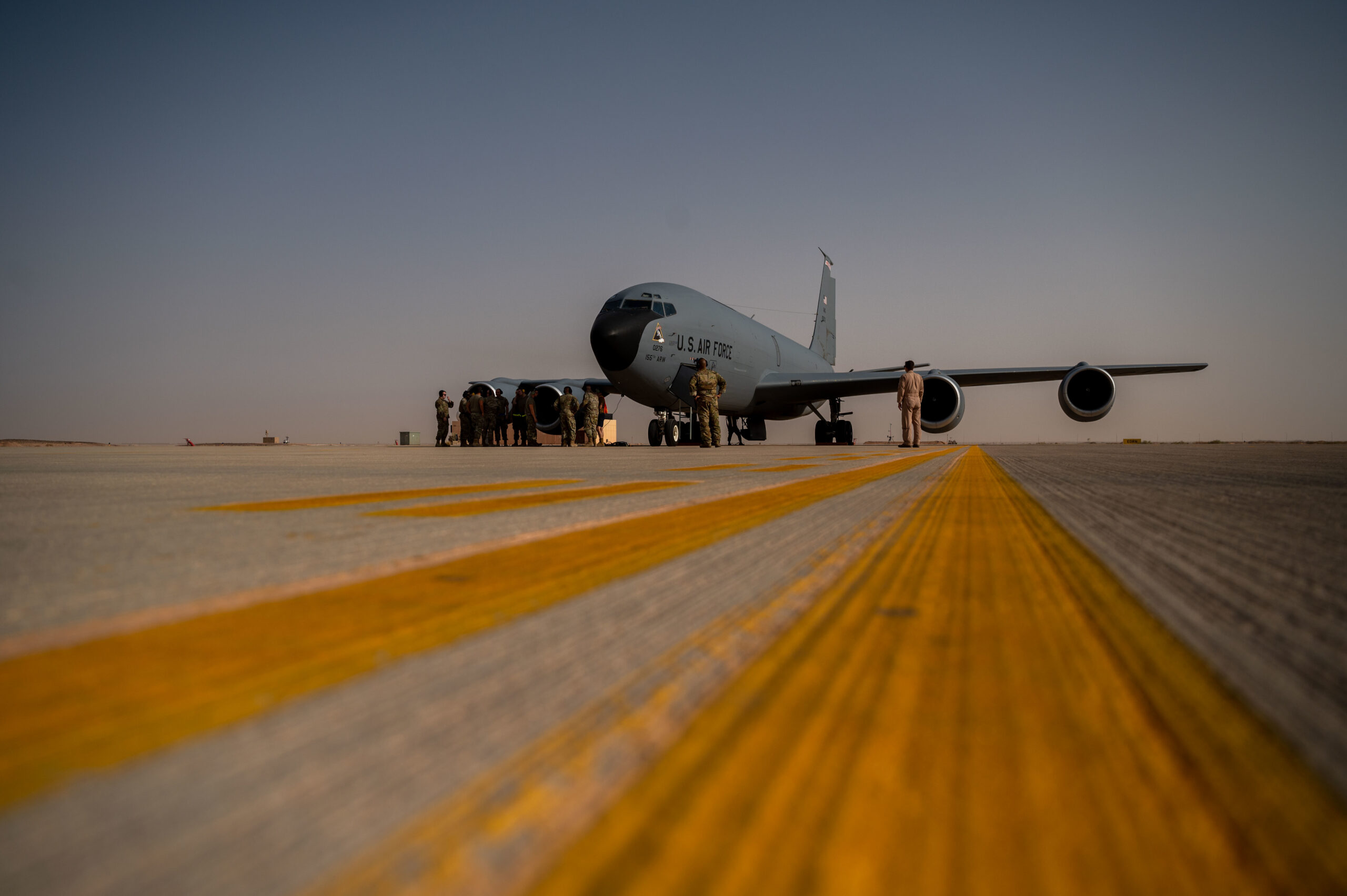
Multiple American service members were wounded and some aircraft were damaged in a March 27 Iranian attack on Prince Sultan Air Base, Saudi Arabia, people familiar with the matter told Air & Space Forces Magazine.

Around 10 service members were wounded, two seriously, according to initial reports.

An Iranian missile struck the base, injuring the service members. Multiple drones were also used in the attack.

A spokesperson for U.S. Central Command declined to comment.

Multiple refueling aircraft and an E-3 Sentry AWACS command and control plane are among the aircraft damaged, according to preliminary information. A photo showed significant damage to a USAF E-3, but the image could not be independently confirmed.
......


Well, there were huge losing for U.S. today.


Danish news has shown the damaged E-3


Soldier30

Experienced member
Russian Armed Forces News Editor
Messages
2,875
Reactions
15 1,632
Nation of residence
Russia
Nation of origin
Russia
Iranian air defenses, presumably Majid, hit a US MQ-9 Reaper reconnaissance UAV and a presumably RQ-21 UAV near the city of Shiraz in Fars province.


Huelague

Experienced member
Messages
5,387
Reactions
19 5,418
Nation of residence
Germany
Nation of origin
Turkey

Trump says he is considering seizing Iran's Kharg Island, as oil price rises​


I would love to play chess with Trump - someone who appears incapable of thinking one move ahead - perhaps because he cannot, perhaps because that is of no interest to him. I doubt he has thought through the ramifications of taking Kharg Island.

If the attraction of taking Kharg Island is to deny Iran revenue from crude sales, why not board and seize vessels loaded at Kharg when they have exited the Gulf? That would preserve Kharg's capacity to export crude when hostilities cease, capacity that may be needed to keep crude prices in check for the benefit of the world economy.

You of you don’t understand that Trump on its own can not change the foreign policy. It’s not all about Trump. It’s the people behind Trump. Trump is a symptom. Not the cause. Even American is the problem. YOU ARE THE PROBLEM.
 

Saithan

Experienced member
Moderator
Denmark Correspondent
DefenceHub Diplomat
Messages
9,866
Reactions
67 22,010
Nation of residence
Denmark
Nation of origin
Turkey

From Shahed to LUCAS: How Iran’s drone doctrine is reshaping American warfare — Phar Kim Beng​


(New users only) Unlock 5.5%* + 10%* p.a. promo rate for 3 months via Versa and enjoy FREE RM10 & when you sign up using code VERSAMM10 with min. cash of RM100 today! T&Cs apply.

Thursday, 26 Mar 2026 3:25 PM MYT

MARCH 26 — The evolution of modern warfare is often driven not by imitation of strength, but by adaptation to vulnerability.
In the unfolding contest between Iran and the United States, this dynamic is now unmistakably clear.

According to multiple reports, including those highlighted by CNN, the American LUCAS drone is, in part, a response modelled on the operational logic of Iran’s Shahed-136 loitering munition.

This is not mere technological borrowing. It is strategic acknowledgment.

For decades, the United States has dominated warfare through precision, sophistication, and overwhelming technological superiority.
Yet the rise of the Shahed-136 has exposed a critical weakness in this model: cost asymmetry. A drone that costs tens of thousands of dollars can compel the use of interceptor systems worth millions.

In doing so, it flips the traditional calculus of power on its head.

The Shahed-136 is deceptively simple.

With its delta-wing design, modest speed, and GPS-based navigation, it lacks the elegance of high-end Western systems. But its strength lies in its ability to be produced cheaply and deployed in large numbers.

Launched in swarms, these drones overwhelm air defences not through precision, but through persistence and volume.

This video grab taken from handout footage released by the Iranian Revolutionary Guard Corps (IRGC) on March 21, 2026, appears to show what it describes as the launch of “the 72nd wave” of missiles carried out against Israeli targets. — AFP pic


This video grab taken from handout footage released by the Iranian Revolutionary Guard Corps (IRGC) on March 21, 2026, appears to show what it describes as the launch of “the 72nd wave” of missiles carried out against Israeli targets. — AFP pic

This is warfare by attrition — industrial, relentless, and psychologically unsettling.
The distinctive buzzing sound of the Shahed has become synonymous with anticipation and dread, a reminder that even low-tech systems can exert high-impact effects.

It is precisely this logic that the United States has now begun to internalise.

The LUCAS drone represents a significant doctrinal shift.

Rather than relying exclusively on expensive missile defence systems, Washington is embracing the principle that to defeat cheap drones, one must deploy equally cheap — or cheaper — countermeasures. In essence, LUCAS reflects a move toward cost parity and scalable defence.

If the Shahed-136 embodies a strategy of saturation, LUCAS is designed to enable counter-saturation.

Unlike traditional interceptors, LUCAS is not meant to operate in isolation. It is part of a broader ecosystem of low-cost, autonomous systems capable of working in coordination.

These drones can loiter in contested airspace, detect incoming threats, and neutralise them through kinetic interception, proximity detonation, or electronic disruption.

The key advantage lies in numbers.

By deploying multiple LUCAS units, the United States can create a layered defence that mirrors the swarm tactics employed by Iran. In doing so, it restores a degree of economic balance to the battlefield.

Yet the implications of this shift go far beyond the technical.

What is emerging is a new paradigm of warfare in which the decisive factor is no longer the sophistication of individual platforms, but the ability to produce and sustain large quantities of functional systems.

In this environment, innovation is measured not only by technological advancement, but by affordability and scalability.

The United States, in modelling aspects of LUCAS on the Shahed concept, is effectively acknowledging that the future of warfare will be defined by this balance.

It is a rare instance where a superpower adapts to the methods of a regional actor—not out of weakness, but out of necessity.

Still, caution is warranted. The existence of LUCAS does not eliminate the threat posed by the Shahed-136. No defensive system can guarantee complete interception, particularly against large-scale swarm attacks.

The very nature of saturation ensures that some drones will penetrate defences, potentially causing significant damage.

Moreover, Iran’s decentralised command structures and distributed launch capabilities complicate efforts to neutralise these systems at their source.

Even in the face of sustained countermeasures, the capacity to produce and deploy Shahed drones remains a formidable challenge.

For South-east Asia, the lessons are immediate and sobering.

As a region heavily dependent on maritime trade and critical infrastructure, Asean cannot afford to ignore the rise of low-cost drone warfare.

The vulnerability of energy facilities, ports, and shipping lanes to such threats is no longer theoretical. The Strait of Malacca, in particular, represents a potential flashpoint where similar tactics could be employed to disrupt global commerce.

Malaysia, as a trading state with significant exposure to global supply chains, must therefore think beyond traditional defence paradigms. Investments in high-end platforms, while still necessary, must be complemented by the development of cost-effective counter-drone capabilities.

This includes not only technological solutions, but also regional cooperation in surveillance, intelligence sharing, and rapid response.
The broader strategic lesson is clear. Power in the twenty-first century is increasingly defined by adaptability.

The ability to learn from adversaries, to absorb their methods, and to innovate in response is becoming as important as technological superiority itself.
In this sense, the Shahed-136 has achieved something remarkable.

It has compelled the United States to rethink its approach to warfare—not by defeating it directly, but by exposing the limitations of its existing model.
The emergence of LUCAS is thus more than a technical development.

It is a symbol of a changing era — one in which the lines between imitation and innovation blur, and where even the most advanced militaries must adapt to the logic of the battlefield.

In the end, the hum of the Shahed has not only echoed across conflict zones.

It has reverberated through the halls of American defence planning, prompting a transformation that may well define the future of war.

And in that transformation, the lesson is unmistakable: sometimes, to win, one must first learn from the enemy.
* Phar Kim Beng, PhD is the Professor of Asean Studies at International Islamic University of Malaysia and Director of Institute of International and Asean Studies (IINTAS).


500

Contributor
Moderator
Think Tank Analyst
Israel Moderator
Messages
1,161
Solutions
1
Reactions
16 3,317
Nation of residence
Israel
Nation of origin
Israel

Two fact:
1.There is censorship in Isreal;
2. The refineries in Haifa is damagd.
Two facts:
1. There is censorship in every country on earth, but Israel is the most open country in Middle East hands down, and one of the most open in the world.
2. There is no any damage to refineries. One of thousands oil storages had minor fire from cluster bomb which was put out in less than a hour.
 

500

Contributor
Moderator
Think Tank Analyst
Israel Moderator
Messages
1,161
Solutions
1
Reactions
16 3,317
Nation of residence
Israel
Nation of origin
Israel
That is simply not true. We found ample of evidence that Israel supported the PKK. Hell even Ocalan verified that they had contact with the Mossad.

Israel sees Turkiye as an enemy (next Iran) of course they are going to use the PKK. Its naive to think otherwise.
If there was a shred of evidence Erdogans propaganda would brodcast it 24/7 non stop. There is nothing at all. PKK is 100% Assad tool, best friend of Ayatulas. Ocalan was captured when Israel-Turkey cooperation was on peak.
 

500

Contributor
Moderator
Think Tank Analyst
Israel Moderator
Messages
1,161
Solutions
1
Reactions
16 3,317
Nation of residence
Israel
Nation of origin
Israel

From Shahed to LUCAS: How Iran’s drone doctrine is reshaping American warfare — Phar Kim Beng​


(New users only) Unlock 5.5%* + 10%* p.a. promo rate for 3 months via Versa and enjoy FREE RM10 & when you sign up using code VERSAMM10 with min. cash of RM100 today! T&Cs apply.

Thursday, 26 Mar 2026 3:25 PM MYT

MARCH 26 — The evolution of modern warfare is often driven not by imitation of strength, but by adaptation to vulnerability.
In the unfolding contest between Iran and the United States, this dynamic is now unmistakably clear.

According to multiple reports, including those highlighted by CNN, the American LUCAS drone is, in part, a response modelled on the operational logic of Iran’s Shahed-136 loitering munition.

This is not mere technological borrowing. It is strategic acknowledgment.

For decades, the United States has dominated warfare through precision, sophistication, and overwhelming technological superiority.
Yet the rise of the Shahed-136 has exposed a critical weakness in this model: cost asymmetry. A drone that costs tens of thousands of dollars can compel the use of interceptor systems worth millions.

In doing so, it flips the traditional calculus of power on its head.

The Shahed-136 is deceptively simple.

With its delta-wing design, modest speed, and GPS-based navigation, it lacks the elegance of high-end Western systems. But its strength lies in its ability to be produced cheaply and deployed in large numbers.

Launched in swarms, these drones overwhelm air defences not through precision, but through persistence and volume.

This video grab taken from handout footage released by the Iranian Revolutionary Guard Corps (IRGC) on March 21, 2026, appears to show what it describes as the launch of “the 72nd wave” of missiles carried out against Israeli targets. — AFP pic


This video grab taken from handout footage released by the Iranian Revolutionary Guard Corps (IRGC) on March 21, 2026, appears to show what it describes as the launch of “the 72nd wave” of missiles carried out against Israeli targets. — AFP pic

This is warfare by attrition — industrial, relentless, and psychologically unsettling.
The distinctive buzzing sound of the Shahed has become synonymous with anticipation and dread, a reminder that even low-tech systems can exert high-impact effects.

It is precisely this logic that the United States has now begun to internalise.

The LUCAS drone represents a significant doctrinal shift.

Rather than relying exclusively on expensive missile defence systems, Washington is embracing the principle that to defeat cheap drones, one must deploy equally cheap — or cheaper — countermeasures. In essence, LUCAS reflects a move toward cost parity and scalable defence.

If the Shahed-136 embodies a strategy of saturation, LUCAS is designed to enable counter-saturation.

Unlike traditional interceptors, LUCAS is not meant to operate in isolation. It is part of a broader ecosystem of low-cost, autonomous systems capable of working in coordination.

These drones can loiter in contested airspace, detect incoming threats, and neutralise them through kinetic interception, proximity detonation, or electronic disruption.

The key advantage lies in numbers.

By deploying multiple LUCAS units, the United States can create a layered defence that mirrors the swarm tactics employed by Iran. In doing so, it restores a degree of economic balance to the battlefield.

Yet the implications of this shift go far beyond the technical.

What is emerging is a new paradigm of warfare in which the decisive factor is no longer the sophistication of individual platforms, but the ability to produce and sustain large quantities of functional systems.

In this environment, innovation is measured not only by technological advancement, but by affordability and scalability.

The United States, in modelling aspects of LUCAS on the Shahed concept, is effectively acknowledging that the future of warfare will be defined by this balance.

It is a rare instance where a superpower adapts to the methods of a regional actor—not out of weakness, but out of necessity.

Still, caution is warranted. The existence of LUCAS does not eliminate the threat posed by the Shahed-136. No defensive system can guarantee complete interception, particularly against large-scale swarm attacks.

The very nature of saturation ensures that some drones will penetrate defences, potentially causing significant damage.

Moreover, Iran’s decentralised command structures and distributed launch capabilities complicate efforts to neutralise these systems at their source.

Even in the face of sustained countermeasures, the capacity to produce and deploy Shahed drones remains a formidable challenge.

For South-east Asia, the lessons are immediate and sobering.

As a region heavily dependent on maritime trade and critical infrastructure, Asean cannot afford to ignore the rise of low-cost drone warfare.

The vulnerability of energy facilities, ports, and shipping lanes to such threats is no longer theoretical. The Strait of Malacca, in particular, represents a potential flashpoint where similar tactics could be employed to disrupt global commerce.

Malaysia, as a trading state with significant exposure to global supply chains, must therefore think beyond traditional defence paradigms. Investments in high-end platforms, while still necessary, must be complemented by the development of cost-effective counter-drone capabilities.

This includes not only technological solutions, but also regional cooperation in surveillance, intelligence sharing, and rapid response.
The broader strategic lesson is clear. Power in the twenty-first century is increasingly defined by adaptability.

The ability to learn from adversaries, to absorb their methods, and to innovate in response is becoming as important as technological superiority itself.
In this sense, the Shahed-136 has achieved something remarkable.

It has compelled the United States to rethink its approach to warfare—not by defeating it directly, but by exposing the limitations of its existing model.
The emergence of LUCAS is thus more than a technical development.

It is a symbol of a changing era — one in which the lines between imitation and innovation blur, and where even the most advanced militaries must adapt to the logic of the battlefield.

In the end, the hum of the Shahed has not only echoed across conflict zones.

It has reverberated through the halls of American defence planning, prompting a transformation that may well define the future of war.

And in that transformation, the lesson is unmistakable: sometimes, to win, one must first learn from the enemy.
* Phar Kim Beng, PhD is the Professor of Asean Studies at International Islamic University of Malaysia and Director of Institute of International and Asean Studies (IINTAS).

Shahed is copy of Israeli Harpy.

harpyar_grad_0120.jpg
 

FiReFTW

Committed member
Messages
215
Reactions
3 248
Nation of residence
Switzerland
Nation of origin
Switzerland
Its quite embarassing that the US lost an AWACS and several tanker aircraft damaged, considering Trump said Iran is obliterated, their navy non existant, airforce completely gone, missile and drone launchers and factories completely destroyed etc... lmao
 
Top Bottom