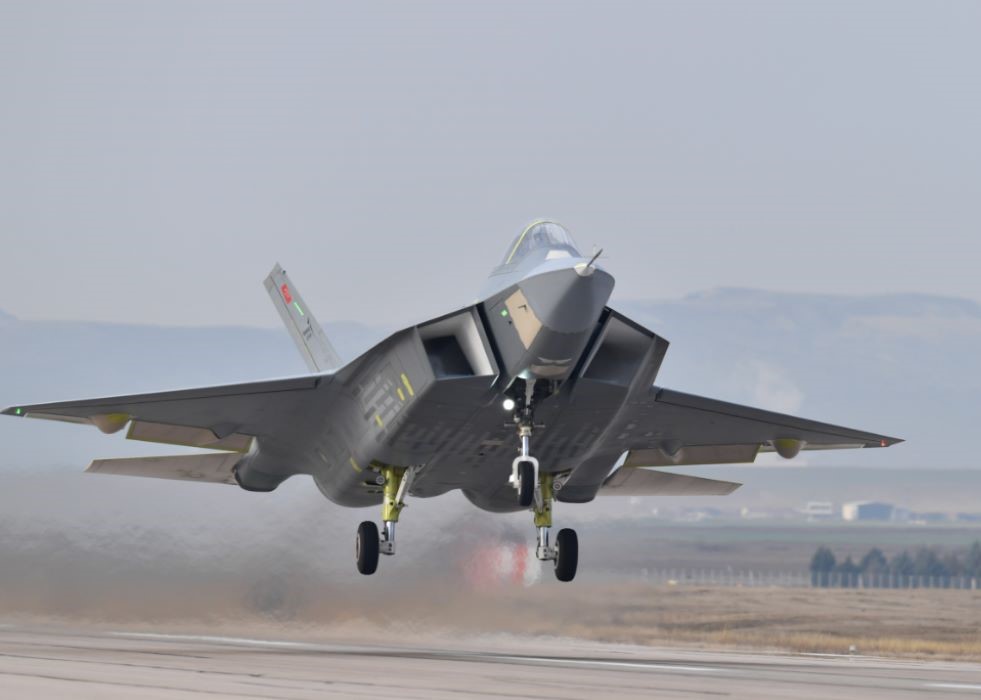
What KAAN Teaches Europe About Sovereign Air Power
Tanyel Çakmak, Ph.D.
Chief of Technology Development, Turkish Aerospace Industries (TUSAŞ)
Introduction
Europe is at a defining moment in combat air. FCAS — the continent's flagship sixth-generation fighter programme — is under pressure. Industrial disputes between Airbus and Dassault, delays in phase execution, and an accelerating geopolitical environment have exposed the fragility of multinational technology development when sovereign interests diverge [1].
The numbers tell a stark story. In 2025, for the first time in NATO's history, all 32 Alliance members met the 2% GDP defence spending target — and European allies and Canada increased their collective defence spending by 20% in a single year, reaching $574 billion [2, 3]. NATO members agreed at the 2025 Hague Summit to reach 5% of GDP in defence and related investments by 2035 [4]. Yet spending alone does not build sovereign capability. The critical question is not how much Europe spends — but what it builds, who owns it, and whether the industrial frameworks exist to sustain it [5, 6].
Türkiye's trajectory offers a striking contrast. With over 3,500 sector companies, more than 1,100 active projects, an R&D budget nearing $3 billion, a localisation rate exceeding 80%, and a project portfolio exceeding $100 billion, Türkiye achieved defence exports of $7.1 billion in 2024 — a 29% increase over the previous year [7]. Defence exports have grown from $1.9 billion a decade prior, with customers now spanning 178 countries [8, 9]. This was not the result of a budget increase alone. It was the result of a deliberate, decade-long investment in sovereign technology development — and KAAN is its most visible expression [10].
Meanwhile, Türkiye's KAAN completed its maiden flight on 21 February 2024 — on time, with over 90% domestic subcontracts on a clear path to full indigenous capability. This was not a coincidence. It was the result of a disciplined, decade-long commitment to sovereign technology development, executed under real programme pressure.
The lessons from KAAN are directly relevant to Europe's next-generation ambitions. Not as a competitor — but as a case study.
The Sovereign Technology Imperative
When Türkiye was removed from the F-35 programme in 2019, it accelerated what was already a strategic imperative: full ownership of critical defence technologies. The KAAN programme had to deliver not just an aircraft, but an entire technology ecosystem — from advanced materials and avionics to system integration and mission software — developed within Türkiye's own industrial base.
This is precisely the challenge Europe faces with FCAS. The question is not whether Europe has the engineering talent to build a sixth-generation fighter. It does. The question is whether the political and industrial frameworks can sustain the technology development process across national boundaries, diverging IP interests, and shifting procurement timelines.
KAAN's answer was to start with sovereignty and build outward — accepting international partnerships where they added genuine value, while retaining full ownership of operationally critical technologies. The result was a platform that no single foreign supplier can hold at risk.
The numbers behind KAAN speak for themselves. The programme achieved its maiden flight on 21 February 2024 — a milestone delivered within a decade of the initial design contract, despite the loss of F-35 programme participation in 2019 and the consequent need to accelerate domestic alternatives across multiple technology domains simultaneously. With the government’s commitment to at least 80% local content, six prototypes planned, and serial production underway, KAAN has already secured its first export contract — with Indonesia committing to 48 aircraft, including licensed production [11]. Perhaps most significantly, the MUM-T (Manned-Unmanned Teaming) concept demonstrated at the World Defence Show 2026, pairing KAAN with ANKA-3 unmanned combat air vehicles, signals that Türkiye is not simply building a fifth-generation fighter — it is architecting a sixth-generation ecosystem [12].
This trajectory — from a nation with less than 20% domestic defence production in the early 2000s to one exporting fifth-generation platforms to four continents — did not happen by accident. It happened because Türkiye made a deliberate, irreversible choice: to own its critical technologies, or not to have them at all.
Three Lessons from KAAN for European Next-Generation Development
1. Technology Readiness Cannot Be Rushed — But It Must Be Managed
One of the most persistent failure modes in complex platform programmes is the premature integration of immature technologies. KAAN's technology development process was built around rigorous Technology Readiness Level (TRL) assessments, ensuring that critical subsystems reached maturity before integration into the platform architecture.
For FCAS, this means resisting the temptation to compress phase timelines under political pressure. The cost of integrating a technology at TRL 4 into a system-of-systems architecture is exponentially higher than the cost of completing its development first. Speed comes from discipline — not from shortcuts.
2. Workshare Must Follow Capability — Not Politics
The current impasse between Airbus and Dassault is, at its core, a workshare dispute. Who owns the fighter's most valuable intellectual property? Who leads on which subsystem? These questions became toxic because they were left unresolved at the programme's foundation.
This is not theoretical. The Eurofighter Typhoon programme — involving the UK, Germany, Spain, and Italy — demonstrated both the strengths and the limits of multinational workshare. Each nation brought genuine, differentiated capability to the programme: BAE Systems led on the forward fuselage and flight control systems, CASA on the rear fuselage, and the consortium on avionics integration. The model worked because workshare was anchored in industrial competence, not negotiated as a political concession.
The A400M transport aircraft offers a parallel lesson. As a seven-nation programme managed through OCCAR (Organisation Conjointe de Coopération en matière d'Armement), it showed that multinational procurement can deliver sovereign capability — but only when each partner's contribution is defined by what they can genuinely build, not what they want to be seen building.
Türkiye's own experience in both programmes — as a significant A400M customer and a former F-35 industrial partner — reinforced a critical insight: the most resilient international programmes are those where each nation's workshare reflects real capability, creating genuine interdependence rather than managed dependency.
KAAN's experience demonstrates that workshare allocation must follow genuine capability — not political negotiation. Where Türkiye had sovereign capability, it led. Where it did not, it partnered strategically. The programme's integrity was preserved because the technology ownership model was clear from the outset.
3. International Partnerships Strengthen — They Do Not Replace — Sovereignty
KAAN benefited from five years of deep technical collaboration with BAE Systems on the TF-X programme – structured around a technical support provider model, in which BAE Systems contributed specific engineering capabilities while full technology ownership remained with Türkiye. This partnership accelerated specific engineering capabilities and established a foundation of mutual understanding that continues to shape the Türkiye-UK defence relationship today.
But the partnership worked because it was structured to build sovereign capability — not to create dependency. Every engineering discipline developed in collaboration, was anchored in a clear vision of what Türkiye would own at the end of the programme.
This is the model Europe needs for FCAS. French and German industrial interests are not incompatible — but they must be aligned around a shared vision of what European sovereignty in sixth-generation air power actually means.
Looking Ahead: The Sixth-Generation Horizon
The transition from fifth to sixth generation is not merely a technology upgrade. It represents a fundamental shift in how combat air power is conceived — from individual platforms to integrated systems of systems, from pilot-centric to human-machine teaming, from national inventories to interoperable fleets.
Türkiye has already begun defining the technology roadmap for its next-generation combat air system, building on the foundations laid by KAAN. The key technologies — advanced propulsion, adaptive stealth, AI-enabled mission systems, and multi-domain connectivity — are not distant aspirations. They are active development programmes.
Europe's window to establish a credible, sovereign sixth-generation capability is narrow. The geopolitical environment will not wait for industrial disputes to be resolved. The question is not whether FCAS will eventually deliver a capable aircraft. The question is whether the current pace of resolution — on workshare, IP ownership, and phase execution — is sufficient to meet the urgency the geopolitical environment demands.
Conclusion
KAAN is not a template for Europe. Every programme operates within its own political, industrial, and strategic context. But the underlying principles — sovereignty first, capability-driven workshare, partnerships that build rather than replace indigenous competence — are universal.
As Europe accelerates its defence build-up and confronts the urgent reality of next-generation air power, the experience of KAAN offers something rare in the defence world: a recent, successful example of indigenous fifth-generation development, completed under genuine pressure, by a nation that chose the harder path of sovereign capability over the easier path of dependency.
That is a lesson worth studying.
References
[1] Breaking Defense. (2025). FCAS Drama: Difficulties Between Airbus and Dassault Again Hit Sixth-Gen Fighter Effort. June 2025.
www.breakingdefense.com
[2] NATO Secretary General's Annual Report 2025. Defence Expenditure of NATO Countries (2014–2025). NATO, March 2026.
www.nato.int
[3] Rutte, M. (2026). NATO Annual Report 2025: European Allies and Canada Boost Defence Spending by 20%. NATO Press Release, 26 March 2026.
[4] NATO. (2025). Defence Expenditures and NATO's 5% Commitment. NATO Topic Page.
www.nato.int
[5] UK Ministry of Defence. (2025). Finance and Economics Annual Statistical Bulletin: International Defence 2025. HM Government, December 2025.
www.gov.uk
[6] European Council. (2025). EU Defence in Numbers. Council of the European Union.
www.consilium.europa.eu
[7] Görgün, H. (2025). SSB 2024 Evaluation&2025 Goals. Defence Turkey Magazine, January 2025.
www.defenceturkey.com
[8] Al Jazeera. (2025). Türkiye's Booming Defence Industry — A Quick Look. Al Jazeera, March 2025.
www.aljazeera.com
[9] Atalayar. (2025). Turkey Exported Arms and Aircraft Worth $7.154 Billion in 2024. February 2025.
www.atalayar.com
[10] Stiftung Wissenschaft und Politik (SWP). (2024). Turkey: An Emerging Global Arms Exporter. SWP Comment 2024/C 06.
[11] Mordor Intelligence. (2025). Turkey Aerospace and Defence Industry Size, Share&Report 2030.
www.mordorintelligence.com
[12] SAHA EXPO / TUSAŞ. (2026). KAAN and MUM-T Concept Display, World Defence Show 2026. Riyadh, March 2026.
The views expressed in this article are those of the author and do not necessarily represent the official position of Turkish Aerospace Industries (TUSAŞ).