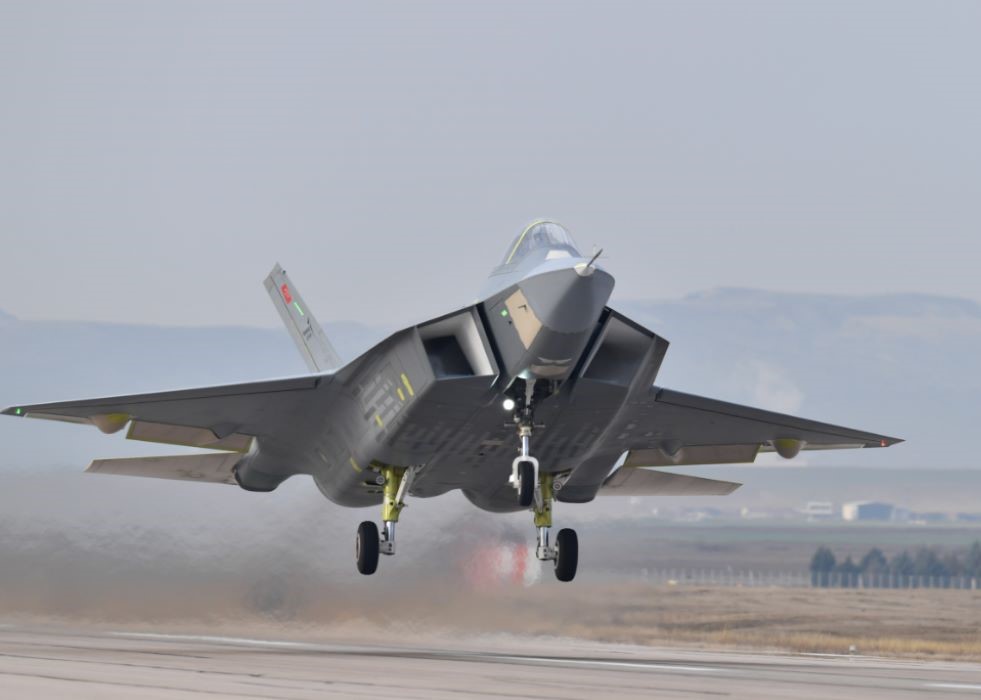
TR Air-Force TF-X KAAN Fighter Jet

IC3M@N FX

Contributor
Messages
595
Reactions
3 30 1,215
Nation of residence
Germany
Nation of origin
Turkey

Internal and External Weapon Integrations for KAAN​


TÜBİTAK SAGE has performed integration work of both internally and externally carried munitions for the KAAN fighter jet in 2025, according to the activity report.
TÜBİTAK’s 2025 activity report included the ongoing integration work for external weapons of the KAAN fighter jet. KGK winged guided bombs, HGK GNSS guided bombs, and SOM cruise missiles are the first externally carried munitions to be integrated on the KAAN fighter. HGK is a GNSS/INS guidance kit available to all Mk-80 GPBs, while KGK, available from Mk-82 to Mk-84, provides extended range through the wing kit. Baseline SOM variants, unlike SOM-J, are too large to fit inside KAAN’s internal bays.
Considering the time it will take to ready the internal weapon bays, and the fact that external weapons testing is less complicated, it is expected that the first weapon tests for KAAN will be performed with the externally carried munitions.
SOM-J, GÖKDOĞAN, BOZDOĞAN, and GÖKHAN will be carried internally; the integration work was previously announced by the Minister of Industry and Technology, Mehmet Fatih Kacır.
 

Gaucho

Active member
Messages
29
Reactions
4 137
Nation of residence
Uruguay
Nation of origin
Uruguay
KAAN Block-10 Fighters to be Introduced Between 2027-2029


"Turkish MoD stated that the initial production variant of the KAAN fighter jet, KAAN Block-10, will be introduced to the inventory between 2027 and 2029.

The 2025 activity report of the Turkish MoD includes that KAAN Block-10 fighter jets, as the low-rate initial production (LRIP) batch, will be taken into the Turkish Air Force inventory between 2027 and 2029."
 

inthrustwetrust

New member
Messages
4
Reactions
13
Nation of residence
Turkey
Nation of origin
Turkey
Kaan in TurAF inventory in 2027, this was not even promised. I want to see Kaan in the TurAF inventory with the TF35k engine in 2029, this is possible.
No, it isn't possible, even in the wildest of imaginations.


It took 11 years for the F119 to go from ground test to production model. This engine was developed by the most experienced engine producer in the world, which had already developed eleven jet engines before this one. The same company developed the F135 based on the F119, and it still took them 9 years to go from ground test to a complete production model. There are hundreds of unique parts in a turbofan engine—tens of components, and each one is a whole world in itself. Such an engine is more complex and harder to develop than anything the Turkish arms industry has done so far.


They could deliver an operational engine with a wet thrust of 35,000 lbf by 2035. Will its dry thrust match the F119's 26,000 lbf? Probably not. It will also have a low TBO at first.

God, you are ‘optimistic’.

*Typo
 

Huelague

Experienced member
Messages
5,090
Reactions
19 5,179
Nation of residence
Germany
Nation of origin
Turkey
To be honest, @Zafer has a point. The whole world laughed at us, even our people, as we talked to develop a 5. Gen. Fighter Jet out of nowhere, same goes for Tf-2000. Now, look where we are. And how fast we go.
 

hugh

Contributor
Messages
564
Reactions
17 1,519
Nation of residence
Turkey
Nation of origin
Turkey
people should stop writing 2027 as if it's a distant time in future. write "next year". now should we expect KAAN in inventor next year? like seriously? the first real prototype hasn't even flown yet but the aircraft will be delivered to the force next year? I mean there are delusional and then there is this.

and then don't even get me started on TF35K. that engine will not be fired before 2028. we haven't even started building it yet. the latest TEI rendering shows that the design needs time to mature.
 

Yasar_TR

Experienced member
Staff member
Administrator
Messages
4,009
Reactions
240 20,860
Nation of residence
United Kingdom
Nation of origin
Turkey
A modern stealth plane’s engine TIT value has not got much to do with it’s IR signature.
A plane like F35 has an engine that is at the limit of current engineering capability. Because of that, the engine keeps breaking down.
The engine’s exact TIT at 1980degrees Celsius is a guesstimate as it is a classified information and not released by US sources. But it is not too far out of that figure. However the plane has very good cooling systems and shielding to camouflage the high heat it‘s engine generates. Consequently it has a relatively low IR signature.
In fact the IR signature of F15 planes are much higher than f35s.

Twin engines don’t help IR signature. It is how well the heat sources are shielded and camouflaged.

A TIT value nearing 2000 degrees Celsius of the f35’s engine, brings with it many problems. Hence f135 engine falters quicker than a f119 engine that powers f22. (F119 has a TIT value of less than 1650 degrees Celsius).
F22, due to it’s superlative nozzle geometry and very good heat shielding together with it’s lower TIT has a lower IR signature than F35 inspite of it’s twin engines.
 

Zafer

Experienced member
Messages
5,306
Reactions
15 8,210
Nation of residence
Turkey
Nation of origin
Turkey
Gg2UwRtXoAALgLF
 

Iskander

Contributor
Think Tank Analyst
Messages
1,050
Reactions
20 2,705
Nation of residence
Azerbaijan
Nation of origin
Azerbaijan
No, it isn't possible, even in the wildest of imaginations.


It took 11 years for the F119 to go from ground test to production model. This engine was developed by the most experienced engine producer in the world, which had already developed eleven jet engines before this one. The same company developed the F135 based on the F119, and it still took them 9 years to go from ground test to a complete production model. There are hundreds of unique parts in a turbofan engine—tens of components, and each one is a whole world in itself. Such an engine is more complex and harder to develop than anything the Turkish arms industry has done so far.


They could deliver an operational engine with a wet thrust of 35,000 lbf by 2035. Will its dry thrust match the F119's 26,000 lbf? Probably not. It will also have a low TBO at first.

God, you are ‘optimistic’.

*Typo
Türkiye, as we know, was not a pioneer in aircraft and engine production. It is simply following the path blazed by other, more developed countries with vast experience. Therefore, Türkiye engineers will have a much easier time; they won't have to repeat the mistakes of aircraft and engine pioneers.
Ten years ago, we could only dream of a Türkiye fighter, but today it already exists and flies.
Russians have been producing fighters for over a hundred years. The Su-57 first flew in 2010. In 16 years, they have produced 35-40 aircraft.
The KAAN made its maiden flight just two years ago.
This may seem like fantasy to many, but I am confident that in a few years, Türkiye will produce more KAAN than Russia produces Su-57.
 

Zafer

Experienced member
Messages
5,306
Reactions
15 8,210
Nation of residence
Turkey
Nation of origin
Turkey
Türkiye, as we know, was not a pioneer in aircraft and engine production. It is simply following the path blazed by other, more developed countries with vast experience. Therefore, Türkiye engineers will have a much easier time; they won't have to repeat the mistakes of aircraft and engine pioneers.
Ten years ago, we could only dream of a Türkiye fighter, but today it already exists and flies.
Russians have been producing fighters for over a hundred years. The Su-57 first flew in 2010. In 16 years, they have produced 35-40 aircraft.
The KAAN made its maiden flight just two years ago.
This may seem like fantasy to many, but I am confident that in a few years, Türkiye will produce more KAAN than Russia produces Su-57.
"Necessity is the mother of invention"; some take their time doing things and some does their best.

There was no reliable simulation software before 2003 or so, but who cares.
 

Spitfire9

Contributor
Think Tank Analyst
Messages
1,059
Reactions
17 1,412
Nation of residence
United Kingdom
Nation of origin
United Kingdom
How is the afterburning version of TF6000 progressing? As I understand things, a lot of the knowledge gained from TF10000 development was supposed to feed into TF35000 development.
 

inthrustwetrust

New member
Messages
4
Reactions
13
Nation of residence
Turkey
Nation of origin
Turkey
How is the afterburning version of TF6000 progressing? As I understand things, a lot of the knowledge gained from TF10000 development was supposed to feed into TF35000 development.

"TF6000 still has a few years of testing and development ahead" September 2025.

It needs to reach a production ready variant before TF10000 can be developed based on it. We need to see TF6000 integrated into a UCAV before we can even start expecting TF10000.
Some defense companies tend to start publicity even before projects properly begin, and then people come here claiming that TF35000 could be installed on Kaan and delivered to the Turkish Air Force by 2029. Meanwhile, we haven’t even seen Kaan P1 fly, let alone Kaan Block 20 or TF10000 tested, let alone TF35000.
I wouldn’t hold my breath for these engines. Kaan will still be the third best fighter in the world even without TF35000. These engines will happen eventually, but TF10000 is unlikely to power any UCAV before the 2030s.
 

hugh

Contributor
Messages
564
Reactions
17 1,519
Nation of residence
Turkey
Nation of origin
Turkey
"TF6000 still has a few years of testing and development ahead" September 2025.

It needs to reach a production ready variant before TF10000 can be developed based on it. We need to see TF6000 integrated into a UCAV before we can even start expecting TF10000.
Some defense companies tend to start publicity even before projects properly begin, and then people come here claiming that TF35000 could be installed on Kaan and delivered to the Turkish Air Force by 2029. Meanwhile, we haven’t even seen Kaan P1 fly, let alone Kaan Block 20 or TF10000 tested, let alone TF35000.
I wouldn’t hold my breath for these engines. Kaan will still be the third best fighter in the world even without TF35000. These engines will happen eventually, but TF10000 is unlikely to power any UCAV before the 2030s.
TF6000 and TF10000 are not different engines. TF10000 is an afterburner extension to TF6000 albeit with some small structural changes due to the added axial loads. TF10000 is probably is being built right now(speculating). The core engine has reached its rated thrust but it needs time to mature before powering any aircraft. Engine maturation is a lengthier process than reaching mere thrust targets.
 

IC3M@N FX

Contributor
Messages
595
Reactions
3 30 1,215
Nation of residence
Germany
Nation of origin
Turkey
Do we now know the configuration of the TEI TF-35000?

My Config:

1x Fan
LPC (2-stage) & HPC (6-stage) 8-Stages
HPT (2-stage)
LPT (2-stage)
Bypass Ratio 0,45 <-- Performance and cooling = Sweetspot


The sections in detail:

Fan (single-stage): Must be designed for a very wide operating range (wide-chord blades) to strike a balance between high airflow during take-off and efficiency at Mach 1.3 (Speed, range and fuel consumption in Supercruise + low IR Signature = Sweetspot) without Afterburner.

LPC (2-stage) & HPC (6-stage): With a total of 8 stages, you achieve an enormous compression ratio and Ease of maintenance. This ensures a very high energy density at the combustion chamber inlet.

HPT (2-stage): This is the key feature. Many US engines use only a single stage. Whilst two stages mean more weight, they can extract energy from the hot gas flow more efficiently without the individual blade being thermally ‘overloaded’.
This is ideal for the Turkish strategy with Nickel-SX.

LPT (2-stage): With a bypass ratio of 0.45, this is entirely sufficient to drive the fan and saves weight compared to a 3- or 4-stage low-pressure turbine.
 
Last edited:

IC3M@N FX

Contributor
Messages
595
Reactions
3 30 1,215
Nation of residence
Germany
Nation of origin
Turkey

What KAAN Teaches Europe About Sovereign Air Power​


Tanyel Çakmak, Ph.D.
Chief of Technology Development, Turkish Aerospace Industries (TUSAŞ)
Introduction
Europe is at a defining moment in combat air. FCAS — the continent's flagship sixth-generation fighter programme — is under pressure. Industrial disputes between Airbus and Dassault, delays in phase execution, and an accelerating geopolitical environment have exposed the fragility of multinational technology development when sovereign interests diverge [1].
The numbers tell a stark story. In 2025, for the first time in NATO's history, all 32 Alliance members met the 2% GDP defence spending target — and European allies and Canada increased their collective defence spending by 20% in a single year, reaching $574 billion [2, 3]. NATO members agreed at the 2025 Hague Summit to reach 5% of GDP in defence and related investments by 2035 [4]. Yet spending alone does not build sovereign capability. The critical question is not how much Europe spends — but what it builds, who owns it, and whether the industrial frameworks exist to sustain it [5, 6].
Türkiye's trajectory offers a striking contrast. With over 3,500 sector companies, more than 1,100 active projects, an R&D budget nearing $3 billion, a localisation rate exceeding 80%, and a project portfolio exceeding $100 billion, Türkiye achieved defence exports of $7.1 billion in 2024 — a 29% increase over the previous year [7]. Defence exports have grown from $1.9 billion a decade prior, with customers now spanning 178 countries [8, 9]. This was not the result of a budget increase alone. It was the result of a deliberate, decade-long investment in sovereign technology development — and KAAN is its most visible expression [10].
Meanwhile, Türkiye's KAAN completed its maiden flight on 21 February 2024 — on time, with over 90% domestic subcontracts on a clear path to full indigenous capability. This was not a coincidence. It was the result of a disciplined, decade-long commitment to sovereign technology development, executed under real programme pressure.
The lessons from KAAN are directly relevant to Europe's next-generation ambitions. Not as a competitor — but as a case study.

The Sovereign Technology Imperative​

When Türkiye was removed from the F-35 programme in 2019, it accelerated what was already a strategic imperative: full ownership of critical defence technologies. The KAAN programme had to deliver not just an aircraft, but an entire technology ecosystem — from advanced materials and avionics to system integration and mission software — developed within Türkiye's own industrial base.
This is precisely the challenge Europe faces with FCAS. The question is not whether Europe has the engineering talent to build a sixth-generation fighter. It does. The question is whether the political and industrial frameworks can sustain the technology development process across national boundaries, diverging IP interests, and shifting procurement timelines.
KAAN's answer was to start with sovereignty and build outward — accepting international partnerships where they added genuine value, while retaining full ownership of operationally critical technologies. The result was a platform that no single foreign supplier can hold at risk.
The numbers behind KAAN speak for themselves. The programme achieved its maiden flight on 21 February 2024 — a milestone delivered within a decade of the initial design contract, despite the loss of F-35 programme participation in 2019 and the consequent need to accelerate domestic alternatives across multiple technology domains simultaneously. With the government’s commitment to at least 80% local content, six prototypes planned, and serial production underway, KAAN has already secured its first export contract — with Indonesia committing to 48 aircraft, including licensed production [11]. Perhaps most significantly, the MUM-T (Manned-Unmanned Teaming) concept demonstrated at the World Defence Show 2026, pairing KAAN with ANKA-3 unmanned combat air vehicles, signals that Türkiye is not simply building a fifth-generation fighter — it is architecting a sixth-generation ecosystem [12].
This trajectory — from a nation with less than 20% domestic defence production in the early 2000s to one exporting fifth-generation platforms to four continents — did not happen by accident. It happened because Türkiye made a deliberate, irreversible choice: to own its critical technologies, or not to have them at all.

Three Lessons from KAAN for European Next-Generation Development​

1. Technology Readiness Cannot Be Rushed — But It Must Be Managed​

One of the most persistent failure modes in complex platform programmes is the premature integration of immature technologies. KAAN's technology development process was built around rigorous Technology Readiness Level (TRL) assessments, ensuring that critical subsystems reached maturity before integration into the platform architecture.
For FCAS, this means resisting the temptation to compress phase timelines under political pressure. The cost of integrating a technology at TRL 4 into a system-of-systems architecture is exponentially higher than the cost of completing its development first. Speed comes from discipline — not from shortcuts.

2. Workshare Must Follow Capability — Not Politics​

The current impasse between Airbus and Dassault is, at its core, a workshare dispute. Who owns the fighter's most valuable intellectual property? Who leads on which subsystem? These questions became toxic because they were left unresolved at the programme's foundation.
This is not theoretical. The Eurofighter Typhoon programme — involving the UK, Germany, Spain, and Italy — demonstrated both the strengths and the limits of multinational workshare. Each nation brought genuine, differentiated capability to the programme: BAE Systems led on the forward fuselage and flight control systems, CASA on the rear fuselage, and the consortium on avionics integration. The model worked because workshare was anchored in industrial competence, not negotiated as a political concession.

The A400M transport aircraft offers a parallel lesson. As a seven-nation programme managed through OCCAR (Organisation Conjointe de Coopération en matière d'Armement), it showed that multinational procurement can deliver sovereign capability — but only when each partner's contribution is defined by what they can genuinely build, not what they want to be seen building.
Türkiye's own experience in both programmes — as a significant A400M customer and a former F-35 industrial partner — reinforced a critical insight: the most resilient international programmes are those where each nation's workshare reflects real capability, creating genuine interdependence rather than managed dependency.
KAAN's experience demonstrates that workshare allocation must follow genuine capability — not political negotiation. Where Türkiye had sovereign capability, it led. Where it did not, it partnered strategically. The programme's integrity was preserved because the technology ownership model was clear from the outset.

3. International Partnerships Strengthen — They Do Not Replace — Sovereignty​

KAAN benefited from five years of deep technical collaboration with BAE Systems on the TF-X programme – structured around a technical support provider model, in which BAE Systems contributed specific engineering capabilities while full technology ownership remained with Türkiye. This partnership accelerated specific engineering capabilities and established a foundation of mutual understanding that continues to shape the Türkiye-UK defence relationship today.
But the partnership worked because it was structured to build sovereign capability — not to create dependency. Every engineering discipline developed in collaboration, was anchored in a clear vision of what Türkiye would own at the end of the programme.
This is the model Europe needs for FCAS. French and German industrial interests are not incompatible — but they must be aligned around a shared vision of what European sovereignty in sixth-generation air power actually means.

Looking Ahead: The Sixth-Generation Horizon​

The transition from fifth to sixth generation is not merely a technology upgrade. It represents a fundamental shift in how combat air power is conceived — from individual platforms to integrated systems of systems, from pilot-centric to human-machine teaming, from national inventories to interoperable fleets.
Türkiye has already begun defining the technology roadmap for its next-generation combat air system, building on the foundations laid by KAAN. The key technologies — advanced propulsion, adaptive stealth, AI-enabled mission systems, and multi-domain connectivity — are not distant aspirations. They are active development programmes.
Europe's window to establish a credible, sovereign sixth-generation capability is narrow. The geopolitical environment will not wait for industrial disputes to be resolved. The question is not whether FCAS will eventually deliver a capable aircraft. The question is whether the current pace of resolution — on workshare, IP ownership, and phase execution — is sufficient to meet the urgency the geopolitical environment demands.

Conclusion​

KAAN is not a template for Europe. Every programme operates within its own political, industrial, and strategic context. But the underlying principles — sovereignty first, capability-driven workshare, partnerships that build rather than replace indigenous competence — are universal.
As Europe accelerates its defence build-up and confronts the urgent reality of next-generation air power, the experience of KAAN offers something rare in the defence world: a recent, successful example of indigenous fifth-generation development, completed under genuine pressure, by a nation that chose the harder path of sovereign capability over the easier path of dependency.
That is a lesson worth studying.

References​

[1] Breaking Defense. (2025). FCAS Drama: Difficulties Between Airbus and Dassault Again Hit Sixth-Gen Fighter Effort. June 2025. www.breakingdefense.com
[2] NATO Secretary General's Annual Report 2025. Defence Expenditure of NATO Countries (2014–2025). NATO, March 2026. www.nato.int
[3] Rutte, M. (2026). NATO Annual Report 2025: European Allies and Canada Boost Defence Spending by 20%. NATO Press Release, 26 March 2026.
[4] NATO. (2025). Defence Expenditures and NATO's 5% Commitment. NATO Topic Page. www.nato.int
[5] UK Ministry of Defence. (2025). Finance and Economics Annual Statistical Bulletin: International Defence 2025. HM Government, December 2025. www.gov.uk
[6] European Council. (2025). EU Defence in Numbers. Council of the European Union. www.consilium.europa.eu
[7] Görgün, H. (2025). SSB 2024 Evaluation&2025 Goals. Defence Turkey Magazine, January 2025. www.defenceturkey.com
[8] Al Jazeera. (2025). Türkiye's Booming Defence Industry — A Quick Look. Al Jazeera, March 2025. www.aljazeera.com
[9] Atalayar. (2025). Turkey Exported Arms and Aircraft Worth $7.154 Billion in 2024. February 2025. www.atalayar.com
[10] Stiftung Wissenschaft und Politik (SWP). (2024). Turkey: An Emerging Global Arms Exporter. SWP Comment 2024/C 06.
[11] Mordor Intelligence. (2025). Turkey Aerospace and Defence Industry Size, Share&Report 2030. www.mordorintelligence.com
[12] SAHA EXPO / TUSAŞ. (2026). KAAN and MUM-T Concept Display, World Defence Show 2026. Riyadh, March 2026.
The views expressed in this article are those of the author and do not necessarily represent the official position of Turkish Aerospace Industries (TUSAŞ).

 

Follow us on social media

Latest posts

Top Bottom