

I hope we'll see weapon tests from KE very soon, I genuinely can't wait.
Nice SOM-J you got there, would be too bad if two of them fits to IWB of Kızılelma.

Latest Thread
- Analysis Turkic joint military model
- CYBINT/DNINT U.S. Probes Cyberattacks on Energy Tankers Bound for American Coast
- Pilatus Aircraft - Switzerland 🇨🇭
- Defence Q&A How will tank armour evolve in the next 25 years?
- Breaking News Rumours - Israel sent a proposal to Ankara to divide Syria into zones of influence, this was rejected by Türkiye
You are using an out of date browser. It may not display this or other websites correctly.
You should upgrade or use an alternative browser.
You should upgrade or use an alternative browser.


When the time comes, some of our neighbours will be sleepless for sure
Nice SOM-J you got there, would be too bad if two of them fits to IWB of Kızılelma.

If SOM-j is launched from KE, why will need ANKA-3?
Nice SOM-J you got there, would be too bad if two of them fits to IWB of Kızılelma.
Why loading SOM-J in KE which is supposed to be unmanned fighter while we are having unmanned stealth bomber?
Anka 3 flies for 10 hours and KE for 5 max. Anka 3 will likely carry more Mk83If SOM-j is launched from KE, why will need ANKA-3?
Why loading SOM-J in KE which is supposed to be unmanned fighter while we are having unmanned stealth bomber?
So we don't need KE unless it is supersonic.Anka 3 flies for 10 hours and KE for 5 max. Anka 3 will likely carry more Mk83
I meant Anka 3 will often carry mk83 and the like. KE has different capabilitiesSo we don't need KE unless it is supersonic.

Anka-3 and KE are quite different aircrafts.
Anka-3 is subsonic. Being a flying wing, it can not go supersonic. But due to its airframe design, it is theoretically a true Low Observable plane. It should have a very low RCS value, especially when married with TF6000 engine. It will have 2 internal weapons bays, each able to house bombs and munition up to 635kg. This is a true deep strike weapon that will perform SEAD/DEAD missions as well as ISR and EW.
Where as KE is a supersonic air interceptor plane, it can carry out bombing missions as well. But it will probably do this from a somehow, stand off distance. It‘s canard design, detracts a little from the total low observable form. Nevertheless it should have a much better RCS than any 4.5 generation fighter jet, especially with RAM paint applied. A canard design is also known to provide good supersonic flight and excellent supersonic and transonic turn performance, and improved short-field landing performance compared to the conventional delta-wing design. So KE should lend itself very well as a carrier operated aircraft in the future.
Anka-3 is subsonic. Being a flying wing, it can not go supersonic. But due to its airframe design, it is theoretically a true Low Observable plane. It should have a very low RCS value, especially when married with TF6000 engine. It will have 2 internal weapons bays, each able to house bombs and munition up to 635kg. This is a true deep strike weapon that will perform SEAD/DEAD missions as well as ISR and EW.
Where as KE is a supersonic air interceptor plane, it can carry out bombing missions as well. But it will probably do this from a somehow, stand off distance. It‘s canard design, detracts a little from the total low observable form. Nevertheless it should have a much better RCS than any 4.5 generation fighter jet, especially with RAM paint applied. A canard design is also known to provide good supersonic flight and excellent supersonic and transonic turn performance, and improved short-field landing performance compared to the conventional delta-wing design. So KE should lend itself very well as a carrier operated aircraft in the future.


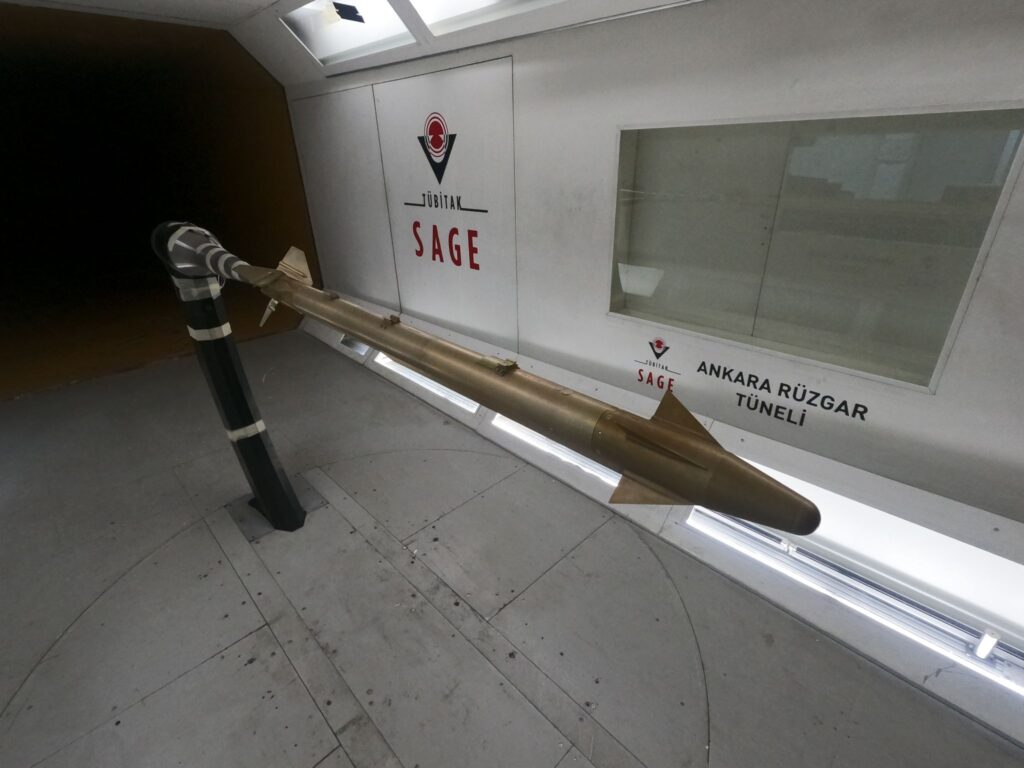
The foldable fin of GÖKSUR was tested in the Ankara Wind Tunnel.

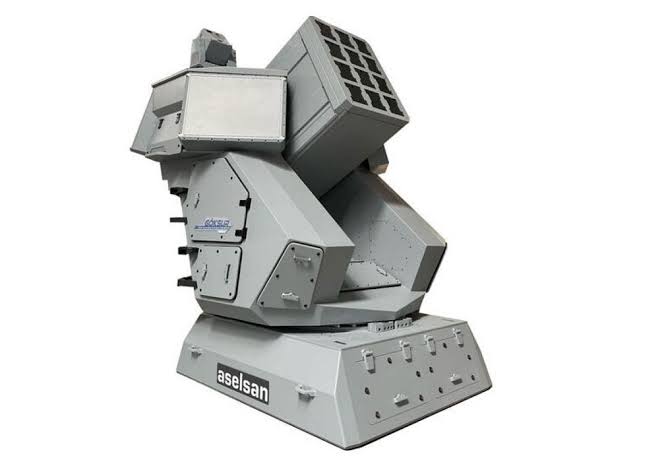
An important test phase related to ASELSAN's Autonomous Close-Range Air Defense Missile System, named GÖKSUR, was carried out in the Ankara Wind Tunnel.
Currently developed by ASELSAN for ship platforms, GÖKSUR will provide air defense using TÜBİTAK SAGE’s BOZDOĞAN-DH missile.
Tested in the Ankara Wind Tunnel
The foldable fin within-visual-range missile model developed under the project was tested at 0.2 Mach speed with different angles of attack, yaw, elevator, aileron, and rudder using the model movement system and a 6-component internal balance in the Ankara Wind Tunnel.
According to information shared by the TÜBİTAK SAGE team, four pressure measurements were taken from the cavity behind the model to perform axial force correction caused by the holding arm.
The scans were conducted continuously as angle of attack scans and yaw angle scans. Measurements were completed in 13 out of a total of 361 scan tests. A total of 15 different control surface angles were used in the tests.

First exhibited at IDEF’23
Specially developed for naval platforms, GÖKSUR was first exhibited at IDEF'23 held last year. The system was specifically designed for naval platforms.
The system uses the BOZDOĞAN-DH missile, developed by TÜBİTAK-SAGE and updated according to the air defense needs of naval platforms, as the interceptor missile. The GÖKSUR Close-Range Air Defense Missile System is being developed within a product family concept and offers a solution with three different configurations based on a modular design approach.
The GÖKSUR Close-Range Air Defense Missile System features 360-degree threat elimination capability, new generation IIR seeker guided missile, multiple target interception capability, ability to operate independently and/or integrated with a platform, mid-course guidance with data link, and high single-shot interception probability.

Equivalent to RAM
The system, which will be equivalent to the US-produced RAM System, has the primary task of destroying anti-ship missiles targeting naval platforms in the air. The Turkish Navy has long faced an embargo on the supply of munitions for the US-produced RAM System installed on the MİLGEM ADA Class Corvettes in its inventory.
Roketsan is also conducting studies on the subject within the scope of the LEVENT Project.
 tolgaozbek.com
An important test phase related to ASELSAN's Autonomous Close-Range Air Defense Missile System, named GÖKSUR, was carried out in the Ankara Wind Tunnel.
Currently developed by ASELSAN for ship platforms, GÖKSUR will provide air defense using TÜBİTAK SAGE’s BOZDOĞAN-DH missile.
Tested in the Ankara Wind Tunnel
The foldable fin within-visual-range missile model developed under the project was tested at 0.2 Mach speed with different angles of attack, yaw, elevator, aileron, and rudder using the model movement system and a 6-component internal balance in the Ankara Wind Tunnel.
According to information shared by the TÜBİTAK SAGE team, four pressure measurements were taken from the cavity behind the model to perform axial force correction caused by the holding arm.
The scans were conducted continuously as angle of attack scans and yaw angle scans. Measurements were completed in 13 out of a total of 361 scan tests. A total of 15 different control surface angles were used in the tests.
First exhibited at IDEF’23
Specially developed for naval platforms, GÖKSUR was first exhibited at IDEF'23 held last year. The system was specifically designed for naval platforms.
The system uses the BOZDOĞAN-DH missile, developed by TÜBİTAK-SAGE and updated according to the air defense needs of naval platforms, as the interceptor missile. The GÖKSUR Close-Range Air Defense Missile System is being developed within a product family concept and offers a solution with three different configurations based on a modular design approach.
The GÖKSUR Close-Range Air Defense Missile System features 360-degree threat elimination capability, new generation IIR seeker guided missile, multiple target interception capability, ability to operate independently and/or integrated with a platform, mid-course guidance with data link, and high single-shot interception probability.
Equivalent to RAM
The system, which will be equivalent to the US-produced RAM System, has the primary task of destroying anti-ship missiles targeting naval platforms in the air. The Turkish Navy has long faced an embargo on the supply of munitions for the US-produced RAM System installed on the MİLGEM ADA Class Corvettes in its inventory.
Roketsan is also conducting studies on the subject within the scope of the LEVENT Project.
GÖKSUR'un katlanır kanatçığı Ankara Rüzgar Tüneli'nde test edildi - Tolga Özbek
GÖKSUR olarak adlandırılan ASELSAN'ın Otonom Yakın Hava Savunma Füze Sistemi ile ilgili önemli bir test aşaması Ankara Rüzgar Tüneli'nde gerçekleştirildi.
tolgaozbek.com
Last edited:
Up up upThe foldable fin of GÖKSUR was tested in the Ankara Wind Tunnel.
An important test phase related to ASELSAN's Autonomous Close-Range Air Defense Missile System, named GÖKSUR, was carried out in the Ankara Wind Tunnel.
Currently developed by ASELSAN for ship platforms, GÖKSUR will provide air defense using TÜBİTAK SAGE’s BOZDOĞAN-DH missile.
Tested in the Ankara Wind Tunnel
The foldable fin within-visual-range missile model developed under the project was tested at 0.2 Mach speed with different angles of attack, yaw, elevator, aileron, and rudder using the model movement system and a 6-component internal balance in the Ankara Wind Tunnel.
According to information shared by the TÜBİTAK SAGE team, four pressure measurements were taken from the cavity behind the model to perform axial force correction caused by the holding arm.
The scans were conducted continuously as angle of attack scans and yaw angle scans. Measurements were completed in 13 out of a total of 361 scan tests. A total of 15 different control surface angles were used in the tests.
First exhibited at IDEF’23
Specially developed for naval platforms, GÖKSUR was first exhibited at IDEF'23 held last year. The system was specifically designed for naval platforms.
The system uses the BOZDOĞAN-DH missile, developed by TÜBİTAK-SAGE and updated according to the air defense needs of naval platforms, as the interceptor missile. The GÖKSUR Close-Range Air Defense Missile System is being developed within a product family concept and offers a solution with three different configurations based on a modular design approach.
The GÖKSUR Close-Range Air Defense Missile System features 360-degree threat elimination capability, new generation IIR seeker guided missile, multiple target interception capability, ability to operate independently and/or integrated with a platform, mid-course guidance with data link, and high single-shot interception probability.
Equivalent to RAM
The system, which will be equivalent to the US-produced RAM System, has the primary task of destroying anti-ship missiles targeting naval platforms in the air. The Turkish Navy has long faced an embargo on the supply of munitions for the US-produced RAM System installed on the MİLGEM ADA Class Corvettes in its inventory.
Roketsan is also conducting studies on the subject within the scope of the LEVENT Project.
GÖKSUR'un katlanır kanatçığı Ankara Rüzgar Tüneli'nde test edildi - Tolga Özbek
GÖKSUR olarak adlandırılan ASELSAN'ın Otonom Yakın Hava Savunma Füze Sistemi ile ilgili önemli bir test aşaması Ankara Rüzgar Tüneli'nde gerçekleştirildi.


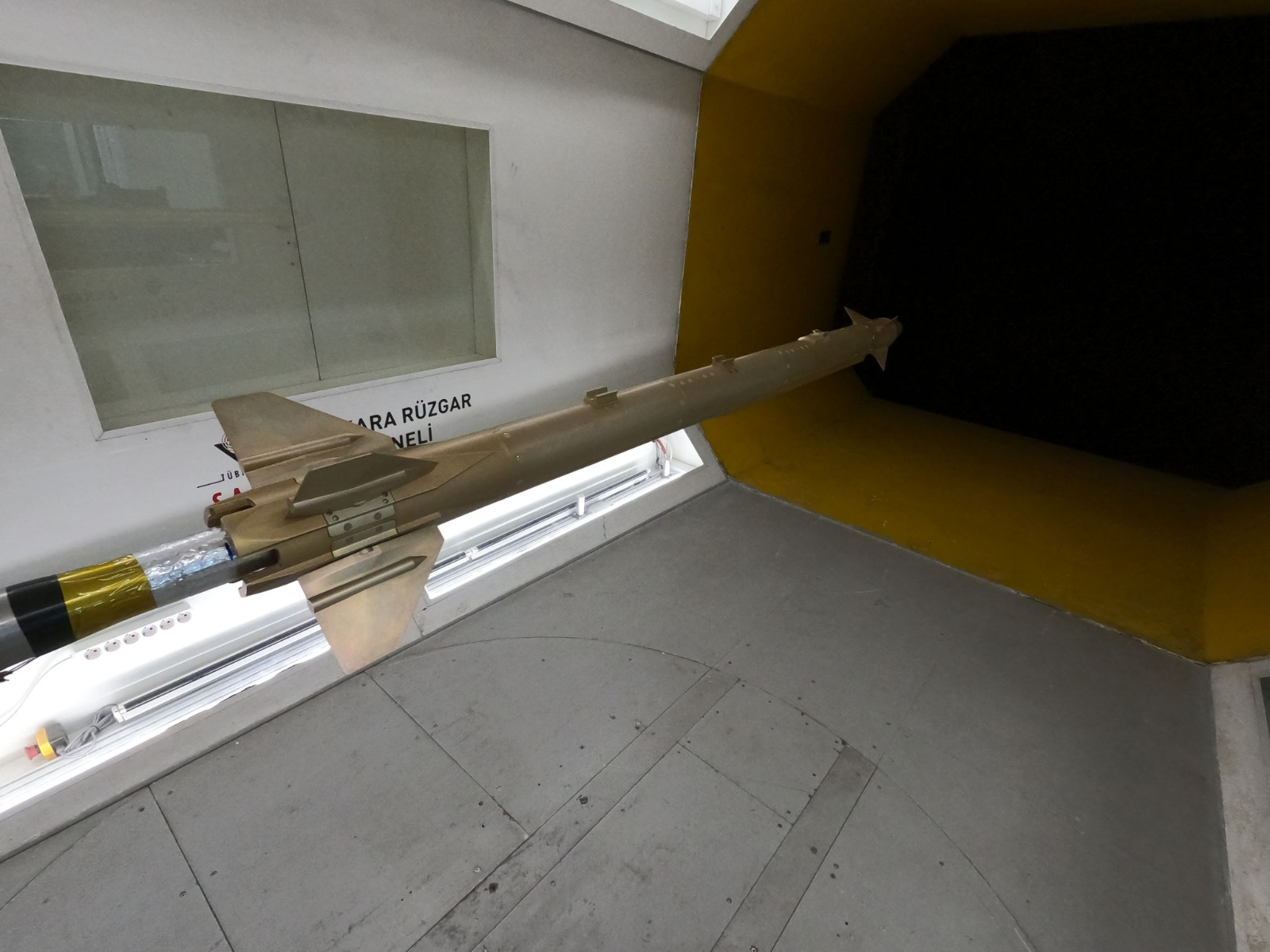
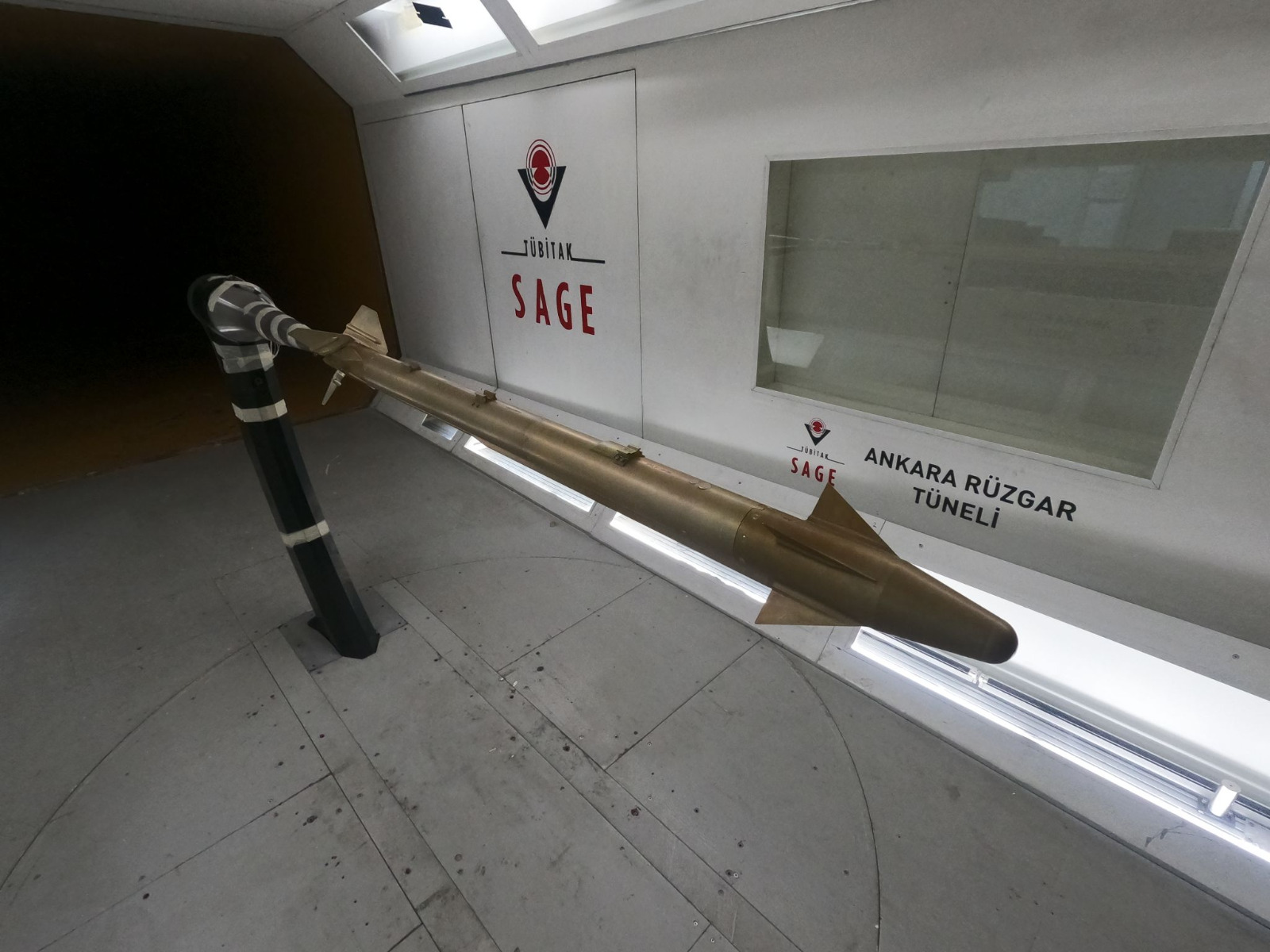
The canister exit velocity tests of Bozdoğan-DH missile, which is the most important section of Göksur CIWS developed for TNF in cooperation with Aselsan/Tübitak Sage, were carried out at ART. The missile will be an improved version of Bozdogan AA missile for naval platforms
https://twitter.com/T_Nblty


The canister exit velocity tests of Bozdoğan-DH missile, which is the most important section of Göksur CIWS developed for TNF in cooperation with Aselsan/Tübitak Sage, were carried out at ART. The missile will be an improved version of Bozdogan AA missile for naval platforms
https://twitter.com/T_Nblty
IMO, this is better than Roketsan Sungur RF.
IMO, this is better than Roketsan Sungur RF.
in a way I agree and seems that Bozdoğan DH may one step ahead?... yet eventhough I may ask for too much I hope both missiles find their places by time, in any case studies on Levent missile is a worthy attempt and definitly important as well IMOLevent missile seems to be our first missile with 8 forward canards (Turkish Python 5)
-more lift upfront
- easier to adjust the angle of attack - high pitch authority- in short most probably our most agile missile so far
-purely speculative but who knows we may be looking at a near future Air to Air missile design as well ???

It depends. It has only an IIR sensor and no passive RF sensors. It is big and expensive because it is designed as an a-a missile for high-value air targets.IMO, this is better than Roketsan Sungur RF.


Wouldn't they each have their own functions depending on operational range/engagement range?
I mean you'd launch this first, and have Sungur 12xcannister launcher ready to spray and pray. along with Phallanx or 35mm
I mean you'd launch this first, and have Sungur 12xcannister launcher ready to spray and pray. along with Phallanx or 35mm

It's still not clear whether it's Göksur or Levent that will take a place on the naval platforms. Both companies are continuing development, with TN using 3D models of Roketsan's launcher. Aselsan & Tubitak are more than just a step ahead, the launcher should be ready by the end of this year, and they have designed (concept) a wider range of applications for the missile and launcher system. They are also studying a VL version for certain applications, if I am not mistaken.The foldable fin of GÖKSUR was tested in the Ankara Wind Tunnel.
An important test phase related to ASELSAN's Autonomous Close-Range Air Defense Missile System, named GÖKSUR, was carried out in the Ankara Wind Tunnel.
Currently developed by ASELSAN for ship platforms, GÖKSUR will provide air defense using TÜBİTAK SAGE’s BOZDOĞAN-DH missile.
Tested in the Ankara Wind Tunnel
The foldable fin within-visual-range missile model developed under the project was tested at 0.2 Mach speed with different angles of attack, yaw, elevator, aileron, and rudder using the model movement system and a 6-component internal balance in the Ankara Wind Tunnel.
According to information shared by the TÜBİTAK SAGE team, four pressure measurements were taken from the cavity behind the model to perform axial force correction caused by the holding arm.
The scans were conducted continuously as angle of attack scans and yaw angle scans. Measurements were completed in 13 out of a total of 361 scan tests. A total of 15 different control surface angles were used in the tests.
First exhibited at IDEF’23
Specially developed for naval platforms, GÖKSUR was first exhibited at IDEF'23 held last year. The system was specifically designed for naval platforms.
The system uses the BOZDOĞAN-DH missile, developed by TÜBİTAK-SAGE and updated according to the air defense needs of naval platforms, as the interceptor missile. The GÖKSUR Close-Range Air Defense Missile System is being developed within a product family concept and offers a solution with three different configurations based on a modular design approach.
The GÖKSUR Close-Range Air Defense Missile System features 360-degree threat elimination capability, new generation IIR seeker guided missile, multiple target interception capability, ability to operate independently and/or integrated with a platform, mid-course guidance with data link, and high single-shot interception probability.
Equivalent to RAM
The system, which will be equivalent to the US-produced RAM System, has the primary task of destroying anti-ship missiles targeting naval platforms in the air. The Turkish Navy has long faced an embargo on the supply of munitions for the US-produced RAM System installed on the MİLGEM ADA Class Corvettes in its inventory.
Roketsan is also conducting studies on the subject within the scope of the LEVENT Project.
GÖKSUR'un katlanır kanatçığı Ankara Rüzgar Tüneli'nde test edildi - Tolga Özbek
GÖKSUR olarak adlandırılan ASELSAN'ın Otonom Yakın Hava Savunma Füze Sistemi ile ilgili önemli bir test aşaması Ankara Rüzgar Tüneli'nde gerçekleştirildi.
in a way I agree and seems that Bozdoğan DH may one step ahead?... yet eventhough I may ask for too much I hope both missiles find their places by time, in any case studies on Levent missile is a worthy attempt and definitly important as well IMO
I believe it is far superior in terms of agility, acceleration, target acquisition (as it benefits from being an A2A missile) but this all comes at a cost, it is heavy and requires a winch for installation and at least 4/5 men and a trolley. Logistically, it can be stored in smaller quantities and has a cumbersome reloading sequence.
While the Levent falls behind in agility and performance, logistically it is quite simple, light and can be handled by 3 people.
If it is a FAC / USV without additional air defence missiles I would prefer Goksur as it can also engage low altitude high speed targets or helis at longer range, while if it is a Corvette and above that needs a higher amount of such missiles I would prefer Levent. On the other hand, Bozdogan DH (Goksur) has a better chance against supersonic/hypersonic missiles.
Roketsan should develop variants of Levent, such as IR - IR beam ride, passive guided RF (illuminated), in addition to the originally planned IIR and IIR+RF. Cirit could have been the cheap C-UAS, but we missed the opportunity, let's try it with Levent as a multi-purpose C-UAS capable of engaging both air and ground threats of various sizes. Half of the anti-ship missiles have no RF guidance anyway, IIR is rising.
No there is a reason why there is no naval AIM-9X. There were sea sparrow based short range naval air defense systems in the past but they were abandoned in favor of RAM and today there are no naval air defense systems based on the predecessor of sea sparrow.Wouldn't they each have their own functions depending on operational range/engagement range?
I mean you'd launch this first, and have Sungur 12xcannister launcher ready to spray and pray. along with Phallanx or 35mm
If we try to intercept incoming missiles and UAVs with Bozdoğan we will likely lose that war fast after the first month.
Last edited:

Baryshx
Contributor
We need agility and performance. Price and weight are secondary, it is the safety of the ships that matters.
You are talking as if Levent won't have agility and performance. Levent will be an inherently agile missile as it is a lot lighter than Bozdogan. Bozdogan uses some really expensive and exotic subsystems to be agile at that weight. Less mass=more inherent agility, more mass=less inherent agility because accelerating, decelerating, and changing the direction of the moving mass in 3D space is very difficult at high speeds(inertia). You need to use exotic subsystems to counteract that which means an expensive missile.We need agility and performance. Price and weight are secondary, it is the safety of the ships that matters.
As I said no one uses AIM-9X instead of RAM and there are good reasons for that.
Baryshx
Contributor
Maybe the US uses AIM-9X and we don't know about it. They use Ram in demonstrations and exercises. And sells Ram to other countries.You are talking as if Levent won't have agility and performance. Levent will be an inherently agile missile as it is a lot lighter than Bozdogan. Bozdogan uses some really expensive and exotic subsystems to be agile at that weight. Less mass=more inherent agility, more mass=less inherent agility because accelerating, decelerating, and changing the direction of the moving mass in 3D space is very difficult at high speeds(inertia). You need to use exotic subsystems to counteract that which means an expensive missile.
As I said no one uses AIM-9X instead of RAM and there are good reasons for that.
İf AIM-9x is useless, we should throw Hisar A trashcan
Bozdoğan with data link could waste much more threats than Levent.
I would say Microwave seekers are outdated since IIR antiship missiles are more popular like NSM and SOM.
Bozdoğan with data link could waste much more threats than Levent.
I would say Microwave seekers are outdated since IIR antiship missiles are more popular like NSM and SOM.


