• Forum restore complete (see latest announcement thread)

TR Foreign Policy & Geopolitics

Şok Tedavisi

Active member
Messages
110
Reactions
186
Nation of residence
Turkey
Nation of origin
Turkey
Even if war happens tomorrow and we dont have airforce supremacy over them , we can easy make ukraine v2 all over israeli border from lebanon to jordan with 1+ million soldiers will be trench war , small wire dron war and artillary war just like ukraine but since israel is so small they will surrender or die . Jordan will be diffucult to enter the war but if they dont they will face civil war or coup 🤣💪🇹🇷💪
How? You can't push Infantry without air support.
 

TurkWolf

Active member
Messages
133
Reactions
1 232
Nation of residence
United Kingdom
Nation of origin
Turkey
What im sick? Is Muslims being blamed for the Arabs incompetence.

Why should Turks, Iranians, Indonesians, Algerians or Moroccans or even Bosniaks be blamed for Israel getting established?

Arab incompetence is what led to Israel in the first place.

Ottomans were not perfect but how stupid can one be to trust the British and the French to give you independance?

Israel wouldnt be a problem due to numerous factors.

Bayezid II instead of encouraging Turks getting rich preferred bring to Jews over to our lands. There is a reason why Europe was kicking them out.

Centuries has past this all snowballed to what it is. Israel really does think Turkiye is easy game like the Palestinians.
Arabs see all non-Arabs as slaves.

Same as their Jew cousins that believe all the world people will end up as slaves to Jews too.

Nothing is ever their fault.

Ottomans did a lot of stupid crap , and thats why they're not around anymore, and living in foreign countries.. one even became a cab driver.

And Israel will think we're weak like Palestinians because our leaders won't escalate.. but against Libya, Armenia or a war-torn weak Assad Syria.. we're brave lions.

Do a few missile near Israel border. and I bet this ends all the issues.. but no. we will never do such a thing.
 

AlperTunga

Committed member
Messages
253
Reactions
5 335
Nation of residence
Switzerland
Nation of origin
Turkey
It appears Israel is determined not to allow Türkiye to get entrenched in Syria. They are bombing potential bases even before the slightest preparations begin. This is bad for us but has nothing to do with AKP or Erdogan being scared. We are just being rational as we cannot afford a war with Israil now. We should however never give up the idea of settling militarily in Syria. We need to somehow accomplish this. Either inch by inch or over the course of a night. Maybe we can deploy sufficient number of them to a location very fast together with several Gürz systems. If we cannot succeed in military entrenchment in Syria we will lose strategically.
 

Şok Tedavisi

Active member
Messages
110
Reactions
186
Nation of residence
Turkey
Nation of origin
Turkey
It appears Israel is determined not to allow Türkiye to get entrenched in Syria. They are bombing potential bases even before the slightest preparations begin. This is bad for us but has nothing to do with AKP or Erdogan being scared. We are just being rational as we cannot afford a war with Israil now. We should however never give up the idea of settling militarily in Syria. We need to somehow accomplish this. Either inch by inch or over the course of a night. Maybe we can deploy sufficient number of them to a location very fast together with several Gürz systems. If we cannot succeed in military entrenchment in Syria we will lose strategically.
We dont have enough AD to cover those places even If we do they have the capacity to strike those bases via F35s, We need cap missions doubled with the AD.
 

AlperTunga

Committed member
Messages
253
Reactions
5 335
Nation of residence
Switzerland
Nation of origin
Turkey
I am talking about a grand strategy of slowly encircling and suffocating Israel. Currently we don’t have enough AD sytems for ourselves. We need to produce more of them and better versions with the time. In the meantime we will have to be patient. The military entrenchment in Syria will be slow initially. Maybe initially we should focus more on economic cooperation, training in Türkiye, and cultural integration. As our might increases we will encircle Israel from Syria, Saudi Arabia, Egypt, and maybe even Lebanon. I think the road to perdition for Israel has begun. And they have started it themselves by declaring us as their enemy.
 

Ryder

Experienced member
Messages
11,418
Reactions
13 19,761
Nation of residence
Australia
Nation of origin
Turkey
I am talking about a grand strategy of slowly encircling and suffocating Israel. Currently we don’t have enough AD sytems for ourselves. We need to produce more of them and better versions with the time. In the meantime we will have to be patient. The military entrenchment in Syria will be slow initially. Maybe initially we should focus more on economic cooperation, training in Türkiye, and cultural integration. As our might increases we will encircle Israel from Syria, Saudi Arabia, Egypt, and maybe even Lebanon. I think the road to perdition for Israel has begun. And they have started it themselves by declaring us as their enemy.

Lebanon is even worse by the way. Lebanon got invaded and parts of Southern Lebanon are occupied by Israel.

Lebanon is too divided for Turkish interests to work there. None of the people there would support Turkiye.

Maybe you can get support among Sunnis thats about it. Even with that they are not reliable enough. Lebanon barely has a Turkish/Turkmen population compared to Iraq and Syria.

Seljuks and the Ottomans did not settle there in big numbers compared to Turkiye, Syria and Iraq.
 

dBSPL

Experienced member
Think Tank Analyst
DefenceHub Ambassador
Messages
2,871
Reactions
123 14,521
Nation of residence
Turkey
Nation of origin
Turkey
Although the probability of it happening is very low, I want to say a few things about this possible war scenario. The issue has recently begun to be discussed within the context of NATO, and Israeli-based think tanks have started discussing possible scenarios through Article 5 of the NATO Treaty. However, this still reflects a very superficial aspect of the issue.

In essence, the crucial element is not the mistake of activating Article 5, which would create the opportunity Türkiye needs, but Article 8. Article 8 would allow Turkiye to create conditions that would paralyze NATO member countries, on which Israel's military logistics are vitally dependent, for a certain period, leaving the two countries to confront each other head-on, should a war become inevitable. When a NATO member is subjected to an armed attack from outside, NATO members cannot side with the aggressor, provide military/intelligence support, or directly violate the NATO treaty and effectively sever ties with the alliance.

Article 5 allows member states to determine the nature of support 'as they see fit,' even if it's just a condemnation. Therefore, Turkiye has never, under any circumstances or during any crisis, expected active and strong NATO support.

However, if the NATO council cannot reach a consensus and Article 5 does not 'naturally' translate into a military operation, the allies will adopt a position of effective inaction or diplomatic neutrality.

If legitimate conditions arise for Turkiye to exercise its sovereign rights and its right to self-defense under Article 51 of the UN Charter, NATO members cannot use military/intelligence force against Türkiye. However, diplomatic and economic pressure tools will be employed to deter Türkiye and limit the crisis.

Therefore, there is no need to attach so much importance to Article 5. The key phrase here is 'if deemed necessary'. The US and Germany can and will say, "We accept Article 5, but we do not deem military intervention necessary..." But the situation Israel will face will escalate in a very different and unpredictable way than attacking Iran and hiding under the skirt of the US.

It is certain that Israel cannot directly attack Turkish territory in a way that would force NATO into an Article 5 crisis, even if reluctantly. However, a potential Israeli attack on Turkish territory is not the only reason that would trigger Türkiye to invoke Article 5, or Article 4 as in the Russia crisis.

Every manned combat aircraft and naval vessel is under the sovereignty of the state. NATO Article 6 makes this point unequivocally clear: "Attacks on Alliance ships or aircraft in the North Atlantic that result in casualties or loss of personnel are entirely within the scope of Article 5."

If a cargo plane belonging to the air force or a patrol boat sailing in the open sea is subjected to a military attack, this immediately triggers Article 5.

Therefore, conclusion 2: Israel cannot attack not only Turkish territory, but also a military ship or aircraft in "international" maritime or airspace. Unmanned systems are not included in this scope, as casualties or attempted murder are the primary criterion.

The issue of Turkish military assets being targeted in third countries is a scenario I've seen a lot about on social media, particularly regarding Northern Cyprus. While the north of the island isn't considered Turkish territory under international law, it has official rights under the 1960 Guarantee Agreement. The Turkish state could declare an attack on the island as an attack on its guarantee rights and national security, and convene an extraordinary NATO meeting under Article 4. Such a crisis would again open a window of opportunity for Türkiye to retaliate with great force.

Conclusion 3: An Israeli attack on Northern Cyprus would open a window of opportunity for Türkiye to retaliate disproportionately. What's important for Turkiye isn't Article 5 and the conditions for joint armed struggle, but rather Articles 4 and 8.

Apart from actual military attacks, cyberattacks are also considered security threats under NATO treaties. In recent years, NATO has included cyberattacks, depending on their nature, in the category of military attacks that can trigger Article 5 under certain conditions.

Conclusion 4: Israel launching a large-scale cyberattack through Turkiye would also trigger NATO Article 4 and trigger a crisis between Israel and NATO.

In short, the biggest mistakes that would completely paralyze Israel within NATO are targeting a Turkish aircraft or warship. However, violating the Turkish border, attacking the military presence in the TRNC (Turkish Republic of Northern Cyprus), and launching large-scale cyberattacks and targeting national infrastructure would also be serious mistakes that could activate NATO mechanisms in favor of Turkiye.

In short, the NATO side of the issue is: If Israeli aggression drags Türkiye into an inevitable war, the Turkish side would readily accept a scenario where, for example, under a NATO crisis, Israel loses its protective shield for a few weeks, or political protection is paralyzed to a certain extent. Looking at the past, Israel needs to carefully analyze how it has already solved the problems of the Turkish state in this way.

And there's another issue: Azerbaijani oil. If any of the above conditions arise and national security threats emerge, the picture here would suddenly reverse.

The Turkish state has undertaken international strict liability under the IGA and HGA agreements in the event of legal incompetence over the destination points and interference with the flow of oil. Therefore, it cannot unilaterally suspend the agreements by citing Israel's controlled aggression as force majeure. Currently, the only way out that could protect the Turkish state from major sanctions in the event of interference with the flow is an official energy embargo from the UN Security Council, which is impossible.

The World Trade Organization has Article 21 of the GATT Security Exception, which allows states to suspend trade agreements in times of war or threat of war, but this does not save Türkiye. This article provides legal protection for Türkiye to stop the sale of its 'own goods,' but transit goods of a third country are an exception and would be considered a restriction on the freedom of transit in arbitration.

In this case, it should be Azerbaijan that shuts off the valve. And the binding threshold is defined in the Shusha Declaration.

According to the joint security protocol signed in 2021: "In the event of a threat or attack by a third state against the independence, territorial integrity, or national sovereignty of one of the signatory countries, the parties undertake to provide each other with the necessary military and strategic assistance."

Therefore, if Israel commits a mistake that would trigger NATO Article 4, the Shusha Security Declaration's joint defense procedure would also come into effect.

If Israel risks a conflict with Turkiye, the Ceyhan Port and Turkish territorial waters would become a war zone. In international law, war is considered the most severe force majeure. Turkiye and Azerbaijan would jointly halt the shipment, thus preventing international arbitration from compensation penalty to either Türkiye or Azerbaijan.

Conclusion 5: If Israel risks a war with Turkiye, the second wave of the domino effect will be an energy crisis.

And, the unseen part of the iceberg: The most devastating aspect of this domino effect is the consequences this war will trigger on Muslim populations, but I won't go into that for now.

Another issue is geographical proximity and a shared maritime border. With air support from the mainland, Turkiye could easily turn the situation into a naval blockade. Despite the damage it would suffer, Turkiye could confine Israel within its borders. In other words, provoking or forcing the Turks to risk everything would largely turn into a doomsday scenario for Israel. Once the arrow has left the bow, the Turks don't care about embargoes or economic pressure; they strike as hard as they can and focus on quickly creating a fait accompli.

Long story short: Turkiye is a regional factor far beyond Israel's capacity; playing with fire is the madness of a genocidal maniac who has been spoiled lately and is now about to lose power, who will not hesitate to set the country ablaze.

There are also very wise people in Israel, and let's hope things get back on track after the elections. We have a grand strategy for the common prosperity and unity of the region; we do not have an Israel-centric destructive perspective. Therefore, the most appropriate policy for Israel is to try to adapt to this, not to dig its own grave by continuing to destabilize the region and this time placing Türkiye at the center.
 
Last edited:

Ryder

Experienced member
Messages
11,418
Reactions
13 19,761
Nation of residence
Australia
Nation of origin
Turkey
Russia bombed Turkish soldiers thats what Israel wants to do.

Nato Article 5 does not cover that either.

Turkiye should start jamming ans locking their planes. Also send some fpvs to Palestinians so they can send those zionists to hell.

These w*nkers wont stop until they achieve their greater israel dreams and them being the top dog of the middle east.

This cant happen.
 

Angry Turk !!!

Contributor
Messages
722
Reactions
7 1,718
Nation of residence
Germany
Nation of origin
Turkey
Although the probability of it happening is very low, I want to say a few things about this possible war scenario. The issue has recently begun to be discussed within the context of NATO, and Israeli-based think tanks have started discussing possible scenarios through Article 5 of the NATO Treaty. However, this still reflects a very superficial aspect of the issue.

In essence, the crucial element is not the mistake of activating Article 5, which would create the opportunity Türkiye needs, but Article 8. Article 8 would allow Turkiye to create conditions that would paralyze NATO member countries, on which Israel's military logistics are vitally dependent, for a certain period, leaving the two countries to confront each other head-on, should a war become inevitable. When a NATO member is subjected to an armed attack from outside, NATO members cannot side with the aggressor, provide military/intelligence support, or directly violate the NATO treaty and effectively sever ties with the alliance.

Article 5 allows member states to determine the nature of support 'as they see fit,' even if it's just a condemnation. Therefore, Turkiye has never, under any circumstances or during any crisis, expected active and strong NATO support.

However, if the NATO council cannot reach a consensus and Article 5 does not 'naturally' translate into a military operation, the allies will adopt a position of effective inaction or diplomatic neutrality.

If legitimate conditions arise for Turkiye to exercise its sovereign rights and its right to self-defense under Article 51 of the UN Charter, NATO members cannot use military/intelligence force against Türkiye. However, diplomatic and economic pressure tools will be employed to deter Türkiye and limit the crisis.

Therefore, there is no need to attach so much importance to Article 5. The key phrase here is 'if deemed necessary'. The US and Germany can and will say, "We accept Article 5, but we do not deem military intervention necessary..." But the situation Israel will face will escalate in a very different and unpredictable way than attacking Iran and hiding under the skirt of the US.

It is certain that Israel cannot directly attack Turkish territory in a way that would force NATO into an Article 5 crisis, even if reluctantly. However, a potential Israeli attack on Turkish territory is not the only reason that would trigger Türkiye to invoke Article 5, or Article 4 as in the Russia crisis.

Every manned combat aircraft and naval vessel is under the sovereignty of the state. NATO Article 6 makes this point unequivocally clear: "Attacks on Alliance ships or aircraft in the North Atlantic that result in casualties or loss of personnel are entirely within the scope of Article 5."

If a cargo plane belonging to the air force or a patrol boat sailing in the open sea is subjected to a military attack, this immediately triggers Article 5.

Therefore, conclusion 2: Israel cannot attack not only Turkish territory, but also a military ship or aircraft in "international" maritime or airspace. Unmanned systems are not included in this scope, as casualties or attempted murder are the primary criterion.

The issue of Turkish military assets being targeted in third countries is a scenario I've seen a lot about on social media, particularly regarding Northern Cyprus. While the north of the island isn't considered Turkish territory under international law, it has official rights under the 1960 Guarantee Agreement. The Turkish state could declare an attack on the island as an attack on its guarantee rights and national security, and convene an extraordinary NATO meeting under Article 4. Such a crisis would again open a window of opportunity for Türkiye to retaliate with great force.

Conclusion 3: An Israeli attack on Northern Cyprus would open a window of opportunity for Türkiye to retaliate disproportionately. What's important for Turkiye isn't Article 5 and the conditions for joint armed struggle, but rather Articles 4 and 8.

Apart from actual military attacks, cyberattacks are also considered security threats under NATO treaties. In recent years, NATO has included cyberattacks, depending on their nature, in the category of military attacks that can trigger Article 5 under certain conditions.

Conclusion 4: Israel launching a large-scale cyberattack through Turkiye would also trigger NATO Article 4 and trigger a crisis between Israel and NATO.

In short, the biggest mistakes that would completely paralyze Israel within NATO are targeting a Turkish aircraft or warship. However, violating the Turkish border, attacking the military presence in the TRNC (Turkish Republic of Northern Cyprus), and launching large-scale cyberattacks and targeting national infrastructure would also be serious mistakes that could activate NATO mechanisms in favor of Turkiye.

In short, the NATO side of the issue is: If Israeli aggression drags Türkiye into an inevitable war, the Turkish side would readily accept a scenario where, for example, under a NATO crisis, Israel loses its protective shield for a few weeks, or political protection is paralyzed to a certain extent. Looking at the past, Israel needs to carefully analyze how it has already solved the problems of the Turkish state in this way.

And there's another issue: Azerbaijani oil. If any of the above conditions arise and national security threats emerge, the picture here would suddenly reverse.

The Turkish state has undertaken international strict liability under the IGA and HGA agreements in the event of legal incompetence over the destination points and interference with the flow of oil. Therefore, it cannot unilaterally suspend the agreements by citing Israel's controlled aggression as force majeure. Currently, the only way out that could protect the Turkish state from major sanctions in the event of interference with the flow is an official energy embargo from the UN Security Council, which is impossible.

The World Trade Organization has Article 21 of the GATT Security Exception, which allows states to suspend trade agreements in times of war or threat of war, but this does not save Türkiye. This article provides legal protection for Türkiye to stop the sale of its 'own goods,' but transit goods of a third country are an exception and would be considered a restriction on the freedom of transit in arbitration.

In this case, it should be Azerbaijan that shuts off the valve. And the binding threshold is defined in the Shusha Declaration.

According to the joint security protocol signed in 2021: "In the event of a threat or attack by a third state against the independence, territorial integrity, or national sovereignty of one of the signatory countries, the parties undertake to provide each other with the necessary military and strategic assistance."

Therefore, if Israel commits a mistake that would trigger NATO Article 4, the Shusha Security Declaration's joint defense procedure would also come into effect.

If Israel risks a conflict with Turkiye, the Ceyhan Port and Turkish territorial waters would become a war zone. In international law, war is considered the most severe force majeure. Turkiye and Azerbaijan would jointly halt the shipment, thus preventing international arbitration from compensation penalty to either Türkiye or Azerbaijan.

Conclusion 5: If Israel risks a war with Turkiye, the second wave of the domino effect will be an energy crisis.

And, the unseen part of the iceberg: The most devastating aspect of this domino effect is the consequences this war will trigger on Muslim populations, but I won't go into that for now.

Another issue is geographical proximity and a shared maritime border. With air support from the mainland, Turkiye could easily turn the situation into a naval blockade. Despite the damage it would suffer, Turkiye could confine Israel within its borders. In other words, provoking or forcing the Turks to risk everything would largely turn into a doomsday scenario for Israel. Once the arrow has left the bow, the Turks don't care about embargoes or economic pressure; they strike as hard as they can and focus on quickly creating a fait accompli.

Long story short: Turkiye is a regional factor far beyond Israel's capacity; playing with fire is the madness of a genocidal maniac who has been spoiled lately and is now about to lose power, who will not hesitate to set the country ablaze.

There are also very wise people in Israel, and let's hope things get back on track after the elections. We have a grand strategy for the common prosperity and unity of the region; we do not have an Israel-centric destructive perspective. Therefore, the most appropriate policy for Israel is to try to adapt to this, not to dig its own grave by continuing to destabilize the region and this time placing Türkiye at the center.
Don't expect anything positive from NATO, Türkiye can only rely on itself.

Türkiye must be strong enough to deter anyone, act as if NATO doesn't exists because in reality it doesn't anyway.
 

dBSPL

Experienced member
Think Tank Analyst
DefenceHub Ambassador
Messages
2,871
Reactions
123 14,521
Nation of residence
Turkey
Nation of origin
Turkey
Don't expect anything positive from NATO, Türkiye can only rely on itself.

Türkiye must be strong enough to deter anyone, act as if NATO doesn't exists because in reality it doesn't anyway.
We don't expect anything from NATO. And I didn't say anything like that anywhere in the post. Neither in 1963-74 nor in 2013-2025 did the Turkish state achieve results with NATO; it achieved results despite NATO.

What I tried to frame in the post is that the vital support that allows Israel to survive militarily, economically, and politically is part of the NATO alliance. The critical point here is that if Israel were to attack a NATO country, thereby creating conditions that would, to a certain extent, comply with Article 51 of the UN Charter, the risk of the NATO countries that sustain Israel being paralyzed for a certain period is tantamount to a doomsday scenario.

NATO Article 8 clearly states: "Member states undertake not to enter into any other international agreements or commitments inconsistent with the NATO Treaty and to abstain from existing conflicting obligations."

This fundamental framework implies that if Israeli aggression crosses red lines, certain mechanisms that could prevent it might be paralyzed for a period of time in response to a 'deemable' Turkish response, creating a phase where Israel will face the cost of its own policies without an international shield of protection and support. This cost would be too heavy for Israel to bear because, as we know from past examples, the Turkish state has never forgotten anything done during the period of patience and preparation.

We are not the aggressor, and we hope that conditions for legitimate intervention will not arise. But if someone imposes war, we will set the terms and timing. That's the situation.
 
Last edited:

AlperTunga

Committed member
Messages
253
Reactions
5 335
Nation of residence
Switzerland
Nation of origin
Turkey
We don't expect anything from NATO. And I didn't say anything like that anywhere in the post. Neither in 1963-74 nor in 2013-2025 did the Turkish state achieve results with NATO; it achieved results despite NATO.

What I tried to frame in the post is that the vital support that allows Israel to survive militarily, economically, and politically is part of the NATO alliance. The critical point here is that if Israel were to attack a NATO country, thereby creating conditions that would, to a certain extent, comply with Article 51 of the UN Charter, the risk of the NATO countries that sustain Israel being paralyzed for a certain period is tantamount to a doomsday scenario.

NATO Article 8 clearly states: "Member states undertake not to enter into any other international agreements or commitments inconsistent with the NATO Treaty and to abstain from existing conflicting obligations."

This fundamental framework implies that if Israeli aggression crosses red lines, certain mechanisms that could prevent it might be paralyzed for a period of time in response to a 'deemable' Turkish response, creating a phase where Israel will face the cost of its own policies without an international shield of protection and support. This cost would be too heavy for Israel to bear because, as we know from past examples, the Turkish state has never forgotten anything done during the period of patience and preparation.

We are not the aggressor, and we hope that conditions for legitimate intervention will not arise. But if someone imposes war, we will set the terms and timing. That's the situation.
Sorry bro, your previous post is well-written like a mini thesis but it is not realistic. Neither US nor Europe will care about any of those points you wrote if there is a war between Israel and Türkiye. The law and contractual agreements exist for them only if they are beneficial for them. I would rather read here analyses on how we can attack Israel from land, air, and sea. For instance how should we build a mobile attack force. Say 100 units of 500 commandos each unit protected by a Gürz and EW systems and then larger units by a combinarion of Hisar A and O. These units can also be protected from the air. We should of course first carry out a multiple stage attack with ballistic and cruise missiles as well as drones. I wish someone knowledgesble spends his time writing about such a scenario in detail. Or is it so hopeless that we need to resort to an analytical scrutiny of Nato articles?
 

I_Love_F16

Contributor
France Correspondent
Messages
931
Reactions
18 2,004
Nation of residence
France
Nation of origin
France
I don’t think Israel is going to attack us directly in our territory. If they want to strike us, it will be in a foreign land (Syria…). They’re going to send a few F-35, do their thing and get back to base. Now what will be our options if that happens ?
 

Şok Tedavisi

Active member
Messages
110
Reactions
186
Nation of residence
Turkey
Nation of origin
Turkey
The judicial process concerning the attack carried out in international waters against activists of the Global Sumud Flotilla, who set out to deliver humanitarian aid to Gaza, continues resolutely. In case file No. 2026/108 of the Istanbul 11th High Criminal Court, proceedings are being conducted against 35 defendants, including Benjamin Netanyahu and Afek Moskovitch.

Within the scope of the case, pursuant to the arrest warrants issued against Benjamin Netanyahu and Afek Moskovitch on July 14, 2026, for the crime of “Genocide,” our Ministry of Justice requested that our Ministry of Interior issue Red Notices for their international wanted status, and the relevant documents were forwarded to our Ministry of Foreign Affairs.

Benjamin Netanyahu and Afek Moskovitch are being prosecuted in connection with the armed intervention in international waters against civilians delivering humanitarian aid to Gaza and the detention of activists for the crimes of “Crimes Against Humanity,” “Genocide,” “Aggravated Deprivation of Liberty,” “Intentional Injury,” “Torture,” “Damage to Property,” “Aggravated Robbery,” and “Hijacking of Means of Transportation.”


They hit our base and plan attacking N. Cyprus and this is the only retalliation we can do? Sending a midget to write a tweet about "Interpol".
 

Fatman17

Experienced member
Moderator
Defence News Editor
Pakistan Moderator
Messages
2,603
Reactions
21 2,128
Nation of residence
Pakistan
Nation of origin
Pakistan
sraeli Prime Minister Benjamin Netanyahu is seeking to portray Türkiye as a new threat as part of "cheap politics" aimed at gaining an electoral advantage, Türkiye's Communications Directorate said Friday, warning that Israel's increasingly aggressive threat rhetoric poses serious risks to regional and global stability.
 

dBSPL

Experienced member
Think Tank Analyst
DefenceHub Ambassador
Messages
2,871
Reactions
123 14,521
Nation of residence
Turkey
Nation of origin
Turkey
Despite intense propaganda and the activities of perception agents on social media, it seems that the approach of the crumbling Israeli government to escalate tensions and provoke Türkiye has failed, and Israel lacks the courage to go any further, as politicians likely received a briefing on this at the recent security summit in Israel.

Likud's domestic political failures should not be the main focus of their election campaign, and Likud should continue to use its belligerent rhetoric and security paranoia until the elections. Israel must either shift up gears or hope that this will suffice until the elections. But, as Israel heads towards elections, Likud faces the risk of its propaganda backfiring, or worse, paving the way for Türkiye to further consolidate its presence in Syria through its own aggression.

If this defeat in domestic politics becomes inevitable, then there is a possibility, it risks war and directly attacks a Turkish presence; it will create conditions for Türkiye to give a retaliation on a scale no other country has ever shown before, as Israel would be the aggressor. According to the Shusha protocol It would face an energy embargo(Azeri oil), and the Turkish army would also be forced to respond on the same basis. The Mecca Protocol will be tested, the issue will be on the agenda of the Organization of Islamic Cooperation and the UN, and Türkiye will have the opportunity to create a window of opportunity by pressuring NATO with Article 8 and Article 4.

My humble opinion, In this grueling psychological battle, we must remain calm and respond within a framework where Israel, if it makes a mistake, will unconditionally be the aggressor. The response should not be given on the terms dictated by a completely deranged genocidal psychopat on the eve of an election, but on terms and conditions that we will determine, at the right time and under the right circumstances.
 
Last edited:

IC3M@N FX

Contributor
Messages
701
Reactions
3 30 1,432
Nation of residence
Germany
Nation of origin
Turkey
Israel is powerless to act – in all three theatres, people are simply waiting for a flashpoint and a fatal mistake on Israel’s part, in the form of a military strike against Turkey. Should this happen, the following would occur: the US would have to deploy massive numbers of troops and equipment to the Middle East to contain the conflict, i.e. to force both parties to the negotiating table. However, this situation must first be brought about, meaning weeks or months would pass in a conflict before it comes to that.
At the same time, a global ‘window of opportunity’ would arise – that is to say, Iran would simultaneously attack Israel with ballistic missiles and offer symbolic support to Turkey. This is not about friendship; rather, from Iran’s perspective, an escalation between Turkey and Israel is very welcome as a means of exerting pressure on the US and Israel.
Russia will ramp up the pressure on Ukraine massively – and I mean really massively; it is well known that the US will then be tied down in the Middle East for several months, which in turn means that it will be unable to supply either Ukraine or Europe.
China is then the final piece of the jigsaw: it would immediately impose a naval blockade or quarantine on Taiwan, possibly combined with a maritime invasion. For the US, this scenario is the ultimate nightmare – which is why they were so enthusiastic about the Mecca Pact: they want the others to sort out the Iran problem, and they’ve had enough of Israel too; they do help them and are legally obliged to do so, but just because Israel takes their fancy, they’re not going to support it in every misdeed – those days, I think, are finally over following the Iran disaster.
 

Huelague

Experienced member
Messages
5,381
Reactions
19 5,413
Nation of residence
Germany
Nation of origin
Turkey
Isreal wants something more. Destroying NATO. F-35 embargo by USA. And F110 engine of course.
 

Fatman17

Experienced member
Moderator
Defence News Editor
Pakistan Moderator
Messages
2,603
Reactions
21 2,128
Nation of residence
Pakistan
Nation of origin
Pakistan

The new great game in the Caucasus​

Five emerging trends are likely to determine its future


Dr Muhammad Ali EhsanAugust 23, 20264 min read


the writer is a non resident research fellow in the research and analysis department of ipri and an assistant professor at dha suffa university karachi

The writer is a non-resident research fellow in the research and analysis department of IPRI and an Assistant Professor at DHA Suffa University Karachi


For centuries, the Caucasus was one of the great frontiers of imperial rivalry, separating and connecting the competing spheres of the Ottoman, Russian and Persian empires. In the twentieth century, the region came under Soviet rule; after the Soviet Union's collapse, the emergence of independent republics dislodged Russia's influence across much of the post-Soviet space.
For generations, the central geopolitical question in the Caucasus was: who rules the Caucasus? Today, a more consequential question is emerging: who connects through the Caucasus? In an increasingly multipolar world, the region is acquiring three competing identities - a frontier, a corridor and a crossroads. Today, not only great powers but also middle and smaller states have substantial geopolitical and geoeconomic stakes in the Caucasus. The region bears striking structural similarities to the Middle East, a region whose politics have long been complicated by overlapping spheres of influence, unresolved territorial disputes, competing corridors, external interventions, historical and identity-based grievances and shifting alliances. Therefore, the question the region faces today is whether the Caucasus can transform these competing interests into commercial success or, like the Middle East, become another arena where geopolitical competition and conflict overwhelm the promise of connectivity.
Five emerging trends are likely to determine its future. They are: the rise of a multipolar world; the contest for connectivity; the geopolitics of energy; Russia's adaptation to a changing regional order; and the Middle Eastern spillover.

In a multipolar world, the Caucasus is likely to emerge as a strategic crossroads where the interests of Russia, China, the US, the EU, Turkey, and Iran intersect. States that shape the trade routes, energy pipelines and railway networks connecting Asia with Europe will gain significant geopolitical and geoeconomic influence. In this sense, the Caucasus could begin to resemble the historical 'Great Game', with major powers competing not only through diplomacy and military means, but also through economic leverage, infrastructure and proxy influence. The Caucasus therefore appears destined to become a principal strategic arena in the emerging multipolar Eurasian order.
The contest for connectivity in the Caucasus will be driven primarily by competition over transport corridors. Three corridors stand out. The first is the Middle Corridor, also known as the Trans-Caspian International Transport Route, which connects China and Central Asia to Europe through Kazakhstan, the Caspian Sea, Azerbaijan, Georgia and Turkey. It offers an alternative to routes passing through Russia and has gained growing strategic importance as a link between Asia and European markets. The second is the Trump Route for International Peace and Prosperity, a US-backed connectivity initiative through southern Armenia designed to link Azerbaijan with its Nakhchivan exclave and provide onward connections towards Turkey and Europe. The third is the Persian GulfBlack Sea transport corridor, an Iranian initiative envisaged as a multimodal route linking the Persian Gulf to Europe through Armenia and Georgia and onward through the Black Sea. Together, these competing corridors could reshape the region's geopolitical and geoeconomic landscape. The contest for connectivity may become one of the defining geopolitical struggles in the emerging Caucasian order.
The geopolitics of energy transportation has brought the US to the region. The US views the region as a means of not only limiting Russian influence but also reducing the Iranian strategic depth. The US diplomatic engagement in Armenian-Azerbaijan peace efforts reflects this broader strategy. Turkey has emerged as the most influential regional power through its recent close ties with Azerbaijan. Iran, on the other hand, views with concern any attempt to isolate it from its neighbor Armenia. Tehran closely watches any transport corridors that might diminish its regional influence and trade interests. China's interest in the region is primarily economic, projected through its BRI connectivity, rail and road infrastructure, and Eurasian trade. Unresolved issues in Abkhazia and South Ossetia in Georgia prevent Russia's natural and existing corridor access to Armenia. The railway connection through Abkhazia has been closed since the early 1990s, and the unresolved Georgian-Abkhaz conflict is indeed a major political obstacle to restoring the RussiaAbkhaziaGeorgiaArmenia rail link. From a geopolitical perspective, the Caucasus has already evolved from its historical role of acting as a buffer zone to becoming a competitive and contested energy and transport corridor.
The future role of Russia will remain one of the most significant aspects. Russia's current strategy in the Caucasus is to deepen its relations with Turkey and Azerbaijan, preserve its ties with Armenia, and maintain its strategic position in the North Caucasus. Its ability to act as the region's sole security guarantor is reduced, particularly after the Armenia-Azerbaijan conflict but largely due to its continued engagement in the Ukraine War. The challenge ahead for Russia is less about exercising exclusive control over the Caucasus but more about preventing its strategic exclusion from an increasingly multipolar order in the region.
The growing spillover of Middle Eastern rivalries into the Caucasus is likely to accelerate the transformation of the region from a post-Soviet security space into an interconnected geopolitical theatre. The standoff between US-Israel and Iran, Turkey's regional ambitions, Gulf states' engagement in the region, and the broader competition between the US, Russia and Iran are likely to be the future stories that may shape the future Caucasian politics. Iran is particularly concerned about expanding Israeli security cooperation with Azerbaijan and deeper Turkish and Western involvement along its northern frontier. Gulf states are showing greater interest in Caucasian energy, investment and connectivity, while Western powers view the region as a means of reducing dependence on Russian and Iranian routes.
All put together, the Middle Eastern conflicts and emerging alliances and partnerships are likely to affect the security calculations for the transport corridors and energy networks in the region. The Caucasus is therefore approaching a strategic choice. It can remain a frontier where competing powers confront one another, become a corridor through which competing powers merely seek passage, or evolve into a crossroads where competing interests are converted into trade, investment and interdependence.

www.dawn.com

 

Fatman17

Experienced member
Moderator
Defence News Editor
Pakistan Moderator
Messages
2,603
Reactions
21 2,128
Nation of residence
Pakistan
Nation of origin
Pakistan
IMG-20260825-WA0038.jpg

🌍 Anadolu’s Morning Briefing

Top stories:

🗞️ US removes Syria from state sponsor of terrorism list

🗞️ US launches Operation Economic Outcast to sever Iran's financial 'lifelines'

🗞️ Türkiye and Qatar aim to increase their bilateral trade volume to $5 billion, Turkish Trade Minister Omer Bolat said

🔗 http://v.aa.com.tr/4036384
 

Fatman17

Experienced member
Moderator
Defence News Editor
Pakistan Moderator
Messages
2,603
Reactions
21 2,128
Nation of residence
Pakistan
Nation of origin
Pakistan
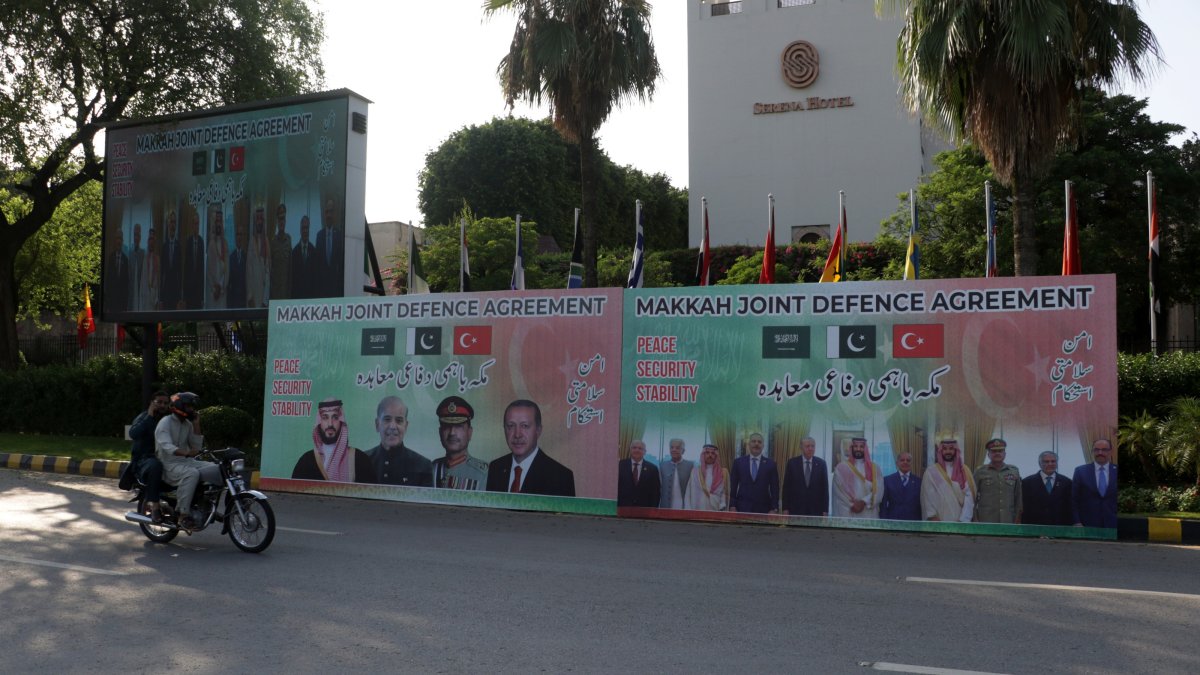
BEIRUT — The recently signed trilateral defense pact between Saudi Arabia, Turkey and Pakistan is expected to boost arms sales from Ankara to Riyadh specifically, but will more broadly bring the defense industries of all three nations into a tighter “ecosystem,” analysts told Breaking Defense.

“The Mecca Pact should not be viewed simply as an arms-export agreement. It is much broader,” said Ali Bakir, defense analyst and an assistant professor at Qatar University. “It aims to facilitate joint investment in defense industries, major defense projects, technology transfer, local production, research and development, training, and the integration of complementary capabilities. Over time, this could transform the relationship from a buyer-seller model into a genuine defense-industrial partnership.”
 
Top Bottom