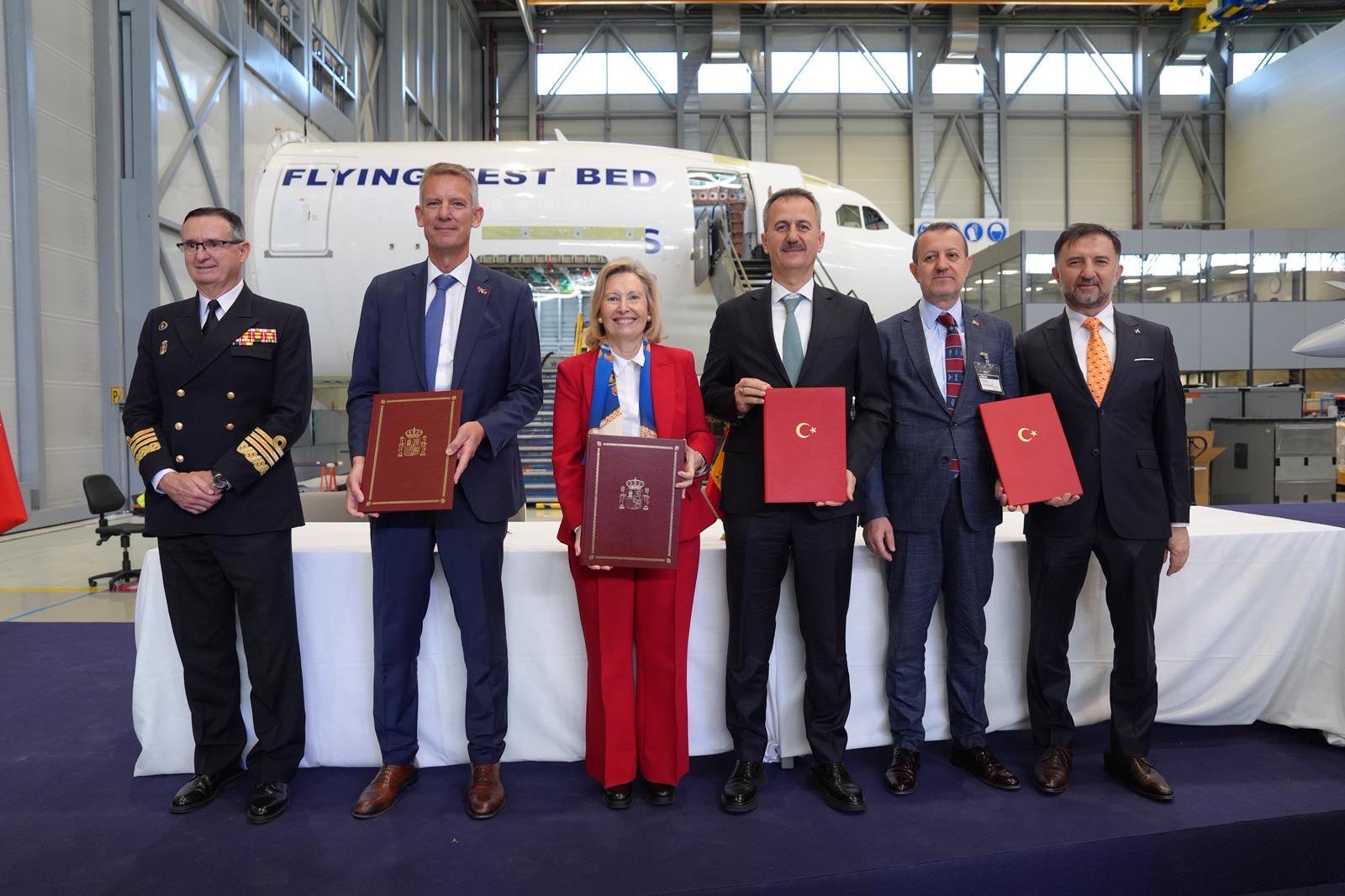
TR HÜRJET-Advanced Jet Trainer/ Light attack aircraft

dBSPL

Experienced member
Think Tank Analyst
DefenceHub Ambassador
Messages
2,765
Reactions
110 14,089
Nation of residence
Turkey
Nation of origin
Turkey

Yasar_TR

Experienced member
Staff member
Administrator
Messages
4,045
Reactions
247 21,090
Nation of residence
United Kingdom
Nation of origin
Turkey
Have you a source?


Spitfire9

Contributor
Think Tank Analyst
Messages
1,100
Reactions
17 1,492
Nation of residence
United Kingdom
Nation of origin
United Kingdom
EJ200 weighs about the same as F404 but produces about 15% more thrust than the F404 used in Hurjet. Of course it is not Turkish so no automatic sovereignty over the engine but if political risk is high with a US engine it should be lower with a European engine. EJ200 cost is much higher than F404.

Turkiye does things quickly. How long might it take to design, build, test and certify an EJ200- powered Hurjet? Could Spain be interested in an EJ200 version or would delivery be delayed too much?
 
Last edited:

Kaan Azman 

Contributor
DH Visual Specialist
Messages
563
Reactions
30 2,303
Nation of residence
Turkey
Nation of origin
Turkey
About carrier based Hürjet, I am starting to have doubts regarding how much of a Hürjet will that be, just aside from obivious design changes

A LCA might be a complementary aircraft for a larger naval aviation fleet but ours is not that large. We have one bet and I don't think Hürjet with LCA-level capabilities is a big enough card. The carrier-based Hürjet will likely end up being way larger (And this is not only wing area) as it is supposed to be the main combat aircraft for MUGEM.

So, even one EJ200 might not cut it for what is in works.

I will try to get an answer on that matter when I go to SAHA EXPO next week.
 

Burberryswine11

New member
Messages
1
Nation of residence
United States of America
Nation of origin
Turkey
About carrier based Hürjet, I am starting to have doubts regarding how much of a Hürjet will that be, just aside from obivious design changes

A LCA might be a complementary aircraft for a larger naval aviation fleet but ours is not that large. We have one bet and I don't think Hürjet with LCA-level capabilities is a big enough card. The carrier-based Hürjet will likely end up being way larger (And this is not only wing area) as it is supposed to be the main combat aircraft for MUGEM.

So, even one EJ200 might not cut it for what is in works.

I will try to get an answer on that matter when I go to SAHA EXPO next week.
I am pretty sure KAAN will be navalized too, but for the first phases yeah Hurjet will be the main aircraft to be used with MUGEM (in a recent video released by TRT Haber they did announce KAAN will be used on MUGEM and the new pictures that were released of MUGEM shows the KAAN on it) other than that I think the naval version will probably be designated as Hurjet B and I also think when they said we almost have a ready ramp and are almost ready for ramp take off tests I think they meant they will start those tests with Hurjet soon? maybe this is all a speculation tho
 

Spitfire9

Contributor
Think Tank Analyst
Messages
1,100
Reactions
17 1,492
Nation of residence
United Kingdom
Nation of origin
United Kingdom
I am pretty sure KAAN will be navalized too, but for the first phases yeah Hurjet will be the main aircraft to be used with MUGEM (in a recent video released by TRT Haber they did announce KAAN will be used on MUGEM and the new pictures that were released of MUGEM shows the KAAN on it) other than that I think the naval version will probably be designated as Hurjet B and I also think when they said we almost have a ready ramp and are almost ready for ramp take off tests I think they meant they will start those tests with Hurjet soon? maybe this is all a speculation tho
Are small fighters practical on carriers without catapults? India abandoned the idea of using their navalised version of Tejas because the load it could carry was too limited for the aircraft to be useful.
 

Pokemonte13

Contributor
Messages
681
Reactions
11 1,254
Nation of residence
Germany
Nation of origin
Turkey
Are small fighters practical on carriers without catapults? India abandoned the idea of using their navalised version of Tejas because the load it could carry was too limited for the aircraft to be useful.
Not really same issue with Kizilelma and Anka. Without a catapult their effectiveness is greatly reduced but I heard from a analyst that the navy might implement a catapult but it’s still not clear if it will happen. I’m guessing having a weak airwing is better than having no airwing.😅😅
 

Saithan

Experienced member
Denmark Correspondent
DefenceHub Diplomat
Messages
9,573
Reactions
61 21,553
Nation of residence
Denmark
Nation of origin
Turkey
Considering how UAV, drones and loitering ammo has left a solid mark on the battlefields, I imagine that all LCA are going to be variants that can combat these threats.


meaning having A2A missiles, but also have pods with mini missiles for combatting drones and such.

Typhoon tests rocket system that could cut cost of downing a drone from $1m to just $20k​


Mike Morton 13th April 2026 at 12:06pm

The Typhoon used in the APKWS trial was fitted with two underwing rocket pods
The Typhoon used in the APKWS trial was fitted with two underwing rocket pods (Picture: BAE Systems)

Typhoons and F-35s have successfully shot down a number of one-way attack drones launched by Iran and its allies over the past few weeks, but this has come at a huge financial cost.
However, BAE Systems has successfully completed the test-firing of a low-cost precision weapon launched from a Typhoon, demonstrating a far more affordable solution to counter UAVs like the Shahed-136.
RAF Typhoon FGR4s are currently armed with a variety of missiles that were largely designed for air-to-air combat against enemy warplanes, and while they may be highly effective, they are also highly expensive.

Hydra meets laser

The AIM-120 AMRAAM (Advanced Medium-Range Air-to-Air Missile), for example, costs around $1m, while AIM-9X Sidewinders are roughly $450,000.
Typhoons also carry short-range missiles such as the IRIS-T (infrared imaging system tail/thrust vector-controlled) and the ASRAAM (Advanced Short Range Air-to-Air Missile), and these are also costly.
When a 617 Squadron F-35B shot down a drone with one such missile, Air Vice Marshal (Ret'd) Sean Bell, a former fighter pilot, likened it to someone using a "sledgehammer to crack a nut".
To offer a more cost-effective solution, BAE Systems and the RAF have been experimenting with the Advanced Precision Kill Weapon System (APKWS) laser-guidance kit, a system which is already in use on a number of US aircraft such as the F-16 Fighting Falcon.
This kit adds an additional section to unguided 70mm rockets like the Hydra, transforming them into precision-guided munitions.
The system, which first went into production back in 2008, creates a weapon with better accuracy that can be deployed against air or ground targets.
As well as fixed-wing aircraft, the system can be fitted to helicopters like the AH-64 Apache, uncrewed aerial vehicles, static and mounted ground platforms, and maritime vessels.
freestar

The 70mm rocket pods fitted to the Typhoon in conjunction with the APKWS guidance kit offer an effective alternative to air-to-air missiles
The 70mm rocket pods fitted to the Typhoon in conjunction with the APKWS guidance kit offer an effective alternative to air-to-air missiles (Picture: BAE Systems)

How it works

The APKWS kit includes advanced distributed aperture semi-active laser seeker optics located on all four guidance wings on the rocket.
These are protected by wing-slot seals prior to firing, avoiding the adjacent fire damage that can interfere with a nose-mounted seeker.
Once the rocket is fired, the APKWS kit's wings deploy and the optics lock on to designated targets, guiding the rocket to the target.
A US soldier loads a 70mm APKWS training round into a pod fitted to an AH-64 Apache - the system has been in use with the US military for more than a decade
A US soldier loads a 70mm APKWS training round into a pod fitted to an AH-64 Apache – the system has been in use with the US military for more than a decade (Picture: US Department of War)

System proven

The trial involving the Typhoon saw the aircraft fitted out with the kit at the flight test development centre in Warton in Lancashire.
The Typhoon was then able to launch a successful strike on a ground-based target at a military testing range at an undisclosed location.
BAE Systems official Richard Hamilton explained: "As the UK's sovereign provider of combat air capability, we play a crucial role in supporting the UK Armed Forces, working closely with the Ministry of Defence to develop technologies that strengthen our national defence capabilities.
"This trial with the APKWS laser-guidance kit on Typhoon demonstrates a game-changing capability and a cost-effective solution that would enhance Typhoon's already impressive range of weapons capabilities."

__________________________________________
So I think that Hürjet is going to find it's market. Only question is how slow our government is going to be in producing Hürjet for own Airforce and make a LCA version of it. Which would require a new license.
 

dBSPL

Experienced member
Think Tank Analyst
DefenceHub Ambassador
Messages
2,765
Reactions
110 14,089
Nation of residence
Turkey
Nation of origin
Turkey
Are small fighters practical on carriers without catapults? India abandoned the idea of using their navalised version of Tejas because the load it could carry was too limited for the aircraft to be useful.
Indian navy had found a long time ago that operating a single engine light fighter from an Aircraft carrier with limited payload and Range is a terrible idea with the whole NLCA program itself. Navy now wants 56 rafale m and only wants tejas naval as a trainer aircraft.

Both of these are worth addressing together because they're related but they conflate two separate questions: Why Tejas Naval struggled structurally, and what role light platforms should play in a carrier air wing. On the aerodynamic side first. India's issue with Tejas Naval wasn't primarily payload: it was approach speed, and payload limitation was a downstream consequence of that. The aircraft's delta wing without leading-edge slats produces a CLmax in the 1.4–1.6 range. Running the carrier approach speed formula: Vapp = 1.3 x √[ (2W) / (ρ . S . CLmax) ]

At a realistic recovery weight of ~8,500 kg, wing area ~38 m², CLmax ~1.5, Tejas Naval's approach speed comes out around 150–155 knots. INS Vikrant's certified recovery limit sits at approximately 140-145 knots. That's the core problem, not the hardpoints. Because the aircraft had to recover light to stay within that envelope, usable payload at recovery became severely constrained. IMHO It's an aerodynamic problem wearing a payload mask.

A conventional swept wing with full high-lift devices typically achieves CLmax values in the 2.0–2.2 range in approach configuration, a reasonable design target for a navalised platform of this class. For a navalized Hürjet at ~7,000 kg recovery weight, ~25 m² wing area, CLmax ~2.0: Vapp ≈ 118–122 knots, quite likely inside any STOBAR carrier's recovery envelope, with meaningful payload still on the rails.

Now, the broader point about payload and range from a ski-jump deck. This is a real constraint and worth being honest about, but it's also frequently overstated. A 12degree ramp doesn't just redirect the aircraft upward, it decouples the climb and acceleration phases. At ramp exit the aircraft already has a vertical velocity component, so the engine's full thrust goes toward accelerating to flying speed rather than fighting gravity simultaneously. The practical result is that a STOBAR platform can achieve a safe departure at a meaningfully lower TWR than a flat-deck rolling takeoff would require, operationally the 0.72–0.78 band is well-established across existing STOBAR types, which opens up more of the payload envelope than the raw weight numbers suggest at first glance.

On the fuel side specifically, this is where engine selection actually matters beyond raw thrust. The EJ200's specific fuel consumption sits at approximately 0.74–0.76 lb/lbf/hr in cruise compared to the F404's ~0.84 lb/lbf/hr. On a platform in Hürjet's weight class with roughly 2,400–2,600 kg internal fuel capacity, that SFC difference translates to a meaningful combat radius improvement, roughly 15% better fuel economy at cruise, which on a 500 nm profile is not a trivial number. Add a single 1,100L centerline drop tank and you're looking at a combat radius in the 500–600 nm range in a hi-lo-hi profile operationally relevant for most Mediterranean threat scenarios.

And here's the part that the Indian Navy story actually illustrates rather than contradicts: the Indian Navy's solution was not to abandon light naval aviation, it was to separate roles. 26 Rafale M for the heavy combat lift, Tejas Naval as the trainer and currency platform. That's a rational division of labor, and it's almost exactly the architecture being discussed for MUGEM. A navalized Hürjet doesn't need to be the Rafale M. It needs to fill the gap, train the pilots, and handle the missions within its envelope, while KAAN Naval matures into the primary combat platform.

About carrier based Hürjet, I am starting to have doubts regarding how much of a Hürjet will that be, just aside from obivious design changes

A LCA might be a complementary aircraft for a larger naval aviation fleet but ours is not that large. We have one bet and I don't think Hürjet with LCA-level capabilities is a big enough card. The carrier-based Hürjet will likely end up being way larger (And this is not only wing area) as it is supposed to be the main combat aircraft for MUGEM.

So, even one EJ200 might not cut it for what is in works.

I will try to get an answer on that matter when I go to SAHA EXPO next week.

This is probably the most technically substantive concern for all of us, and it deserves an honest answer. First, the TWR picture across realistic mission profiles. Using EJ200 afterburner thrust at 90 kN and a navalised Hürjet empty weight estimate of ~6,700 kg (baseline ~6,200 kg plus a conservative 500 kg STOBAR penalty):

ConfigurationFuelPayloadGross WeightTWR
CAP / Light load60% internal (~1,440 kg)2x Gökdoğan + 4x Bozdoğan (~900 kg)~9,000 kg~1.01
CAP / Extended80% internal + 1x drop tank (~2,700 kg)same as CAP~10,300 kg~0.90
ASuW / Strike100% internal (2,400 kg)2x Atmaca + 2x drop tanks + EO pod (~3,350 kg)~12,450 kg~0.74

Also, need to add, one more variable worth factoring in: the navalisation weight penalty isn't fixed. Hürjet is already a composite-heavy platform, and if the structural reinforcement package, is engineered from the outset in thermoplastic composites rather than conventional aluminium alloys, the same structural targets can be met at roughly 20–25% lower weight for those components. PEEK and PPS-based thermoplastics also offer superior moisture and corrosion resistance compared to thermoset composites, which is a relevant double advantage in a naval operating environment. The non-optimizable portion of the penalty, -arresting hook assembly, corrosion protection systems, folding mechanism actuators- remains largely fixed. But on a realistic best-case basis, this pushes the total navalisation penalty toward the 350–400 kg range rather than the 500+ kg conservative estimate, which keeps the CAP configuration TWR comfortably above 1.10 even at standard fuel loads.

The 0.74 TWR in the heaviest configuration is within STOBAR departure parameters, MiG-29K routinely operates in this band from INS Vikramaditya. The ski-jump geometry handles the rest as discussed above.

Now, the single-engine question more broadly. The concern is legitimate for a primary strike platform operating at the heavy end of that table consistently. A twin-engine configuration would obviously improve both the payload-range envelope and the single-engine-failure survivability picture over water, both real considerations for a carrier-based aircraft. Nobody's going to pretend otherwise.

But here's the framing that matters: the question isn't whether a twin-engine naval platform would be preferable in an ideal world. Of course it would. The question is what's achievable within a realistic development window. India's (which is usually our main reference source on this subject) own TEDBF 'Twin Engine Deck Based Fighter' is essentially the acknowledgment that Tejas Naval hit its single-engine ceiling and a clean-sheet twin is needed for the primary strike role. That program is currently projecting a first flight around 2030s and carrier qualification well into the late 2030s. Turkiye doesn't have a parallel twin-engine LCA program at any stage of development currently.

So the realistic choice isn't single-engine Hürjet Naval versus some twin-engine alternative that already exists. It's single-engine Hürjet Naval in the 2030s versus nothing fixed-wing until KAAN Naval qualifies, which on an optimistic timeline is mid-to-late 2030s at the absolute earliest, and KAAN Naval itself hasn't been formally launched as a program yet. A single-engine platform that's actually there is operationally more valuable than a twin-engine platform that isn't.

The "how much of a Hürjet will it be" question is also interesting because it cuts both ways. Yes, a navalised variant with a larger wing, reinforced structure, folding wingtips and a new engine is meaningfully different from the baseline aircraft. But that's also exactly how the MiG-29K relates to the MiG-29, how the F/A-18C relates to the YF-17, how the Rafale M relates to the Rafale C. Naval derivatives are always substantially evolved platforms. IMHO That evolution doesn't make them a different aircraft, it makes them a mature one.

 
Last edited:

dBSPL

Experienced member
Think Tank Analyst
DefenceHub Ambassador
Messages
2,765
Reactions
110 14,089
Nation of residence
Turkey
Nation of origin
Turkey
So what does 2,500–3,400 kg of payload actually buy you in a naval operational context? This is where the abstract performance numbers connect to real mission utility, so it's worth going through the primary scenarios explicitly.

ASuW Anti-Surface Warfare: The most operationally significant loadout for MUGEM's threat environment. Two Atmaca Block-II missiles come in at approximately 800 kg each including launcher hardware, so roughly 1,650–1,700 kg for the pair. Add an electro-optical targeting pod (~150 kg), two wingtip Bozdoğan for self-defense (~120 kg), and a centerline drop tank for extended range, you're around 2,200 kg total external load at a gross weight of approximately 11,300 kg. TWR at departure sits around 0.79, within STOBAR parameters.

The operational output of that loadout: two Atmaca missiles represent a saturation strike against a single surface combatant or a sequenced attack on two separate targets. Atmaca's 200+ km range means the Hürjet never needs to enter the engagement envelope of a frigate's point defense systems. For context, a single Turkish frigate carries 8 Atmaca as its primary ASuW battery. Two Hürjet-D sorties simultaneously put the equivalent of half that battery in the air from a mobile, repositionable platform, that's not a trivial contribution to a carrier group's strike calculus.

CAP Combat Air Patrol: Clean configuration: 2x Gökdoğan BVR (~180 kg each), 4x Bozdoğan WVR (~140 kg each), 80% internal fuel plus one centerline drop tank. Gross weight approximately 10,420 kg, TWR ~0.88 at departure, climbing progressively above 0.95 as fuel burns through the patrol cycle.

At EJ200 SFC levels this configuration gives a loiter time of approximately 45–55 minutes on station at 250 nm from the carrier — adequate for a layered CAP rotation with 4–6 aircraft cycling. TWR of 0.88 at departure is well within STOBAR parameters, and the energy picture improves meaningfully as the drop tank empties. The Gökdoğan's active radar seeker and 100+ km range means the Hürjet-D is not a passive target in a BVR engagement. It's a genuine intercept platform within its design envelope.

MUM-T Strike Package: This is arguably the most interesting configuration because it's where the tandem seat layout creates genuine asymmetric value. Front seat handles the aircraft, rear cockpit officer manages 2–3 Kızılelma-II or Anka-3 loyal wingmen via line-of-sight datalink. External load: one datalink relay pod, one EW jamming pod, 2x Gökdoğan for self-protection, roughly 750-800 kg total. Gross weight approximately 9,500 kg, TWR ~0.97.

The operational geometry here is significant. The Hürjet-D orbits at 35,000–40,000 ft at the edge of the adversary's AD bubble ' lets say 150–180 nm standoff' while the Kızılelma wingmen penetrate at low altitude into the defended zone. Line-of-sight datalink at that altitude gives an effective control radius of approximately 200–220 nm to the surface, covering the entire inner engagement envelope. The rear cockpit officer is essentially running a mini strike package with meaningful standoff firepower while the manned platform remains outside most threat envelopes. A single Hürjet-D in this configuration represents a strike package that would otherwise require a dedicated UCAV control aircraft, an EW platform, and a fighter escort as three separate assets.

SEAD Suppression of Enemy Air Defenses: 2x Akbaba anti-radiation missiles (~365 kg each, broadly comparable in class and weight to the AGM-88 HARM), 2x Bozdoğan self-defense (~140 kg each), one EW jamming pod (~150 kg). Total external load approximately 1,160-1,165 kg, gross weight around 9,800 kg, TWR at departure ~0.94. The Hürjet-D's energy management in this configuration allows rapid repositioning between emission spikes exactly the kind of agility SEAD profiles demand. Not a dedicated Wild Weasel platform, but as a first-day-of-war SEAD asset operating in coordination with Kızılelma strikes, the loadout and performance numbers place it well within a credible mission envelope.

Light CAS / ISR: 4x MAM-type precision munitions, 2x Teber laser guidance kits on Mk-82 bodies (~270 kg each), one CATS targeting pod (~150 kg), centerline drop tank. Total approximately 1,000/1,100 kg external, gross weight ~9,800 kg, loiter endurance at low-medium altitude approximately 90–110 minutes at 150 nm. For amphibious support operations 'exactly the kind of scenario MUGEM's design implies' this is a meaningful presence over the battlefield.

**

CONCLUSION: The aggregate picture across these five profiles: a navalized Hürjet with a 90–100 kN engine is not trying to be a Super Hornet. It's a versatile light platform that covers ASuW, CAP, MUM-T strike management, SEAD and CAS from the same airframe and the same ski-jump deck. The question isn't whether it does each of these missions as well as a heavier dedicated platform; it doesn't, and nobody claimed it does. The question is whether it does them well enough to be operationally meaningful, and the loadout numbers suggest the answer is yes.
 

dBSPL

Experienced member
Think Tank Analyst
DefenceHub Ambassador
Messages
2,765
Reactions
110 14,089
Nation of residence
Turkey
Nation of origin
Turkey
There's a dimension to this discussion that hasn't come up yet and I think it's actually central to understanding why the navalized Hürjet makes programmatic sense even if you remain skeptical about its combat credentials.

Carrier aviation is a perishable skill. Deck qualification, arrested landing currency, ski-jump departure profiles, formation procedures in a confined maritime environment all require dedicated platforms and continuous repetition. The US Navy maintains the T-45 Goshawk fleet for exactly this reason: 221 aircraft built, still in service, solely to keep carrier pilots current and to qualify new ones. The T-45 has never fired a weapon in anger. Nobody calls it a vanity solution.

If MUGEM operates a KAAN Naval air wing in the 2040s, say 40 primary combat aircraft, the supporting trainer requirement by standard naval aviation ratios sits at roughly 10-14 dedicated carrier trainers. A navalized Hürjet fills that role natively. It has tandem seating, it's already designed around the same deck environment, and the rear cockpit instructor has full situational awareness of the student's inputs. Purpose-built carrier trainers are expensive and time-consuming to develop from scratch. Hürjet Naval is effectively already most of the way there, which means the program has a guaranteed minimum order floor that exists completely independently of the combat platform debate.

Even if Türkiye ultimately decides the Hürjet-D's combat contribution is modest and KAAN Naval carries the primary strike burden from the mid-2040s onward, the trainer requirement doesn't go away. That's not nothing. That's the foundation of a sustainable naval aviation ecosystem.

On the export side, the land-based LCA variant and the navalized version are not separate products competing for the same budget logic. They reinforce each other. An aircraft that can reliably depart a 12 degree ramp at around 125 knots has the aerodynamic margin to operate from under 1,400 metre runways with meaningful payload, a characteristic that matters considerably in Southeast Asia, parts of the Middle East, and Eastern Europe where basing infrastructure is either limited or contested.

The M-346FA and T-50 Golden Eagle occupy adjacent market space but neither offers the same thrust-to-weight headroom in the hot-and-high or short-field envelope that a 90-100 kN powered Hürjet would bring. A European-engined, or eventually TEI-sourced, Hürjet also carries none of the US export control complications that shadow F404-powered competitors. Also, for smal-to-mid-size customers(e.g. many African air forces) who've had F-16 transfers complicated by political considerations or can't affordable, that's a genuine differentiator.

The combined picture is a program that produces 10-14 trainers for MUGEM's long-term carrier aviation ecosystem, let's say 24 light combat aircraft for first-phase operations, and a credible export product in the LCA configuration, all before you account for the doctrinal bridge function it serves while KAAN Naval matures.

So again, to pull this together, because I think the discussion has been running on slightly different tracks. MUGEM's first steel was cut in 2025. Realistic timelines for a first-of-class vessel of this complexity place the launch window around 2029-2030, with sea trials and initial operational capability realistically in the 2033-2035 range. That's what first-of-class carrier programs consistently look like historically, even for nations with established advanced naval construction industries.

A KAAN Naval variant, which hasn't been formally launched as a program yet, would need to complete aerodynamic development, structural navalisation, arrested landing qualification, ski-jump departure envelope expansion, and full carrier integration trials before reaching IOC. Clean-sheet naval combat aircraft programs historically run 12-15 years from program launch to carrier qualification. Even on an optimistic timeline, MUGEM reaches operational status and spends several years at sea before its primary combat aircraft is ready.

The French didn't have Rafale Marine until 2004-05. The Super Etendard entered service in 1978 and flew from French carriers for 26 years bridging that gap. The British flew the Harrier from Invincible-class carriers from 1980 until the F-35B transition, not because the Harrier was the ideal solution but because it was the available one, and available beats ideal when the ship is already being built.

A navalized Hürjet with a 90-100 kN engine, AESA integration, and a MUM-T architecture isn't a fallback. It's a deliberate first-generation capability that covers CAP rotations, ASuW strike with Atmaca, SEAD support with Akbaba, and loyal wingman management with Kızılelma, from a ski-jump deck, while simultaneously training the pilots who will eventually transition to KAAN Naval. The naval development path doesn't constrain the aircraft or the program. It elevates both. And that decade of operational experience MUGEM accumulates in the 2030s will be worth considerably more than whatever performance delta separates the Hürjet-D from the platform that eventually succeeds it.

(A small personal note to close: I wasn't planning to spend my holiday down a Hürjet rabbit hole. But I'm not unhappy about it. Because no technical argument quite captures what it means for the first manned supersonic jet in the history of the Republic to also become a genuine naval aviation solution, what that does for an industrial base, for operational diversity, for the confidence that comes from building something rather than waiting to buy it. Hürjet isn't the summit of Mount Ağrı. But right now, it might be the most important tool that gets us there.)
 
Top Bottom