

Not bloody worth it if you ask me with the hilariously short range and long charging time.Electric motors require much less maintenance than internal combustion engines. There are no oil problems. They don't require a gearbox, etc.

Latest Thread
- Kyrgyzstan rejects European proposal to accept migrants
- Russia Project 885M nuclear-powered submarine *Novosibirsk* strikes a target at a range of 1,200 km with a Kalibr missile.
- Space Brazil ties up with India's Skyroot Aerospace to develop Satellite Launch Vehicle
- Bangladesh Opinion Bangladesh’s intelligence challenge
- Open-source AI for exploiting cyber vulnerabilities
You are using an out of date browser. It may not display this or other websites correctly.
You should upgrade or use an alternative browser.
You should upgrade or use an alternative browser.

The ability to transport APCs using tank carrier vehicles solves the problem behind the front lines. On the front lines, just as we send tankers behind the tanks for fuel logistics, we will send generators for the electric motorized APCs.Not bloody worth it if you ask me with the hilariously short range and long charging time.
So, we are going to unnecessarily increase the logistical and maintenance footprint on the frontline with generators, which will create their own noise and heat btw, and still carry fuel anyway for those generators. And limited range without generators just means they either have very limited operational time and very long down time compared to simply fuelling an APC. Or put generators in and still create heat and noise we are supposed to be solving anyway. And btw, it's not like drones are using heat seeker or "lock on" to sounds or something, it still is an APC that looks like an APC.The ability to transport APCs using tank carrier vehicles solves the problem behind the front lines. On the front lines, just as we send tankers behind the tanks for fuel logistics, we will send generators for the electric motorized APCs.
Electronic warfare systems also use the same generators.So, we are going to unnecessarily increase the logistical and maintenance footprint on the frontline with generators, which will create their own noise and heat btw, and still carry fuel anyway for those generators. And limited range without generators just means they either have very limited operational time and very long down time compared to simply fuelling an APC. Or put generators in and still create heat and noise we are supposed to be solving anyway. And btw, it's not like drones are using heat seeker or "lock on" to sounds or something, it still is an APC that looks like an APC.
Noise Level 64 dB (7 m) Low Thermal Signature Low Exhaust Temperature, Low Thermal Signature
You are clearly underestimating military-grade generators.

I think you have got the wrong end of the stick here mate!So, without a generator it has 1/3 range of an M113, and to have better range it needs a generator, negating all of its supposed benefits. And that charging time is abysmal for an armoured vehicle that might have to leave at a moments notice.
Think of Electrodiesel engines used in train locomotives.
You have a diesel generator that produces electricity. That electricity drives the motors at the wheels or tracks of the vehicle. When the vehicle is not using full power, then the same generator charges the batteries. The battery power when fully charged, can only give a range of 150km. But it is silent. But the vehicle can go 650km when electrodiesel power keeps charging.
It is a hybrid drive.
E-ZPT’s propulsion concept is best described as electric traction backed by an endurance safety net. Reporting indicates battery packs mounted on both sides of the vehicle support a range of around 150 km, depending on terrain, while an onboard generator feed can extend range to 650 km. Crucially, the same reporting notes the generator can provide feed while the vehicle remains in motion, reducing the operational penalty of relying on stationary charging or fixed infrastructure. This architecture aligns with a central constraint for ground forces: electrification can offer tactical advantages, but maneuver formations still require long-range autonomy across dispersed routes, extended patrol cycles, and contingency redeployments where charging opportunities may be limited or contested.
Türkiye Begins Fielding E-ZPT Electric Armoured Personnel Carrier for Low-Signature Operations
Türkiye delivers its first serial-produced E-ZPT electric APC, marking a quiet but strategic shift in M113 modernization.
 www.armyrecognition.com


I also understood it as a Hybrid propulsion system.
I think getting some and using them to gain experience is okay.
But they're not calling it Hybrid.
I think getting some and using them to gain experience is okay.
But they're not calling it Hybrid.
They are not. True.I also understood it as a Hybrid propulsion system.
I think getting some and using them to gain experience is okay.
But they're not calling it Hybrid.
But essentially it is a form of hybrid power generation system. However the diesel power is not used. It is only electric power that propels. So they may be partially correct not to call it hybrid.
By using electric power you get many advantages.
1. Very high torque values. It would put a 1500bhp diesel engine’s torque to shame.
2. Longer range. M113 has 480km range. Electric version goes 650km.
3. No transmission. Hence weight saving.
4. Simpler maintenance.
5. During battery power the vehicle is quieter with less heat generation
6. On board diesel generator’s heat output would be a lot less than full diesel power pack’s.
7. Due to electric powertrain’s more efficient design, fuel consumption will be lower.
Check out the first 2021 version prototype’s torque values. They probably developed this new one using the old prototype as a template.
Last edited:
My only worry is like @boredaf that a pure electric solution isn't battletested and we don't know how it'll operate when it's hit.They are not. True.
But essentially it is a form of hybrid power generation system. However the diesel power is not used. It is only electric power that propels. So they may be partially correct not to call it hybrid.
By using electric power you get many advantages.
1. Very high torque values. It would put a 1500bhp diesel engine’s torque to shame.
2. Longer range. M113 has 480km range. Electric version goes 650km.
3. No transmission. Hence weight saving.
4. Simpler maintenance.
5. During battery power the vehicle is quieter with less heat generation
6. On board diesel generator’s heat output would be a lot less than full diesel power pack’s.
7. Due to electric powertrain’s more efficient design, fuel consumption will be lower.
Check out the first 2021 version prototype’s torque values. They probably developed this new one using the old prototype as a template.
View attachment 80473
I mean we saw in early Ukraine war how turkish Kirpi got hit by an FPV, but could still run away with only 3 wheels or so.


I think I know who the customer target is
They made a "Kaplan" wannabe using different suppliers this time ? But with a 120mm barrelI think I know who the customer target is


They made a "Kaplan" wannabe using different suppliers this time ? But with a 120mm barrel
Until a few years ago, we had no modern tank options, but today we have the Altay MBT, Kaplan MT, Karpat MT, and modernized M60TM, M60 MZK, and Leopard 2A4TIYK as national options. We have started transferring our older tanks like the M48/M60 to countries like Somalia, and we should soon have several types of main battle tanks covering both land and naval forces and move towards standardization.
While the land forces are focusing on two different types of tanks medium and heavy for operational diversification, it might be appropriate for the naval forces to focus on medium class tanks. We may also need to develop a wheeled tank concept for African missions.

Pokemonte13
Contributor

Land forces currently have not shown interest in light/medium tank at all only altay and modernizing existing tanks. I think a fire support vehicle with 105mm rifled gun on 8x8 could be useful but army is very stubborn.Until a few years ago, we had no modern tank options, but today we have the Altay MBT, Kaplan MT, Karpat MT, and modernized M60TM, M60 MZK, and Leopard 2A4TIYK as national options. We have started transferring our older tanks like the M48/M60 to countries like Somalia, and we should soon have several types of main battle tanks covering both land and naval forces and move towards standardization.
While the land forces are focusing on two different types of tanks medium and heavy for operational diversification, it might be appropriate for the naval forces to focus on medium class tanks. We may also need to develop a wheeled tank concept for African missions.
Pokemonte13
Contributor
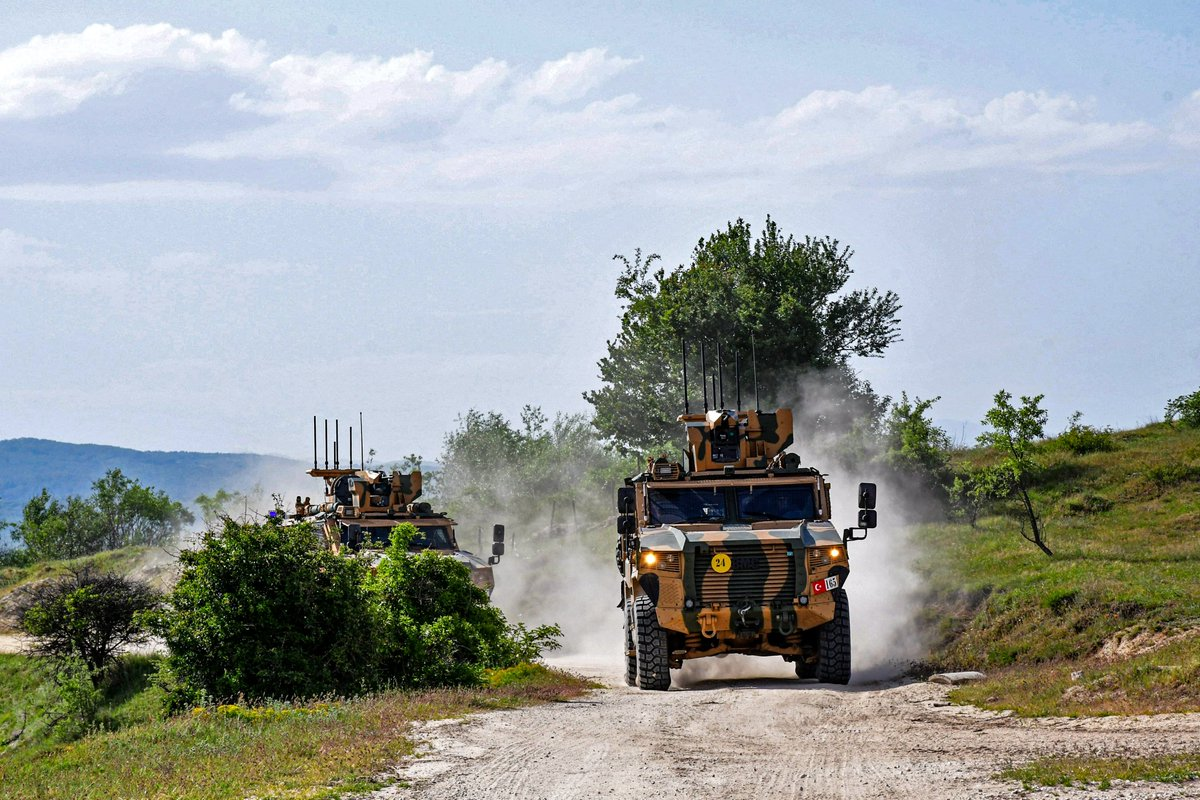
Vuran has been such a great stopgap solution for the mechanized units. It's nowhere near enough, but its availability was a godsend. Nearly all of them are equipped with jammers and a RCWS. This was done against insurgent threats, but what's old is new and jammers are great against FPVs, while Sarp can be further enhances against any and all drone types in time, including fiber optic ones.


Nope, but it looks cool. In real world everyone in that picture might as well be carrying giant banners that read "DRONE BAIT".Is this WW2 tactic still usable in 2026?
Experienced in the Euphrates Shield operation it still works. but need more supported by other elements.Is this WW2 tactic still usable in 2026?
There were no FPVs in 2016 save for tiny homegrown capabilities. These guys are foraying into open space after a beach landing. It's training for yesterday's war. Which is not a bad thing directly, because war is fluid; but we are once again are slow to follow up with the times.Experienced in the Euphrates Shield operation it still works. but need more supported by other elements.
You've made a valid point; sometimes we're slow to adapt, but sometimes our objectives are different. Ultimately, we won't replicate the operation we conducted in full view of the world in a potential attack.There were no FPVs in 2016 save for tiny homegrown capabilities. These guys are foraying into open space after a beach landing. It's training for yesterday's war. Which is not a bad thing directly, because war is fluid; but we are once again are slow to follow up with the times.
In your opinion, how should tanks, infantry, and support units be positioned in a potential amphibious assault operation? Should all personnel move behind armor, or should there be infantry outside to increase our visibility?


