
Latest Thread
You are using an out of date browser. It may not display this or other websites correctly.
You should upgrade or use an alternative browser.
You should upgrade or use an alternative browser.


“Four US soldiers who went missing during a NATO exercise in Lithuania today were reportedly found dead in an area close to the Belarusian border.”
So far, there is no official statement regarding their deaths but rumors and news pieces.
“Four US soldiers who went missing during a NATO exercise in Lithuania today were reportedly found dead in an area close to the Belarusian border.”
So far, there is no official statement regarding their deaths but rumors and news pieces.
Chief of the Turkish General Staff, General Metin GÜRAK, officially welcomed the Chairman of the NATO Military Committee, Admiral Giuseppe CAVO DRAGONE, who is in Ankara as an official guest, with a military ceremony.


It is a sound approach, it would mean more airframes + sensor numbers (and availability and positive sum integration capacity) per resource unit investment.

 www.military.com
That translates to a global supply chain procuring and modifying aircraft faster than current programs allow, while also allowing for phased growth without redesigns. It would supposedly reduce sustainment costs and minimize future upgrades.
For example, a 6-8 member crew would operate a G550 at a cost of about $6,000 per hour, over a period of 8-10 hours and in a craft with higher survivability against threats.
That’s compared to a 12-14 member crew of an E7 operating at the approximate cost of $20,000 per hour, over a period of 10-12 hours and in a craft with moderate survivability against threats. The E-3 crew, described as a craft with low survivability costs a 16-20 member crew roughly $30,000 over an 8-10 hour period.
“That ensures political ownership, creates workshare for European industry, and opens opportunities for regional AI/ML and systems suppliers. Politically, a NATO‑owned G550 fleet would demonstrate cost-conscious burden sharing and turn the 5% pledge into tangible capability.”
(More at link)
White Paper Circulating Pentagon Calls For New Aircraft Plan With NATO: Exclusive
Military.com has exclusively learned that a white paper on U.S. aircraft in association with NATO allies is moving through the Pentagon for Secretary Hegseth's final approval.
www.military.com
Less Money, Better Safety
The document circulating through the Department of War calls for a NATO‑owned, European-led business jet fleet, structured under the NATO Support and Procurement Agency (NSPA). It could be jointly funded and operated to avoid current bottlenecks.That translates to a global supply chain procuring and modifying aircraft faster than current programs allow, while also allowing for phased growth without redesigns. It would supposedly reduce sustainment costs and minimize future upgrades.
For example, a 6-8 member crew would operate a G550 at a cost of about $6,000 per hour, over a period of 8-10 hours and in a craft with higher survivability against threats.
That’s compared to a 12-14 member crew of an E7 operating at the approximate cost of $20,000 per hour, over a period of 10-12 hours and in a craft with moderate survivability against threats. The E-3 crew, described as a craft with low survivability costs a 16-20 member crew roughly $30,000 over an 8-10 hour period.
Air Solution
“This is a European-led solution in execution,” the paper states. “While the baseline airframes and some mission systems draw from U.S. and Israeli programs, conversion, certification, sustainment, and mission software can—and should—be conducted in Europe.“That ensures political ownership, creates workshare for European industry, and opens opportunities for regional AI/ML and systems suppliers. Politically, a NATO‑owned G550 fleet would demonstrate cost-conscious burden sharing and turn the 5% pledge into tangible capability.”
(More at link)

T
TR_123456
Guest
Wow,should be a first?The NATO Support and Procurement Agency (NSPA) has awarded ASELSAN a contract to supply the Alliance with “Identification of Friend or Foe” (IFF) Interrogator Systems for Man-Portable Air Defense Systems (MANPADS) as part of its mission to ensure deterrence against increasing aerial threats on the global theatre.
The contract is a framework agreement valid for three years, which ensures the supply of the material throughout the period. ASELSAN, as a long-standing IFF provider in every domain and one of the few providers of Mode-5 IFF Systems, takes utmost pride in offering its services & support to NSPA
Normaly the US gets such a contract,no?


Interestingly that was my first thought. Our important high end product in the hands of our friendsWow,should be a first?
Normaly the US gets such a contract,no?

Not really, Aselsan is a big subcontractor; many stuff are license built and sold. These NSPA tenders are open to every NATO country company; anyone can enter.Wow,should be a first?
Normaly the US gets such a contract,no?


Trump is not always praising other people, but there is one exception - Mark Rutte. And as the NATO boss is set to visit Trump on Wednesday, your reporter wonders: could the US president one day say “bye, bye” to the alliance? Let's take a look at what the actual rules say.
Under the 1949 NATO treaty, the exit process seems simple. A country submits a formal notice, and one year later, they are out.
ADVERTISEMENT
But under US domestic law, it is a completely different story. In 2023, legislation was passed to prevent any president from resigning unilaterally.
And to legally withdraw, US President Donald Trump would need a two-thirds supermajority in the Senate or a specific act of Congress.
And although no one has ever fully left the alliance, France came close.
In 1966, President Charles de Gaulle withdrew France from NATO's military command. US troops were ordered to leave French soil, and the alliance had to pack up its headquarters and move from Paris to Brussels.
And it took more than four decades for France to rejoin the military command in 2009.
However, even if Trump cannot easily withdraw, experts warn he could still follow a similar path and hollow out Washington's participation.
He could severely slash funding, withdraw key personnel, or simply refuse to honour the mutual defence pledge.
And if Washington stays in the alliance in name only, calling it a "paper tiger", one could say NATO is already weakened from within, having jeopardised the one thing that matters most: its credibility.

 www.euronews.com
_________________________________________
Oh... So the time when France rejoined NATO was when they decided to attack and bomb Libya.
Under the 1949 NATO treaty, the exit process seems simple. A country submits a formal notice, and one year later, they are out.
ADVERTISEMENT
But under US domestic law, it is a completely different story. In 2023, legislation was passed to prevent any president from resigning unilaterally.
And to legally withdraw, US President Donald Trump would need a two-thirds supermajority in the Senate or a specific act of Congress.
And although no one has ever fully left the alliance, France came close.
In 1966, President Charles de Gaulle withdrew France from NATO's military command. US troops were ordered to leave French soil, and the alliance had to pack up its headquarters and move from Paris to Brussels.
And it took more than four decades for France to rejoin the military command in 2009.
However, even if Trump cannot easily withdraw, experts warn he could still follow a similar path and hollow out Washington's participation.
He could severely slash funding, withdraw key personnel, or simply refuse to honour the mutual defence pledge.
And if Washington stays in the alliance in name only, calling it a "paper tiger", one could say NATO is already weakened from within, having jeopardised the one thing that matters most: its credibility.
Watch: Are we witnessing the end of the US in NATO?
Trump is not always praising other people, but there is one exception - Mark Rutte. And as the NATO boss is set to visit Trump on Wednesday, your reporter wonders: could the US president one day say “bye, bye” to the alliance? Let's take a look at what the actual rules say. #EuropeToday
www.euronews.com
_________________________________________
Oh... So the time when France rejoined NATO was when they decided to attack and bomb Libya.
Oh... So the time when France rejoined NATO was when they decided to attack and bomb Libya.
Not exactly. French already joined US w.r.t Afghanistan post 9-11. About 4 - 5 divisions too and significant air assets too iirc....not small amount.
Rejoining nato command officially was matter of time (after mitterand iirc pared down the degaulle thing by 90% already in the 80s iirc, sensing cold war stage at that point and observing what US/UK/Germany could do w.r.t Reforger etc), more logistics meetings you can directly sit in on top level and optimize 5 - 10 year strategy/spendin etc etc.
France was always in NATO during this phase (60s - 80s), they just wanted more of their own strategic autonomy.
US could have kept paris as nato hq too, they just wanted to show degaulle a consequence of pulling out of NATO command (degaulle ofc was upset NATO didnt help out w.r.t Algeria etc*)
*this episode bears some parallels to current M.E dynamics/theatrics.
US President Trump's frequent threats to leave NATO, as well as the US army's heavy use of expensive, military assets in Iran has weakened the alliance, former US ambassador to NATO tells Euronews.
Former US ambassador to NATO, Ivo Daalder, said repeated threats by U.S. President Donald Trump to withdraw from NATO, as well as confrontations with America's European allies over their refusal to join the war, have created the ‘worst crisis’ NATO has ever faced.
ADVERTISEMENT
“The last six weeks have been extraordinarily damaging to NATO,” Daalder told Euronews' Shona Murray.
“We see a divided NATO, which has been the goal of first the Soviet Union and then Russia for the better part of 80 years,” he said.
Daalder said Trump’s statements suggesting the U.S. might not defend NATO allies against future military aggression by Russia or other adversaries have destabilised the alliance and shaken the global order.
He added that the six‑week war against Iran has depleted U.S. military resources by burning through large stocks of interceptors and other missiles in the bombing campaign.
“A NATO that is truly at loggerheads, a NATO in which the president of the United States says, ‘I'm not going to defend you’, it is a good time to test NATO if you are sitting in Moscow,” he said.
“It’s also a good time to test what you could get away with in Taiwan if you're sitting in Beijing, because much of the US military capability has been moved to the Gulf,” he warned.
Daalder, who served as U.S. ambassador under former President Obama from 2009 - 2013 said described the US/Iran war as a “strategic blunder of historic proportion.”
“Much of US military capabilities has been expended on this war, which turned out to be a strategic blunder of historic proportion,” he said.
His comments come as NATO Secretary General, Mark Rutte is in Washington D.C. for a series of discussions including with Trump, and Secretary of State Rubio, as well as Defence Secretary, Pete Hegseth. Rutte is expected to try to salve some of the hostility which has emerged between the US and its allies in Europe.
Meanwhile, Daadler’s believes that - on the face of it - Iran holds the “upper hand” in relation to the terms of the ceasefire negotiated on Tuesday to avert all out ‘civilisational destruction.’
An agreement was made to reopen international shipping routes through the Strait of Hormuz, reportedly however, permission will be required from the Iranian armed forces for vessels attempting to pass.
Iran has held the Strait hostage as part of its retaliation against the US and Israel. It's effective closure has triggered skyrocketing gas and oil prices as well as major economic uncertainty across the globe.
The full details of how the Strait will be secured for all international shipping including the passage of Gulf oil and gas is unclear.
“The Strait of Hormuz was open before the bombing started,” Daalder said.
“Now ships may be going through. We don't know how many. We don't know when. We don't know where. And in any case, the Iranians are claiming they will maintain control," he said.
"That is a massive change in Iran's benefit and to the detriment not only of the United States and Israel," he said.

'NATO in grave danger after Iran war,' former US NATO ambassador warns
US President Trump's frequent threats to leave NATO, as well as the US army's heavy use of expensive, military assets in Iran has weakened the alliance, former US ambassador to NATO tells Euronews. #EuropeToday
www.euronews.com

Defence: Europe needs a plan B for NATO
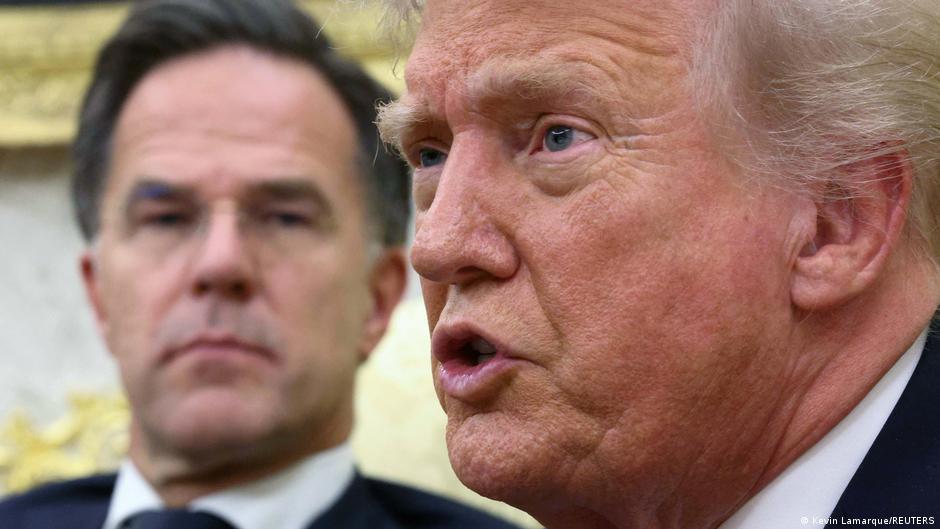
Europe mulls the prospect of a NATO without the US
As the US president escalates threats to destroy Iran, will NATO be collateral damage? A former American ambassador says the alliance is "not dead" but "deeply damaged" by trans-Atlantic divisions.
 www.dw.com
NATO Secretary-General Mark Rutte has supported the US-Israeli action and played down the rift. "In the alliance, you will always have different views," he said on March 26. "But when it comes to not accepting Iran having a nuclear and missile capability, we all agree ... What the United States is doing now is degrading that capability. And yes, I applaud that."
How the hell did this person become secretary for NATO. He's still sucking up to US with this kind of comments for appeasing.
Last edited:


