• Forum restore complete (see latest announcement thread)

TR Turkiye's F-35 Project and Discussions

Kartal1

Experienced member
Moderator
Messages
5,291
Reactions
114 19,734
Nation of residence
Bulgaria
Nation of origin
Turkey
Guys, many messages were moved and some were deleted.

We are seeing a big number of off topic posts in the last week. Please let's help each other and keep the discussion as relevant to the name of the thread as much as possible. Otherwise we will be forced to take harsher measures.

There are many relevant threads for different discussions like the Air Forces thread, KAAN thread, Greece-Turkiye relationship and also nobody limit you guys to open new threads if you think the forum is lacking something. If you decide that you would go off topic I advice you to quote the post you want to respond in the relevant thread and continue discussion there.

Thank you!
 

Oublious

Experienced member
The Netherlands Correspondent
Messages
2,780
Reactions
15 6,101
Nation of residence
Nethelands
Nation of origin
Turkey

US Under Secretary of State for Political Affairs Victoria Nuland {CNN Turk}

- Frankly, if we can resolve this S-400 issue, which we want to do, the US will be pleased to welcome Turkey back into the F-35 family.

- But first we must solve this other issue, and while solving it we must also ensure that Turkey has a strong air defense


the million dollar question is, what is the other issue?
 

what

Experienced member
Moderator
Messages
2,365
Reactions
17 6,976
Nation of residence
Germany
Nation of origin
Turkey
I think she implies getting the F16 deal done is the other issue.
 

godel44

Committed member
Messages
167
Reactions
8 505
Nation of residence
Turkey
Nation of origin
Turkey
As long as funding for Kaan won't be affected, getting 20-40 F35 would be ideal both to bridge the time gap until Kaan becomes operational and also to learn more extensively the 5th gen characteristics by using F35 and participating in NATO exercises.

S400s were not an ideal decision to begin with and with Siper coming online it's looking more and more undesirable. It would be best to move it to Azerbaijan. Due to Shusha Declaration, we can recall it anyway if there is an attack on Turkey.
 

Saithan

Experienced member
Moderator
Denmark Correspondent
DefenceHub Diplomat
Messages
9,857
Reactions
67 22,002
Nation of residence
Denmark
Nation of origin
Turkey
why from SBB and not from FM ? Aren't our FM suppose to be the one to react first on these statements ?

Is it because it was an under secretary that floated the idea ?
 

dBSPL

Experienced member
Think Tank Analyst
DefenceHub Ambassador
Messages
2,871
Reactions
123 14,521
Nation of residence
Turkey
Nation of origin
Turkey
NEW: Turkish Defence Ministry sources' reaction to these statement by Biden Admin on F35 issue:

- There is no change in the stance of both countries right now
- At this stage, the statements made by the USA should be considered a declaration of good faith.

What we really need now is for KAAN to make its first flight and re-enter the international aviation agenda. At the same time, I wish TAI-Aselsan would conduct some social media activities with the progress of the Özgür program. There is a timidity in the Turkish public opinion that I find hard to understand. While the F-35 is not on the agenda, statements from the US seriously manipulating Turkish defense enthusiasts.
 

Heartbang

Experienced member
Messages
2,588
Reactions
9 4,035
Nation of residence
Turkey
Nation of origin
Turkey
USA should be considered a declaration of good faith.
They're being highly charitable.

If the US were serious about Turkiye's return to the F-35 program, they wouldn't unleash the news from the mouth of that ghoul, Victoria Nuland.

Fact is, they were testing our resolve on the KAAN program, both as a state and as a nation.
The state did good, but as a nation we unfortunately shat the bed, explosively.
 

Chocopie

Contributor
South Korea Correspondent
Messages
634
Reactions
37 2,298
Nation of residence
Germany
Nation of origin
South Korea
And USA says to Türkiye, no F-35 because of S-400 🤣
KM-SAM was developed in the late 90s with Russian missile side thruster and cold launch tech transfer coupled with Korean seeker and detection electronics and even US Patriot missile concept. It‘s distincly different to S-300/-400 and an independent Korean system.

The Russians integrated the advanced Korean electronics developments of the project and made S-350 Vitayz system.
 
Last edited:
S

Scott Summers

Guest
As long as funding for Kaan won't be affected, getting 20-40 F35 would be ideal both to bridge the time gap until Kaan becomes operational and also to learn more extensively the 5th gen characteristics by using F35 and participating in NATO exercises.

S400s were not an ideal decision to begin with and with Siper coming online it's looking more and more undesirable. It would be best to move it to Azerbaijan. Due to Shusha Declaration, we can recall it anyway if there is an attack on Turkey.

Why Azerbaidjan? To scout Armenian planes?

Put the S400 in the southest point of North Cyprus and Israeli F35's and F15's wont fly in that zone anymore, because that was the main argument of the USA to cancel the delivery.
 

dBSPL

Experienced member
Think Tank Analyst
DefenceHub Ambassador
Messages
2,871
Reactions
123 14,521
Nation of residence
Turkey
Nation of origin
Turkey
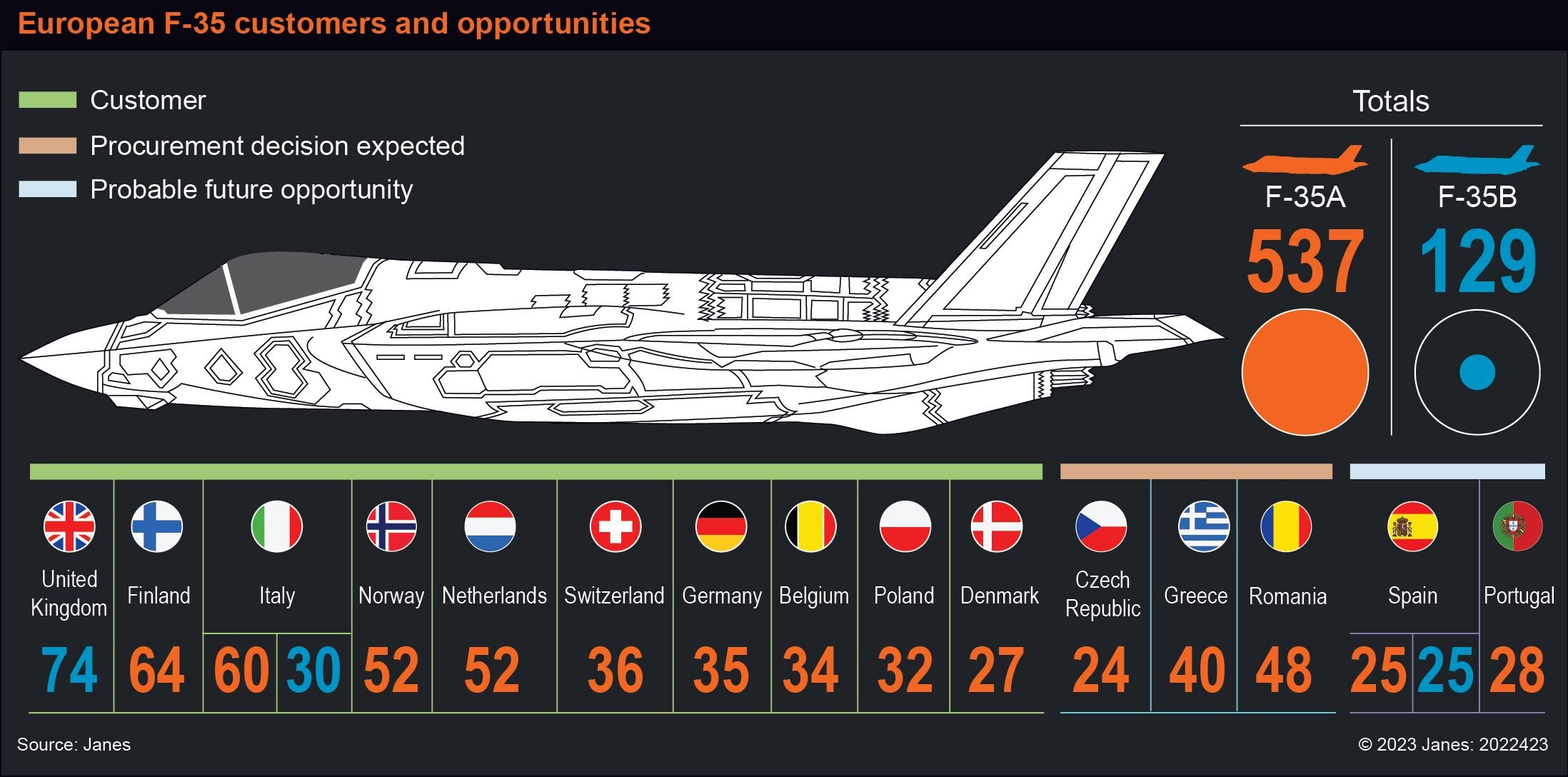
Janes chart showing the distribution of F-35s to Europe zone NATO countries
GFudncEWUAAMGYA


If not for political interference in the US, TR would be the largest non-US F-35 operator in the NATO's Europe region, with its +100 quota.

...and we would probably be talking about the 2040s for KAAN.
 
Last edited:

Kartal1

Experienced member
Moderator
Messages
5,291
Reactions
114 19,734
Nation of residence
Bulgaria
Nation of origin
Turkey
Janes chart showing the distribution of F-35s to Europe zone NATO countries
GFudncEWUAAMGYA


If not for political interference in the US, TR would be the largest non-US F-35 operator in the NATO's Europe region, with its +100 quota.

...and we would probably be talking about the 2040s for KAAN.
Turkiye is the second largest F-16 operator in the world. In another parallel universe most probably we would've been the second largest F-35 operator also.
 

Chocopie

Contributor
South Korea Correspondent
Messages
634
Reactions
37 2,298
Nation of residence
Germany
Nation of origin
South Korea
Turkiye is the second largest F-16 operator in the world. In another parallel universe most probably we would've been the second larges F-35 operator also.
That would still be Japan with domestic license assembly by MHI and F135 engine parts production by IHI and regional MRO&U center.

147 F-35 fighter jets in total:
105x F-35A variant (US & Japan made)
42x F-35B variant (US made)


Zafer

Experienced member
Messages
5,654
Reactions
15 8,712
Nation of residence
Turkey
Nation of origin
Turkey
Fidan, who also touched on the F-35 issue, said:

"You know, we were part of this program concerning the F-35, then unjustly there was talk of us being removed from it, citing the S-400 issues. We are maintaining our position again, meaning we have a national payment made here, there are planes we need to receive. Turkey is always ready to discuss and debate these issues openly and broadly. At this stage, we actually believe that we can discuss these issues from different perspectives. We also think that America should be open-minded about this, there are some exchanges of views."


From "We want our money back!" to "We want our Aircrafts."?
We wanted our money back because they wouldn't give us the planes covered by the money. If they have changed their mind and will deliver us the planes then why not. If they want us to buy more planes that is not acceptable by us. If they want us to supply parts to their F35 production I would say why not.
 

Bozan

Experienced member
Messages
1,518
Reactions
5 1,844
Nation of residence
United Kingdom
Nation of origin
Turkey
Fidan, who also touched on the F-35 issue, said:

"You know, we were part of this program concerning the F-35, then unjustly there was talk of us being removed from it, citing the S-400 issues. We are maintaining our position again, meaning we have a national payment made here, there are planes we need to receive. Turkey is always ready to discuss and debate these issues openly and broadly. At this stage, we actually believe that we can discuss these issues from different perspectives. We also think that America should be open-minded about this, there are some exchanges of views."


From "We want our money back!" to "We want our Aircrafts."?

He said:

NEED
 

Bogeyman 

Experienced member
Professional
Messages
9,925
Reactions
76 33,074
Website
twitter.com
Nation of residence
Turkey
Nation of origin
Turkey

70 Percent or More of F-35s May Not Be Combat Capable​


A September 2023 Government Accountability Office (GAO) report on the F-35 revealed some shocking statistics on just how unready hundreds of billions of dollars worth of F-35s are to provide actual combat power. In fact, the report indicated that only 15 to 30 percent of F-35s may be capable of combat.

But if you were to read a typical article in the media, you might believe that, on average, some 55 percent of F-35s are combat-capable. However, you would be wrong. You see, when the average person sees a report declaring that 55 percent of F-35 combat aircraft are “mission capable,” they assume mission capable equals combat capable. But in doing so, they are being deceived.

The deception comes out of how the F-35 program office and the whole of the Department of Defense define “mission capable.” It turns out that the DoD definition of “mission capable” does not mean combat capable. What it means is that an aircraft can fly and perform at least one mission. So, a plane designated as mission capable might be capable of doing some type of combat, but it might not. Instead, the mission it might be capable of executing could be testing or training, or some other mission that does not involve combat. And even if it is considered capable of testing or training, it might not be capable of doing the full gamut of testing or training you would expect from a fully functional aircraft. Likewise, it could still be classified as mission capable even if it is only capable of executing a portion of the combat-type missions it is supposed to be able to perform.

Hence, within the environs of the military–industrial–congressional complex, “mission capable” is a highly ambiguous term that allows for a whole lot of gaming of accountability metrics. And it tells us very little. Still, it is worth noting that at a 55 percent mission capable rate, the F-35 fleet is well below program targets of 90 percent for the F-35A (Air Force) and 85 percent for the fighter’s F-35B (Marine Corps) and F-35C (Navy) variants. In other words, the F-35 fleet as a whole is nowhere near meeting its mission capability goal of being able to do anything at all.
However, there is another metric that is more useful: “full mission capable.” It turns out that “full mission capable” F-35s are supposed to be able to perform all the missions for which they were contracted, including combat-oriented missions, surveillance, training, testing, show of force, etcetera. This metric is not often publicized, but in the case of the F-35, the watchdog side of the GAO actually did a detailed report of the problems and issues with the F-35 that included how the F-35 fleet looked from the “full mission capable” perspective.

Even for someone who is an F-35 realist, the results are shocking. Not only is the F-35 fleet’s full mission capable rate in the neighborhood of 30 percent (see table on page 96 of the report), the full mission capable rate of the Marine Corps’ F-35B was a miserable 15.5 percent in March 2023. More current full mission capable rates have not been published, but given the program’s ongoing problems and issues, including unreliable engines that are now under-specced due to feature creep, it is highly unlikely the situation has improved in the last year.
And then there is the fact that being fully mission capable is no indicator of how well the plane executes its missions. For example, the F-35 could be designated as mission capable for conducting close air support missions despite the fact the F-35 is the very antithesis of what a close air support plane should be and is not capable of executing genuine close air support.

But given the F-35’s unreliability, talking about full mission capability rates of anything approaching even 50 percent is a pipe dream. And it cannot be overemphasized that the F-35/Joint Strike Fighter has been in development since 1994, costing billions of dollars.

This brings us back to the question of just how many of the over 600 F-35s delivered to the U.S. military can provide significant, non-trivial combat ability. The answer is we really don’t know. But if we combine the F-35’s fragility with its very low full mission-capable and sortie generation rates, it probably isn’t many. Especially, when you think of how many decades and billions of dollars we have dumped into it.
Nevertheless, we will continue to dump billions of dollars into the F-35 program that is already “more than a decade delayed and $183 billion over its original plans” as long as the incestuous relationship between defense contractors, the military, and Congress is permitted to dominate defense procurement.


1.png


Heartbang

Experienced member
Messages
2,588
Reactions
9 4,035
Nation of residence
Turkey
Nation of origin
Turkey

70 Percent or More of F-35s May Not Be Combat Capable​


A September 2023 Government Accountability Office (GAO) report on the F-35 revealed some shocking statistics on just how unready hundreds of billions of dollars worth of F-35s are to provide actual combat power. In fact, the report indicated that only 15 to 30 percent of F-35s may be capable of combat.

But if you were to read a typical article in the media, you might believe that, on average, some 55 percent of F-35s are combat-capable. However, you would be wrong. You see, when the average person sees a report declaring that 55 percent of F-35 combat aircraft are “mission capable,” they assume mission capable equals combat capable. But in doing so, they are being deceived.

The deception comes out of how the F-35 program office and the whole of the Department of Defense define “mission capable.” It turns out that the DoD definition of “mission capable” does not mean combat capable. What it means is that an aircraft can fly and perform at least one mission. So, a plane designated as mission capable might be capable of doing some type of combat, but it might not. Instead, the mission it might be capable of executing could be testing or training, or some other mission that does not involve combat. And even if it is considered capable of testing or training, it might not be capable of doing the full gamut of testing or training you would expect from a fully functional aircraft. Likewise, it could still be classified as mission capable even if it is only capable of executing a portion of the combat-type missions it is supposed to be able to perform.

Hence, within the environs of the military–industrial–congressional complex, “mission capable” is a highly ambiguous term that allows for a whole lot of gaming of accountability metrics. And it tells us very little. Still, it is worth noting that at a 55 percent mission capable rate, the F-35 fleet is well below program targets of 90 percent for the F-35A (Air Force) and 85 percent for the fighter’s F-35B (Marine Corps) and F-35C (Navy) variants. In other words, the F-35 fleet as a whole is nowhere near meeting its mission capability goal of being able to do anything at all.
However, there is another metric that is more useful: “full mission capable.” It turns out that “full mission capable” F-35s are supposed to be able to perform all the missions for which they were contracted, including combat-oriented missions, surveillance, training, testing, show of force, etcetera. This metric is not often publicized, but in the case of the F-35, the watchdog side of the GAO actually did a detailed report of the problems and issues with the F-35 that included how the F-35 fleet looked from the “full mission capable” perspective.

Even for someone who is an F-35 realist, the results are shocking. Not only is the F-35 fleet’s full mission capable rate in the neighborhood of 30 percent (see table on page 96 of the report), the full mission capable rate of the Marine Corps’ F-35B was a miserable 15.5 percent in March 2023. More current full mission capable rates have not been published, but given the program’s ongoing problems and issues, including unreliable engines that are now under-specced due to feature creep, it is highly unlikely the situation has improved in the last year.
And then there is the fact that being fully mission capable is no indicator of how well the plane executes its missions. For example, the F-35 could be designated as mission capable for conducting close air support missions despite the fact the F-35 is the very antithesis of what a close air support plane should be and is not capable of executing genuine close air support.

But given the F-35’s unreliability, talking about full mission capability rates of anything approaching even 50 percent is a pipe dream. And it cannot be overemphasized that the F-35/Joint Strike Fighter has been in development since 1994, costing billions of dollars.

This brings us back to the question of just how many of the over 600 F-35s delivered to the U.S. military can provide significant, non-trivial combat ability. The answer is we really don’t know. But if we combine the F-35’s fragility with its very low full mission-capable and sortie generation rates, it probably isn’t many. Especially, when you think of how many decades and billions of dollars we have dumped into it.
Nevertheless, we will continue to dump billions of dollars into the F-35 program that is already “more than a decade delayed and $183 billion over its original plans” as long as the incestuous relationship between defense contractors, the military, and Congress is permitted to dominate defense procurement.


View attachment 66589
This pleases me very much. I've been like this in the house for the past 30 minutes.

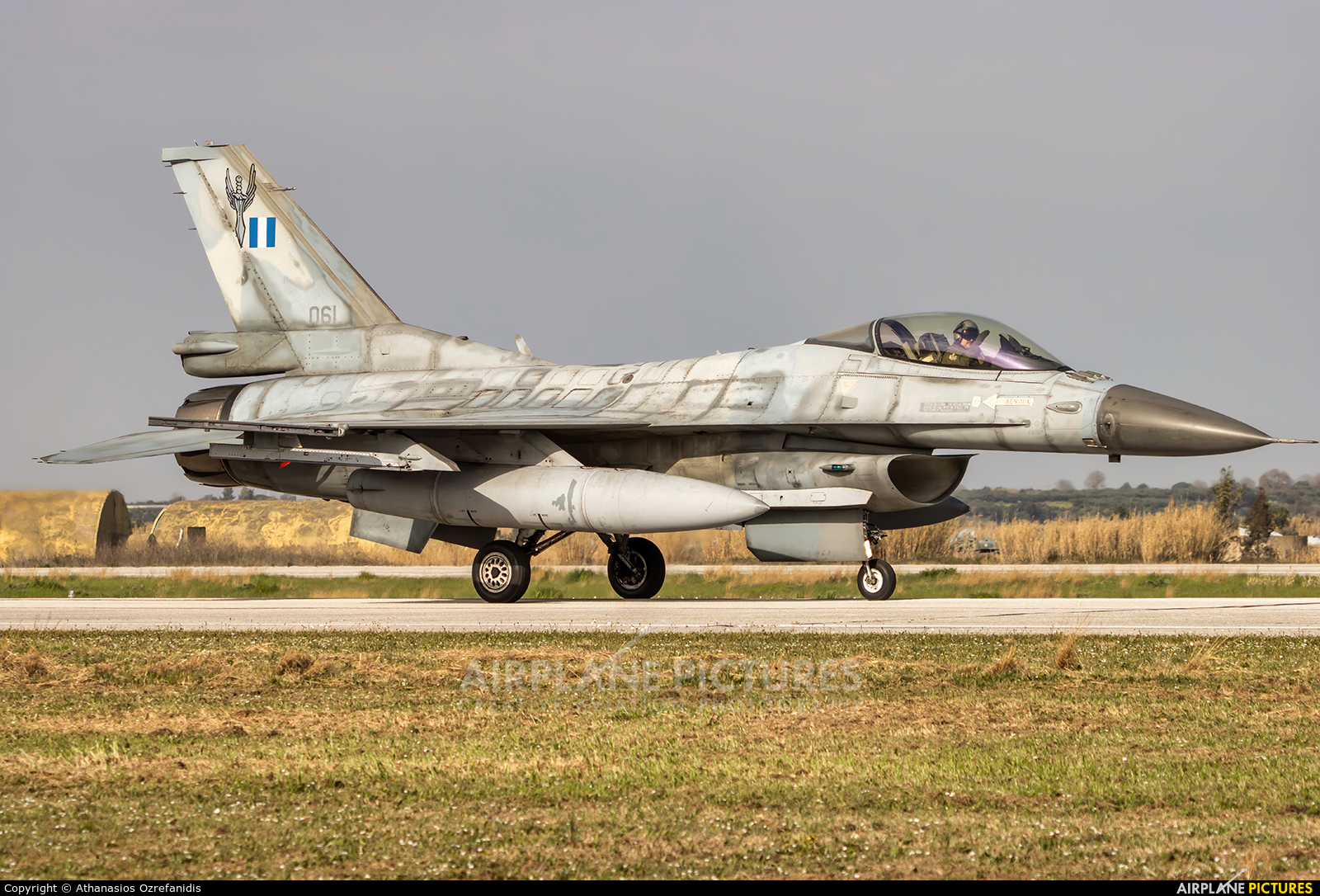
I wonder how the the hell the Greeks will manage to maintain their F-35's. Their F-16's are so rusty, they got their own patina!
1457566.jpg
 

Oublious

Experienced member
The Netherlands Correspondent
Messages
2,780
Reactions
15 6,101
Nation of residence
Nethelands
Nation of origin
Turkey

70 Percent or More of F-35s May Not Be Combat Capable​


A September 2023 Government Accountability Office (GAO) report on the F-35 revealed some shocking statistics on just how unready hundreds of billions of dollars worth of F-35s are to provide actual combat power. In fact, the report indicated that only 15 to 30 percent of F-35s may be capable of combat.

But if you were to read a typical article in the media, you might believe that, on average, some 55 percent of F-35s are combat-capable. However, you would be wrong. You see, when the average person sees a report declaring that 55 percent of F-35 combat aircraft are “mission capable,” they assume mission capable equals combat capable. But in doing so, they are being deceived.

The deception comes out of how the F-35 program office and the whole of the Department of Defense define “mission capable.” It turns out that the DoD definition of “mission capable” does not mean combat capable. What it means is that an aircraft can fly and perform at least one mission. So, a plane designated as mission capable might be capable of doing some type of combat, but it might not. Instead, the mission it might be capable of executing could be testing or training, or some other mission that does not involve combat. And even if it is considered capable of testing or training, it might not be capable of doing the full gamut of testing or training you would expect from a fully functional aircraft. Likewise, it could still be classified as mission capable even if it is only capable of executing a portion of the combat-type missions it is supposed to be able to perform.

Hence, within the environs of the military–industrial–congressional complex, “mission capable” is a highly ambiguous term that allows for a whole lot of gaming of accountability metrics. And it tells us very little. Still, it is worth noting that at a 55 percent mission capable rate, the F-35 fleet is well below program targets of 90 percent for the F-35A (Air Force) and 85 percent for the fighter’s F-35B (Marine Corps) and F-35C (Navy) variants. In other words, the F-35 fleet as a whole is nowhere near meeting its mission capability goal of being able to do anything at all.
However, there is another metric that is more useful: “full mission capable.” It turns out that “full mission capable” F-35s are supposed to be able to perform all the missions for which they were contracted, including combat-oriented missions, surveillance, training, testing, show of force, etcetera. This metric is not often publicized, but in the case of the F-35, the watchdog side of the GAO actually did a detailed report of the problems and issues with the F-35 that included how the F-35 fleet looked from the “full mission capable” perspective.

Even for someone who is an F-35 realist, the results are shocking. Not only is the F-35 fleet’s full mission capable rate in the neighborhood of 30 percent (see table on page 96 of the report), the full mission capable rate of the Marine Corps’ F-35B was a miserable 15.5 percent in March 2023. More current full mission capable rates have not been published, but given the program’s ongoing problems and issues, including unreliable engines that are now under-specced due to feature creep, it is highly unlikely the situation has improved in the last year.
And then there is the fact that being fully mission capable is no indicator of how well the plane executes its missions. For example, the F-35 could be designated as mission capable for conducting close air support missions despite the fact the F-35 is the very antithesis of what a close air support plane should be and is not capable of executing genuine close air support.

But given the F-35’s unreliability, talking about full mission capability rates of anything approaching even 50 percent is a pipe dream. And it cannot be overemphasized that the F-35/Joint Strike Fighter has been in development since 1994, costing billions of dollars.

This brings us back to the question of just how many of the over 600 F-35s delivered to the U.S. military can provide significant, non-trivial combat ability. The answer is we really don’t know. But if we combine the F-35’s fragility with its very low full mission-capable and sortie generation rates, it probably isn’t many. Especially, when you think of how many decades and billions of dollars we have dumped into it.
Nevertheless, we will continue to dump billions of dollars into the F-35 program that is already “more than a decade delayed and $183 billion over its original plans” as long as the incestuous relationship between defense contractors, the military, and Congress is permitted to dominate defense procurement.


View attachment 66589

I do think the share of complexity within the software of F35 is the biggest problem, almost 30 years ago when they started the project. First generation software engineers are all gone, how many software egnineers are changed? How does is work when you write a code for the the fighter when you are new? Will you need to study the software before you update it?


I have the feeling F35 will always go like that :D.
 
Top Bottom